Daily Dose of Europe: Paris’ Notre-Dame Cathedral

The crisis of this year has overshadowed one from last year: the shocking fire at France’s top church, Notre-Dame Cathedral. Like the rest of our world right now, that cathedral is damaged and on the mend…yet it survives, as ever, as a powerful symbol of France.

The coronavirus can derail our travel plans…but it can’t stop our travel dreams. And I believe a daily dose of travel dreaming can actually be good medicine. One of the great joys of travel is seeing art masterpieces in person. And I’m currently featuring 10 of my favorites — including this one.
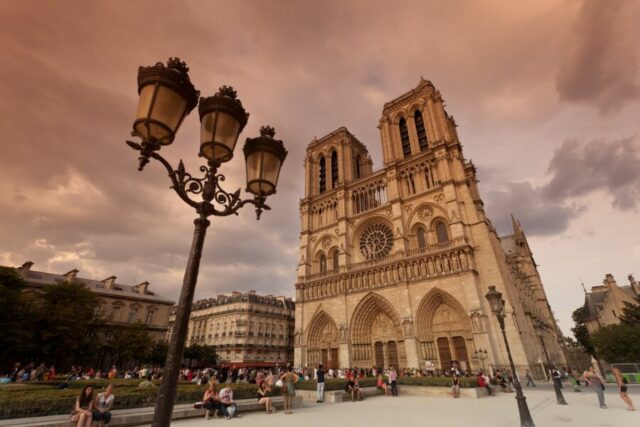
On an island in the center of Paris — on the spot dubbed “point zero” — stands the world’s best-known Gothic cathedral. Notre-Dame’s facade is instantly recognizable: the twin rectangular towers, the circular rose window, the three arched doorways, the rows of statues…and the impish gargoyles that line the roof.

The round rose window frames a statue of “Our Lady” (Notre Dame) to whom this church is dedicated. For centuries, Mary, the mother of Jesus, has symbolized the Christian faith’s compassionate heart. And here she stands at the heart of the facade, surrounded by the halo of the rose window. And this church stands at the heart of Paris, where the ancient Parisii tribe settled, where Romans built their pagan Temple of Jupiter, and where the Franks replaced it with a Christian church.

Imagine the faith of the people who built this massive cathedral. Countless people of high and low standing dedicated their lives to building this church, knowing it wouldn’t be finished until long after they were dead. They broke ground in the year 1163 with the hope that someday their great-great-great-great-great-great grandchildren might attend the dedication Mass. Two centuries later, in 1345, they did.

Over the centuries, the cathedral continued to evolve and undergo renovation. Recently it suffered a devastating fire (2019), requiring yet another makeover, and adding another chapter to its long history.

Stepping inside, put on a medieval pilgrim’s perspective as you soak in the ambience of this centuries-old space. Follow the slender columns up 10 stories to where Gothic arches come together like praying hands. Take in the subtle, mysterious light show that God beams through the stained-glass windows.

This is Gothic. Taller and filled with light, this was a new design needing only a few load-bearing columns, topped by crisscrossing pointed arches to support the weight of the stone roof. No longer did walls have to be thick and fortress-like to provide support — instead they could be filled with windows.

Back outside Notre-Dame, you see the gangly architectural elements of Gothic: pointed arches, tall windows, lacy stone tracery, and statues.

Most distinctive of all are the flying buttresses, the 50-foot-long stone beams that stick out from the church. They were the key to the Gothic structure. With pointed arches supporting the roof, the weight of the roof pressed outward, not down (as with earlier round arches). Flying buttresses supported that weight by pushing back in. This Gothic technology, with its skeletal structure mostly protruding on the outside, was invented in Paris in the 13th century. It enabled architects to erect lofty cathedrals with roofs supported by thin columns, allowing for “walls” of glorious stained glass.

The church’s roofline is dotted with statues of grotesque winged creatures. These bizarre beasts represented tormented souls caught between heaven and earth. They also functioned as drain spouts. When it rained, they made a gargling sound, giving us their name — gargoyles. Or maybe that’s the sound of Quasimodo as he limps along the roofline, grunting and grimacing with appreciation at this, the wonder of the High Middle Ages.

This is an excerpt from the full-color coffee-table book Europe’s Top 100 Masterpieces by Rick Steves and Gene Openshaw. Please support local businesses in your community by picking up a copy from your favorite bookstore, or you can find it at my online Travel Store. To enhance your art experience, you can find a clip related to this artwork at Rick Steves Classroom Europe; just search for “Notre Dame”.

Daily Dose of Europe: Champs-Elysées: The Parisian Promenade

I have a ritual when in Paris. I ask my cabbie to take me around the Arc de Triomphe two times, then drop me off to stroll down the city’s grand boulevard, the Champs-Elysées.

Even if we’ve had to postpone trips to Europe, I believe a daily dose of travel dreaming can actually be good medicine. Here’s another one of my favorite travel memories — a reminder of what’s waiting for you in Europe at the other end of this crisis.

We plunge into the grand traffic circle where a dozen venerable boulevards converge on the mightiest of triumphal arches. Like referees at gladiator camp, traffic cops are stationed at each entrance to this traffic circus, letting in bursts of eager cars.

In the mid-19th century, Baron Haussmann set out to make Paris the grandest city in Europe. The 12 arterials that radiate from the Arc de Triomphe were part of his master plan: the creation of a series of major boulevards, intersecting at diagonals, with monuments (such as the Arc de Triomphe) as centerpieces. As we careen around the chaotic circle, I wonder what Haussmann would think of the scene today.

Each visit here reminds me of the greatness of France. As the marble relief of Lady Liberty scrambles up the arch Napoleon ordered built, heroically thrusting her sword and shrieking at the traffic, all of Paris seems drawn into this whirlpool. Being immersed in this scene with my cabbie so in control always makes me laugh out loud.

The commotion of cars fights to get to the arch at the center as if to pay homage to the national spirit of France. Cars entering the circle have the right-of-way; those already in the circle must yield. Parisian drivers navigate the circle like roller derby queens. Tippy little Citroën 2CVs, their rooftops cranked open like sardine lids, bring lumbering buses to a sudden, cussing halt. It’s a game of fender-bender chicken.

On this visit, after barely avoiding an accident, my cabbie calms me, saying, “In Paris, a good driver gets only scratches, not dents.” Groping for the lost end of my seatbelt, I say, “There must be an accident here every few minutes.” He explains, “In the case of an accident here, each driver is considered equally at fault. This is the only place in Paris where the accidents are not judged. No matter what the circumstances, insurance companies split the costs 50-50.” While we’re momentarily stalled on the inside lane, I pay and hop out.

I’m ready for my stroll on the Champs-Elysées. I like to say it out loud: shahn-zay-lee-zay. This grandest of boulevards is Paris at its most Parisian: sprawling sidewalks, stylish octogenarians caked in makeup, concept cars glimmering in showroom windows, and pastel macarons in grand cafés.

Paris’ characteristic love of strolling (a stately paced triathlon of walking, window-shopping, and high-profile sipping) dates from the booming 19th century, with its abundance of upper-class leisure time and cash. Donning an aristocratic air, I amble gently downhill to the immense and historic square called the Place de la Concorde.

Even small-town French kids who haven’t traveled beyond a TV screen know that this boulevard is their country’s ultimate parade ground, where major events unfold: the Tour de France finale, Bastille Day parades, and New Year’s festivities.

In 1667, Louis XIV opened the first stretch of the Champs-Elysées: a short extension of the Tuileries Gardens leading to the palace at Versailles. Many consider this moment to be the birth of Paris as a grand city. The Champs-Elysées soon became the place to cruise in your carriage. It still is today — traffic can be jammed up even at midnight.

A century after Louis XIV, the café scene arrived. Cafés were ideal for both Parisian pleasure-seekers and thinkers, conspiring to share ideas and plot revolutions. That coffee-sipping ambience survives today, amid pop-clothing outlets and music megastores. Two cafés, Le Fouquet’s and Ladurée, are among the most venerable in Paris.

Le Fouquet’s started as a coachman’s bistro. Then it gained fame as the hangout of French biplane pilots during World War I, when Paris was just a few nervous miles from the Western Front. Today, it’s pretty stuffy — unless you’re a film star. The golden plaques at the entrance honor winners of France’s version of our Oscars, the Césars. While I find the interior intimidating, the people-watching from the sidewalk tables makes the most expensive espresso I’ve found in Paris a good value.

You’re more likely to see me hanging out at Ladurée, working delicately through an Oreo-sized macaron with fine silverware. This classic 19th-century tea salon and pastry shop has an interior right out of the 1860s. The bakery makes traditional macarons with a pastel palette of flavors, ranging from lavender and raspberry to rose. Get a frilly little gift box to go, or pay the ransom and sit down and enjoy the Champs-Elysées show in sweet style.

Until the 1960s, the boulevard was pure Parisian elegance, lined with top-end hotels, cafés, and residences. Locals actually dressed up to stroll here. Then, in 1963, the government, wanting to pump up the neighborhood’s commercial metabolism, brought in the Métro to connect the Champs-Elysées with the suburbs. Suddenly, the working class had easy access. And bam — there goes the neighborhood.

The arrival of McDonald’s was another shock. At first it was allowed only white arches painted on the window. Today, the hamburger joint spills out onto the sidewalk with café-quality chairs and stylish flower boxes.

As fast food and pop culture invaded and grand old buildings began to fall, Paris realized what it was losing. In 1985, a law prohibited the demolition of the classy facades that once gave this boulevard a uniform grace. Consequently, many of today’s modern businesses hide behind 19th-century facades.

The nouvelle Champs-Elysées, revitalized in 1994, has new street benches, lamps, and an army of green-suited workers armed with high-tech pooper scoopers. Two lanes of traffic were traded away to make broader sidewalks. And plane trees (a kind of sycamore that thrives despite big-city pollution) provide a leafy ambience.

As I stroll, I notice the French appetite for a good time. The foyer of the famous Lido, Paris’ largest cabaret, comes with leggy photos and a perky R-rated promo video.

The nearby Club Med building is a reminder of the French commitment to vacation. Since 1936, France’s employees, by law, have enjoyed one month of paid vacation. The French, who now have five weeks of paid vacation, make sure they have plenty of time for leisure.

On the Champs-Elysées, the shopping ends and the park begins at a big traffic circle called Rond-Point. From here, it’s a straight shot down the last stretch of the boulevard to the sprawling square called the Place de la Concorde. Its centerpiece was once the bloody guillotine but is now the 3,300-year-old Obelisk of Luxor. It was shipped here from Egypt in the 1830s, a gift to the French king.

I stand in the shadow of that obelisk with my back to the Louvre, once Europe’s grandest palace, and now its grandest museum. Looking up this ultimate boulevard to the Arc de Triomphe, I can’t help but think of the sweep of French history…and the taste of those delightful macarons.

(This story is excerpted from my upcoming book, For the Love of Europe — collecting 100 of my favorite memories from a lifetime of European travel. It’s coming out in July, and available for pre-order.)

Daily Dose of Europe: St. Sulpice — The Grand Organ of Paris

These days, on Sunday mornings I’ve been “attending” church by Zoom-ing in from my couch. But I’m dreaming of some of my favorite European churchgoing experiences. And near the top of the list is the organ loft at Paris’ St. Sulpice.

With so many of us stuck at home for the foreseeable future, I believe a daily dose of travel dreaming can actually be good medicine. Here’s another one of my favorite travel memories — a reminder of what’s waiting for you in Europe at the other end of this crisis.

On Sunday morning in Paris, I’m enjoying Mass in a church with perhaps Europe’s finest pipe organ. St. Sulpice has only 40 or 50 worshippers this morning. I grab a pew.

Going to church anywhere south of the Rhine generally means going to Mass. Catholics claim that since Mass is the same everywhere, there’s no language barrier. Maybe it’s just the Lutheran in me, but I miss the alpha, the omega, and, except for Communion, nearly everything in between.

When I do make it to church in Europe, I’m surrounded by towering vaults, statues of weary saints, and small congregations, but it’s the music that sends me. The spiritual sails of St. Sulpice have been filled for two centuries by its 6,600-pipe organ. Organists from around the world come to Paris just to hear this organ.

As the first Mass of the morning finishes, half the crowd remains seated as the organist runs a musical victory lap. I happen to sit next to Lokrum, a young organist from Switzerland. He never comes to Paris without visiting St. Sulpice. When the organ stops, he whispers, “Follow me. You see nothing like this in America.”

I follow Lokrum to the back of the church. A small church-mouse of a man opens a little, unmarked door and we scamper like sixteenth notes up a spiral staircase into the organ loft of our wildest dreams. Here, organists are intimate with an obscure world few have entered. They speak of masters from 200 years ago as if they have just heard them in concert.

Lokrum stops me at a yellowed document. Dragging his finger down the glass frame, he says reverently, “The 12 St. Sulpice organists. Most of them are famous in the evolution of pipe-organ music. They have made wonderful music in this church for over 200 years, with no break.”

Like presidents or kings, the lineage is charted on the wall. Charles-Marie Widor played from 1870 to 1933. Marcel Dupré from 1934 to 1971. “Dupré started a tradition at St. Sulpice,” Lokrum says. “For generations people who love the organ have been welcomed here in the loft every Sunday.” (Note that recently, this practice was discontinued.)

And now, the organist is Daniel Roth. I join a select group of aficionados who gather around this slight, unassuming man, who looks like an organist should. He pushes back his flowing hair with graceful fingers. He knows he sits on a bench that organists the world over dream of warming. Maintaining Dupré’s tradition of loft hospitality, Roth is friendly in four languages.

History is thumbtacked all around: dusty charts of the pipes, master organ builders, busts of previous organists, and a photo of Albert Schweitzer with Dupré. And watching over it all is a bust of the idol of organists, Johann Sebastian Bach.

Lokrum pulls me behind the organ into a dark room filled with what looks like 18th-century Stairmasters. “Before electricity, it took five men to power these bellows. And these bellows powered the organ.”

Suddenly, the music begins, signaling the start of the next Mass. Back at the organ, a commotion of music lovers crowds around a tower of keyboards in a forest of pipes. In the middle of it all, under a dangling heat lamp, sits Monsieur Roth. With boyish enthusiasm, he sinks his fingers into the organ.

Flanked by an assistant on either side of the long bench, his arms and legs stretched out like an angry cat, Roth plays all five keyboards. Supremely confident, he ignores the offbeat camera flashes of his adoring fellow organ lovers, follows the progress of the Mass via a tiny mirror, and makes glorious music.

The keyboards are stacked tall, surrounded by 110 stops — wooden knobs that turn the pipes off and on — in a multitude of tonal packages. His assistants push and pull the stops after each musical phrase. They act quickly but as carefully as though God were listening.

Lokrum motions me to a chair with a commanding perch to oversee the musical action. On a well-worn wooden keyboard of foot pedals spreading below the bench, Roth’s feet march with his fingers. A groupie turns on his recorder to catch the music as Roth cranes his neck to find the priest in his mirror.

I peer down at the busy keyboards and Roth’s marching feet. Then, turning around, I peek through the pipes and down on a small congregation. Just as priests celebrate Mass in a church whether worshippers are present or not, this organ must make music. I marvel at how the high culture of Europe persists. I’m thankful to experience it so intimately.

(This story is excerpted from my upcoming book, For the Love of Europe — collecting 100 of my favorite memories from a lifetime of European travel. It’s coming out in July, and available for pre-order. And you can also watch a video clip related to this story: Just visit  Rick Steves Classroom Europe  and search for “Sulpice.”)

Daily Dose of Europe: Fine Living at a Parisian Market 

Let’s go for a (vicarious) walk together along Paris’ finest market street: Rue Cler.

Europe is effectively off-limits to American travelers for the time being. But travel dreams are immune to any virus. And, while many of us are stuck at home, I believe a daily dose of travel dreaming can actually be good medicine. Here’s another one of my favorite travel memories — a reminder of what’s waiting for you in Europe at the other end of this crisis.

I grew up thinking cheese was no big deal. It was orange and the shape of the bread: slap, fwomp…cheese sandwich. Even though I’m still far from a gourmet eater, my time in Paris — specifically shopping at the Rue Cler street market with my restaurateur friend Marie — has substantially bumped up my appreciation of good cuisine.

In the skinny shadow of the Eiffel Tower, Rue Cler still feels like village Paris. Lined with shops that spill out into the street, it’s also bustling with shoppers. Marie explains that Parisians shop almost daily for three good reasons: their tiny kitchens have tiny refrigerators, fresh produce makes for a good meal, and they like shopping. It’s an important social event: a chance to hear about the butcher’s vacation, see photos of the florist’s new grandchild, relax over un café, and kiss the cheeks of friends. Demonstrating back and forth on my cheeks, Marie says, “The Parisian standard is twice for acquaintances (kiss, kiss) and three times for friends you haven’t seen in a while — like you (kiss, kiss, kiss).”

Observing Parisian shoppers, I quickly recognize the cardinal rule: Whenever popping in and out of French shops, it’s polite to greet the proprietor (“Bonjour, Madame”) and say “Merci” and “Au revoir” as you leave. This simple practice can make the difference between being treated as an ignorant tourist and being treated as a temporary local.

The neighborhood produce shop wraps around the corner with an enticing rainbow of fruits and vegetables on display. Marie, using it as a classroom in smart grocery shopping, explains, “We Parisians demand the freshest fruits and vegetables and we shop with our noses.” As if to demonstrate how exacting she is when shopping for her restaurant, Marie flips into gear: “Smell the cheap foreign strawberries. Then smell the torpedo-shaped French ones (gariguettes). Find the herbs. Is today’s delivery in? Look at the price of those melons! What’s the country of origin? It must be posted. If they’re out of season, they come from Guadeloupe. Many Parisians buy only French products and don’t compromise on flavor because they eat with the season.”

Next door, the fishmonger sells the freshest fish, which is brought in daily from ports on the English Channel, 100 miles away. In fact, seafood in Paris is likely fresher than in many towns closer to the coast because Paris is a commerce hub and from here it’s shipped out to outlying towns. Anything wiggling?

At the boucherie, Marie shows me things I might have otherwise avoided on her menu: rognons (kidneys), foie (liver), coeur de boeuf (heart of beef). She hoists a duck to check the feet; they should be rough and calloused, an indication that they weren’t stuck in an industrial kennel but ran free on a farm. She explains, “While Americans prefer beef, pork, and chicken, we French eat just as much rabbit (lapin), quail (caille), lamb (agneau), and duck (canard). The head of a calf is a delight for its many tasty bits.” The meat is seasonal. In the winter, game swings from the ceiling.

Farther down Rue Cler, the picnic-friendly charcuterie (or traiteur) sells mouthwatering deli food to go. Because apartment kitchens are so small, these handy gourmet delis make it easy for Parisians to supplement their dinners in style.

At the cave à vin (wine shop), the clerk is a counselor who works with customers’ needs and budgets. He will even uncork a bottle for picnickers. While drinking wine outdoors is taboo in the US, it’s pas de problème in France.

The smell of cheese heralds the fromagerie. It’s a festival of mold, with wedges, cylinders, balls, and miniature hockey pucks all powdered white, gray, and burnt marshmallow. Browsing with me through a world of different types of cheese, Marie explains, “Ooh la la means you’re impressed. If you like cheese, show greater excitement with more las. Ooh la la la la.”

She leads me to the goat-cheese corner, holds the stinkiest glob close to her nose, takes a deep, orgasmic breath, and exhales, saying, “Yes, this smells like zee feet of angels.”

The white-smocked cheesemonger knows Marie well. Sensing I’m impressed by his shop, he points out the old photo on the wall from when his father ran the shop. It was labeled BOF for beurre, oeuf, fromage. For generations, this has been the place where people go for butter, eggs, and cheese. As if I’m about to become a convert to the church of stinky cheese, he takes us into the back room for a peek at les meules — the big, 170-pound wheels (250 gallons of milk go into each). Explaining that the “hard” cheeses are cut from these, he warns me, “Don’t eat the skin of these big ones…they roll them on the floor. But the skin on most smaller cheeses — the Brie, the Camembert — that is part of the taste.” Marie chimes in, “It completes the package.”

And what’s cheese without bread? The bakery is our final stop. Locals debate the merits of rival boulangeries. It’s said that a baker cannot be good at both bread and pastry. At cooking school, they major in one or the other. But here on Rue Cler, the baker bucks the trend. Marie explains that this baker makes good bread (I get a baguette for my sandwich) and delicious pastries. Voilà, dessert!

By now, I’ve assembled the ingredients for the perfect picnic. Marie heads off to her restaurant, while I head for a park bench with a view of the Eiffel Tower, settle in, and enjoy my Rue Cler feast. A passerby smiles and wishes me a cheery “Bon appétit!”

(These daily stories are excerpted from my upcoming book,  For the Love of Europe — collecting  100  of my favorite memories from a lifetime of European travel, coming out in July.  It’s available for pre-order. And you can also watch a video clip related to this story: Just visit Rick Steves Classroom Europe and search for Paris.)

Reflections on Notre-Dame

The beloved Notre-Dame is like the needle upon which Paris spins — historically, culturally, geographically, and religiously — and it has been, for eight centuries. It was built by generations of Parisians who dedicated their lives to the project, knowing they would never live to see it finished. Sitting on the sacred ground of the earliest Parisians, upon the ruins of a pagan temple — and having survived wars, revolutions, and other fires through the ages — there’s no doubt it will be repaired and carry on.

This spot, the place of so many burials, coronations, and historic gatherings through the ages, is a part of what it means to be Parisian — and to be French. My hunch is that when travelers visit this church a century from now, its story will be the same, with one little addition: the fire of 2019.

Today, I am celebrating Europe’s commitment to culture — and Europe’s resiliency.


https://www.facebook.com/willripleynews/videos/691662604582080/?v=691662604582080