Daily Dose of Europe: Fine Living at a Parisian Market 

Let’s go for a (vicarious) walk together along Paris’ finest market street: Rue Cler.

Europe is effectively off-limits to American travelers for the time being. But travel dreams are immune to any virus. And, while many of us are stuck at home, I believe a daily dose of travel dreaming can actually be good medicine. Here’s another one of my favorite travel memories — a reminder of what’s waiting for you in Europe at the other end of this crisis.

I grew up thinking cheese was no big deal. It was orange and the shape of the bread: slap, fwomp…cheese sandwich. Even though I’m still far from a gourmet eater, my time in Paris — specifically shopping at the Rue Cler street market with my restaurateur friend Marie — has substantially bumped up my appreciation of good cuisine.

In the skinny shadow of the Eiffel Tower, Rue Cler still feels like village Paris. Lined with shops that spill out into the street, it’s also bustling with shoppers. Marie explains that Parisians shop almost daily for three good reasons: their tiny kitchens have tiny refrigerators, fresh produce makes for a good meal, and they like shopping. It’s an important social event: a chance to hear about the butcher’s vacation, see photos of the florist’s new grandchild, relax over un café, and kiss the cheeks of friends. Demonstrating back and forth on my cheeks, Marie says, “The Parisian standard is twice for acquaintances (kiss, kiss) and three times for friends you haven’t seen in a while — like you (kiss, kiss, kiss).”

Observing Parisian shoppers, I quickly recognize the cardinal rule: Whenever popping in and out of French shops, it’s polite to greet the proprietor (“Bonjour, Madame”) and say “Merci” and “Au revoir” as you leave. This simple practice can make the difference between being treated as an ignorant tourist and being treated as a temporary local.

The neighborhood produce shop wraps around the corner with an enticing rainbow of fruits and vegetables on display. Marie, using it as a classroom in smart grocery shopping, explains, “We Parisians demand the freshest fruits and vegetables and we shop with our noses.” As if to demonstrate how exacting she is when shopping for her restaurant, Marie flips into gear: “Smell the cheap foreign strawberries. Then smell the torpedo-shaped French ones (gariguettes). Find the herbs. Is today’s delivery in? Look at the price of those melons! What’s the country of origin? It must be posted. If they’re out of season, they come from Guadeloupe. Many Parisians buy only French products and don’t compromise on flavor because they eat with the season.”

Next door, the fishmonger sells the freshest fish, which is brought in daily from ports on the English Channel, 100 miles away. In fact, seafood in Paris is likely fresher than in many towns closer to the coast because Paris is a commerce hub and from here it’s shipped out to outlying towns. Anything wiggling?

At the boucherie, Marie shows me things I might have otherwise avoided on her menu: rognons (kidneys), foie (liver), coeur de boeuf (heart of beef). She hoists a duck to check the feet; they should be rough and calloused, an indication that they weren’t stuck in an industrial kennel but ran free on a farm. She explains, “While Americans prefer beef, pork, and chicken, we French eat just as much rabbit (lapin), quail (caille), lamb (agneau), and duck (canard). The head of a calf is a delight for its many tasty bits.” The meat is seasonal. In the winter, game swings from the ceiling.

Farther down Rue Cler, the picnic-friendly charcuterie (or traiteur) sells mouthwatering deli food to go. Because apartment kitchens are so small, these handy gourmet delis make it easy for Parisians to supplement their dinners in style.

At the cave à vin (wine shop), the clerk is a counselor who works with customers’ needs and budgets. He will even uncork a bottle for picnickers. While drinking wine outdoors is taboo in the US, it’s pas de problème in France.

The smell of cheese heralds the fromagerie. It’s a festival of mold, with wedges, cylinders, balls, and miniature hockey pucks all powdered white, gray, and burnt marshmallow. Browsing with me through a world of different types of cheese, Marie explains, “Ooh la la means you’re impressed. If you like cheese, show greater excitement with more las. Ooh la la la la.”

She leads me to the goat-cheese corner, holds the stinkiest glob close to her nose, takes a deep, orgasmic breath, and exhales, saying, “Yes, this smells like zee feet of angels.”

The white-smocked cheesemonger knows Marie well. Sensing I’m impressed by his shop, he points out the old photo on the wall from when his father ran the shop. It was labeled BOF for beurre, oeuf, fromage. For generations, this has been the place where people go for butter, eggs, and cheese. As if I’m about to become a convert to the church of stinky cheese, he takes us into the back room for a peek at les meules — the big, 170-pound wheels (250 gallons of milk go into each). Explaining that the “hard” cheeses are cut from these, he warns me, “Don’t eat the skin of these big ones…they roll them on the floor. But the skin on most smaller cheeses — the Brie, the Camembert — that is part of the taste.” Marie chimes in, “It completes the package.”

And what’s cheese without bread? The bakery is our final stop. Locals debate the merits of rival boulangeries. It’s said that a baker cannot be good at both bread and pastry. At cooking school, they major in one or the other. But here on Rue Cler, the baker bucks the trend. Marie explains that this baker makes good bread (I get a baguette for my sandwich) and delicious pastries. Voilà, dessert!

By now, I’ve assembled the ingredients for the perfect picnic. Marie heads off to her restaurant, while I head for a park bench with a view of the Eiffel Tower, settle in, and enjoy my Rue Cler feast. A passerby smiles and wishes me a cheery “Bon appétit!”

(These daily stories are excerpted from my upcoming book,  For the Love of Europe — collecting  100  of my favorite memories from a lifetime of European travel, coming out in July.  It’s available for pre-order. And you can also watch a video clip related to this story: Just visit Rick Steves Classroom Europe and search for Paris.)
Daily Dose of Europe: French Escargot and the Beauty of Terroir

I always used to wonder if all those French food snobs were just faking it. But then I thought about baseball.

Because of the coronavirus, Europe is effectively off-limits to American travelers through at least mid-April. But travel dreams are immune to any virus. As we work through these challenging days, I believe a daily dose of travel dreaming can actually be good medicine. Here’s another one of my very favorite travel dreams-come-true…a reminder of what’s waiting for you in Europe on the other end of this crisis.

Walking through France’s finest vineyards in the fabled Côte d’Or (or “Gold Coast”) of Burgundy, the proud vintner guiding me becomes evangelical.

Pointing to the ground, she says, “A good grape must suffer. Look at this soil — it is horrible . . . it is only rocks. That is why these grapes have character. The roots of these struggling vines are thin as hairs. Searching as much as 30 meters down, they reach, reach, reach for moisture. The vines in the flat fields” — she motions, almost disdainfully, to fields just a kilometer away — “have it too easy . . . a silver spoon in their mouths. It’s like people. The fine wines of humanity, they are the ones who have suffered.”

“Like Tina Turner?” I ask.

“Exactly!” she says.

“The best vintners don’t force their style on the grape. They play to the wine’s strength, respecting the natural character of the sun, soil, and vine…the terroir. They play the wine like a great musician plays classical music. You don’t want to recognize the musician. You want to hear the Beethoven.”

That afternoon, I bike through these revered vineyards, where road signs read like a list of fine wines. Wines here are named not for the grape, but for the place of their origin. The more specific the place name, the higher the quality. A wine called simply “Burgundy” for the region would be a basic table wine. A wine labeled by the village (for instance, “Pommard”) would be better. Those named for the vineyard (such as “Clos de Pommard”) would be excellent and for a certain patch of land within that vineyard (cru or grand cru) the very best.

I head to a restaurant set in a vineyard that I remember from a previous visit, a place called Le Relais de la Diligence. Two years ago, the vines were lapping at its tables. Today, it’s in a wheat field. I’m told that with the whole world making good wines, the French are cutting back on quantity, using marginal land for other crops, and working to build the quality.

Despite the view of wheat instead of grape vines, the food is delightful, as is the wine. I’m struck by the sophistication of the presentation and service as well as the casual atmosphere, with families and even dogs enjoying the scene. (There is a doggy meal printed on the menu.)

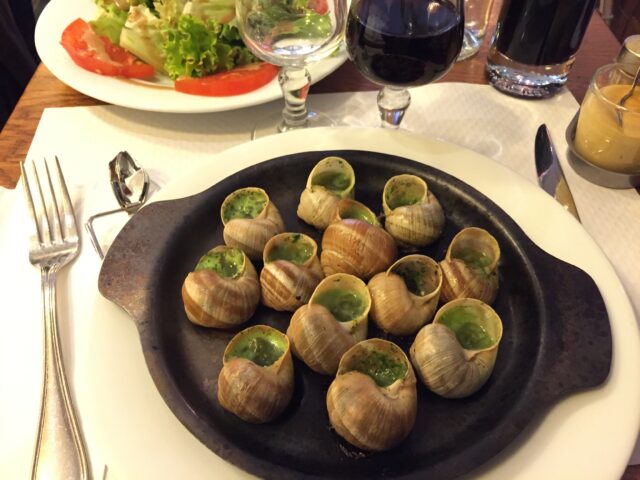
Feeling adventurous, I order the escargot, a classic French dish that’s sourced a little differently these days. Good escargot must grow wild. The great French snail was once so common that early-19th-century train companies hired women and children to clean them off the tracks so the trains could get a grip. Today, the French snail has gone the way of the great American buffalo. As effective chemicals have successfully killed off weeds and undesirable insects, they have also decimated the slug and snail populations. Much of the escargot in France is farmed. Locals know the farmed gray snails are mediocre at best. The top-quality free-range snails most likely last slithered in Poland.

Through my meal, I ponder, not for the first time, whether there is something pseudo-sophisticated about all this finicky French food culture. While buying wine, if you ask what would be good with escargot, the wine merchant will need to know how you plan to cook the snails. “Oh, you’re cooking it that way? Then you need something flinty — a Chablis.” Too bad if you were hoping for a good Chardonnay.

Then I think of the way an American who pooh-poohs the French passion for fine points in cuisine might celebrate the nuances of baseball. Take a Frenchman to the ballpark. All the stuff that matters to me—how far the runner is leading off first base, who’s on deck and how he does against left-handed pitchers, how deep the bullpen is, put in a pinch runner! — is nonsense to him.

The next time I put a little ketchup on my meat and my French friend is aghast, I’ll accept it with no judgment. I’ll just remember that with two outs and a full count, he’ll have no idea how I know the runner’s off with the pitch.

(This story is excerpted from my upcoming book, For the Love of Europe — collecting 100 of my favorite memories from a lifetime of European travel, coming out in July. It’s available for pre-order.)

Epiphany!

Galette des Rois
Photo Credit: Steph Gray

Christmas in some European countries kicks off 12 more days of religious observance — the famous Twelve Days of Christmas. They end today (January 6) with the Epiphany holiday, when the Three Wise Men were said to have finally brought their gifts to the baby Jesus.

France, not surprisingly, celebrates Epiphany in an edible way. For several days from Christmas until the Feast of Epiphany, the French line up at bakeries to buy the galette des rois — the “Cake of Kings.” They bring these to dinner parties, and enjoy them as snacks and with mid-afternoon tea. The tradition of the treats dates back to the 14th century.

What’s the reason for this enormous amount of pastry consumption? (Although honestly, who needs a reason to eat pastry?) Inside each galette hides a tiny trinket, usually made of porcelain. While these once had religious significance, today they range from miniature paintings of Picasso’s Guernica or Leonardo da Vinci’s Mona Lisa to figurines of Zorro or even Harry Potter. The trinkets hidden inside each galette are called fèves, named for the fava beans that were the original prizes. Today, fèves are highly collectible.

Traditionally, the cake is cut while the youngest child at the table designates who will get each piece (so there’s no cheating). Everyone takes careful bites of the pastry until someone finds the fève. The excited winner gets the fève, as well as a golden paper or plastic crown that tops the cake — and becomes king or queen for the day.

In Italy, Epiphany is the time of La Befana, the legendary Good Witch of Christmas, who gives gifts to children. Find out more about La Befana.

A Bum, a Baguette, and a Moment: Connecting with People

Chartres Cathedral

Leaning back on my bench, I marveled at the floodlit facade of Chartres Cathedral. Munching on my baguette with brie, I was pondering how, for centuries, nobles and peasants alike have been awestruck by this view. Then in my periphery, I noticed a bum on the next bench, reaching toward me — and offering me a swig of red wine from his battered 1.5-liter plastic water bottle. Backlit by the floodlighting and with a twinkle in his friendly eyes, he looked like a character in an over-the-top romantic painting of folk characters on sale at a French town market.

Even though we hardly talked and I politely rejected his wine, we were both there — connected, sharing the moment. It was a fleeting, yet very human, encounter — and it added to my experience of Chartres.

The essence of good travel is people. If I’m leading a tour or writing a guidebook, the mark of a job well done is how well I connect people with people. If I’m making a TV show and it doesn’t have local voices, the show will be flat. And when I’m enjoying a European vacation, my journal is more interesting when it includes stories of people I’ve met along the way.

Developing a knack for sparking such experiences is our challenge as good travelers. I like to take it a step further — to be a keen observer, connecting experiential dots that may seem random by putting them into cultural and historical context…and then learning from them. As a travel writer, that’s my challenge. And that’s my mission.

What about you? How have you connected with people in your travels? I’d love to hear about your own bum and baguette moments.

Mont Blanc: Long-Distance Hikes and Mountain Hospitality

I was just in the Alps with my TV crew, filming three new episodes of Rick Steves’ Europe. We spent a couple of days hiking (and filming) on the Tour du Mont Blanc trail, in the French Alps. It’s a whole parallel world there, away from the tourist crowds and intensity of the Alpine resorts, and really peaceful 

After just a taste of this classic long-distance hike, I am dreaming of coming back and doing the entire loop — and once again, I’m reminded that you can never run out of rewarding corners of Europe to explore. 

What’s your favorite long-distance hiking experience in Europe?