The Route du Vin in Alsace

The Route du Vin is the Wine Road of Alsace. This region, between the Rhine River and the Vosges Mountains, has historically been fought over between France and Germany. The Germans believe the mountains are the natural border, while the French think it’s the river. It’s interesting to think that this is a kind of continental cultural divide — with Romance cultures to the south, and Germanic to the north. Perhaps that explains how every other city here feels like it’s been rebuilt after a terrible war. Using Colmar as a springboard, it’s easy to tour the region.

The Vineyards of Alsace

Alsace’s Wine Road is blanketed with lush vineyards and dotted with charming towns. You can hike, bike, hire a taxi, catch the bus, or join a minibus tour like I did (a half-day for €60).

Adorable Kaysersberg

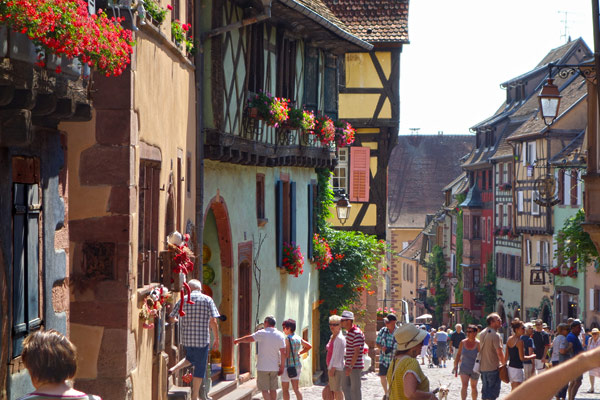
The Route du Vin is dotted with delicious little towns. Kaysersberg is one of the most charming.

Channeling water power in Alsatian villages

Alsatian villages nestle in valleys on small rivers, which medieval villagers hijacked, broke into canals, and used to power their mills. Today, when you explore these towns, it’s fun to imagine what a blessing water power must have been.

The original gourmet

This sign marked the mansion of the Kaysersberg gourmet. I never realized the derivation of the word “gourmet”: Each city in a wine region (like Alsace) had a man appointed to rate and price wines, and serve as the middleman between vintners and the wine-drinking public. He facilitated the sale of wine…and knew that having quality food in association with the wine would help. Eventually he became the man with the finest food in town, or the “gourmet.” The actual job of the gourmet survived in Alsace until the 1930s.

Cutting a Cobble in Colmar

It’s so important to be “heads-up” when you’re traveling. For example, each Tuesday, folk dancers and musicians from a nearby village share their talents on Colmar’s main square. I’m sure there are tourists sitting in their hotel rooms watching TV who would love this fun and free slice of Alsatian culture. They just forgot to ask their hotelier or at the TI if there was anything happening tonight in Colmar.

If you can’t see the video below, watch it on YouTube.

Flip-Flopping Colmar: Wurst with Fine Sauces

I just flew from Prague to Basel and hopped on a train to Colmar, France. I’m meeting the co-author of our France guidebook, Steve Smith, to do some research work, and then we’ll meet our film crew to make two new TV shows in France.

I love Colmar. For years, it was a two-night stop on our “Best of Europe in 22 Days” tour. Today it seems strange to think that the most charming city in the German-flavored corner of France called Alsace would merit that coveted spot on our “grand tour.” When designing the tour, we figured that on a three-week Europe tour, while you’d obviously visit Paris, you’d also want a look at the French countryside. And Colmar offered a way to break the long drive from the Swiss Alps to the grand finale in Paris. As a bonus, it let us include a look at the WWI battlefield sights of Verdun and a stop at a Champagne cave, to boot.

Now, our Best of Europe tours stop in Burgundy rather than Alsace. We made the change because Burgundy is more quintessentially French than Alsace. But if you’re touring Alsace, Colmar is still the best home base. I like Alsace — but it really is a mix of German and French culture, as this is the region that for centuries flip-flopped between Germany and France depending on who won the last war. That’s why you find people here named Jacques Schmidt or Gunter Dubois, and the wurst comes with fine sauces.

Each Tuesday evening, a folk group brings the half-timbered main square of old Colmar to life.
I love traveling through France with Steve Smith, the co-author of our France guidebook. And everywhere we go in France, we meet happy travelers with the book. They are eager to share their experiences — as you can see in this photo of Steve and some satisfied readers — and in our work, we find that very helpful.
I’m starting to see more innovative ways to use your mobile device when sightseeing. These QR codes (which you can scan with your smartphone's camera) are posted at each spot of interest in Colmar. Scan it, and bam! You’ve got the information right there on your screen for free. It’s almost as helpful as our guidebook!
I’m starting to see more innovative ways to use your mobile device when sightseeing. These QR codes (which you can scan with your smartphone’s camera) are posted at each spot of interest in Colmar. Scan it, and bam! You’ve got the information right there on your screen for free. It’s almost as helpful as our guidebook!

Guest Blogger: The Travelphile and a Sense of Place

Where we travel and how we travel shapes our travel experience — obviously. And who we travel with does, too. I’ve been traveling quite a bit lately with a remarkable woman, Trish Feaster. We’re different types of travelers — and I’ve been struck by how those differences broaden and enrich my travel experience.

Trish is a linguist, while I am a confirmed monoglot. Her love of language has given my recent travels a new dimension. She’s a foodie, while I’m an “intermediate eater.” Her ability to get the same joy out of a menu that I get out of an art gallery has broadened my cultural experience (and even — a little bit — my waistline). And her emphatic joie de vivre tempers my workaholism in a way that — ironically — makes me especially productive as a travel writer. I find that now I experience, and write about, things that I wouldn’t have made time for if I were on my own.

Trish is an avid photographer as well as an inspiring writer. Her blog, The Travelphile, provides a showcase for her work. (It also gives a more candid look at my non-European travels than you’ll get on my own blog, as we enjoy lots of travel fun that has nothing to do with Europe.) I think her insightful blog entries complement my own, and she deserves more readers. To give you a taste of Trish’s writing, she’ll be occasionally guest-blogging here in the coming weeks. I hope you’ll enjoy her take on traveling; if you do, please follow her blog. Thanks.

A Place That’s All Your Own

One of the most annoying things about travel/tourism is that if you’re going to someplace that’s popular, everyone else is too. That means crowds, lines that seem to have no end, pushing and shoving, and odors that you didn’t think were humanly possible. With all of that mass of humanity, patience and a good sense of humor seem to melt away quicker than ice under a scorching sun.

Although most people would prefer to travel in low or shoulder season to avoid crowds (and elevated prices), for many, that’s simply not possible. One way to get around that scene is to not be in it. Find a better way to enjoy your travels by being in a place when there are few people and make it a place that’s all your own — even at the busiest time of the travel season.

This summer, because I’ve been working as an assistant guide, I have been, by necessity, out and about when everyone else is. While being on a tour has its privileges (such as guided tours with incredibly talented and smart local guides or entrances to sites/activities without waiting in line), it’s still next to impossible to avoid the fact that everyone and their mother is at the same place you are everywhere you go.

To have a more peaceful and intimate experience, I made a conscious effort to enjoy the places we visited either really early in the morning or really late at night. Now obviously I wasn’t getting into museums with an Early Admission Ticket like at Disneyland (Whoa, there’s a idea! Museums, get on that!), and I certainly didn’t do this every day. But, I did get to see places in ways that most travelers — or even locals for that matter — don’t. It takes effort and sometimes a little bit of planning (going to bed early so you can be up at 6 a.m., resting in the afternoon so you can be up until 1 a.m.), but it’s so worth it to watch the sunrise over a glassy lake, to be one of twelve people standing on the Mont Saint Michel causeway at midnight listening to the waves kiss the shores of the sandy bay, to dance like no one is watching in front of the Eiffel Tower, to smell the fresh cut hay just two miles away from the nearest castle, or to be the first person of the day to stroll through the main street of a town that is just on the verge of waking up. Even if you do it just to get a pristine photo without others blocking your view, you can have a really magical moment if you can find a way to enjoy a place all on your own.

Here are just some of the places where I took advantage of being out and about when the the crowds were getting their beauty sleep.


At 5:30 in the evening, what once was a empty square is peppered with a few too many people.

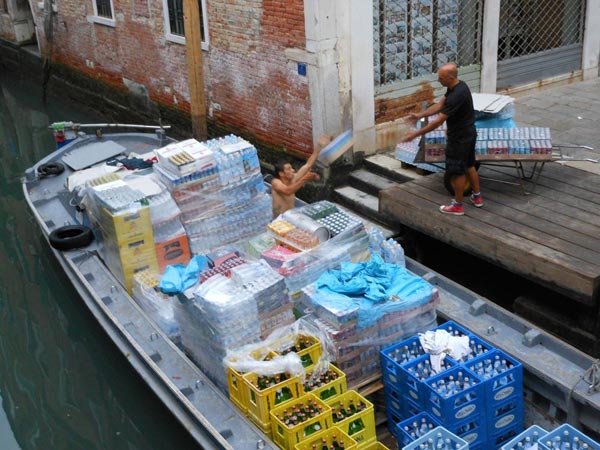
Early in the morning, boats haul their goods to merchants of Venice.

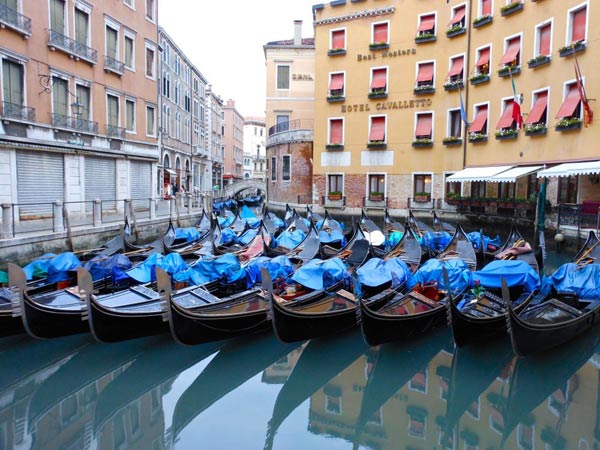
Gondolas nestle together in the cove of a canal in the early morning hours before the tourists arrive en masse.

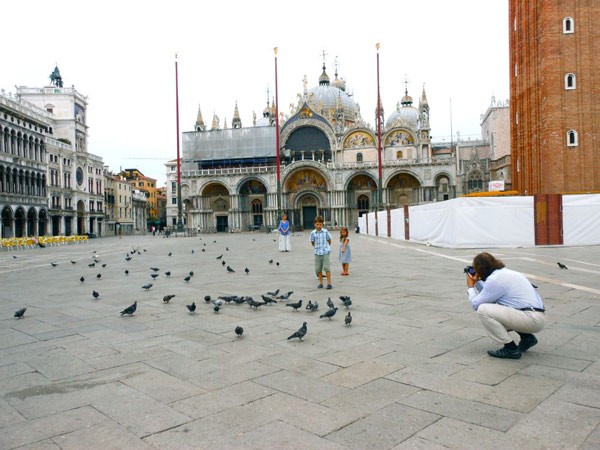
This family and I had the same idea: get up early and have Venice all to yourself.

The peace and tranquility of Venice are best enjoyed early at morning or late in the evening.

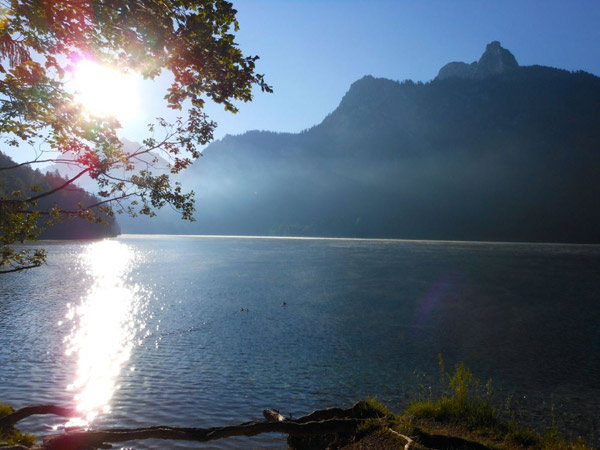
On this morning, I ran from Austria to Germany and was treated to a calming moment on a lake before joining the crowds later that day at Neuschwanstein Castle.

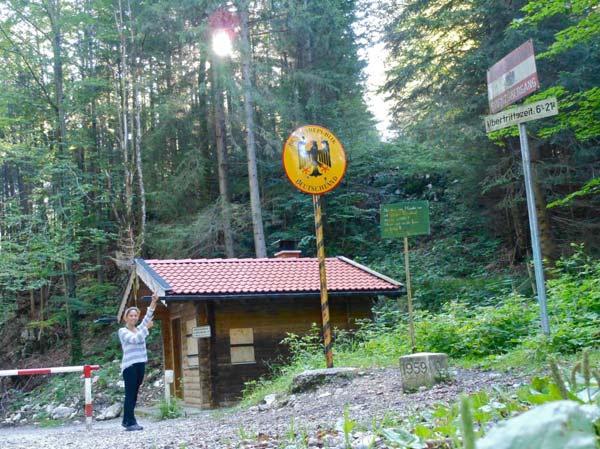
Even the Austria/Germany border guard wasn’t up and about at this early in the morning.

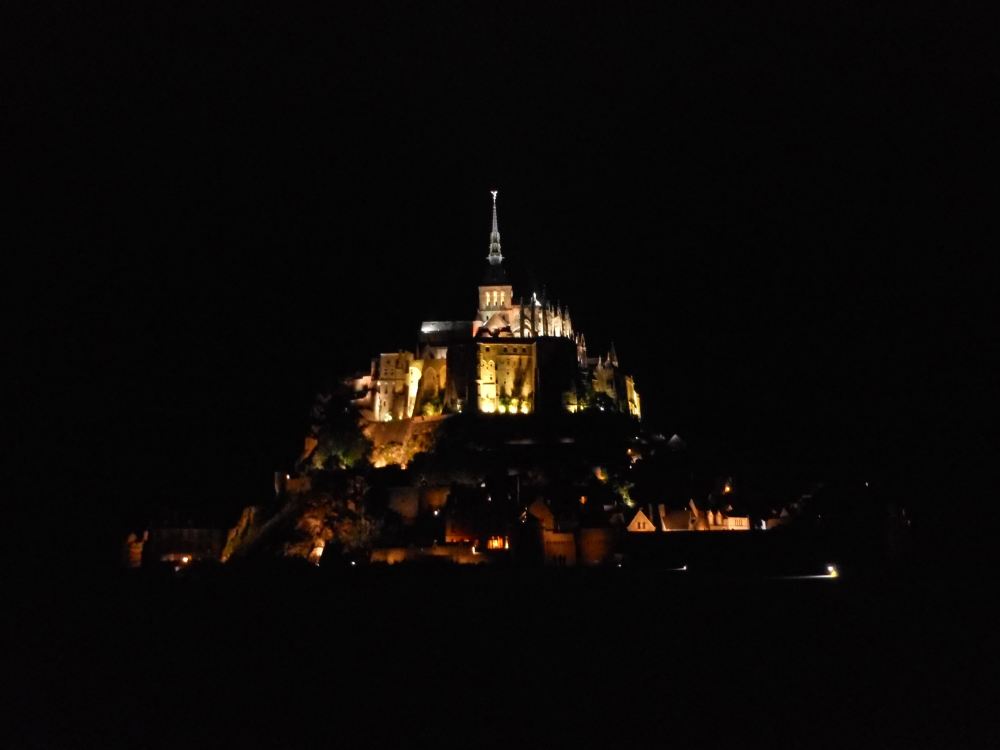
Le Mont-Saint-Michel has stood majestically as a beacon to pilgrims for centuries, and at night it is at its most striking and its most tranquil.

It’s hard to imagine that in only an hour from when I took this shot, this place was full of people standing practically shoulder-to-shoulder.

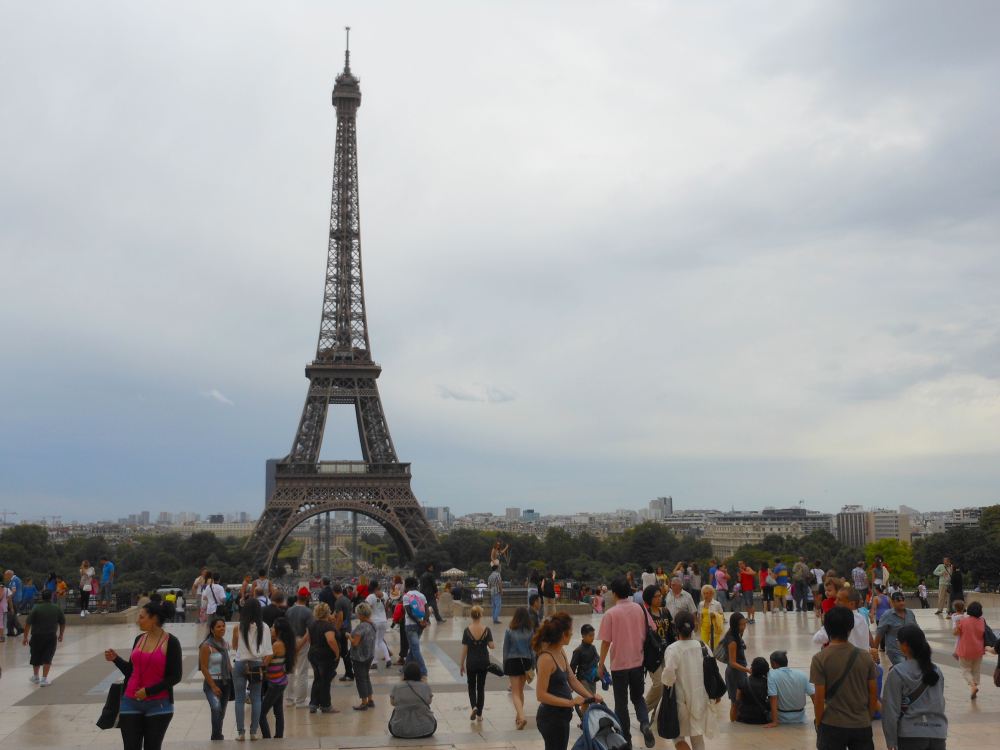
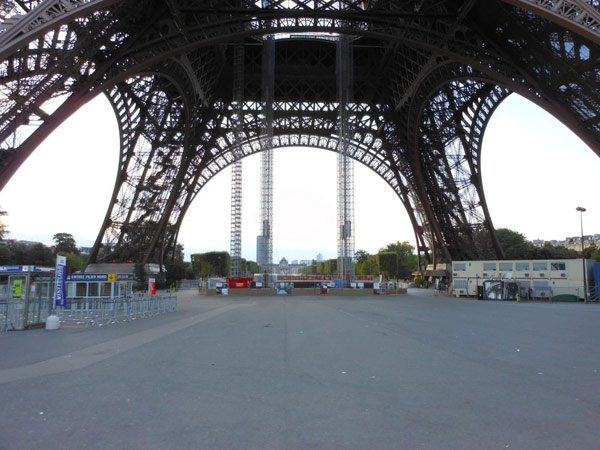
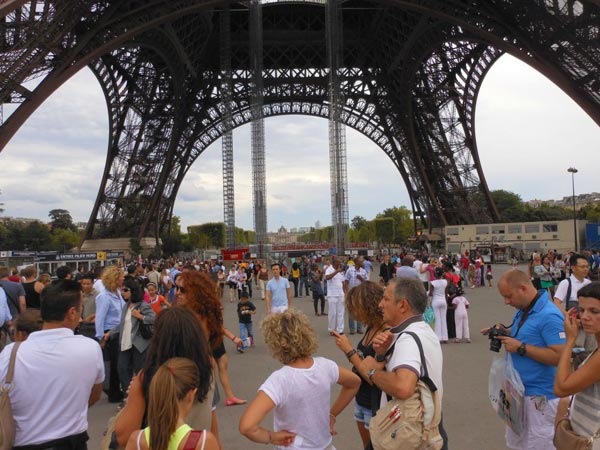
People were waiting for two hours just to buy their tickets so they could stand in line again to take the elevator up the Eiffel Tower.

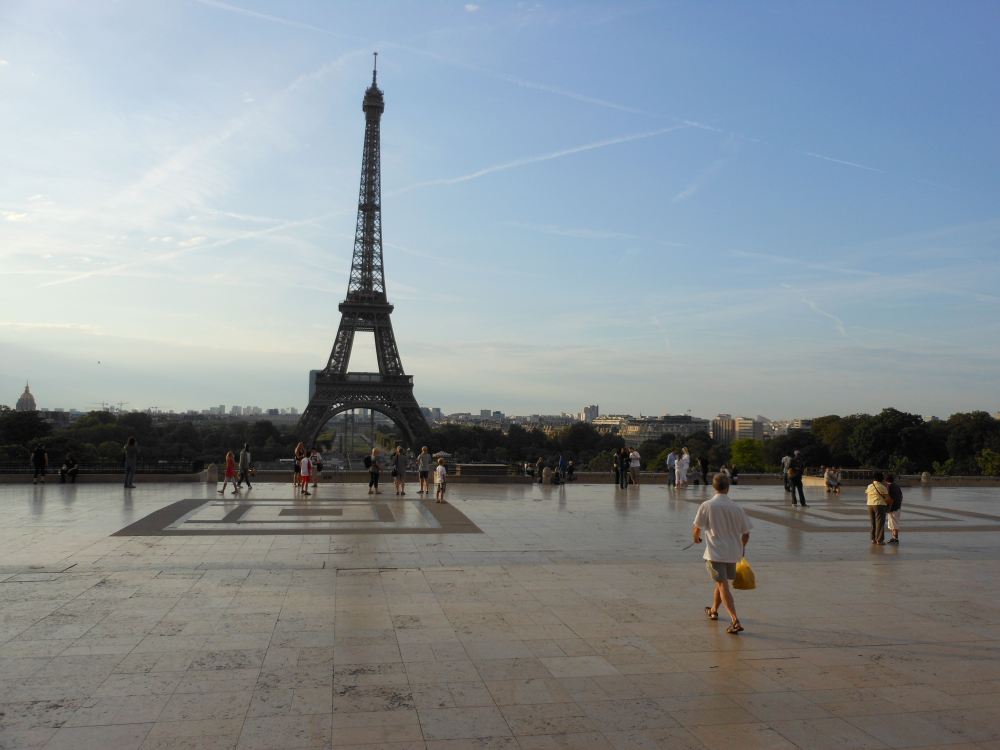
Early in the morning, you can get a nearly unobstructed view of the Eiffel Tower.

A Tour Guide’s Experience with Health Care Phobia in France

I believe that, especially with a good guide, travel can be transformative and richly experiential…both a political act and a spiritual act. It forces people to grow, to deal with others who see things differently, to get out of their comfort zones, and to grapple with their own ethnocentricity and hang-ups. While people don’t generally sign up for a tour thinking they are investing in the growing pains of a broader perspective, I encourage my guides — like a loving parent who works to broaden a child’s palate — to thoughtfully set up experiences that can pry open a little wider the hometown blinders of an American traveler. Recently, one of our guides (who happens to be an American) shared this fascinating experience relating to health care in France. Here’s her report:

When I’m leading a tour in France, I always give a talk on the French tax, education, and health care systems. When speaking to a tour group — many of whom are relatively well-off, middle-aged Americans — these subjects can be a little controversial…even taboo. But I believe these issues are essential for anyone hoping to understand contemporary French society and culture.

The French pay lots of taxes for social programs. These taxes allow for “free” universal health care (not socialized medicine, but rather a quasi-private system overseen by the government — rated #1 in the world by the World Health Organization) and “free” education through the university level for all French citizens. Of course, health care and education are not free — they are paid for collectively by the entire society through taxes.

The French, in general, believe this is a good system. As is the case with other Europeans, they are not eager to pay high taxes (the French pay about 30 percent income tax, plus about 20 percent sales tax). But they have high expectations for the programs their taxes pay for, and they generally embrace the system. The French see their tax dollars at work each time they go to the doctor of their choosing and pay only a small co-pay (about $20); when they don’t have to worry whether they can afford their cancer treatment; and when they don’t have to ask, “How will I pay for higher education for my child?” No one in France is in debt because they have cancer or because they went to school to become a teacher.

When I explain this to my tour members, I let them know that I don’t think the French system is perfect, and neither do the French.  It’s expensive. There is abuse. And some people fall through the cracks. But I believe that when our tax, health care, and education expenses are added together, we Americans end up paying more for less. The French, by their communal nature, prefer the collective approach — life with more taxes and without the economic stress that we treat as normal. I graduated from the University of Washington owing $30,000, and my parents owed even more. My 30-year-old brother, who is self-employed with no insurance, fell off his bike and had to wait more than six hours to be seen in the emergency room. He was billed $7,000 for that visit. My underinsured father had quadruple bypass heart surgery and had to file for bankruptcy because he couldn’t pay his medical bills.

Rick Steves groups are filled with people of all political stripes, but nearly everyone is rational, open-minded, and willing to respect (if not agree with) the opinions of others. But on a recent tour, a few of my tour members were angered that I would “talk positively about socialism” (as they put it). One couple (I’ll call them Jane and John) said they vehemently disagreed with everything I said — not just my opinions, which I could understand, but even the facts and statistics I had cited, and the personal French accounts I’d collected. Jane insisted that no one could be happy living in a system where one is responsible for carrying the weight of their neighbor.

The next morning, when I went down to breakfast, Jane and John weren’t anywhere to be found. Finally John appeared looking like he’d seen a ghost — like he hadn’t slept all night. Turns out he hadn’t. Jane had suffered a severe medical problem the night before, but she wouldn’t let John come get me to help — she refused to see a doctor in France. I went to see Jane and convinced her to go to the hospital. When we got there, she was seen within two minutes of walking through the door, they were giving her tests within five minutes, and after ten minutes, she felt comfortable enough with the quality of care that she told me I didn’t need to stay.

I went back when it was time for Jane to be discharged. Fortunately, her condition had not caused long-term damage, and with medication she’d be able to return home to follow up with her own doctors. But John was struggling to sort things out with the discharge nurse. I translated the nurse’s explanation that she couldn’t accept their US insurance information — in fact, there was nothing to pay. John turned to me and said, “Do you know how much this overnight stay would cost in the US? This is crazy! Are you sure I don’t have to pay?” Determined to “pay their own way,” John and Jane took out their credit card. After some convincing, I persuaded the nurse to charge them a small “donation” of about $200.

I’m so thankful Jane was able to walk away from the incident. And I also hope that maybe their experience opened their minds a bit. We don’t need to embrace European social ethics. But we should be open to learning about them and respecting people who choose to design caring societies a little differently than ours.