Daily Dose of Europe: Bayeux Tapestry

This skinny, 70-yard-long strip of cloth depicts a crucial historical event that helped shape the Europe we know.

As America continues to suffer crisis upon crisis, it has never been more important to broaden our perspectives and learn about the people and places that shape our world. And for me, one of the great joys of travel is seeing art masterpieces in person. Learning the stories behind great art can shed new light on our lives today. Here’s one of my favorites.
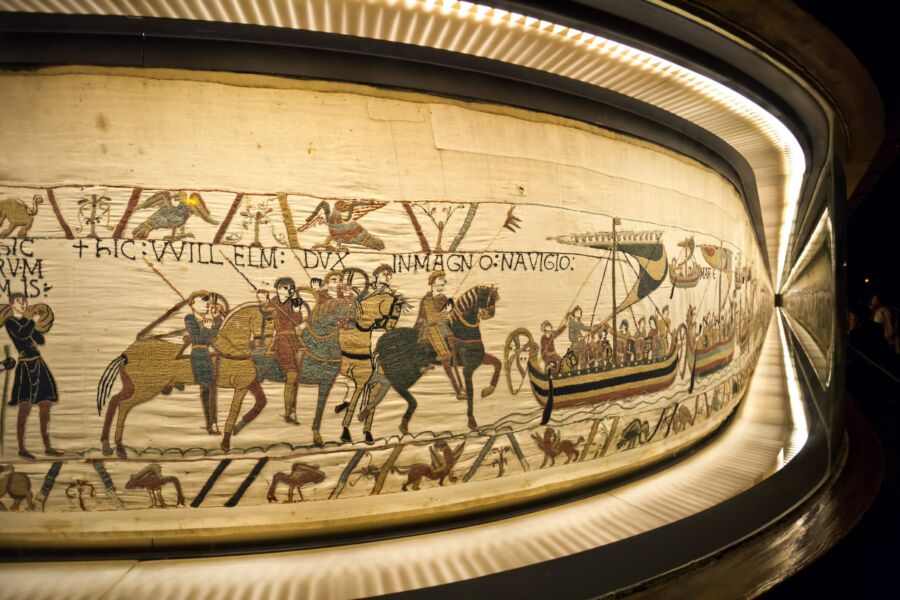
Like a graphic novel, the Bayeux Tapestry tells the mesmerizing story of how William the Conqueror and Harold of England competed for the English crown. The tale culminates in one of the most pivotal battles in history: The Battle of Hastings in 1066.

The story begins in London. In the opening scene — the first of about 60 in the tapestry — the reigning King of England, Edward, is presiding on the throne in his palace. He orders his brother-in-law Duke Harold to ride off to France. At that time, Normandy (northern France) was under English rule. Harold was to announce to all the subjects that Edward had decided who his successor as king would be — a seemingly illegitimate duke called “William the Bastard,” known today as “William the Conqueror.”

The tapestry is realistic enough that even an illiterate peasant could understand what’s happening. The Latin titles reinforce the main characters and key events. Down-to-earth details keep you “reading.” The narrative is framed by a border (top and bottom) with more eye candy — some related to the story, some mere decoration.

The climax of the whole tapestry is the Battle of Hastings, which pitted the invading Normans of France, led by William, against the Anglo-Saxons of England, led by Harold. It was a fierce, 14-hour battle. Knights on horseback charge, swordsmen clash, and archers launch arrows, leaving the battlefield strewn with mangled corpses. According to historical accounts, Harold fell from his horse. He lifts his visor to shout to his men, when suddenly — shoop! — Harold gets hit with an arrow, right in the eye. Finally, an enemy horseman bends down to finish Harold off with a sword. The title above says it all: “Here King Harold is slain.”

The Battle was won by William. The Normans now ruled England. This illegitimate child, until then known as “William the Bastard,” could now call himself “William the Conqueror.” Unfortunately, that’s where the Bayeux tapestry ends, because the final scene is missing, lost to history.

But we know the rest of the story. William marched to London, claimed his throne, and (though he spoke no English) became king of England. This set in motion 400 years of conflict between England and France — not to be resolved until the 15th century. However, on the plus side, the Norman conquest of England brought that country into the European mainstream. Because of the events depicted on the Bayeux tapestry, England got a stable government, contact with the rest of Europe, and a chance to eventually grow into a great European power.

And today, historians and tourists alike can stand in the presence of this precious document, stroll slowly along, and see those momentous events from nearly a thousand years ago unfold before their eyes.

This art moment — a sampling of how we share our love of art in our tours — is an excerpt from the new, full-color coffee-table book, “Europe’s Top 100 Masterpieces,” by Rick Steves and Gene Openshaw. Please support local businesses in your community by picking up a copy from your favorite bookstore, or you can find it at my online Travel Store. To enhance your art experience, you can find clips related to this artwork at Rick Steves Classroom Europe; just search for Bayeux.
Daily Dose of Europe: Venus de Milo

The Venus de Milo — the goddess of love, sculpted in about 100 BC — sums up all that ancient Greece stood for.

As America continues to suffer crisis upon crisis, it has never been more important to broaden our perspectives and learn about the people and places that shape our world. And for me, one of the great joys of travel is seeing art masterpieces in person. Learning the stories behind great art can shed new light on our lives today. Here’s one of my favorites.

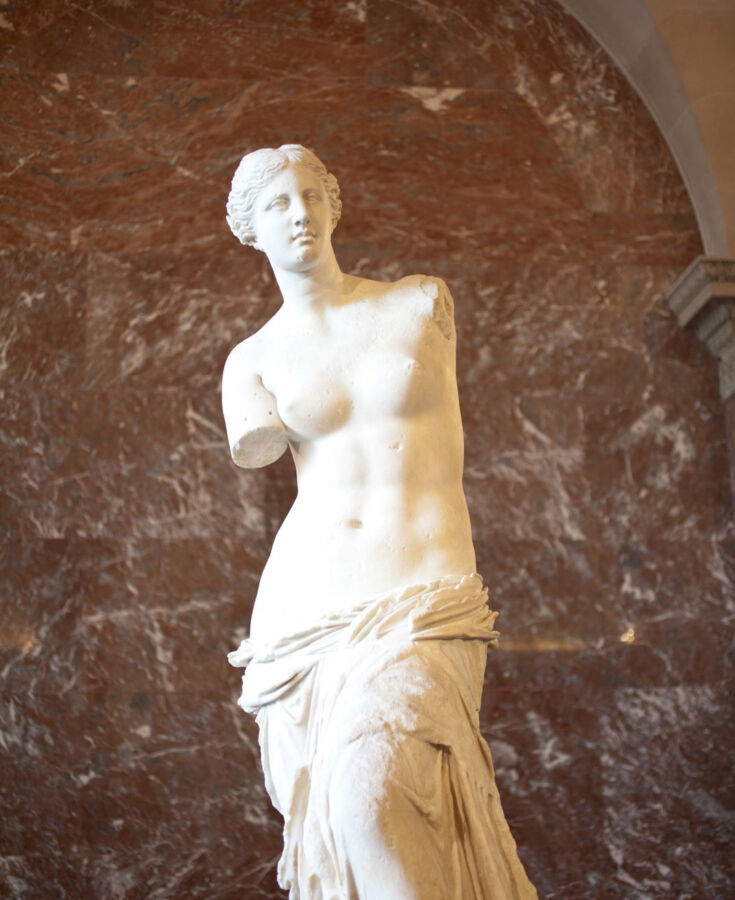
The Venus de Milo created a sensation when it was discovered in 1820, on the Greek island of Milos. Europe was already in the grip of a classical fad, and this statue was a hit. The ancient Greeks pictured their gods in human form — which meant that humans are godlike. Venus’ well-proportioned body embodied the balance and orderliness of the Greek universe.

Split Venus down the middle from nose to toes and see how the two halves balance each other. Venus rests on her right foot (that contrapposto pose so popular with classical sculptors). She then lifts her left leg, setting her whole body in motion. It’s all perfectly realistic: As the left leg rises, her right shoulder droops down. And as her knee points one way, her head turns the other. Despite all this motion, the impression is one of stillness, as Venus orbits slowly around a vertical axis. The twisting pose gives a balanced S-curve to her body. The balance between fleeting motion and timeless stability made beauty.

Other opposites balance as well, like the smooth skin of the upper half of her body that sets off the rough-cut texture of her dress. She’s actually made from two different pieces of stone plugged together at the hips (you can see the seam). The face, while realistic and anatomically accurate, is also idealized — like a goddess, she’s too generic and too perfect. This isn’t any particular woman, but Everywoman — all the idealized features that appealed to the Greeks.

The statue became famous for a number of reasons. Venus’ classic beauty was seen as the ideal of female grace. The statue is a rare Greek original, not a Roman copy. Its sudden discovery (by a humble Greek farmer) made great news copy.

Most of all, Venus brought with her an air of mystery. Who was this beautiful woman? She’s probably Venus, but no one knows for sure. What is she thinking? Her expression is alluring yet aloof. Her dress dangles suggestively; she’s both modestly covering her privates but hinting at more.
And what were her arms (which were never found) doing? No one knows. Some say her right arm held her dress, while her left arm was raised. Others think she was hugging a statue of a man or leaning on a column. I say she was picking her navel.

Regardless, though Venus’ arms have been lost over the centuries, her eternal beauty remains intact.

This art moment — a sampling of how we share our love of art in our tours — is an excerpt from the new, full-color coffee-table book, “Europe’s Top 100 Masterpieces,” by Rick Steves and Gene Openshaw. Please support local businesses in your community by picking up a copy from your favorite bookstore, or you can find it at our online Travel Store. To enhance your art experience, you can find a clip related to this artwork at Rick Steves Classroom Europe; just search for Louvre.

Daily Dose of Europe: Delacroix’s Liberty Leading the People

The sight of mass protests — people striving for change and the betterment of society — always gets me thinking about Delacroix’s Liberty Leading the People. While the specifics are different, both this painting and the current Black Lives Matter movement are united by a striving for justice and liberty for all citizens…not just the privileged and elite. And both show how people from all walks of society can be united in one voice.

Lady Liberty, carrying the French flag, represents the ongoing struggle and relentless quest for freedom. Nicknamed “Marianne,” she is often seen as the symbol of the French Revolution of 1789, though this painting depicts a later revolution.

It’s Paris. The year is 1830. King Charles X had just suspended civil liberties, and his subjects were angry. The Parisians have taken to the streets once again to fight their oppressors. Eugène Delacroix witnessed the events during those “Three Glorious Days” of revolution, and began composing this work.

The people have taken up arms and erected a barricade in a street near Notre-Dame (in the background). Guns blaze, smoke billows, and bodies fall. Every social class is involved: the hard-bitten proletarian with a sword, an intellectual with a top hat and a sawed-off shotgun, and even a little boy brandishing pistols. Leading them on through the smoke and over the dead and dying is the figure of Liberty, a fearless woman waving the French flag.

Delacroix packed the painting with symbols. To stir the emotions, Delacroix concentrates on the three major colors — the red, white, and blue of the French tricolore. Lady Liberty’s pose is classic, patterned after the ancient goddess Libertas. But instead of a torch and staff, this secular goddess brandishes a flag and a gun. She sports a red “Phrygian cap,” the bandana worn by 1789 revolutionaries.

Delacroix’s painting epitomizes a controversial new style — Romanticism. The canvas is epic in scale (12′ × 10′), the colors bold, and the scene emotional, charged with rippling energy.

The July Revolution of 1830 was a success, and the people toppled their despotic king. Delacroix’s painting was hailed as an instant classic, a symbol of French democracy.

However, the struggle didn’t end there. They’d only replaced one despot with another less-repressive king. For the next few decades, French radicals continued to battle monarchists in pursuit of full democracy (including the 1832 revolt dramatized in Les Misérables). Delacroix’s painting with its inflammatory message had to go underground, and was rarely exhibited in public. But it inspired his fellow lovers of liberty, like Victor Hugo. It may have influenced another French artist, Frederic-Auguste Bartoldi, in his imagery of the Statue of Liberty. Finally in 1874, the political winds were right for it to take its place in the halls of the Louvre.

The painting was born in an era when many still believed that some were born to rule, ordained by God, while others were fated to be ruled. Delacroix stirred France’s passion for liberty. To this day his painting symbolizes the never-ending struggle of the common rabble who long for “Liberté, Egalité, Fraternité” — “Liberty, Equality, and the Brotherhood of All.” And that cry for liberty, equality, and brotherhood still rings on our streets today.

This art moment — a sampling of how we share our love of art in our tours — is an excerpt from the full-color coffee-table book Europe’s Top 100 Masterpieces by Rick Steves and Gene Openshaw. Please support local businesses in your community by picking up a copy from your favorite bookstore, or you can find it at my online Travel Store. To enhance your art experience, you can find a clip related to this artwork at Rick Steves Classroom Europe.

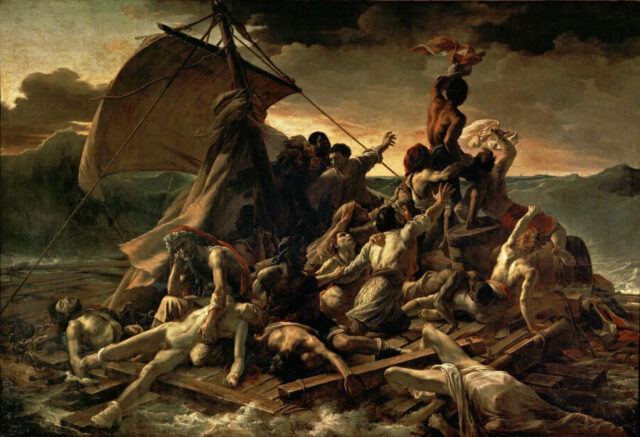
Daily Dose of Europe: Géricault’s Raft of the Medusa

A glimmer of hope in a time of crisis…this painting feels made for our current time.

The coronavirus can derail our travel plans…but it can’t stop our travel dreams. And I believe a daily dose of travel dreaming can actually be good medicine. One of the great joys of travel is seeing art masterpieces in person. Here’s one of my favorites.

In 1816, the French ship Medusa went down off the coast of Africa, and the tragedy gripped the nation. Accounts poured in of the unspeakable hardships these French citizens suffered.

In Paris, the young artist Théodore Géricault began chronicling the tragic event. Like a method actor, he immersed himself in the project. He interviewed survivors and honed his craft sketching dead bodies in the morgue and the twisted faces of lunatics in asylums. He shaved his head and worked alone, wallowing in the very emotions he wanted to portray.

He captured the moment when all hope seemed lost.

Clinging to a raft in the midst of a storm-tossed sea is a tangle of bodies sprawled over each other. The scene is alive with agitated, ominous motion — the ripple of muscles, churning clouds, and choppy waves. The rickety raft is nearly swamped. The dark colors — dull green seas, dark brown raft, and ghostly flesh — are as drained of life as the survivors’ spirits. On the right is a deathly green corpse dangling overboard. Of the 150 people who originally packed onto the raft, only these few remained. They floated in the open seas for almost two weeks — suffering unimaginable hardship and hunger, even resorting to cannibalism. The face of the old man on the left, cradling his dead son, says it all — it’s hopeless.

But wait!

There’s a stir in the crowd. Someone has spotted something. The bodies rise up in a pyramid of hope. The diagonal motion culminates in a waving flag. They wave frantically, trying to catch the attention of something on the horizon, their last desperate hope. It’s a tiny ship — the ship that did finally rescue them and bring the 15 survivors home.

For months, Géricault worked feverishly on this giant canvas. When he emerged, it captured the traumatized mood of a French nation still in mourning. Géricault had also revolutionized art, paving the way for a bold new style — Romanticism. His contemporaries were still following the Neoclassical tradition of idealized gods and Greek-statues-on-canvas. Géricault shattered the mold, adding a gritty realism and super-ultra-mega-heightened emotion. What better story than this shipwreck to shock and awe the public? In the artistic war between hearts and minds, Géricault’s Romantic style went straight to the heart. He used rippling movement, strong shadows, and powerful colors to catch us up in the excitement. If art controls your heartbeat, this is a masterpiece.

It also sounded another trumpet of the Romantic movement. Ultimately, it championed the godlike heroism of ordinary people who rise above their suffering to survive.

This art moment — a sampling of what we try to incorporate in our tours — is an excerpt from the full-color coffee-table book Europe’s Top 100 Masterpieces by Rick Steves and Gene Openshaw. Please support local businesses in your community by picking up a copy from your favorite bookstore, or you can find it at my online Travel Store. To enhance your art experience, you can find a clip related to this artwork at Rick Steves Classroom Europe; just search for Lourve.

Daily Dose of Europe: Rigaud’s Louis XIV

In this age of austerity, the opulence of the Palace of Versailles seems more over-the-top than ever. And that’s all because of the giant ego and extravagant personal style of one man: Louis XIV.

The coronavirus can derail our travel plans…but it can’t stop our travel dreams. And I believe a daily dose of travel dreaming can actually be good medicine. One of the great joys of travel is seeing art masterpieces in person. Here’s one of my favorites.

The official portrait of the King of France shows a 63-year-old man at the peak of his power. He wears the coronation robe — a luxuriant blue, white, and gold garment — and stands amid the royal regalia: the red-canopied throne, the crown, and the sword of Charlemagne on his hip. This is the ultimate image of a divine-right ruler — a king who could rule unchecked by the laws of man, and whose authority came directly from God.

It’s the year 1701, when France was Europe’s most powerful country. Louis’ lavish palace of Versailles trumpets his divine power. Louis is the “Sun King,” tracing his divine authority back even to the classical god Apollo. He’s Europe’s king of kings, the absolute example of an absolute monarch. Louis summed it up best himself with his famous rhyme, “L’état, c’est moi!” (lay-tah say mwah): “The state, that’s me!”

Rigaud captures all the splendor, but he also gives a peek at the flesh-and-blood man beneath the royal robe. Louis, striking a jaunty pose, turns out to meet the viewer’s gaze. He puts one hand on his hip and balances the other nonchalantly atop his cane — oh wait, that’s actually the royal scepter, which he’s playfully turned on its head. Louis tosses his robe over his shoulder, revealing his athletic legs. Louis loved to dance, and even as an old man, he looked good in tights.

In fact, Louis’ subjects adored him. He was polite and approachable, and could put commoners at ease with a joke. He was everything a man could aspire to be: good-looking, an accomplished guitar player, a fine horseman, witty conversationalist, statesman, art lover, and lover of women.

Rigaud shows Louis at his best. The painting is nine feet tall, so Louis is fully life-size, and positioned so this not-so-tall man (5’5”) can literally look down on us. Louis’ robed body forms an imposing pyramid turned at three-quarter angle, placed in the center of a rectangular frame. Louis’ face is age-appropriate: handsome, but realistically doughy and double-chinned. Every detail is immaculate, from the texture of the fabrics to the ruffled curtains to his jeweled necklace. Rigaud’s painting was so realistic, it served as Louis’ body-double in the throne room whenever the king was away.

Louis is dressed to kill. He was Europe’s great trendsetter. His blue robe, embroidered with gold fleur-de-lis, is turned out to show off the white ermine lining. His “everyday” clothes were soon seen throughout Europe: a delicate lace cravat (on his chest), matching lace cuffs, poofy breeches for pants, silk stockings, and square-toed shoes with Louis’ fashion signature — red heels.

And the hair! Louis once had flowing curls down his shoulders, but as he aged, he took to wigs — more than 300 of them. This one has twin peaks parted down the middle, and it stretched to his waist. Thanks to Louis, big-hair wigs became trendy. (“Bigwigs” everywhere wore them.)

Even this portrait by Rigaud set trends. Louis-wannabe’s in palaces throughout Europe struck similar poses with similar clothes. But none could match the original Sun King. Louis XIV was the fullest expression of the divine monarch: an accomplished man who embodied a god on earth.

This art moment — a sampling of what we try to incorporate in our tours — is an excerpt from the full-color coffee-table book Europe’s Top 100 Masterpieces by Rick Steves and Gene Openshaw. Please support local businesses in your community by picking up a copy from your favorite bookstore, or you can find it at my online Travel Store. To enhance your art experience, you can find a clip related to this artwork at Rick Steves Classroom Europe; just search for Louis.