London with Rick Steves in My Ears


Our crew (left to right: director Simon, cameraman Peter, and host Rick), finished 20 hard days of shooting and production with all our work — the rough footage for three new TV shows — saved onto a single hard drive the size of an iPhone.

It was the last day of my trip — 25 days of guidebook research followed by 20 days of TV production. Finally, my crew flew home with the footage (not actually “footage” anymore — three weeks of filming is contained on a single, massive hard drive). I was free to do one of three things: stay in the room and edit the research I had done; just go out, relax, and have fun in London; or do all my London audio tours. With so many people using my free audio tours, I decided to do that.

It was a strangely entertaining day. I spent it doing the five London audio tours from my Rick Steves Audio Europe app. For six hours I listened to my voice narrating the very best of London, while my brain was finding ways to make these tours better.

My day went like this: Buy a £7 all-day tube/bus pass (a great deal at about $11), catch the Tube directly to Westminster, do my Westminster Walk (Westminster Bridge to Trafalgar Square), walk The Strand to St. Clement Danes Church, and do my City of London Walk (St. Clement Danes to London Bridge) — interrupting it midway to do my St. Paul’s Cathedral Tour. Then have lunch at the Counting House, taxi to the British Museum to do that tour, and then catch a bus to Euston Station to do my British Library Tour. Finally, catch the Tube for the direct ride back to my hotel in South Kensington. Time management was key: The British Library closed at 6 p.m., but my “off-peak” transit pass wouldn’t let me start until 9:30 a.m.

London’s subway was Europe’s first great system and is consequently the ricketiest — but it still works marvelously. With earbuds in my ears as I walked the streets, the constant churn of London — people, local professionals, big tour buses, taxis, and so on — was strangely more apparent. I was a keen observer. With my buds in, no one talked to me. I was invisible. I noticed what a great percentage of people on the streets were also lost in their buds.

Listening to my tour, I caught a few mistakes. Many of them reminded me of the dangers of travel writing anywhere. For example, I just assumed the Thames flowed. But looking into the river, I realized it is tidal and, when things are slack, it just sits there.

My goal for the audio tours is to make them “real time.” I found, for instance, there is a two-minute stretch on the walk from the Westminster Bridge to Parliament Square that could be filled with informative narration so people wouldn’t have to press stop and walk to the next spot.

The monuments of London have never looked so good. It was fun to be here in the wake of the Olympics. Everyone we talked with commented on how the games went swimmingly — but for tourism, restaurants, taxis, tour guides, and so on, it was a quiet three weeks. As is so often the case, profiteering (the threat of prices jacked up during an event) caused many people (like us, who made a point to arrive after the games finished), to stay away during the anticipated, overpriced commotion.

Whitehall — London’s Pennsylvania Avenue — was grand. Security was almost military — guards with machine guns at the ready strolling in front of the gate at #10 Downing Street (and at train stations and Heathrow Airport). Judging by the traffic, it seems the standard, big-bus sightseeing day trips seem to have been driven out of business by the double-decker, Hop-on Hop-off tour buses. In fact, “HOHO” buses seemed as numerous as regular city buses.

Reaching Trafalgar Square, I concluded that the Westminster Walk is nearly perfect. I’m very happy with it. From that point, I realized it would have been convenient if the City of London Walk started there rather than a mile east at the edge of The City. But walking The Strand to that starting point, I realized we left this stretch out for good reason — it’s boring.

It rained as I walked through The City, the one-square-mile, old town center now consumed by the financial district and Christopher Wren churches. It’s liberating to not care about the weather. For three weeks I needed sunshine to make good TV. Now, with the crew gone, I was singin’ in the rain.

For lunch, I dropped by the Counting House, a former, elegant bank building converted into a fancy pub that’s popular with the neighborhood’s professionals. I confirmed my feeling that, while there are plenty of “cheap and cheery” modern eateries in London, this is a great spot for a memorable lunch.

After touring St. Paul’s, I hopped into a cab thinking that would save me time as it was getting late. I was wrong. Traffic was slow, the meter reached £12, and I could have got to my next sight faster  — and free  — with my all-day transit pass. Still, I enjoyed the British Museum and British Library. Then, brain drained, I hopped the Tube and zipped directly back to my hotel in South Kensington.

It was an exhilarating day — not unreasonable for first timer to do it, too. And it was cheap: about £20 for transportation, the audio tours were free, and the sights were free (except St. Paul’s, which costs £15). Lunch cost £15 with a beer. The total: about £50 for a very full day in London.



London’s Anglesea Arms Pub

When in London, I like to stay in South Kensington. It’s a classy neighborhood — so elegant, my hotel is not allowed to put out a sign. It also has a quintessential British pub, the Anglesea Arms.

Along with beautiful Georgian architecture, the Anglesea Arms is filled with classy Londoners.


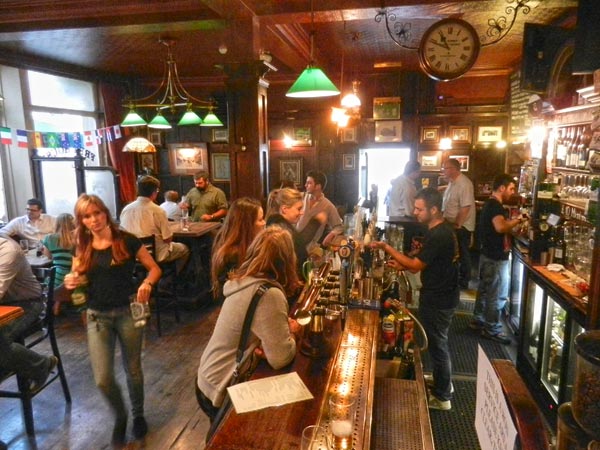
The Anglesea Arms Pub is everything a British pub should be, in my mind. Musty paintings and old-timers, beautiful people backlit, dogs wearing Union Jack vests, a long line of tempting tap handles advertising beers available, and flower boxes spilling color around picnic tables perfect for a warm summer evening. That’s why I recommend the Anglesea Arms in my London guidebook.


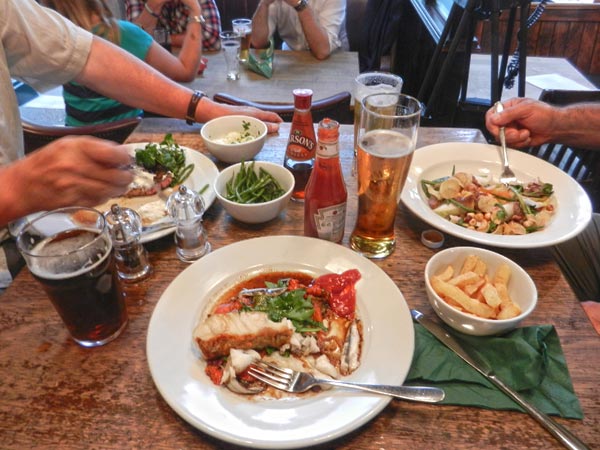
And for me, eating in a pub that takes its cooking seriously is the best deal in town. For £15 (just under $25), you get a delightful meal. When you consider the high cost of dining in London, the joy of immersing yourself in a neighborhood pub, and the quality of this dinner, this is a great value.

To top it off, we filmed an on-camera for our Travel Skills Special here. After a pint of beer, I was thankful I remembered my lines. Looking up from my meal and into the lens, I drilled home my point: “Unification does not threaten Europe’s diversity. In fact, that diversity is both as vivid as ever, and more accessible. Imagine: Today for lunch, it was quiche and fine French wine under the Eiffel Tower; for dinner, it’s pub grub and a hearty ale in a classic London pub. Here’s to diversity.”

Bulleting Under the English Channel

I still get excited about the Eurostar train trip from Paris through the English Channel Tunnel (a.k.a. “Chunnel”) to London. But the routine at the station has become, well, routine: Show your ticket and passport. Wait in a lounge until it’s time to board. Cross over the tracks on a secure sky bridge to a secure platform where your bullet train awaits, and follow the crowds as security officials make sure everyone gets on the right car. Within minutes, you’re zipping at 180 mph across the French countryside. Now that the new tracks are complete on the English side, you go just as fast there — and within about 2.5 hours, you’re in London.

When the tracks parallel the highway, we pass cars like they’re standing still (the train is going 100 mph faster than the speeding cars). When the attendant offers wine, it isn’t the cheap stuff they serve on American airlines — it’s a fine French Médoc.

And then, suddenly, there’s darkness for 20 minutes. Whenever I ride my bullet train down through the tunnel deep below the English Channel, playful thoughts fill my head.

If you can’t see the video below, watch it on YouTube.

To Celebrate Our Pocket Guides, I’m Sharing Some Tips on Rome, Paris, and London

My publisher tells us that our new Pocket Guides to London, Paris, and Rome are doing great–not cannibalizing sales of our full-size guidebooks to those cities but getting in on the thriving market for smaller, more colorful, and more portable “best of” and “top ten” guidebooks. To celebrate their success, here’s a fun Q&A for people anticipating trips to my three favorite big cities in Europe:

Best photo op in each city?
Rome: The old ladies on their folding chairs as they hang out in the Jewish Quarter; rays of sunlight cutting through St. Peter’s Basilica; the scene on Via del Corso in the early evening when it’s closed to traffic, and the community is out for the passeggiata.
Paris: The city from top of Montparnasse Tower (you don’t have to look at the Montparnasse Tower); the neighborhood action on a street like rue Montorgueil; the honey-colored tones of freshly baked bread and pastries at just about any corner bakery.
London: Different angles on the Millennium Bridge; the pageantry during the Changing of the Guard at Buckingham Palace; Big Ben and the Houses of Parliament from the top of the London Eye.

Best free yet enriching experience in each town?
Rome: Going to a late Mass at St. Peter’s Basilica (most days at 5 p.m.); being all alone in the Pantheon very early or very late; exploring the back streets of Trastevere.
Paris: Being in the organ loft at St. Sulpice Church as Daniel Roth plays a short concert between Masses on Sunday; sitting on the steps of Sacré-Cœur in Montmartre as darkness settles on the City of Light.
London: Enjoying the many wonderful and free galleries and museums–especially the British Museum and the British Library; taking in Speakers’ Corner at Hyde Park on Sunday; viewing the legal action in the Old Bailey courtrooms.

Favorite single museum and why in each town?
Rome: The Borghese Gallery–It must be the most sumptuous palace in Italy even without its many Bernini masterpieces, including my favorite statue anywhere, Apollo and Daphne.
Paris: The Louvre–It shows off the greatest collection of art in Europe in what was its biggest palace.
London: The British Museum–It’s the chronicle of our Western civilization.

What guilty pleasure do you indulge in each city?
Rome: Staying in the decadent Hotel Nazionale and dining at my favorite restaurant, Il Gabriello.
Paris: Pigging out on macarons at Ladurée on the Champs-Elysees.
London: Riding in the big black taxis just to talk with the cabbies; wandering through the parks, browsing from obscure monument to obscure monument, while people watching.

Biggest mistake time-strapped travelers make in each city, and how to avoid it?
Rome: Going to sights like St. Peter’s and the Colosseum when there is a long line. Rather than waiting an hour to get in, you can be all alone at the greatest church in Christendom if you simply go early or late. And the line for the Colosseum is actually a line to buy a ticket, which is a combo-ticket that includes the neighboring Palatine Hill. Simply pick up your ticket at the Palatine Hill entrance a short walk away, and stroll right past the long line waiting for tickets at the Colosseum.
Paris: Waiting in long lines for the Louvre, Orsay Museum, Sainte-Chapelle, and Versailles. All can be avoided simply by purchasing the Paris Museum Pass (sold at any city museum).
London: Going to a play when you’re suffering from jet lag–that’s one expensive nap. That’s why, if I’m touring England, I go from the airport directly to Bath (a relaxing, smaller town) to get over jet lag. I finish my tour in London when I’m fully adjusted to local time. And that way, nothing will be anticlimactic since I end up in exciting London. It’s the best finale for a trip around Britain.

Cooking Up a Cumbrian Fry, B&B Style

I’m staying with Val and David Fisher, who run Howe Keld, my favorite B&B in Keswick — the best home-base town for exploring the Cumbrian Lake District in northern England. It occurred to me that a great B&B is great only when it’s run by hands-on owners…and there’s a lot of work they have to do behind the scenes. I surprised Val and David with my little camera during their busy time in the kitchen so that you can have a Back Door look at how the traditional Cumbrian Fry (breakfast) is cooked up. This hearty meal came in handy as the sun started to shine, kicking off a fabulous day of filming. We finished our TV show with all the sunny glory we had been waiting — and praying — for.

If you can’t see the video below, watch it on YouTube.