Aerø: Everything’s so…Danish

Enlarge photo

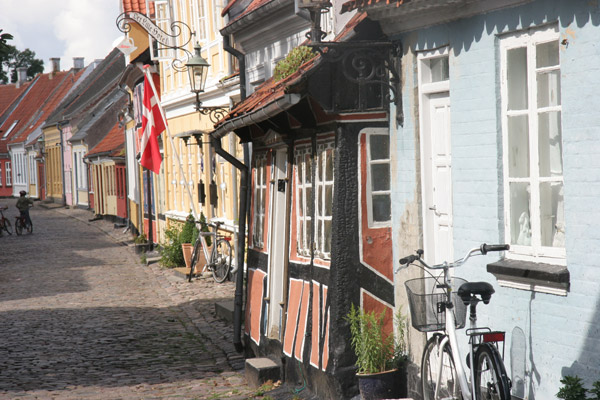
To commemorate the Smithsonian Presents Travels with Rick Steves magazine — now on sale online, and at newsstands nationwide — Rick is blogging about the 20 top destinations featured in that issue. One of those destinations is the Danish isle of Aerø.

While big cities often mask the distinctive features of a nation, I find the rural corners and small towns give a better insight into what makes a particular culture unique. A strong social ethic permeates Danish society, and you really feel that on the quiet and sleepy little isle of Aerø.

On Aerø, you’re welcome to pick berries and nuts, but historically the limit has been “no more than would fit in your hat.” For years I’ve been recommending Mrs. Hansen’s bike-rental depot next to the gas station at the edge of town. Recently, a big hotel in town (with far more economic clout) decided to rent bikes, too. I saw Danish communalism in the reaction of a local friend of mine: “They don’t need to do that — that’s Mrs. Hansen’s livelihood.” Of course, there’s no law forbidding it, and with our social ethic, we’d just say competition is good. But in Denmark, to look out for Mrs. Hansen’s little bike-rental business was a matter of neighborly decency.

I love to rent a bike from Mrs. Hansen and pedal into the idyllic Danish countryside, where I find myself saying “cute” more than I should. When in the Netherlands, I have a running joke with my guide friends. We say, “Everything’s so…Dutch.” Now, in Denmark, I say, “Everything’s so…Danish.”

Denmark is, simply, cute. Travelers here find the human scale and orderliness of Danish society itself the focus of their “sightseeing.” The place feels like a pitch ‘n putt course sparsely inhabited by blonde Vulcans. And survey after survey finds the Danes the most content and happy people on the planet.

Europeans Share Their Health Care Experience, Part 1: Scandinavia

To bring some diverse experience into the discussion on health care reform here in the USA, I’ve asked my friends in Europe to share how health care works in their lives. In this four-part series, we’ll start with the most highly taxed and socialistic part of Europe: Scandinavia.

From Hakan in Sweden:

In Sweden, we have free choice in health care. It means that patients can choose a hospital anywhere in the country.

In 2005, the cost of the health and medical care sector amounted to 8.4 percent of GDP (in the US, it was over 15 percent). This amount includes the cost of pharmaceutical products, dental care, eyeglasses, and patient fees paid by households.

We employ a “high-cost protection scheme” that means that no patient ever needs to pay more than a total of 900 SEK (about $125) over a 12-month period. For pharmaceutical costs, no patient has to pay more than SEK 1,800 (about $250) over a 12-month period for prescription drugs. This way, no citizen will be put into poverty because of health problems.

The fee for visiting a doctor or hospital varies from 100-300 SEK (about $14-32), but once you have paid 900 SEK in a 12-month period, the rest of the care is totally free — no matter what kind of treatment you need. Private-care providers are also “clients” of the government. A patient can choose a private doctor or hospital, pay the small fee, and the government pays the difference.

The health and medical services have an obligation to strengthen the situation of the patient, for example, by providing individually tailored information, freedom to choose between treatment options, and the right to a second opinion in cases of life-threatening or other particularly serious diseases or injuries.

Having lived here all my life and raised my family here in Stockholm, I honestly do not see anything bad with our health care system.

From Richard in Demark:

I have lived and worked in Denmark for 24 years and have had numerous encounters with the health care system. In all cases I was satisfied or impressed with the quality of service and the low cost (apart from the tax system — more about that later).

The health care system in Denmark is free to all who live here. Even visiting tourists will be treated free of charge in case of an emergency. A non-Danish friend of mine who sprained her ankle during a recent visit was X-rayed, bandaged, treated by a doctor, and even given a pair of crutches to use — and was not charged anything. She was only asked to return the crutches when she left Denmark.

The quality of Danish health care — which is not run on a profit motive — is very good, though there is a waiting time for some non-life-threatening operations like a hip replacement. But everyone will eventually get the operation they need. Hospitals are free, doctor visits are free, and medicine is highly subsidized so that those who need a lot of medicine get it at a greatly reduced charge. Dentistry is subsidized.

This is paid for through our tax system, which — at 52 percent — is perhaps the highest in the world. None of the 10 political parties in Denmark has ever wanted to change that, because they know that they would not get any votes. The vast majority of Danes are agreeable to pay these high taxes; they know that they get about 50 percent of the money back each year in a vast array of benefits. Seven out of 10 Danes are willing to pay even more taxes, if necessary, to maintain the health care system we expect.

Danes have the mature and realistic understanding that you cannot give everyone a quality health care system, good schools, and the elements that help to make for a good quality of life, without paying for it. Freedom does not mean not paying taxes. For us, freedom is paying taxes. By taking care of each other, and the weaker elements in our society, we all have a better quality of life with very low crime rates, few prisons, and a sense of security that it is not “me against the world.” That is part of what it means to be Danish.

From Hanne and Trond in Norway:

In Norway, everyone has, in principle, equal rights to health care. Norwegian hospitals are “free” for patients (being financed with taxes) and everyone is entitled to treatment, irrespective of income and insurance. However, many things are not always working well here.

When hospitalized, no one asks for insurance coverage. You can stay for as long as it takes without having to worry about costs. At the hospital, every part of the treatment is free, indefinitely. At home, people with chronic illnesses get medicine and necessary medical equipment almost for free, save for a limited, annual base payment.

But some parts of the system don’t function well. Depending on the illness, you could wait a long time for necessary hospital treatment (typically non-emergency surgery). For instance, you have to go through your family doctor in order to be referred to a specialist. When the family doctors have way too many patients and limited opening hours (and limited telephone hours!), this is often an obstacle. Of course, any emergency treatment is exempt from “queuing.”

As for the cost, the hospitals operate with a combined budget of approximately NOK 75 billion ($13 billion). Our health care is not free — we pay for it in our taxes: Our corporations pay a flat tax rate of 28 percent on their profits. Wage income is taxed under a progressive structure, from almost zero (very low, part-time wages) to a maximum marginal tax rate of 54 percent. The average “industrial worker” has a tax rate of 30 to 35 percent.
Warrior Pigeons and Savage Mushrooms

A few more “leftovers” from my recent trip:

While traveling on business — especially while filming — I have the time figured out very carefully and always have necessary reservations to keep things moving smoothly. In Denmark, leaving the Isle of Ærø early one morning as we began a demanding day of filming — and proud of my ability to read the sign — I directed us into a line for the ferry that said “reservation.” I felt smart…until all the other lines emptied into the ferry and I realized I put us in the “no reservations” line. We nearly didn’t get onto the boat.

A couple days later, I left Denmark with a 20-kroner coin in my pocket — worth about $4. It occurred to me that I couldn’t think of a nation that had a smaller “biggest coin” than the USA. (Europe’s 2 euro coin is worth over $3. Canada has a $2 coin.) What does it say about a nation that can’t get used to a coin worth more than 25 cents? We’ve tried 50-cent and one-dollar coins, but they just don’t work. (Now, don’t think this comment is anti-American…it’s an innocent question, neither pro- nor anti-USA.)

In Denmark, things are so costly that it seemed people consume more sparingly. The society is designed in a way that encourages people to consume less, chew slower, and just sip it. A glass of beer costs $10. A cup of coffee can cost $7 — and refills are unheard of. I think they know they could make more money if they embraced the “Big Gulp” track and started super-sizing things. But the collective decision is not based on what’s good for the economy. A Costco economy is just not Danish.

Susanna, who runs a gorgeous little B&B on the Isle of Ærø, hosts lots of travelers from both my guidebooks and my Scandinavia tours. She observed that nearly 100 percent of those with my guidebook are Democrats, while those taking my tours are half Democrats and half Republicans. Hmmmm.

While beer costs a fortune in Denmark, it’s half the price and twice as good in Belgium. Good beer has been a theme of mine in Belgium. Everywhere else, it seems you order what’s on tap for the best local brew. Here, the experts remind me that because there is such a vast selection of beloved specialty beers, there is not enough quantity consumed of any single brew to keep kegs from going old and stale. Therefore, the connoisseurs prefer their beer in the bottle.

Wandering around Brussels, I found a monument to “Au Pigeon Soldat WWI” at the end of St. Catherine’s Market. Imagine, honoring the men who cared for the pigeons that played an important role in a world war.

One evening I ordered wild mushrooms because of their evocative name in French: champignons sauvages.

Denmark: A Pitch ‘n Putt Course Sparsely Inhabited by Vulcans

I’ve been in Denmark filming for a week now. When in the Netherlands, I have a running joke with Simon (my TV director). We say, “Everything’s so…Dutch.” Now, in Denmark, we say, “Everything’s so…Danish.” While our Copenhagen show is featuring a thriving metropolis, our Danish Countryside show features cuteness.

Danes enjoying the trendy new part of Aarhus (where a once-paved-over river is now revealed and lined by popular eateries).
Enlarge photo

And Denmark is, simply, cute — cute, cute, cute. The place feels like a pitch ‘n putt course sparsely inhabited by blonde Vulcans. Poll after poll lists them as the most content and happy people on the planet. And it’s flat. Going over a huge suspension bridge and enjoying a vast territorial view, I realized how rare it is to get a “high wide” shot of the countryside. The place is so flat that we’ve been climbing silos and pulling over on the crests of bridges to get the best “high wide.”

We were at the local Disneyland: Legoland, a wildly popular place featuring 58 million Lego bricks built into famous landmarks from around the world. (They claim if you lined them all up, they’d stretch from here to Italy.) The place was crawling with adorable little ice-cream-liking, blonde children. Even with piles of sugar, it was so mellow. Kids were holding their mothers’ hands learning about the Lego buildings, or smiling contentedly as they whipped around on the carousel.

In the middle of the countryside, the newly paved roads are lined by perfectly smooth bike lanes — one for each direction. Even in the countryside, there are more bikes than cars. No one’s uptight. We got in a little traffic jam — everyone takes it in stride. Damn those Danes.

I’ve been wondering how the Danes pull it off. I think their success relates to the free rider problem and the social contract. I don’t think many Americans can conceptualize the “free rider problem.” Basically: If I do it, I can get away with it; but if everyone does it, the system will collapse. So when deciding how to act, Danes take into consideration what would happen to their society if everyone cheated on this, sued someone for that, took advantage of that technicality, freeloaded here, or ignored that rule there.

Europeans trade off individual-ism for social-ism. The Danes seem to take it to an extreme. I don’t know how well I’d fit in here, to be honest. But I am so intrigued. Danes are famous for not jaywalking. At 3 a.m., they still stop for a red light. When I jaywalk elsewhere, I do so thinking people will appreciate my lead and follow me. When I jaywalk here, Danes look at me like I’m a bad influence on the children present.

People laugh politely when I ask if they speak English, responding, “Of course I do.” Conversation flows easy. Here are a few comments I’ve heard this week:

“In Denmark, you have to work quite hard to find a crack to fall through. A few people with alcohol problems manage to be homeless. Yes, we are the most contented people. We pay, on average, 50 percent taxes — yes, worker or big shot, we pay about 50 percent. Of course, we get lots for that. We’ve had national healthcare since the 1930s. We know nothing else. If I don’t like the shape of my nose, I pay to fix that. But all else is taken care of. All education is free. And university students get $800 a month for living expenses for up to six years. When there is a student demonstration, it’s generally for more pocket money. We Danes believe a family’s economic status should have nothing to do with the quality of the healthcare or the education their children receive. I believe in the US, you pay triple per person what we pay as a society for healthcare. Your system may be better for business…but not better for service. Essentially, we already have the euro — it’s just divided not into 100 cents, but into 7.5 crowns. The Danish kroneris fixed to the Euro at that rate.”

When I saw the tombstone store with Tak for Alt (“Thanks for Everything”) pre-carved into the stones, I figured it was a message from the dead one after a very blessed life in Denmark (like “That’s all, folks”). But I learned today that it’s a message from those bidding their loved one farewell (like “rest in peace”). Still, I think when a Dane dies, they (more than their loved ones) should say, “Tak for Alt.”

Shrimps on the Barbie…We Must Be in Denmark

I’ve been trying to analyze why I enjoy traveling so much. All I do is work all day long, every day, and it brings me pure joy.

The isle of Aero welcomes visitors with a special Danish cuteness.
Enlarge photo

Just last night with our camera crew, I was sitting on the beach on a remote Danish isle digging into a grand picnic as the sun was sinking heavy and red into the…whatever Danish sea was out there. It was like an hourglass — unstoppable, dictating when we would be done filming. We set about shooting a great bit, and getting the open of the show at the same time.

A charming family who happened to be German (but looked Danish enough) joined us with their terrier named “Jackson.” I couldn’t stop singing the classic Nancy Sinatra/Lee Hazelwood song. Jorgen Otto, the lord mayor of the island — a wiry former headmaster of the local school, and clearly charismatic enough to be a popular small-town politician — was sitting cross-legged with us, strumming his guitar and teaching us a Danish shanty about a sinking ship in which all the sailors survived and made it home to their beloved. The picnic was all spread out, and shrimp and wieners were sizzling on the hibachi. And the tiny beach shacks behind us were looking so Danishly cute. It was perfect.

After popping another shrimp into Jackson’s eager and hairy trap, which made us all laugh, I looked into the camera, and said (with a vaguely Australian accent), “Hi, I’m Rick Steves, back with more of the best of Europe. This time we’re on the beach, got a good cold beer, and the shrimp’s on the barbie. It must be the best of…Denmark. Thanks for joining us.”

The beach was filled with Germans vacationers — whose grandfathers had invaded this place. We had just biked down from a thousand-year-old mystical burial site — a stone-lined mound the shape of a Viking ship. It sat upon a five-thousand-year-old burial chamber. Next to it was a village church with a list of pastors going back 500 years. The current pastor, Agnus, was the first woman on the list. At the rear of the nave, as if his hand were on the theological rudder, a painting showed Martin Luther standing strong with his hand on the Bible. All this history added poignancy to the experience.

I feel charmed to be turned on by all this. When I wonder why, it comes back to my studies. I got my history degree accidently. Because I had traveled, taking history classes was simply fun. One morning in the UW dormitory, I woke up, realized I had already taken seven classes, and it hit me: “Three more classes, and I’ll have my degree — and bam, I’m a historian.”

Since then, I’ve spent a third of my life exploring Europe — enjoying “continued education” with a curriculum I’ve tailored specifically for myself. And I marvel at how my travels stoke my interest in history, and the fun my interest in history brings.

Just this summer, I’ve enjoyed finding out why 7,000 Danes volunteered to fight with the Nazis against the USSR; tried to get my head around the possibility that the Vikings’ rape, pillage, and plunder image may be a bad rap (while in York, the capital of Viking England a thousand years ago); and heard stories of that monk in the Champagne region of France who double-fermented his wine, invented something new and bubbly, and ran famously down the halls of his monastery, shouting, “Brothers, come quickly, I’m drinking stars!” And, just today, here on the Danish Isle of Ærø, I learned how its “duty-free age” age as a smuggling capital on the border between Germany and Denmark created the lovely collection of captains’ homes I’ve been ogling all afternoon.

And eating my way through Europe this summer has also reminded me how understanding “food patriotism” in different corners brings out fun and fascinating facets of my favorite continent. In Scotland, I learned locals are passionate about finding and describing the whisky that fits their personality. Each guy in the pub has “his” whisky. And the descriptors (fruity, peppery, peaty, smoky) are much easier to actually taste than their wine-snob equivalents.

In Greece, I got a good, strong dose of how olive oil and national pride mix. Locals are outraged at Greek olive oil being bottled and sold as “extra virgin Italian oil,” and are determined to elevate the image of Greek olive oil so growers won’t take a hit by selling it to Greek oil companies.

And, this week in Denmark, I learn that pickled herring is almost a religion for many Danes. My friend, a local guide here, claims to eat it every morning for breakfast and three times a week for lunch.

In a few days, I fly to Istanbul — where I get to refine my appreciation for baklava again. (I get it tuned up as often as possible.)

What’s the point? When you travel, you find the enthusiasm of locals for their national dishes rubs off on you…and you fly home with more favorite foods. Travel makes life simply more tasty, and history more poignant.