Daily Dose of Europe: Copenhagen’s Christiania — No Cars, Corporations, or Dead Fish

When traveling in Europe, I love the great art, the delicious food, and the beautiful scenery. But I also appreciate getting a glimpse into other societies that embrace different ways of doing things. One of my favorite examples of that is a squatters’ commune tucked amid a tidy little corner of Copenhagen: Christiania.

Even though we’re not visiting Europe right now, I believe a daily dose of travel dreaming can be good medicine. I just published a collection of my favorite stories from a lifetime of European travels. My new book is called “For the Love of Europe” — and this story is just one of its 100 travel tales.

I’m strolling through the commotion of downtown Copenhagen, past chain restaurants dressed up to look old, and under towering hotels that seem to be part of a different international chain each year. Then, as if from another age, a man pedals by with his wife on a “Christiania Bike” — two wheels pushing a big utilitarian rounded bucket. You’d call them “granola” in the US. They look as out of place here in Copenhagen as an Amish couple in Manhattan.

I pause to watch the parade that follows them: ragtag soldiers-against-conformity dressed in black making their way through the bustling, modern downtown. They walk solemnly behind a WWII vintage truck blasting Pink Floyd’s “Another Brick in The Wall.” I’ve never really listened to the words until now. These “soldiers” are fighting a rising tide of conformity. They want to raise their children to be free spirits, not cogs. Painted onto their banner — an old sheet — is a slogan you see in their Christiania squatter community: “Lev livet kunstnerisk! Kun døde fisk flyder med strømmen.” (“Live life artistically! Only dead fish swim with the current.”) They fly the Christiania flag: an orange background with three yellow dots for the three “i”s in “Christiania” (or, some claim, for the “o”s in “Love Love Love”).

In 1971, the original 700 Christianians established squatters’ rights in an abandoned military barracks, just a 10-minute walk from the Danish parliament building. Half a century later, this “free city” still stands — a human mishmash of idealists, hippies, potheads, non-materialists, and free-spirited children.

The population includes 900 people, 200 cats, 200 dogs, 17 horses, and 2 parrots. Over 100 of the original squatters, seniors with Willie Nelson’s fashion sense, still live here. When someone moves out, the community decides who will be invited in to replace that person. Most residents are employed: A third of the adult population works on the outside, a third works on the inside, and a third doesn’t work much at all.

Christiania sprawls just behind the spiral tower of Our Savior’s Church in the trendy district of Christianshavn. Welcoming visitors and even offering daily tours in summer, it’s become the second-most-visited sightseeing stop in Copenhagen (move over, Little Mermaid). Tourists react in very different ways to this place. Some see a haven of peace and freedom. Others see dogs, dirt, and dazed people. Some see no taboos. Others see too many tattoos.

Entering the community, I pass under the sign announcing that I am leaving the European Union. The main drag is nicknamed “Pusher Street” for the marijuana-selling stands that line it. (Residents preemptively destroyed the stalls in 2004 to reduce the risk of Christiania being disbanded by the government, but that didn’t last.) While the laws here are always in flux, I notice the small, sweet-smelling stretch of Pusher Street, dubbed the “Green Light District,” where pot is openly sold, is back. Signs, while acknowledging that this activity is still illegal, announce: “1. Have fun; 2. No photos; and 3. No running — because it makes people nervous.”

As I walk down Pusher Street, I see Nemoland, a kind of food circus. At the end of the street, a huge warehouse called Den Grønne Hal (“The Green Hall”) does triple-duty as a recycling center, a craft center for kids, and an evening concert hall. Behind it, climbable ramparts overlook an idyllic lake and a forest that’s dotted with cozy if ramshackle cottages.

From Den Grønne Hal, a lane leads to a pleasant café, and beyond that, to the Morgenstedet vegetarian restaurant — a great place for a simple, friendly meal. A former barracks near the entrance of Chris­tiania now houses Spiseloppen, a classy restaurant serving up gourmet anarchy by candlelight. Away from Pusher Street, I find myself lost in truly untouristed, residential Christiania, where the old folks sit out on the front stoop watching kids chasing ducks and flying with delight down homemade ziplines.

The free community has nine rules: no cars, no hard drugs, no guns, no explosives, and so on. While exploring this idealistic world, I realize that, except for the bottled beer being sold, there’s not a hint of any corporate entity. Everything is handmade. Nothing is packaged. That rejection of corporate values is part of what makes this community’s survival so tenuous.

Christiania has long faced government attempts to shut the place down. Back when real estate was much cheaper in Copenhagen, city officials looked the other way. But as the surrounding neighborhood gentrified, developers began eyeing the land Christiania’s hippies were squatting on. A certain intense breed of capitalist has a tough time allowing something that could be privatized and profitable stay public. The people of Christiania have learned to live with uncertainty.

Recently, I received an email from some readers who’d visited. They said: “We’re not prudes, but Christiania was creepy. It was too much for our family. Don’t take kids there or go after dark.” I agree that a free city is not always pretty. But perhaps those parents were as threatened as much by Christiania’s non-materialism as they were by its grittiness. Watching parents raise their children with Christiania values, I’ve come to believe very strongly in this social experiment. Certainly our world, so driven by aggressive corporate and materialist values, can afford to let people with alternative viewpoints have a place to be alternative. Christiania is a social flower that deserves a chance to bloom.

This story appears in my newest book, For the Love of Europe — collecting 100 of my favorite memories from a lifetime of European travel. Please support local businesses in your community by picking up a copy from your favorite bookstore, or you can purchase it at my online Travel Store. You can also find a clip related to this story at Rick Steves Classroom Europe; just search for Copenhagen Contrasts.

Daily Dose of Europe: Ærø — Denmark’s Ship-in-a-Bottle Island 

Sometimes you just need to escape. And the adorable Danish island of Ærø is the perfect place for just that.

Europe is effectively off-limits to American travelers for the time being. But travel dreams are immune to any virus. And, while many of us are stuck at home, I believe a daily dose of travel dreaming can actually be good medicine. Here’s another one of my favorite travel memories — a reminder of what’s waiting for you in Europe at the other end of this crisis.

Few visitors to Scandinavia even notice Ærø, a sleepy little island on the southern edge of Denmark. It’s a peaceful and homey isle, where baskets of strawberries sit in front of farmhouses — for sale on the honor system. Its tombstones are carved with such sentiments as: “Here lies Christian Hansen at anchor with his wife. He’ll not weigh until he stands before God.”

The island’s statistics: 22 miles by 6 miles, 7,000 residents, 350 deer, no crosswalks, seven pastors, three police officers, and a pervasive passion for the environment. Along with sleek modern windmills hard at work, Ærø has one of the world’s largest solar power plants.

Ærø’s main town, Ærøskøbing, makes a fine home base for exploring the isle. Many Danes agree, washing up on the cobbled main drag in waves with the landing of each ferry.

With lanes right out of the 1680s, the town was the wealthy home port to more than 100 windjammers. The post office dates to 1749 and cast-iron gaslights still shine each evening. Windjammers gone, the harbor now caters to German and Danish holiday yachts. On midnight low tides, you can almost hear the crabs playing cards.

The town’s sights, while humble, are endearing. The Hammerich House, full of old junk, is a 1920s garage sale of a museum. Around the corner, the Bottle Peter Museum is a fascinating house with a fleet of more than 750 different bottled ships. Old Peter Jacobsen devoted a lifetime to his miniature shipyard before he died in 1960 (probably buried in a glass bottle). Squinting and marveling at his enthralling little creations, it occurs to me that Ærø itself is a ship-in-a-bottle kind of place.

Taking a 15-mile bike ride, I piece together the best of Ærø’s salty charms. Just outside of town, I see the first of many U-shaped farmhouses, so typical of Denmark. The three sides block the wind to create a sheltered little courtyard and house cows, hay, and people. I bike along a dike built in the 1800s to make swampland farmable. While the weak soil is good for hay and little else, they get the most out of it. Each winter farmers flood their land to let the saltwater nourish the soil and grass, in the belief that this causes their cows to produce fattier milk and meat.

Struggling uphill, I reach the island’s 2,700-inch-high summit. It’s a “peak” called Synneshøj, pronounced “Seems High” (and after this pedal, I agree).

Rolling through the town of Bregninge, I notice how it lies in a gully. I imagine pirates, centuries ago, trolling along the coast looking for church spires marking unfortified villages. Ærø’s 16 villages are built low, in gullies like this one, to make them invisible from the sea — their stubby church spires carefully designed not to be viewable from potentially threatening ships.

A lane leads me downhill, dead-ending at a rugged bluff called Vodrup Klint. If I were a pagan, I’d worship here — the sea, the wind, and the chilling view. The land steps in sloppy slabs down to the sea. The giant terraces are a clear reminder that when saturated with water, the massive slabs of clay that make up the land here get slick, and entire chunks can slip and slide.

While the wind at the top seems hell-bent on blowing me off my bike, the beach below is peaceful, ideal for sunbathing. I can’t see Germany, which is just across the water, but I do see a big stone which commemorates the return of the island to Denmark from Germany in 1750.

Back up on the road, I pedal down a tree-lined lane toward a fine 12th-century church. As they often do all over Europe, this church marks a pre-Christian holy site. In a field adjacent to the church stands theLangdyssen Tingstedet — a 6,000-year-old dolmen, an early Neolithic burial place. While Ærø once had more than 200 of these prehistoric tombs, only 13 survive.

The name “Tingstedet” indicates that this was also a Viking assembly spot. This raised mound, roughly the shape and length of a Viking ship, evokes the scene when chiefs gathered here around their ancestors’ tombs a thousand years ago. The stones were considered fertility stones. For centuries, locals in need of a little extra virility chipped off bits and took them home.

I enter the church. Like town churches throughout the island, a centuries-old paint job gives the simple stonework a crude outline of the fine Gothic features this humble community wished it could afford. Little ships hang in the nave, perhaps as memorials to lost sailors. A portrait of Martin Luther hangs in the stern, making sure everything’s theologically shipshape. The long list adjacent allows today’s pastor to trace her pastoral lineage back to Dr. Luther himself. The current pastor, Janet, is the first woman on the five-centuries-long list. A pole with an offering bag comes equipped with a ting-a-ling bell to wake those nodding off.

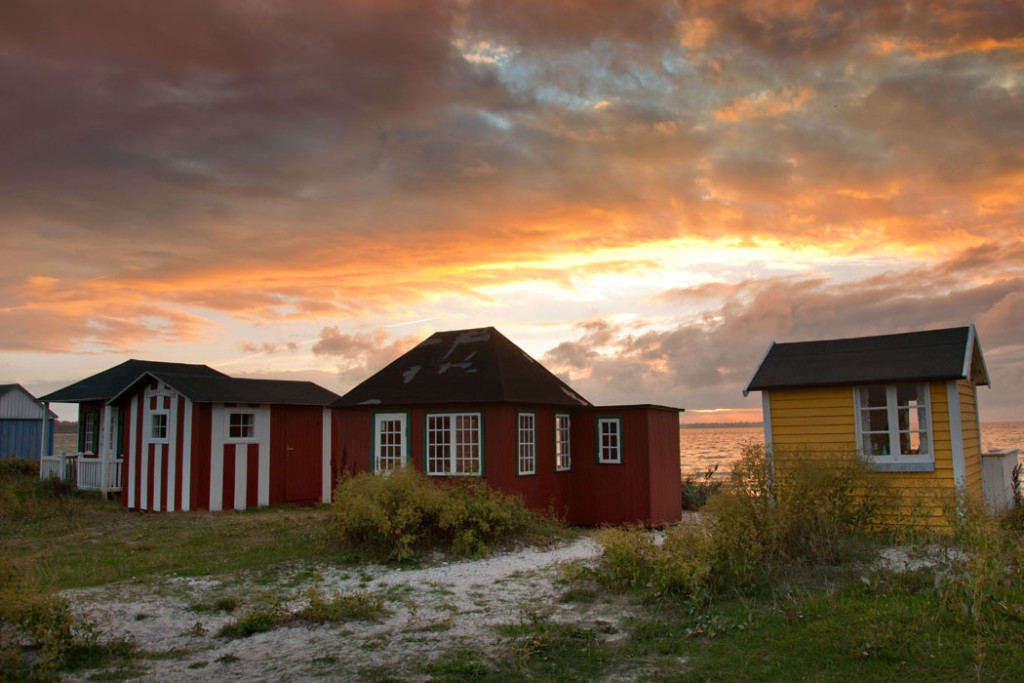
From the church, it’s all downhill back to Ærøskøbing. The sun is low in the sky, so I coast right on through town to the sunset beach — where a row of tiny huts lines the strand and where so many locals enjoyed a first kiss. The huts are little more than a picnic table with walls and a roof, but each is lovingly painted and carved — stained with generations of family fun, memories of pickled herring on rye bread, and sunsets. It’s a perfectly Danish scene — like Ærø itself — where small is beautiful, sustainability is just common sense, and a favorite local word, hyggelig, takes “cozy” to delightful extremes.

(These daily stories are excerpted from my upcoming book,  For the Love of Europe — collecting  100  of my favorite memories from a lifetime of European travel, coming out in July.  It’s available for pre-order. And you can also watch a video clip related to this story: Just visit Rick Steves Classroom Europe and search for Ærø.)

Sunsets on the Road: My Top Ten

I love sunsets. They can be a vivid and romantic capper for a beautiful day on the road. Here are a few dramatic and memorable sunsets that come to mind:

1. On the Greek isle of Santorini, nursing a drink with a single flower in a vase on my table, as I sit on the lip of the crater high above the glittering Aegean Sea.

2. On the Nile, just across from Luxor, as the sun sets, the temperature drops, and villages come alive. As I’m poled along the shore in a classic felucca boat, children frolic, long-legged birds strike a pose, and I glide like a silent voyeur through the reeds.

3. On Denmark’s Aerø Island, warming myself by a beach fire while children splash in the shallow waters of the bay, and parents sit peacefully on the porches of tiny beach cabins.

Ærøskøbing homes

The sun sets on Denmark’s Aerø Island. (Photo: Dominic Arizona Bonuccelli)

4. In Granada, Spain, joining the “Gypsies and hippies” at the St. Nicholas viewpoint as the setting sun makes the Alhambra glow red, evoking the tumult of its violent history.

5. On a ferry charging across the Greek sea, with dolphins — who seem to come out for the sunset — playfully loping ahead of the ship’s bow.

6. In England’s Cumbrian Lake District, sitting pensively on a stone at the Castlerigg Stone Circle just outside of Keswick, savoring a moment which inspires anyone to poetry…especially as sheep stir up the fragrance of the wild grass and the scent comes with a whiff of mystical druids, who once used these stones for their worship, dancing in the long shadows.

7. In Paris, sitting on the steps of the Sacré-Cœur atop Montmartre, surrounded by backpackers, buskers, and local lovers as Paris spreads out before me and slowly the sky grows dark and the City of Light is turned on.

8. On a Norwegian fjord, taking my dessert of ice cream and fresh berries out of my hotel’s dining room and sitting along at the end of the pier. The water is glassy and frightfully deep, black rock cliffs rocket into the sky above me, and the sun dips too early behind the peaks.

9. In Assisi, on the rampart of a ruined castle, with olive groves at my feet leading to a vast and lush Umbrian vista; imagining the age when each town was its own little state, and enjoying the same birdsong that inspired St. Francis.

10. And my favorite sunset: from my deck back home, on the Puget Sound just north of Seattle, as a golden path of sparkles leads across the bay to snowcapped Olympics. The sun settles behind the latest in a series of chosen peaks, and the ferries ply silently across as the water begins to glow like floating lanterns.

What is your favorite sunset far from home?

Europe’s Mightiest Bridge, Connecting Denmark and Sweden

Part of the fun of traveling in Europe is using massive and inspiring infrastructure — like this bridge that connects Denmark and Sweden. In this clip, my train is in an erector set-type tunnel under an-eight lane highway crossing the Øresund Bridge. Behind me is Copenhagen (not Stockholm, as I say), and up ahead is Malmö, Sweden.

What are your favorite “infrastructure” experiences?