Daily Dose of Europe: Van Eyck’s “Arnolfini Wedding”

Sometimes dubbed “The Shotgun Wedding” (for the bride’s seemingly pregnant state), this painting depicts a well-heeled Italian businessman and his wife in their upscale apartment in the cosmopolitan city of Bruges, Belgium.

As America continues to suffer crisis upon crisis, it has never been more important to broaden our perspectives and learn about the people and places that shape our world. And for me, one of the great joys of travel is seeing art masterpieces in person. Learning the stories behind great art can shed new light on our lives today. Here’s one of my favorites.

The painting is likely a wedding portrait. Jan Van Eyck (c. 1390–1441) meticulously paints the couple’s rich trappings: their brass chandelier, Oriental carpet, canopied bed, and imported oranges on the windowsill. He highlights their incredibly expensive clothes — made of luxurious fabrics, with rich colors, and trimmed with rare fur. No wonder. Giovanni Arnolfini was a cloth merchant, living in the city that was Europe’s main producer and exporter of high-fashion couture.

The realism is astonishing. It’s a masterpiece of down-to-earth details. Van Eyck has built a virtual dollhouse, inviting us to linger over the furnishings. Feel the texture of the fabrics, count the hairs of the couple’s terrier, trace the shadows generated by the window. Each object is painted at an ideal angle, with the details you’d see if you were standing right next to it. The string of beads hanging on the back wall are as crystal clear as Mrs. Arnolfini’s bracelets.

To top it off, look into the round mirror on the far wall — the whole scene is reflected backward in miniature, showing the loving couple and a pair of mysterious visitors. Is one of them Van Eyck himself at his easel? Has the artist painted you, the home viewer, into the scene?

This seemingly simple picture was groundbreaking in the world of art. It’s (arguably) the first modern oil painting, made by dissolving pigments in vegetable oil, rather than tempera (which uses egg yolk). Van Eyck could lay down, say, a patch of brown, then apply a second layer of translucent orange, then another. The colors bleed through to create the figure — like the Arnolfinis’ meticulously detailed terrier.

This portrait of a Bruges power couple is one of history’s first paintings that wasn’t of a saint, king, pope, or miraculous event. Van Eyck was glorifying ordinary people, signaling the advent of humanism. He created the first slice of everyday life.

The exact meaning of the portrait isn’t clear. Van Eyck left clues that lead people to conclude this represents a marriage vow of some sort. The chandelier with its one lit candle likely symbolized love — how it keeps shining even in daylight. The fruit on the windowsill was fertility, and the dangling whisk broom was the new wife’s domestic responsibilities. And the terrier? He’d be Fido — fidelity.

Van Eyck proudly signed the work (above the mirror) “Jan van Eyck was here, 1434.” It’s as if he was asserting to be an eyewitness to the event, and he captured that exact moment, just as it was, for posterity.

By the way, the woman likely was not pregnant. The fashion of the day was to gather up the folds of one’s full-skirted dress. At least, that’s what they told her parents.

This art moment — a sampling of how we share our love of art in our tours — is an excerpt from the new, full-color coffee-table book, “Europe’s Top 100 Masterpieces,” by Rick Steves and Gene Openshaw. Please support local businesses in your community by picking up a copy from your favorite bookstore, or you can find it at my online Travel Store. To enhance your art experience, you can find video clips at Rick Steves Classroom Europe. 
Daily Dose of Europe: Bruges — Pickled in Gothic 

Chocolates, craft beer, church tower chimes…what’s not to like? Join me on a mellow little visit to Bruges, Belgium.

Europe is effectively off-limits to American travelers for the time being. But travel dreams are immune to any virus. And, while many of us are stuck at home, I believe a daily dose of travel dreaming can actually be good medicine. Here’s another one of my favorite travel memories — a reminder of what’s waiting for you in Europe at the other end of this crisis.

With a smile, the friendly shopkeeper hands me a pharaoh’s head and two hedgehogs. Happily sucking the liquor out of a hedgehog, I walk out of the small chocolate shop with a €3 assortment of Bruges’ best pralines — chocolate treats with sweet fillings.

Belgian chocolate is considered Europe’s finest. And in Bruges, locals boast that their chocolate is the best in Belgium. I’m always tempted by the treats in display windows throughout town. Godiva’s chocolate is thought to be the best big-factory brand, but for quality and service, I drop by one of the many family-run shops. (I pray for cool weather in Belgium because quality chocolate shops close down when it’s hot.)

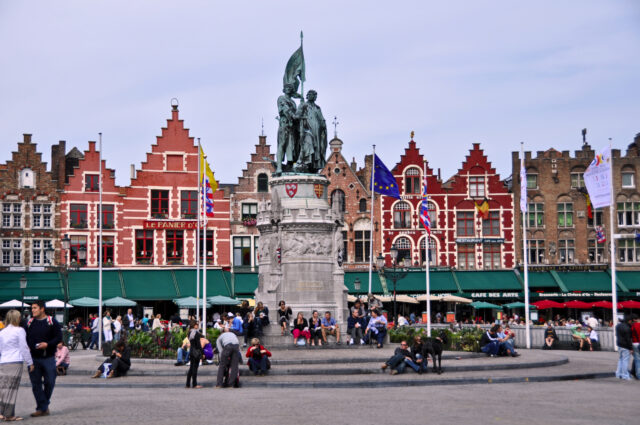
Free time to explore Bruges always puts me in a fun-loving mood. With Renoir canals, pointy gilded architecture, and stay-awhile cafés, the marvelously preserved medieval town is a delight. Where else can you bike along a canal, munch mussels, drink fine monk-made beer, see a Michelangelo statue, and savor heavenly chocolate, all within 300 yards of a bell tower that rings out “Don’t worry, be happy” jingles?

The town is Bruges (broozh) in French and English, and Brugge (BROO-gah) in Flemish. Before it was French or Flemish, the name was a Viking word for “wharf” or “embankment.” Right from the start, Bruges was a trading center. By the 14th century, it had a population of 35,000 (comparable to London’s) and the most important cloth market in northern Europe. By the 16th century, silt had clogged the harbor and killed the economy. Like so many of Europe’s small-town wonders, Bruges is well-pickled because its economy went sour. But rediscovered by modern-day tourists, Bruges thrives.

The colorful heart of the city, Market Square, is ringed by great old gabled buildings. Since 1300, it has been crowned by a leaning bell tower with a famous set of musical bells. Climbing its 366 steps rewards me with a commanding view and a chance to peek into the carillon room. I time my climb to be there on the quarter hour. That’s when the giant revolving barrel with movable tabs jerks into motion and mechanically rings the 47 bells to play the tune du jour.

Marveling at the medieval contraption doing its musical thing, I meet the carillonist who explains how the adjustable tabs are moved one way to ring different bells and the other way to make different rhythms. For concerts, the barrel is disengaged, which then engages the manual keyboard. About to leave, I shake his hand…and realize it’s deformed by a massive callous making his little finger twice the normal width. Noticing my reaction, he says, “That’s from lots of practice…a carillonist plays the keyboard with fists and feet rather than fingers.” Then he reminds me there’s a free concert tonight at eight.

Scampering down the spiral steps, I realize I need to be quick to see the remaining sights and still have time for the brewery tour. Thankfully, everything’s very close.

The Basilica of the Holy Blood is named for its relic of the blood of Christ, which, according to tradition, was brought to Bruges in 1150 after the Second Crusade. The City Hall has the oldest and most sumptuous Gothic hall in the Low Countries. The Gruuthuse Museum is a wealthy brewer’s home, filled with everything from medieval bedpans to a guillotine. The Church of Our Lady has a brick tower that rockets high above anything else in town — standing as a memorial to the power and wealth of Bruges in its heyday. The church holds a delicate Madonna and Child by Michelangelo. Bought with money made from Bruges’ lucrative cloth trade, it’s said to be the only statue by the artist to leave his native Italy during his lifetime.

I step into the De Halve Maan brewery just in time for the last English-language tour of the day. This is a handy way to pay my respects to the favorite local beer: Brugse Zot. The happy gang at this working family brewery posts a sign reminding their drinkers: “The components of our beer are vitally necessary and contribute to a well-balanced life pattern. Nerves, muscles, visual sentience, and a healthy skin are stimulated by these in a positive manner. For longevity and life-long equilibrium, drink Brugse Zot in moderation!” Like any good beer tour, it finishes with a proud tasting.

Belgians, who seem to speak better English after a beer, love to show off their beer expertise. The man at the bar gives me an earful. “Our country has more than 350 types of beer. That’s the most. And each beer must be served in the right glass. If they don’t have the correct glass, I will order a different beer. Look at our variety,” he says, handing me a menu of what’s available. “Dentergems is made with coriander and orange peel. Those who don’t usually like beer might enjoy our fruity brews: cherry-flavored kriek and raspberry-flavored frambozen.”

I tell him I like the complex and creamy, monk-made Chimay.

He says, “Me as well. Brewed by Trappist monks, the Chimay could almost make celibacy livable… almost.”

I walk off my beer buzz with a stroll through the begijnhof — a tranquil courtyard of frugal little homes. For reasons of war and testosterone, there were more women than men in the medieval Low Countries. The religious order of Beguines gave women (often single or widowed) a dignified place to live and work. While there are no longer Beguines, many begijnhofs survive — taken over by town councils for subsidized housing, or — like this one — still church-owned and housing nuns. Walking beneath the wispy trees of the charming begijnhof almost makes me want to don a habit and fold my hands.

It’s been a full day, but I’m not quite ready for my hotel room. Stopping by a waffle stand, I get a Belgian waffle to go. Grabbing a wooden bench in the little courtyard under the bell tower, I’m just in time for the evening carillon concert. As the bells ring, I imagine the musician’s massive calloused hands hard at work. Eating the last sweet strawberry on my waffle, I ponder how, even though this Gothic town is a thousand years old, it makes me feel like a kid.

(These daily stories are excerpted from my upcoming book, For the Love of Europe — collecting 100 of my favorite memories from a lifetime of European travel, coming out in July. It’s available for pre-order. And you can also watch a video clip related to this story: Just visit Rick Steves Classroom Europe and search for Bruges.)

My Talk with Peter the Cabbie

Travelers often struggle to find someone interesting to interview to better understand local issues. I find cabbies are a great resource. I was wondering why Belgium finds it challenging to keep its Flemish- and French-speaking regions from splitting up the country. Here’s my cabbie’s three-minute take on things as he drove me to the Brussels airport. How do you find cabbie chat while on the road?


This is Day 69 of my 100 Days in Europe series. As I research my guidebooks and make new TV shows, I’m reporting on my experiences and lessons learned in Vienna, the Alps, the Low Countries, England, and beyond. Find more right here on my travel blog.

Travel Bite: Bruges, Belgium

From time to time, we share a random video to fuel your travel dreams. Today, we’re sharing this clip from my TV episode about Belgium. Join me as I visit a Bruges museum that displays masterpieces by the great Flemish painter Hans Memling. In the St. John Altarpiece, Memling shows us the full range of his palette, from medieval grace to Renaissance realism to avant-garde surrealism…all in a luxurious setting somewhere between Bruges and heaven.

Stand with Brussels…and Keep on Traveling

Learning of today’s tragic attacks in Brussels, my first thought was of that city’s unique knack for celebrating life. It’s a city of great humanity, and great joy. In recent visits, I’ve been inspired by beer pilgrims who flew all the way from New York for a three-day weekend of sipping the world’s finest monk-made brews. After taste-testing decadent chocolates in a line of five venerable shops in a row, I’ve spied yet another shop…and popped yet another praline. And standing on the Grand Place, which was lovingly blanketed with flowers, I’ve enjoyed the best open-air jazz I’ve ever heard — forever giving Europe’s finest town square a joyful soundtrack in my mind.

Brussels

Photo: Francisco Conde Sánchez, CC BY-SA 3.0

Half of Belgium speaks French, and the other half Flemish — but, with a battlefield called Waterloo just a few miles beyond its suburbs, Brussels understands the importance of getting along. And, as a city beloved for its cartoons, beer, chocolate, and buckets of mussels, it knows the rewards of cooperation are rich.

Brussels is the capital of Europe — an experiment in pluralism more open and determined than anywhere in the world. And not surprisingly, forces against freedom and pluralism have attacked it. In a world of soft targets, easy access to explosives, and vivid media, terrorism is here to stay. And our challenge to maintain a free and open society is here to stay, as well. Europe is strong. It will pursue both safety and the bad guys. And, as a matter of principle, its people will continue to embrace freedom. As a matter of principle, I will keep on traveling. How about you?