Lutherans Take Over Washington, DC

Today, Lutherans everywhere are commemorating Reformation Day — the 500th anniversary of the day Martin Luther nailed his 95 Theses to the door of Wittenberg’s Castle Church, kicking off the Protestant Reformation. I’m in Washington, DC, and I’ve been celebrating since Sunday.
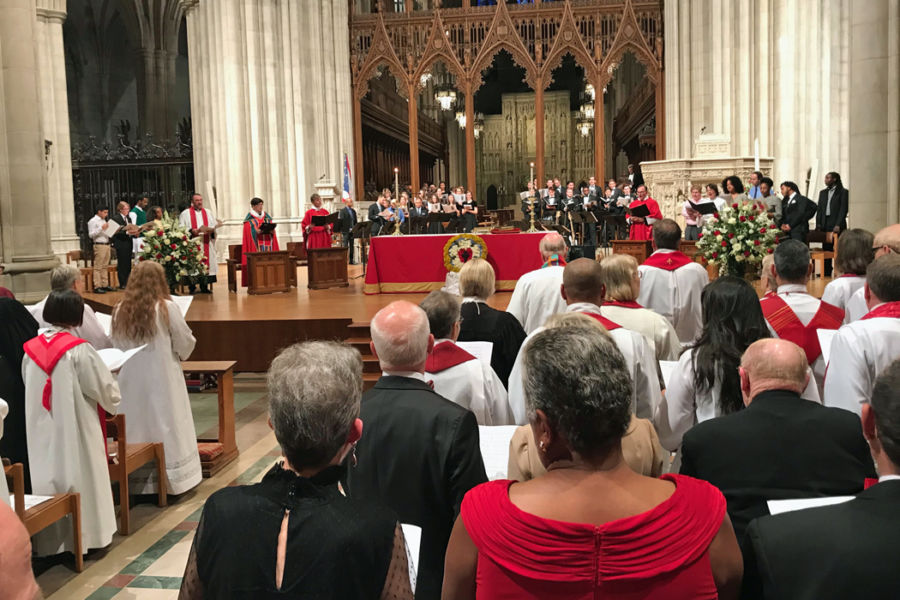
Washington National Cathedral interior

Whenever a big church event is held here, it’s likely to be at the Washington National Cathedral, a must-see attraction when visiting our capital. On Reformation Sunday, thousands of Lutherans filled the place. It was High Church at its best — lots of bishops, red scarves and ties everywhere, a celebration of many cultures, and amazing music. Being among so many Lutherans singing “A Mighty Fortress Is Our God” (our “fight song”) made it particularly unforgettable. And I got to enjoy a few lighthearted moments before the service with my friend, David Beckmann, President of Bread for the World (an organization we’ve supported for decades through our work at Rick Steves’ Europe).

David Beckmann and Rick Steves

After the service, I partied at the Mayflower Hotel with our wonderful Presiding Bishop, Elizabeth Eaton, and church leaders from far and wide. For the first time in my life, I wore a bowtie — thanks to some thoughtful friends who saw I was a bit underdressed and had neglected to wear the color of the day: red. Wearing a fancy little bowtie at the Mayflower Hotel…it just made perfect sense.
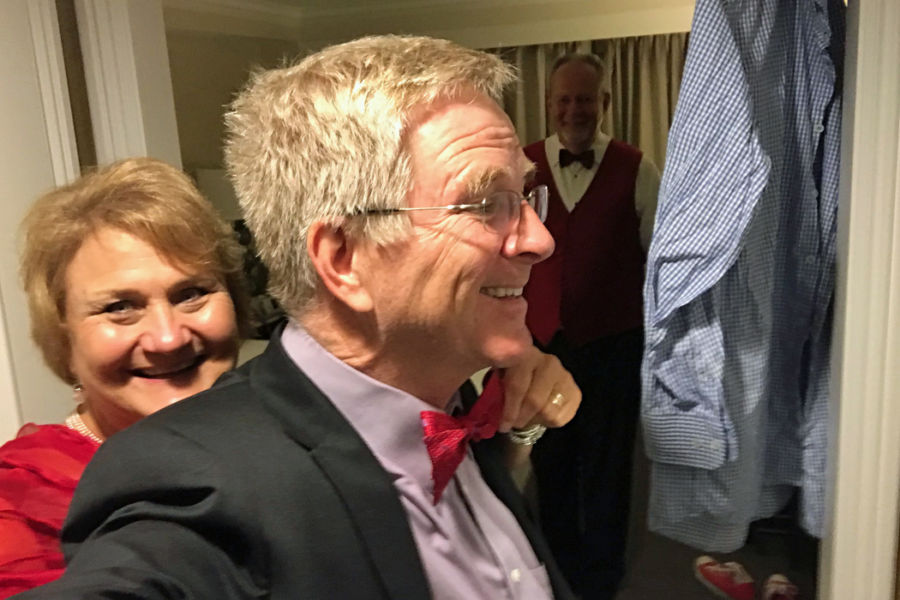
Rick Steves with bowtie

Together with Bishop Eaton, we celebrated diversity. We raised a glass to Elizabeth Platz, who became the first female Lutheran pastor in 1970, and we honored guests from around the world. Of course, my Lutheran heritage is as white as can be, but there are far higher proportions of Lutherans in several African countries — including Tanzania and Namibia —than there are in the USA. I’m also proud that the Evangelical Lutheran Church in America was a leader in welcoming gay members and clergy — even though that caused hundreds of congregations to leave, in search of less open churches.

Presiding Bishop Elizabeth Eaton and Rick Steves

Presiding Bishop Elizabeth Eaton

Today, we’re in the midst of an impressive capital campaign to make both our foundation and our reach stronger. And, while Luther managed to split the “one catholic and universal Church,” a big part of our 500th-anniversary joy is how, after five centuries — with leadership from both Pope Francis and Bishop Eaton — the Roman Catholic Church and the Lutheran Church have never been closer and healthier in their shared mission.

Yesterday, our group visited the delightful Folger Shakespeare Library (just a block behind the Capitol). The library has one of the world’s top collections of books and documents from the Reformation and the 16th century. They welcomed us with an amazing literary treat: a table of precious works from the age of Luther, including an actual papal indulgence — one of the things that riled Luther the most. These were coupons, printed up en masse and sold by the Roman Church, promising forgiveness and a quicker ride to Heaven.

Folger Shakespeare Library interior papal indulgence


What about you? I’d love to hear about how you are celebrating the the 500th anniversary of the Reformation.
 

Video: Rick Steves’ Luther and the Reformation

On October 31, 1517 — 500 years ago today — Martin Luther nailed his “95 Theses” on the door of Wittenberg’s Castle Church, kicking off the Protestant Reformation. This courageous stand by one man sparked a century of conflict, changing Europe and Christianity forever.

In Rick Steves’ Luther and the Reformation, you’ll learn the story of a humble monk who lived a dramatic life. I visit key sites relating to the Reformation (including Erfurt, Wittenberg, and Rome) and explore the complicated political world of 16th-century Europe — from indulgences to iconoclasts, and from the printing press to the Counter-Reformation. It’s a story of power, rebellion, and faith that you’ll never forget. To watch, check your local public television listings or stream the full hour right here:

“I’ll Push You”: A Camino Journey

Check out this inspirational story from two members of our traveling community, Justin Skeesuck and Patrick Gray.

Despite a rare neurological disease that confines him to a wheelchair, Justin has always pursued a life of adventure and travel. One day, while watching a Rick Steves’ Europe episode about Northern Spain, he decided that he wanted to tackle the 500-mile Camino de Santiago trail. When he asked his best friend what he thought, Patrick had a simple and direct response: “I’ll push you.”

The two travelers document their 35-day wheelchair journey across mountains, deserts, hills, and valleys in I’ll Push You, a new movie that is being released nationwide on Thursday. Happy travels, Justin and Patrick!

My Take on Catalonia vs. Spain

We’re living in a time when groups who consider themselves “nations without states” are making bold moves for independence. And the recent news of the Catalan government pushing to separate from Spain, along with Madrid’s harsh response, has taken many by surprise.

The big question for many: Is it safe to travel in Barcelona and the rest of Catalonia right now? Statistically, I’d say yes —  especially compared to the risks people take when traveling around the USA. But that’s a personal decision each traveler needs to make. If you can’t be relaxed — even in a place that is, by any rational measure, plenty safe — it’s not much of a vacation.

For many Americans, their dream destination is La-La Land. (The only guidebook that outsells my bestsellers is for Disney World.) And if you want La-La Land, go for it. But I believe in encouraging Americans to venture beyond Orlando and enjoy a firsthand look at the fascinating realities playing out beyond our borders. Right now, personally, I’d jump at the opportunity to be in Barcelona — to feel the energy and frustration sloshing around its streets, to talk to people, and to witness history unfolding. But that’s a personal call. I’ve been in many places much more volatile than Barcelona is right now (from Moscow to Sri Lanka, Nicaragua to Egypt, Tijuana to Palestine)…and have always been thankful for the experience.

If you are traveling to Catalonia soon, it’s important to stay informed. Follow the news carefully, and steer clear of areas where protests are taking place. Keep a close eye on the US State Department’s travel alerts and warnings. And, for a second opinion, I also like to monitor the United Kingdom’s Foreign Travel Advice. When in doubt about whether a particular area or gathering is safe, err on the side of caution.

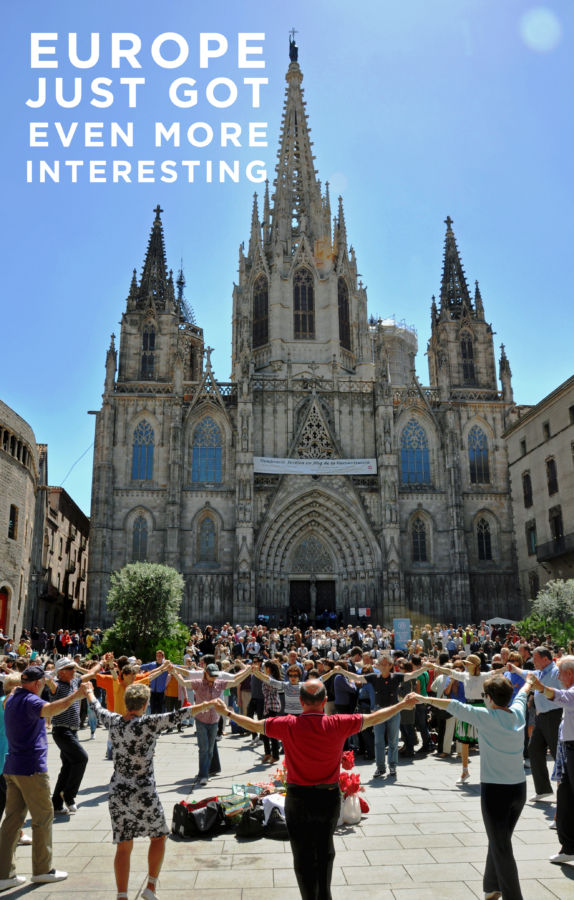
As for the future of Catalonia — who knows? I remember a time — in the 1970s, under Franco — when the very idea of “Catalonia” was prohibited. The Catalan language, flag, and other cultural symbols were illegal. But the demise of Franco and the arrival of democracy brought a surge in Catalan patriotism. These days, everyone gathers in front of the Barcelona cathedral each Sunday morning to dance the treasured Sardana (once outlawed by Franco), kids learn and speak the Catalan language first, and everywhere you go, you’ll see the proud red-and-yellow stripes of the Catalan flag.

An EU parliamentarian might use the recent news from Catalonia as a concrete example of why Europe supports ethnic regions rather than political borders. When you look at turmoil across the globe, much of it is because, long ago, powerful states drew political borders with no regard to small ethnic groups. Had the Catalan nation been respected when the line between France and Spain was drawn, things would be different today.

As with the Scots in the UK, the Kurds in Turkey, the Russians in eastern Ukraine, and other minority groups across Europe, many Catalans believe that now is the time for more autonomy. What’s happening between Spain and Catalonia is another vivid reminder that Europe is a dynamic organism. While Europeans are enjoying an era of unprecedented peace and cooperation, contemporary politics still come with plenty of conflict.

Learning about history as it unfolds is part of the joy of travel — whether it’s chatting with Brits in a pub just after Brexit, commiserating with Greeks about their economic struggles, or rubbing elbows with Catalans as they’re facing a moment of truth about how far they’ll go in pursuit of independence.

We live in interesting times. And, as things get more and more interesting, you have a big choice to make: La-La Land…or reality — Orlando or Barcelona. Happy travels!

Travel Stories: Romantic Culture Shock

Thank you for sharing all your hilarious travel stories this week! I’ve had so much fun reading your comments. I’ve got one last topic for you, and it’s a good one: romantic culture shock. I’m sure many of us travelers have experienced this, and we can laugh about it now.

I remember one time, I fell in love with a Japanese girl I met in Europe back in my student vagabond days. I later traveled around Japan with her. We ventured to the island of Kyushu so I could be introduced to her very traditional family. I couldn’t visit their actual house, as we were not supposed to be that serious yet. So, this gathering was in a kind of mountain spa lodge. Before dinner, I had to soak in a hot tub with her father. He was drunk, and we were both naked. He didn’t speak English, and all he knew about America was how horrible we were to the Indians. While the hot tub was designed to relax you before dinner…all I could do was endure a righteous lecture about American atrocities…in Japanese. He was obsessed with the topic. At dinner, he continued his rant, stabbing the table with his chopsticks to emphasize his points. That was trying…but the girlfriend was well worth the trouble.

How about you? Have you ever experienced romantic culture shock?