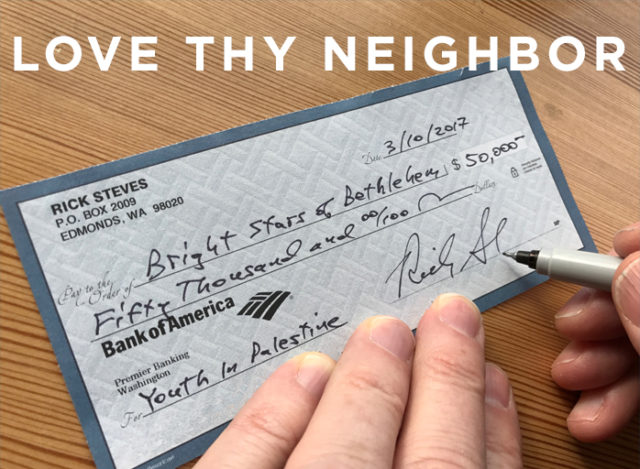
Love Thy Neighbor: $50,000 to Bright Stars of Bethlehem

Over the past weeks, millions of Americans have been inspired, in their own way, to celebrate and defend what they believe makes our country so…American. Last Wednesday, I declared that I’d give a donation to an organization helping the youth of Palestine equal to the amount spent on travel gear through last Thursday at ricksteves.com/shop.

More than 600 of you responded, spending a total of $33,287 on our Rick Steves guidebooks, DVDs, accessories, and travel bags. That’s triple our normal total!

As promised, I’m matching your collective shopping spree. And — further motivated by our government’s threat to drastically cut domestic and foreign aid programs — I’m upping my gift to an even $50,000. Thinking about how this money will help that community in such a troubled region brings me (and hopefully all of us) real joy.

check

Bright Stars of Bethlehem funds a cultural center where Palestinian boys and girls from every corner of their community can enjoy dimensions of life that we in America often take for granted. I’ve visited this center on two recent trips and its work is truly inspirational.

When I think about the “love thy neighbor” ethic and Golden Rule that is a common denominator of the three great religions that share the region we call the Holy Land, and then hear the leader of my country declare “America first,” I’m troubled by the disconnect.

I’m so thankful for your support in this small but exciting initiative. This money, when invested smartly in Palestine for such an important cause, is more than compassionate. Wielding this “soft power” from the mightiest nation on earth will contribute to an enduring peace more than the use of conventional “hard power.”

Thanks again and happy travels!

Turkey Update: What’s Erdogan up to?

Travel as a Political Act bookI’ve been hard at work updating my “Travel as a Political Act” book and I’d love some help from my traveling friends who are familiar with Turkey.

I’m rewriting the chapter on Turkey to include information about the 2016 coup attempt there — and the extreme reaction to the coup by President Erdogan.

You can read the rough introduction to the chapter below. And, if you are up to date on Turkey, I’d appreciate your suggestions on how to better describe the changes brought on by what seems like a dictator in the making.  What’s it like for the locals and for tourists in Turkey now? What’s Erdogan up to?  Thank you.


Turkey and Erdogan

My Dad used to be absolutely distraught by the notion that God and Allah could be the same. Years ago, I couldn’t resist teaching my toddler Andy to hold out his arms, bob them up and down, and say, “Allah, Allah, Allah” after table grace just to freak out his Grandpa. Later, rather than just torture my Dad, I took a more loving (and certainly more effective) approach to opening him up to the Muslim world: I took him to Turkey. Now — while he’s still afraid of ISIS — my Dad is no longer afraid of Islam.

While violent Islamic fundamentalists represent a tiny fraction of all Muslims, the threats they pose are real. And they get plenty of media coverage. To help balance my understanding of Islam, I make a point to travel there and learn about its reasonable, mainstream side.

Just as Europe and the US are dealing with rising populism, nativism, and fear-mongering politicians looking for an excuse to cut down on freedoms and amp up their military and local forces of “law and order.” And just as pluralistic secular Western governments are dealing with fundamentalists in their society that would prefer to see sins treated as crimes and their style of prayer in school, Muslim nations have that same dynamic. In fact, the challenges, while similar, are more extreme in much of the Islamic world.

I have long loved traveling in moderate, Western-facing Muslim countries such as Turkey and Morocco where embracing secularism was not seen as being anti-Muslim but simply the mark of a modern democracy. Visiting moderate developing nations which happen to be primarily Muslim gives us a safe and fascinating look at our globe’s fastest-growing religion, practiced by more than 1.5 billion people worldwide. Through travel, we can observe Islamic societies struggling (like our own society) with how to navigate through a rough-and-tumble globalized world. In doing so, we gain empathy.

I have long considered Turkey one of my favorite countries and a good classroom in which to better understand our world and its struggles. Through my company, I’ve offered (and guided) tours of Turkey through good times and bad since before the first Gulf War (in 1990). We’ve followed Turkey’s torrid modernization, its battles with separatist Kurds, and its internal tug-of-war between modern urban secularists and traditional more rural fundamentalists. And, for many years, I’ve worried with my Turkish friends about the slow yet persistent drift to the political right and the rise of Islamic fundamentalism in that country that has always taken great pride in the modern constitution given to it by its founding father, Ataturk. Then, in 2016, a failed coup attempt gave the country’s president the opening he needed to become its dictator.


Erdogan vs. Secular, Pluralistic Turkey

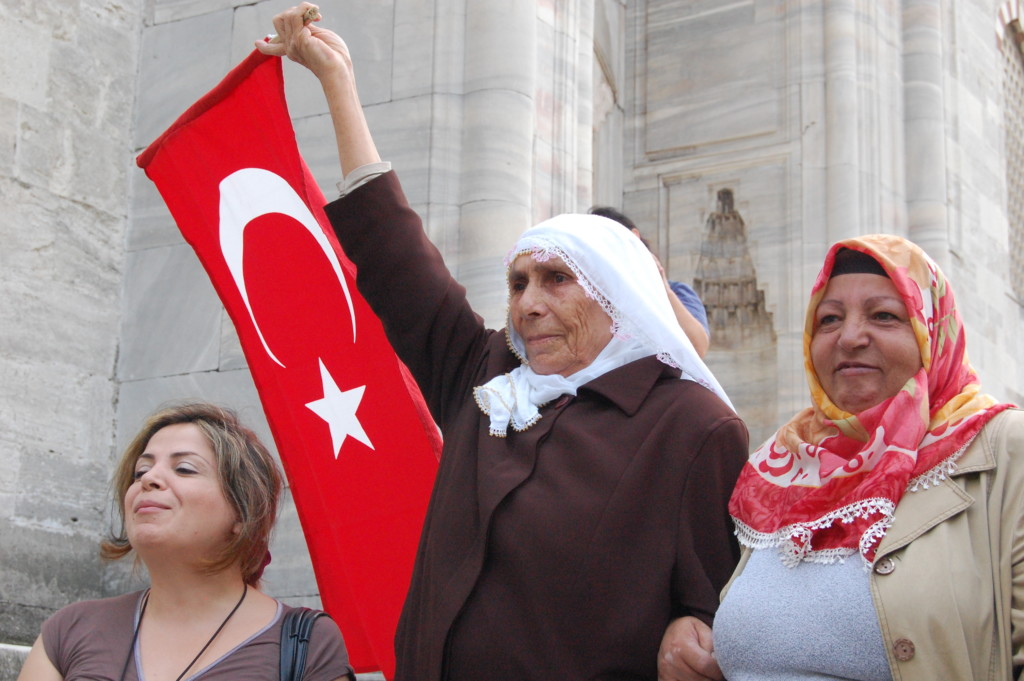
Turkey is not living in Mr. Rogers’ neighborhood. Ten percent of its society is Kurdish and many Kurds have aspirations to secede and join an independent Kurdistan. Just as rich and powerful forces push a right wing and fundamentalist agenda in the USA, powerful and wealthy forces are pushing a right-wing and Islamic agenda in Turkey. For a decade I considered Turkey a model of balancing the needs of a strong leader with Western ideals of pluralism and secularism. And for years, Muslims in neighboring countries dreaming of a more democratic system looked to Turkey for inspiration and as a model. But gradually it became clear that Turkey’s leader, Recep Tayyip Erdogan, had a different vision: to make Turkey less free and more Islamist. The constitution, given the modern state of Turkey at its founding in 1923 by Ataturk, anticipated such a leader. In fact, that constitution called for a strict separation of mosque and state and even required the Turkish military to overthrow its own president if ever he violated that tenet (which they’ve actually had to do on several occasions).

Turkey’s President Erdogan needed an excuse to declare a state of emergency and establish his more authoritarian rule and he got it in mid-2016. On July 15th, 2016, a faction of Turkey’s military attempted a coup (apparently to stop Erdogan’s over-reach). It failed and Ergodan responded with a harsh crackdown. Erdogan declared an extended state of emergency, replacing leading generals, silencing professors, shutting down the press, and locking up thousands of western-minded Turks. He essentially criminalized his political opposition. Before the coup attempt and all the purging, Ergodan — during his attempt to get Turkey admitted to the EU — was praised for supporting religious freedoms and civil rights. Suddenly, it was all different. The leaders of the military were replaced by Erdogan cronies. The military and the judiciary, both counted on for their defense of secularism, were effectively silenced. Erdogan moved to stop the public from organizing. He blocked or limited internet access and social media. Turks were arrested on charges of simply insulting the president. Erdogan, named by the European Voice newspaper “European of the Year” in 2004, had now moved Turkey — its populace thoroughly frightened and silenced — closer to a Muslim autocracy.

For many years the predictable question I’d get from loved ones is, “Why are you going to Turkey?” With each visit to Istanbul, one of my favorite cities in the world, my thoughts were: Why would anyone not travel here? Now, with the darkness of Erdogan settling on 70 million Turks, Western tourism is essentially dead in a country where it once thrived. Hotels are shut down, squares that thrived with guests from around the world are quiet, and there’s barely a foreigner in sight. From a safety point of view, I would be totally comfortable visiting Istanbul. I’d receive a warm and eager welcome. But I’d be sad, as the free spirit I expect to find in Turkey would be in hiding.

This chapter shares favorite moments I’ve enjoyed over the years in pre-Erdogan Turkey. The lessons are true as ever. And hopefully, when the spirit of Ataturk retakes its rightful place as the guiding light of the Turkish people, we’ll be traveling there again soon.
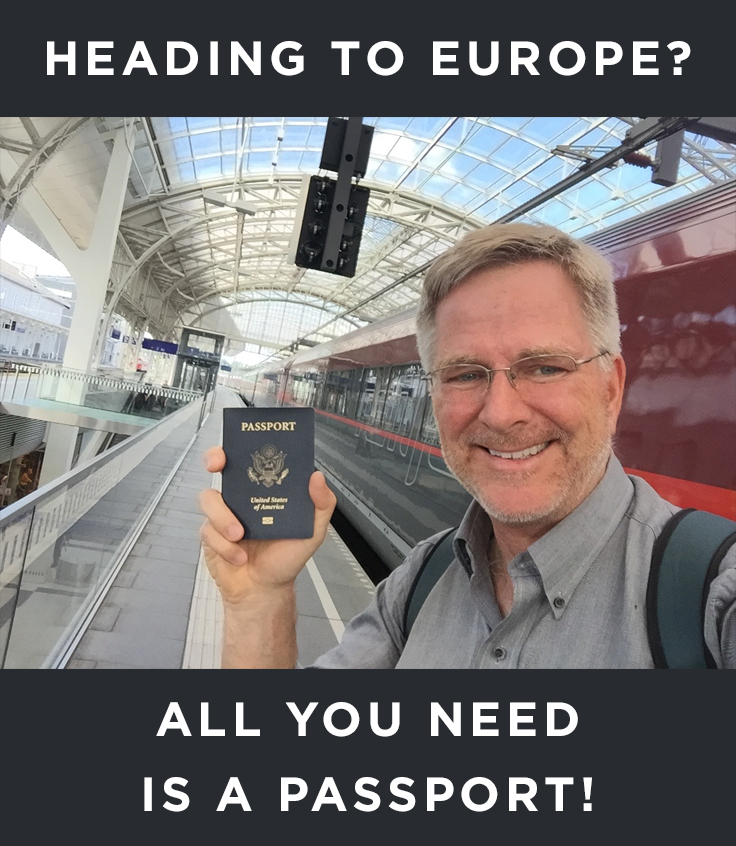
Heading to Europe? All You Need is a Passport!

A branch of the European Union recently held a symbolic and show-of-hands vote in favor of requiring American visitors to apply for entry visas. This has caused some confusion – especially among those who read headlines instead of details. Let me offer an explanation. And to cut to the chase, there is zero chance that Americans will need visas to travel to EU countries in 2017.

Rick Steves holding a passport

The vote was a call from five European nations that the US requires visas for (Bulgaria, Cyprus, Croatia, Poland, and Romania) to treat travelers from the USA the same: to require an entry visa. This is simply a matter of national pride and reciprocity.

While they make a fair case, these five countries are just a small part of the roughly 400 million citizens of the European Union. And the EU values the economic boost brought by nearly 13 million US visitors a year. Especially this year, with the dollar so strong on the euro, Europe is salivating for the boost to their economies American tourists will bring. A new visa requirement to soothe the damaged pride of those five nations is highly unlikely.

No visa is required for Americans to enter the EU and no changes in this requirement are expected. Changing this would involve all the member states and would take years to actually make happen. So do not worry.

On a related note, many Americans wonder what kind of reception we’ll receive in Europe with the chaotic and generally “ugly American” vibe coming out of the White House. We know from our own experience since our election that Europe may be amazed at the choice of the American people for “the leader of the free world,” they have been rattled by such choices in the past and have always understood that there’s a big difference between US government policy and proclamation and the attitudes and beliefs of individual American travelers. Just like we wouldn’t condemn an Italian for being ruled by a buffoon like Berlusconi or a Turk being ruled by a tyrant like Erdogan, reasonable Europeans will not condemn Americans for what they think about our president.

I’m looking forward to four wonderful months of travel throughout Europe in 2017 as are our guides and the thousands of travelers who have already signed up for our 2017 tours. While we took 20,000 happy travelers on Rick Steves Europe Tours in 2016, we’re on track to take even more in 2017. If you have any questions or concerns about these issues, please email us or give us a ring. Your peace of mind is a big part of a great European vacation.

Happy travels!

Exploring our Shared Humanity in Bethlehem

Don’t just get mad at the news — make a difference. Here’s how: From now through Thursday, for every dollar you spend at ricksteves.com/shop, I’ll give a dollar to help fund hope in Palestine.

Feeling frustrated and impotent because of the news lately? Me too. But rather than just fume, I want to make a difference. With fear trumping compassion in America’s policy toward refugees and our government’s recent change of policy regarding the Holy Land, I’m inspired to raise money for a good cause in Palestine. And I’d like your help. So, from now through Thursday (March 9, 2017), for every dollar spent at ricksteves.com/shop on any guidebooks, travel gear, or luggage, I’ll give a dollar to Bright Stars of Bethlehem. (This is not just our profit. I’ll match everything you spend.) That’s right: if $50,000 is spent at ricksteves.com/shop (and I hope we hit that mark), I’ll send a check for $50,000 to Bright Stars of Bethlehem. I know this sounds crazy, but if you went to Bethlehem (in Palestine), as I did, and saw their work — or watched the following six-minute video — you’d see my logic.

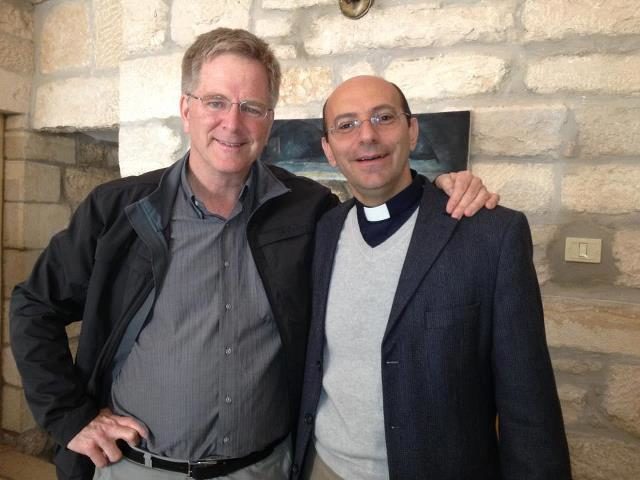
On my last trip to Palestine, perhaps the most inspirational experience I had was meeting the Rev. Dr. Mitri Raheb, pastor at the Christmas Lutheran Church in Bethlehem, and seeing the work he’s doing for the Palestinian people — both Christians and Muslims. We stayed in their Bethlehem cultural and conference center, and we filmed a basketball game there — bringing together kids from the entire community, both Christian and Muslim. This clip shows part of that game, and my time in Bethlehem with local guide Kamal Mukarker — including a memorable meal we shared in his home. These images help remind me of the humanity behind the policy, and the idea that, if you believe we’re all children of God, then we are all equally precious.

Dr. Raheb is a Palestinian who runs a thriving cultural center ministry in the middle of walls, checkpoints, and hopelessness, offering opportunities and hope for his community “from womb to tomb.” Having dinner with Mitri, staying in his conference and cultural center on two different trips, and seeing the energy and mission in action, his work brought to mind two beautiful quotes: Gandhi said, “Power based on love is a thousand times more effective and permanent than the one derived from fear of punishment.” And Jesus said, “Truly I tell you, in as much as you did it to one of the least of these who are members of my family, you did it unto me.”

 Rick Steves and Mitri Raheb

I treasure the memory of meeting Rev. Dr. Mitri Raheb in Bethlehem.
(Photo: Bright Stars of Bethlehem)

Reading the recent news, and considering the firsthand experience I had on two recent trips in Palestine, I’m more concerned than ever that this fragile, complex, and very human situation needs a careful and thoughtful policy. All of the talk about who’s the American ambassador to Israel, moving the US Embassy to Jerusalem, building more Jewish settlements in the West Bank, and the question of a two-state solution versus a one-state solution is serious business with real consequences — especially to millions of Palestinians, who don’t even have a seat at the table.

After my trips to the Holy Land — and talking to people on both sides of the issue, from Israeli settlers to Palestinian clerics — it’s clear to me that a two-state solution (which President Trump recently backed away from) is best for Israel, and the only viable hope for peace. The alternative — a one-state solution — can only take one of two forms: a modern, pluralistic democracy with equality for all citizens (which would mean the Jewish Israeli population would soon be a minority in their own land, and the Jewish-ness of Israel would fade away); or a state where half the people were Muslim but only Jews would have full citizenship (which sympathizers of the Palestinian cause would call “Apartheid-like”). With a smart two-state solution, however, Israel could be secure and Palestine could be free. I realize that’s a tough challenge. But it’s the only winning option for those who want an Israel that’s both free and Jewish. Further Jewish settlements in Palestine (the West Bank) will make a viable two-state solution even more difficult to reach.

The impact of American policy on people in the Holy Land is not certain. But the impact of this donation is: Again, for every dollar spent at ricksteves.com/shop from now through tomorrow, I’ll give a dollar to Bright Stars of Bethlehem. (By the way, “good causes” come at me all the time. I’m confident this is a powerful way to make a difference: to turn our extra dollars into real hope and joy…and contribute to peace.)

Thanks, shalom, and salaam,

Rick Steves

Avoiding ATM Fees and Scams

Credit card

We’re all in the same traveling school of hard knocks, and it’s OK to compare notes. I have to admit, I’ve never done the math to see how much I lose in fees and conversion rates with my debit card at ATM machines in Europe. While I’m pretty sure it’s a lot less than the old traveler’s checks, I bet it’s a pretty substantial expense. It’s important to remember that no one changes money because they’re nice. It’s done to make money (either in fees or exchange rates). Tips like taking big withdrawals rather than many small ones to minimize your transaction fees are pretty common sense. There are ways to get better rates and lower fees depending on which card you use and which bank you visit. My gut feeling is that I’ll get a better rate at an actual bank than using an ATM at a convenience store or gas station. Many travelers fall victim to an aggressive scam where the shop or restaurant offers to convert your bill “for your convenience” into dollars. Because of my cynicism for anything in the financial world, I’m pretty confident that this is just a costly little scam to give the unknowing traveler a lousy rate.

What are your insights and tips so we can minimize our money exchange expenses?