Lisbon feels to me like Europe’s San Francisco with rattling trolleys, a famous suspension bridge, a heritage dominated by a horrific earthquake (1755), and lots of fog. I’m kicking off my two months of spring research here–and I’ve hit the ground running to be sure everything in my Rick Steves Portugal guidebook is up-to-date for the 2015 edition.
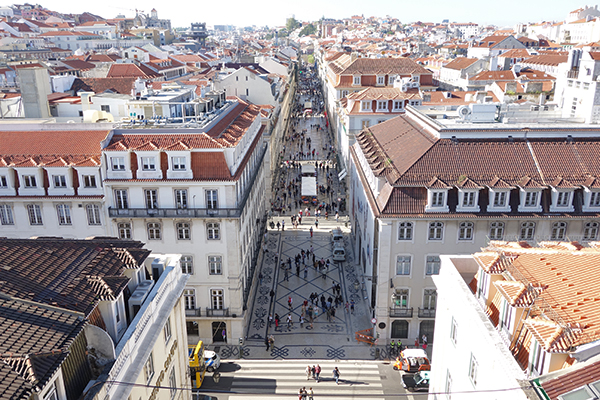
Rua Augusta: The triumphal arch that serves as a gateway to the city is now open for visitors, affording a grand view down the main drag, Rua Augusta. As can be seen from the top of the arch, the center of town was rebuilt in a strict grid plan after the earthquake/tsunami/fire of 1755 left Lisbon a smoldering pile of rubble.Lisboners Like Their Sidewalks Slippery and Artistic: Lisbon’s characteristic limestone and basalt mosaics (calçada) decorating its sidewalks are an icon of the city. But they are slippery and expensive to maintain. With the tough economy, the city government is talking about replacing them with modern pavement. Lisboners are saying no way.Quiosque Cafés Bring Life to Lisbon Miradors: Kiosks (“quiosques” in Portuguese) are the rage in Lisbon, giving squares and miradors (viewpoints) an outdoor café ambience. Judging by the crowds enjoying the spring sunshine, the economy is showing signs of happiness.Fish Dinner…Cheap, Fresh, Tasty, and Memorable: Characteristic hole-in-the-wall diners hustle for business and offer both fresh fish and great prices. I always look for a small, handwritten menu in the local language only posted on a low-rent street filled with locals; that’s my key to a good value. My longtime favorite in this crusty corner of town went out of business, so this eatery will take its place in the new edition. Prices in Portugal are amazing–hearty meals for €9 and they’re big enough to split…and that’s in the capital city. It gets cheaper in the smaller towns.Basta to Bankers Around the World: Locals are saying “basta” (enough) to financial austerity. The discussion these days in Portugal is how the finances of this society are rigged to keep the 99 percent down. Locals sing a sad song I’ve heard before: The banks, politicians, and economic elites are working together; the working blokes get the shaft; and the rich just get richer.Demonstrating with Smiles: In post-crisis Portugal (like Spain, Greece, and other countries with struggling economies) you’ll find workers and retirees complain by marching. In Portugal, the people are so sweet that demonstrations feel like festivals. I don’t know exactly was getting the brunt of their dissatisfaction, but it gave me warm and fuzzy feelings all over.The Dictator’s School Books: Portugal has come a long way in the last generation. They overthrew their authoritarian government in the early 1970s–four years after the death of long-term dictator António Salazar. It’s amazing to think that within living memory Hitler, Mussolini, Franco, and Salazar were all buddies in Europe’s club of Fascist dictators. Today, you can buy textbooks reprinted from a time when schools were propaganda tools of the government.
If you missed the webcast of our March 22nd Travel Festival, no problem! We’ve just added those classes to our array of free, online travel talks. Our newest batch includes my lectures on Spain, Portugal, Germany & Austria, Switzerland, England & Wales, Scotland, and Packing Light, plus Cameron Hewitt’s info-packed talks on the Czech Republic, Poland & Hungary and on Croatia & Slovenia–plus three on European Cruising.
I’ve always believed that a class-lecture setting is a hugely effective way to learn about travel. And that’s why I’m so excited about filming and producing classes on each country in Europe, and making them available to view for free on my new state-of-the-art website. It’s like the “Rick Steves University of Smart European Travel”–with no tests and no tuition. (Have a good trip and you get an “A” and all the credit!) Now anyone planning or even just dreaming of a trip can enjoy all that knowledge for free–anytime, anywhere.
When touring France, it’s important to get a balance between Paris and the countryside. Awesome, dominating, endlessly romantic, and thrilling as Paris may be, you can’t just go to Paris and say you’ve seen France. In my mind, Burgundy is “profound France” and offers a delightful rural balance to the urban energy of Paris. But in the end, Paris always charms. This clip shows why I’m excited to be returning and why, on our Best of Europe tour, Paris is the finale.
If you can’t see the video below, watch it on YouTube.
“From palm trees to snowballs”–perhaps the most thrilling juxtaposition of sights you can enjoy in a day of touring in Europe–is our nickname for driving from the Italian Riviera (Cinque Terre) to the heart of the Swiss Alps–the Berner Oberland. To have the most wonderful mix of cow culture and alpine thrills, we have long stayed in my favorite little alpine village…tiny Gimmelwald, a humble peasant hamlet where nearly everyone has the same last name. Check out this video clip taken high upon “scalps of the Alps,” and you’ll see why I get excited just thinking about my upcoming trip to Switzerland.
If you can’t see the video below, watch it on YouTube.
In May I’ll give myself a little vacation. This year, I’m booked on our Best of Europe in 21 Days Tour–the same route I drove in my minibus back in the 1970s and 1980s. It collects Europe’s greatest hits into an amazing three-week journey.
Of all our tour itineraries, a consistent best seller is our Venice-Florence-Rome in 10 Days thriller. Talk about mainlining all the travel wonder of Italy: I can’t think of a more intensely entertaining 10 days in Europe for anyone who enjoys great food, people, fun, art, and culture then joining what my staff fondly refers to as “VFR.” So for eight out of the 21 days in Europe on my tour, I’ll start with a cappuccino and a cheery “Buon giorno!” in these three magnificent cities. When in Rome, I’ll be sure to go on the city’s ritual evening stroll–the passeggiata.
If you can’t see the video below, watch it on YouTube.