 |
|
Enlarge photo |
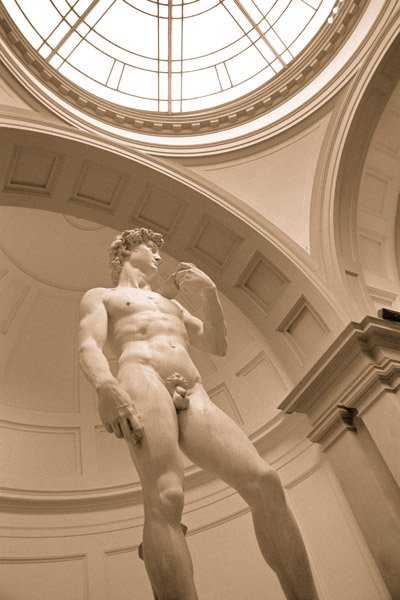
To commemorate the Smithsonian Presents Travels with Rick Steves magazine — now on sale online, and at newsstands nationwide — Rick is blogging about the 20 top destinations featured in that issue. One of those destinations is actually a work of art: Michelangelo’s David, in Florence.
Some people are not impressed by beauty. They can still enjoy art. I love the thought that art is more than beauty. It’s the closest thing to a time-tunnel experience we can have in our travels. Really. It can take you back. But only if you know the context in which it was created. Who paid for it and why? What was going on at the time? Was the artist just earning a paycheck, or did he have something to say? Were he and his patron in synch or at odds?
Of course, when you look into the eyes of Michelangelo’s David, you’re looking into the eyes of Renaissance Man. Sizing up the giant of medieval darkness, man at the turn of the 16th century had decided he could triumph and step into the modern age. It’s humanism, and it’s also local pride. Michelangelo sculpted David in a time when city-states were proud. Florentines were a particularly proud bunch. While the people of Siena might take a statue they believed brought them a plague, break it into bits, and bury it all around the city of Florence, people in Florence would urinate into the river as if they were peeing on Pisa — a rival town just downstream. David was an apt mascot for proud and confident Florence. God blessed David, enabling him to slay the much stronger giant. And God blessed Florence, enabling it to rise above its crude city-state neighbors.
Other art also takes you traveling and takes you back. Albrecht Dürer’s Self-Portrait, the first of its kind, is of a proud dandy — a cultural leader who deserved respect and good pay. He had just traveled to Italy, where painters were better respected than in his homeland Germany, and where they were given more esteem and more money.
Vincent van Gogh’s Potato Eaters takes you to a humble home of a farm family in 1885 in Belgium. Five salt-of-the-earth peasants with bony fingers share a lamp and a plate of potatoes. Van Gogh knew these people. Before being a painter, he tried to be a pastor. He lived, worked, and clearly empathized with poor miners and farmers. He cared about their lot in life, portraying them gnarled and ugly…but noble at the same time. And with this painting, his first masterpiece, he takes us there.
A helpful mindset when enjoying art in your travels is to imagine the reality of the artist and of the people for whom the art was created. If they had never seen a photograph, a movie, or never traveled. If they believed that God threw lightning bolts when he was angry. If they thought women were evil, Caesar was God, or pewter goblets represented the good life. Munch’s Scream doesn’t just scream. It screams for a reason.
This is why I miss Mona Winks! Bring it back, Rick. Good stuff.
I really loved to see the statue of David at the Academia, but I was surprised how little else was there, considering purchasing tickets ahead and standing in line. I would think they would expand it to feature more art.
When you have David why would you need anything else? It literally took my breath away and brought tears to my eyes. I have seen it twice and it was so both times.
I had all but forgotten about Mona Winks! What a great book! Thanks for reminding me…
I have to concur with sue–when a piece of work is in a class by itself, it can own its own venue they was David does. And I concur once more with Sue about ACTUALLY SEEING HIM IN PERSON. A tremendous experience. Something I’ll never forget was that first day in Florence; I arrived later than expected from my train from Venice and missed my alloted slot time for the Accademia. Instead I had to wait in line later in the day-November (2006) so not that big a deal. Ended up being in line with some friendly college students, and we were let in together. Not five minutes later some of those same students were off to the side at the corners of the main archway, just scribbling with abandon. I spied a look over one fellow’s shoulder to see, and damn if it wasn’t the best rendering of the scuplture onto paper I’d ever seen. I nodded in approval, and his grin expressed his thanks. These kind artistic memories are worth a passport’s weight in gold (times a thousand, if you please)…
I cherish my copy of Mona Winks (2000) and use it with the museums maps. I agree with Jeff–please bring it back so I can get an updated copy.
Cool!!
It’s so nice Article. I appreciate it. I will keep visiting this blog very often. I am very pleased to find this site.