Driving an hour outside of Managua, we visit the town of San Juan de Oriente, where 90 percent of the people are indigenous (of native rather than European descent), and the economy is based on pottery. We meet Valentín López, who is passionate about keeping the pre-Colombian local art alive in his craft. As we sit in his workshop, he dances while his son plays the marimba (a xylophone-like wooden instrument favored among indigenous Nicaraguans). And as he dances, he explains the connection of their craft to their indigenous past.
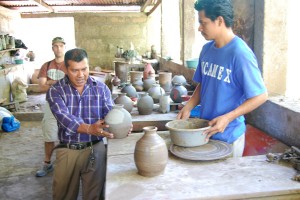
Then we gather around the wheel and he demonstrates the traditional way pottery is made, painted, and burnished. It’s all organic: clay pounded by bare feet, brushes made of a woman’s hair, and giant seeds as burnishers. As his son kick-starts the potter’s wheel, Valentín notes there is no electricity involved ‘ “The gas is rice and beans.” When the boy quickly gets the wheel really ramped up with his muscular leg, he adds, “This town produces very good soccer players.” A recurring theme of his demonstration is how the indigenous potters are in tune with nature. In the US, a potter orders clay on the phone. Here, they hike to the clay pit and gather it themselves.
The chance for the tourist to be humiliated follows, and I jump at the opportunity. Climbing into the potter’s chair is like saddling a strange animal. I push the heavy stone wheel with my feet. It’s awkward. With images of Fred Flintstone trying to start his car, I struggle to get it going. My foot nearly gets pinched and dragged by the rough wheel under the brace of the table ‘ which would make me probably the first person to lose a leg to a potter’s wheel.
The potter’s son helps me get the wheel turning with a full head of steam, and then slams a blob of clay onto my spinning work table. I cup it, and it wobbles. He shows me how to be gentle with the clay. As he trickles on some water and guides my fingers and thumbs, the clay comes to life. But my creation is still a clumsy little baby…eventually made elegant, effortlessly, by my teenage teacher.
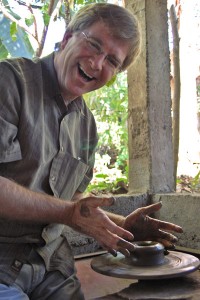
Glancing down the row of eight stations like the one I’m sitting at, all under the shade of a corrugated tin roof, I imagine this cottage industry in full swing. And I appreciate the timelessness of the technology. While the advent of plastic must have done to pottery what the advent of cars did to blacksmithing, indigenous people want vessels that are of the earth, made by hand, and ornamented with the iconography of their ancestors. And, as long as there are indigenous people ‘ even if there are no tourists seeking souvenirs ‘ there will be potters in Latin America.
There’s an indigenous pride throughout Latin America. And, although decimated by European colonialism, the indigenous people of Latin America play a bigger role in contemporary society than Native Americans do in the USA.
The struggles of the indigenous people are an important theme in the political discussion in Latin America today. They are the ones discriminated against in schools, the work force, in the judicial system, and so on. If a Mestizo (mixed-race Latin American) loses his temper or does something violent, rather than say, “The devil made me do it,” he’ll say, “Se me salió el indio” (The Indian just came out of me.) Throughout much of Latin America, to call someone indigenous is an insult. For any indigenous person, a visit to Bolivia or Guatemala ‘ the only two predominantly indigenous countries left ‘ is how they can go back in time.
While indigenous people have distinct languages and cultures, their spiritual outlook is basically the same ‘ from the wilderness of Canada to the southern tip of the hemisphere. While it seems they have embraced Catholicism vigorously, I’ve heard the word “synchronism” repeatedly. The traditional spirituality survives to this day as many indigenous Christians routinely weave pre-Christian customs into their modern religion.
Unfortunately, in most of Latin America, it is the brown people who end up living with discrimination and are destined to live in poverty. I grew up fascinated by Pancho Villa, but always considered him a Mexican bandit. Indigenous Latin Americans refer to him as a hero who stood up against white dominance. As long as indigenous Latin Americans are kept down, my hunch is that the headlines will be filled with the Pancho Villas of the 21st century as they stand up for their rights in an aggressive and often uncompromising modern world.
As I watch Valentín and his son turn, polish, and bake their pottery with a spiritual connection to their ancestors much healthier than the connection I enjoy to my ancestors, I gain a new respect for the strength of indigenous culture in our hemisphere.
I really enjoy reading Rick`s takes on the political situation south of the border. I admire his open minded, intellectual approach to travel. Though I am an ardent Tea Bagger, I really appreciate all that President Obama and the democratic party have done to facilitate our open mindedness as a society and what they have done to cure the ills of the previous administration, all embodied by Rick Steves. Thanks Rick!
A couple years ago when we were in Costa Rica, one of our activities was a day out horseback riding. The Father of the family picked us up at our hotel and one other girl from the Netherlands, so it was a very one on one day for us. The mother made us the meal of the day and their 20 something son took us on the most wonderful horseback riding tour I have ever been one. At the end of the day the son went to his room and cleaned up and the father served us a beer. We loaded in the van to go back to the resort and the son all dressed for the night (it was a Saturday), was going into town. On the way we picked up girls and boys of the same age until the van was full, they were all going to Church. The young adults all had to fulfill their church service before they could go out on the town for the night. We learned so much that day, it turned out to be a once in a life time experience.
Rick [INVALID] I have a great book suggestion for you. “Thou Shall Prosper” by Rabbi Daniel Lapin. In part, it explains how our society is conditioned to think that business and people who have achieved financial success are bad, i.e., God is not on their side, which leads some people to think that it`s noble for governments to steal from the rich to give to the poor. It seems like you have bought into that myth, which is kind of odd given your business/financial success.