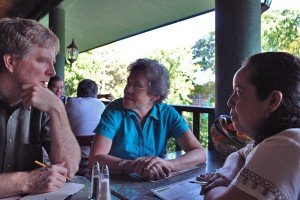
To balance our conversation, we went from poor, maternal head-of-household (Señora Nicaragua) to longtime activist/publisher. We had coffee with María López Vigil, a former nun and now editor of Envío (the monthly magazine of political and economic analysis on Nicaragua, published by the University of Central America). Here are a few insights from our conversation:
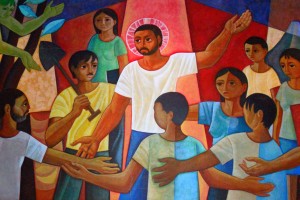
The birth of Liberation Theology as a political power came out of the 1968 gathering of Latin American Catholic Church leaders in Medellín, Colombia. It established a radical doctrine with three key points: 1. Structural poverty is sinful; 2. Violent response to that is just, for the sake of dignity which God intended for all people; 3. God is not neutral ‘ God is on the side of the poor. Medellín (meh-deh-YEEN) empowered peasants throughout Latin America. In El Salvador, where this brand of Christianity was particularly strong, campesinos kept saying, “We follow Medellín” ‘ which caused the befuddled National Guard to look for a person named Medellín.
The revolution used Liberation Theology to stand up against John Paul II, who opposed using religious fervor to win economic justice. Liberation Theology came naturally for Latin America because it’s poor and the only continent with a majority of Catholics. When the Sandinistas won power, the wind went out of the Liberation Theology sails. But its basic message remains embraced by the people: The Church should be about justice, not rituals.
María affirmed the feeling I picked up from others in Nicaragua that today it seems, in general, the Church has lost the revolutionary fervor. Once-activist Christians are spent. They have accepted peace without as much justice as they once demanded. The Mother Teresa approach to things ‘ that a Christian is charitable and helps the poor ‘ has surpassed the Archbishop Oscar Romero approach, which fights for economic justice, asks why there is hunger and desperation in a world of plenty, and organizes the poor. During the revolutionary days, the big question was not, “What’s his political party?” It was, “Is he organized?”
I asked María about globalization, and she said locals seem to accept it like they do the weather. Not liking it is futile and makes no sense. You just have to live with it. In globalization, there are no frontiers or borders for the flow of money ‘ but there are borders for flow of people. This is the crux of why globalization is tough on the poor. María pointed out that there is plenty good about globalization. Ideas have no borders now. That means, for example, women can see examples where women in other cultures have rights. She said globalization ‘ which inspires, motivates, and generates hard questions ‘ has been good for women.
I am particularly interested in the cost of debt relief for the world’s poorest countries. Banks in the rich world don’t just forgive debt to poor countries. They exact a price. According to María, neoliberal structural adjustment exacted on Nicaragua in return for some debt relief has been disastrous on her society. In return for debt relief, health and education were cut back and privatized. (It seems interesting that health care and education will take a hit as the USA attempts to tackle its own debt problems.) María said it was believed that the private sector would better manage health and education ‘ but in reality, in the transition from government to corporation, it just went from one monopoly to another.
When asked what one thing might be fundamental to Nicaragua’s economic success, María said, “Education.” Education is like planting seeds. When done right, the fruit will just keep on coming.
Very good comparison. I too believe that education is the only way for third world countries to make their way out of poverty. It is so great that almost every where in the world there is access for citizens to see how the rest of the world functions. All the countries that I have traveled to I am always amazed that they may not have a toilet, but they always seem to have a cell phone and there are internet cafe`s on every corner. It is disturbing to see how bad education is getting cut, especially California, this is our future.
I think it would be interesting to hear Rick`s ideas on how we as a country, not left or right, can do to help. It may receive a better response than the political tone. Volunteer programs for teachers, similar to the doctors. Maybe there is one, I`m not sure, just throwing it out there. I think Rick has a great pulpit from which to speak and a wonderful audience listeners from both sides that would set aside differences to help out. If our discussion focused around ways to help we might come up with some solid ideas. :)
Education alone will not produce economic success. The USSR had a pretty good educational system but an abysmal economy. So, education is necessary but not sufficient for a thriving economy. As it turns out, a system involving free people working towards their own dreams in as unfettered an environment as possible produces the most economic growth. Works every time it is tried. Trust the people. Trust freedom.
BTW, liberation theology is errant nonsense. You can cite no passage of the Bible which advocates violence to achieve political or economic ends. Further, nothing in the Bible justifies or requires socialism or communism (and yes, I know the difference between the two abhorrent systems).
As it turns out, a system involving free people working towards their own dreams in as unfettered an environment as possible produces the most economic growth. Works every time it is tried. Trust the people. Trust freedom. – Bill In theory this sounds great, but it`s not the reality for a lot of people in the U.S. I`d love to work towards my dreams and be prosperous, but I`m stuck in a low-paying, dead-end job that I hate simply b/c the company offers great health insurance that I can`t get any place else (pre-existing condition leaves me out of other options; Medicaid would send me into idleness and poverty) and I`ve been discriminated against in job opportunities b/c I have a disability. A lot people aren`t really free b/c of injustices in American health insurance and b/c of institutionalized bigotry. What do you suppose I do about this, Bill?
It`s interesting that people like Bill can write off millions of thoughtful, caring Christians in Latin America (both rich and poor, peasants and professors) by simply saying their view of their Bible is “errant nonsense”. Smart people can differ respectfully. It would be nice if we all could.
Seriously Rick, I have been wondering about liberation theology. What specific quotes from the Bible do its followers say justifies it? I would be interested to know.
Liberation theology IS heretical because it calls for the Gospel of Jesus to be taken over by Marxism. It also revives the doctrine of universalism, which places man`s physical needs above his spiritual. It undermines the doctrine of salvation through faith alone in Jesus Christ. Advocating physical violence to attain social justice, which is something Liberation Theology proposes, is outrageous. Means do not justify ends period. You can travel all you want to and talk to as many ex-priests and ex-nuns as you want to, Rick, but you are ignorant if you think you can separate Marxism from liberation theology, and in the end you will still have poverty and nothing near the social “justice” that you claim to want.
Rick, I would like to differ respectfully. :) New Testament theology in no way supports a particular political system. People that try to use Christianity to justify their political goals have been around for a long time (The Crusades, etc.). In Ephesians 6, Paul instructs slaves to obey their masters, and also tells masters to be good to their slaves. Do I think this condones slavery? Absolutely not! It speaks to the reality of the world in Jesus` day and neither condones nor condemns the practice. Christians are called to show love and compassion, regardless of their life situation (rich or poor, slave or free). Anyone who calls for revolution or warfare in the name of Christ is speaking heresy. Likewise, Christians are instructed to care for the poor and broken. I share your passion for helping people and trying to understand the political challenges different countries face. Thanks for continuing to speak out about your experiences, I always find your blog interesting and enlightening.