Here you can browse through my blog posts prior to February 2022. Currently I'm sharing my travel experiences, candid opinions, and what's on my mind solely on my Facebook page. — Rick

Mani Barnacles and Swinging Gourds

Enlarge photo

The Mani Peninsula, the southern tip of mainland Greece (in fact of the entire continent), feels like the end of the road in Europe. It’s stark and sparse — imagine Connemara in the bleak west of Ireland…after three centuries of drought. Also like Ireland, today’s Mani population is a tiny fraction of what it was as many of its former residents either fled the country for the promise of far away lands like America or were killed in the violent bickering that seems to be a local trait. Only goats thrive here. Salads come with a slab of feta cheese the size of a paperback. While mountains striped with abandoned terraces hint that the Mani once grew much more, for two centuries olives have been the only Mani export. According to a museum display, historically the economy was based on three things: immigration, piracy, and brigandage. People hid out tucked in the folds of the mountains far from the coast and marauding pirate ships of old. Ghostly barnacle-like hill towns serrating distant ridges are fortified for threats from both without and within. Cisterns which once sustained tough communities by catching pure rainwater are now mucky green puddles that would turn a goat’s stomach. The bleak history and rugged landscape provides an evocative backdrop — making hedonism on the Mani coast all the more hedonistic. Stepping out of my room and onto the shady veranda, I bonked my head on a lemon. Then, strolling to the taverna on the beach, I enjoyed images of a long ago Mani dinner — settling my chair into the sand under a bare and dangling lamp at sunset.

Enlarge photo

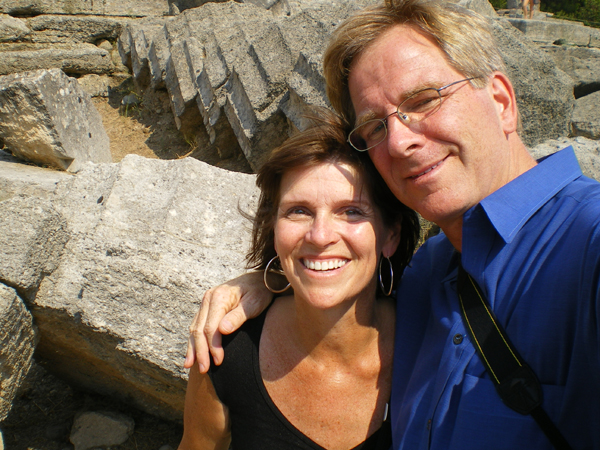
While squeezing lemon on my octopus, I enjoyed a faint but refreshing spritzing. Wondering from where the mist came, I looked over to see a tough young man in a swim suit the size of a rat’s hammock tenderizing someone else’s dinner by slamming it over and over on a rock. Today, twenty years later, Anne and I settle in at Lela’s Taverna under a leafy canopy. Lights bulbs still swing in the breeze — but, no longer naked, they’re dressed in gourd lamp shades. Lela, bent and cloaked in black, scurries as a fleeting rain storm drives a few people inside. We sit under an eave enjoying the view. Anne asks Lela’s son the difference between white wine and rosé. He says, “It’s the same but for the color.” I go for the ouzo — if only to watch it cloud over as I trickle in the water. I love gazing into the misty Mediterranean, knowing the next land is Africa. Inky waves churn as a red sun sets. The light morphs as it does each evening from solar to incandescent. In a land where “everybody’s grandma is the best cook,” ancient Lela is appreciated for the way she gives her tzatsiki a fun kick and how she marinates her olives. I can’t get past “good morning” (kalimera) with this Greek language. You try it: ne, okh’i, parakalo, kalimera, poli kala (yes, no, please, good morning, very good). I attribute my problem to confusion caused by the three words I know in Hawaiian: King Kamehameha, Haleakala, and Mele Kalikimaka.

Enlarge photo

A local guide explained that while the French keep their mouth shut when they talk, the Greeks keep it very open. While I’m tempted to keep my mouth shut while I don’t talk, I’m determined to get the basic Greek vocabulary down. Here, perhaps more than anywhere in Europe, saying just a couple of local words endears visitors to the people they meet. Mele Kalikimaka.

Lash a Flute to a Goatskin and Squeeze out some Greece

All over the world (whether in Mexico City, Dublin, Turkey or Egypt), before heading into the hinterland, it’s important to stop by the big museum in the capital city to see the art treasures dug up in the rural sights you’re heading out to see. The National Museum in Athens is no exception.

Enlarge photo

There’s a new rule. Only in Greek museums is “posing with the art” explicitly forbidden. Tourists just can’t resist getting personally involved with the gods. Goofy as it is, I didn’t know how much I’d miss not being able to “pose” with Adonis or Aphrodite. Actually being a participant in one of our tours, I’m reminded of how a well-organized tour takes all the time inefficiency out of travel. I’m also reminded of the value of connecting with great local guides. Our guide in Athens was a wealth of insights mixed with attitude: “Fay — like Faye Dunaway” explained, “We Greeks smoke, hate breakfast and just can’t get along with each other. But give us a common enemy and we become tight as a fist.” Fay reminded me how a Greek trait is to think of things in terms of word history and analyze word origins: “Sanctuary” is a holy enclosure. “Democracy” is literally “people power.” She asked me if I — “so tall and blond” — was Scandinavian? I said yes and she responded “Then why are you Steves. You should be Nelson or something like that.” Referring to the Acropolis and Agora (ancient market place) as uptown and downtown, she made the hot and dusty visit a delight, bringing meaning to the rubble with clever insights. Greek architecture is made of stone; Roman of stone, clay and brick; early Christian of only clay and brick. While ancient Egyptian wood survives, the wood of ancient Greek buildings is gone because of the humidity here. Greeks designed on a human scale…appropriate for their democracy. When the Romans came, they added gigantism. As Romans didn’t have democracy, their leaders had a taste for grandeur — putting an “un-Greek” veneer of power on the Agora with pompous staircases, fancy pavement and oversized temples and statues. You can tell Roman statues from Greek ones by knowing that Roman ones are bigger-than-life, not freestanding (always propped on something), with “too much robe” and they come with inter-changeable heads. Masters of both imperial ego and efficiency, they reused stone bodies, economically replacing just the head with each new emperor. That’s why lots of Roman statues are headless with necks “scooped out.” As usual, a local guide lets me affirm or shoot down my favorite lines. While I’ve done a lot of affirming during the first two days of our tour, I’ve had to humbly debunk myself too. For twenty years I’ve said, “The Treasury of Delos was so important that all the other islands were called the Cycladic Islands because they make a cycle or circle around that pivotal island of Delos.” Now I learn that while the word “Cycladic” does describe the circle of islands, the name predates the treasury by centuries. I always held that the origin of the word barbarian was from ancient Romans who considered everyone who didn’t speak Latin or Greek to be babbling like animals — you know…bar bar bar barians. Now I learn that, rather than Roman ethnocentricity, the word “barbarian” originated with ethnocentric Greeks (who, when hearing non-Greek speakers, labeled them barbarians for their crude-sounding language…bar bar bar). I’ve always said that Greek architects understood that a long straight base line on a building creates the illusion of sagging, therefore they bowed their temple floors up just a tad in the middle. Fay explained that was true — but only for the Parthenon in Athens. The Greeks remain pissed-off at the British for swiping their Parthenon statues. In 1803, the Ottoman Turks, who controlled Greece, could care less about Greek cultural treasures. They were happy to take a bribe from Englishman Lord Elgin to let him make off with the finest of ancient Greek statuary.

Enlarge photo

Athens’ massive new Museum of the Acropolis being built today at the foot of the Acropolis hill has a big and plush section designed to house the Elgin marbles now held in London’s British Museum. This will likely remain empty and the vision will likely never amount to more than wishful thinking because the British Museum knows if it returned the Greek treasures, every culture with treasures held hostage in London would be emboldened to make similar demands. The guides who lead tours for me know I’m a sucker for touristic folk-dance shows. Last night, more than half our group joined me and Anne at a theater under the Acropolis and under that stars to see Medieval Greek flirting set to music. Just like male peacocks need to try harder to get a date, the male dancers — with pompoms on their slippers — seemed to do all the high kicking. The sweet girls just enjoyed the show — clucking in masse while checking out the guys like you’d look at horses’ teeth at a cattle market. I found myself staring with my ears at the folk music — with its squawky flutes, crude fiddle, pipes and drums — hearing it as a kind of ethno trance music. Then, staring with my eyes at the bagpiper, I imagined the first time a Greek shepherd lashed a double reed flute to a goat skin, filled it with his breath and squeezed out a crude tune.

Drizzling Honey as if to Scribble, "Yes, I’m in Greece!"

Flying from Seattle to Athens, we changed planes in bleak and rainy Amsterdam. I realized that miserable weather at a transfer city makes me wickedly happy. Let it rain in Holland…we’re flying to Greece for two weeks of virtually certain sunshine.

Enlarge photo

On the plane, people asked, “Where are you going this time?” It was fun to answer, “I’m taking one of them Rick Steves’ tours.” I’m always impressed when planning to make a meeting halfway around the world with 15 minutes to spare, and I get there just as planned. Anne and I checked into Hotel Hera and joined our tour group on the rooftop — a view of the Acropolis and welcome drinks in hand. Last time I was on this rooftop, it was bare concrete with rickety plastic furniture. I was the driver/guide of a minibus tour…a true adventure, with the blind leading the blind. Now, it’s a different Greece. Like the city itself, the hotel has enjoyed a complete makeover. It was still a Rick Steves’ tour…but with a plush and shady rooftop, a scholar guide (Colin Clement) and me on vacation with Anne. I joked with Colin that it’s easy to be an impressive guide in Greece, because brilliance is relative and rare is the American tourists who has a clue about Greek history. Colin was worried I’d be bored. I was wondering what it would be like to be off-duty, with no real agenda other than to enjoy myself. My mom could never sit down and relax with company, and I struggle with my “mother-guide complex” (e.g., audio concerns when Colin was giving his intro talk). Colin stressed punctuality, and how we will actually leave people behind who are late for the bus. Someone cracked, “What’s the difference between a tour member and a hitchhiker?” The answer: “Five minutes.” Colin prepped us for the experience. If you ask for a “no smoking” section, they’ll sit you anywhere and remove the ashtray. Someone asked for a doggie bag on his last tour, and the waiter took the remains of their meal away, and brought it back in a sack, proudly announcing that he put other people’s leftovers in as well, so that the dog would have a real feast.

Enlarge photo

Talking with members from our group, it was clear: retired people want longer trips, working people need shorter trips. Two retired couples were fresh off of our Turkey tour, combining that and our Greece tour for a month-long visit. And, for many, this two-week itinerary was a stretch. The delightful pedestrian lane that now circles the Acropolis hill is symbolic of the great changes in Athens from the last decade or so. We strolled it with the local paseo crowd. They just had an election yesterday. I asked a local the results, and he said, “Good for owners, bad for workers.” Wandering through the city, you still feel the heritage from the 2004 Olympic Games. And even from the Para-Olympics. A small industrial elevator riveted to the face of the Acropolis’ cliff now makes that ultimate historic hilltop accessible to all. While that’s great, I have to admit I have a problem with the grooved inlay cut into every sidewalk. In hopes of enabling people who can’t see to get around the city with their white canes, they cut up every sidewalk and inlaid grooves to guide the canes. In practice, crazy obstructions make following the grooves impossible. The result: a city painfully in need of charm has new sidewalks which happen to be the ugliest in Europe. Athens, once so congested and polluted, has made huge strides. But it’s still intense and congested. It seems there’s about one blade of grass for each of the city’s 3 million cars. For a taste-version of “pinch me I’m in Greece,” I needed two things: a souvlaki pita and a local yogurt. Wandering the old town under a floodlit Acropolis, munching my souvlaki rolled in greasy pita bread, is like a ritual for me. And to cap that, I drop by a dessert place for a yogurt, and patiently drizzle honey on it as if I’m scribbling “Yes, I’m in Greece!”

Eagle Bone Flutes and Whirling Turks

Flying to Greece to meet our “Best of Greece” tour, I anticipated big, noisy Athens followed by vivid village experiences.

Enlarge photo

I started daydreaming about the fun I’ve had in Turkish villages (where I’ve had more experience) and how that offered an insight into that culture. Like little flip-floppy butterflies, I caught them somewhere over Greenland and lay them out here: I was in Güzelyurt for everybody’s favorite festival of the year: a circumcision party! Locals call it “a wedding without the in-laws.” The little boy, dressed like a prince, rode his donkey through a commotion of friends and relatives to the house where a doctor was sharpening his knife. Even with paper money pinned to his uniform and loved ones chanting calming, spiritual music, he must have been frightened. But the ritual snipping went off without a glitch — and a good time was had, at least by everyone else. On another occasion in central Turkey, I was invited into a village home for tea, or chai. While my hostess prepared the chai, her little boy let me finger his ancient-looking eagle bone flute. While we played, I heard his father playing another flute from a hill above the village. The woman went about her day with the comforting sound of her husband tending their flock. He was away…yet they were somehow still together. Turkish villages are ugly, with unfinished buildings bristling with rough rooflines of rusty concrete reinforcement bar. For years I assumed Turks just didn’t care how things looked. Then a friend told me, “In Turkey, rebar holds the family together.” In times of demoralizing inflation, rather than watch its value shrink in a bank, Turks invest any extra money in a family home. One wall, window, and roof at a time, they slowly construct a house bit by bit. Turkish parents strive to leave their children the security of their own home. At the edge of town I came upon a school stadium filled with students thrusting their fists into the air and screaming in unison “We are a secular nation.” I asked my guide, “What’s going on — don’t they like God?” She explained, “No, we love God. But with the rising tide of Islamic fundamentalism just across our borders, we Turks are concerned about the fragile ‘separation of mosque and state’ — which is guaranteed by the constitution the father of our nation, Ataturk, gave us.” One evening, a village mayor invited us into his home. Children played squawky instruments and beat drums as all present danced in stocking feet on hand woven carpets. Dancing in Turkey is easy — just hold out your arms, snap your fingers, and wiggle your shoulders. I was dancing with the mayor’s wife. Between tunes, he wanted me to know I was completely welcome in his home. He pointed to the most sacred place in the house — the Quran bag which hung on the wall. He said, “In my Quran bag I keep a Quran, a Bible, and a copy of the Torah. It reminds me that Jews and Christians, like we Muslims are ‘people of the book’—we all worship the same God.” Village artisans enjoy showing off. I visited a woodcarver famous for creating exquisite prayer niches. Every village in the region wanted one for their mosque. My friends and I observed while chips flew. Suddenly he stopped, held his chisel high to the sky, and declared “a man and his chisel, the greatest factory on earth.” I asked to buy one of his carvings. He gave it to me saying, “For a man my age, just to know that something I carved would be taken to America and appreciated…that’s payment enough. Please take this as my gift to you.” As the sun prepared to set, we climbed to a roof top to observe a dervish whirl. Dervishes are a Muslim sect who follow the teachings of Mevlana. While tourists typically see the whirling dervishes as a kind of cruise-ship, shore-excursion entertainment, it is a meditative form of prayer and worship. The dervish agreed to let us observe if we understood what the ritual meant. He explained that with one foot anchored in his home, the other foot steps 360 degrees around as if connecting to the entire world. One arm raised and the other lowered, as he turns he becomes a conduit, symbolically connecting the love of God with all of creation. He spun himself into a trance. With his robe billowing out, his head cocked peacefully to the side, and his arms a tea kettle of divine love, the sun set on the village that offered such a rich insight into a world so far from my own. Simple encounters in a remote village anywhere in the world remind me that other people don’t have the American dream. They have their own dream. Turkey, the size of California with 70 million people, has the Turkish dream. That doesn’t scare me. It doesn’t threaten me. It makes me thankful.

A Romantic Road Bus Tour Comeback?

This summer while updating my Germany guidebook, people in the Würzburg tourist board asked me why I no longer recommended the Romantic Road (the bus route connecting the Rhine and Munich/Füssen with a stop in Rothenburg). The Romantic Road was one of the 16 original “back doors” back in my 1980 first edition of Europe Through the Back Door (read the excerpt) and it slowly went downhill until I realized it was still in the book only because of my fond memories. They asked for my reasons. I gave them. And they responded impressively concerned and now I have hopes that the Romantic Road could once again be worth a day of your German vacation. This exchange of letters is kind of wonky, but anyone who loved this bus ride back in the 1970s and 1980s may find it nostalgic. And it does give an insight into how the general cultural environment has changed, making it more challenging to connect with charming slices of traditional cultures. (If you have any personal experience with the Romantic Road bus tour — then or recently — please share them with us on this blog. And hopefully, next year, we can share happy news about the new and improved Romantic Road bus tour.)

Dear Sir,
Thanks for asking my opinion on the Romantic Road. In my career as a travel writer I have seen it slowly slip from a fun-loving, economic peek at the best of Germany perfectly designed to fit a Eurail travelers needs to a greedy, lost opportunity trying to capitalize on a once upon a time good reputation among travelers. I used to consider it a key element to any best of Europe trip itinerary. Now I hardly mention it (except for drivers looking for a pretty route they can do themselves). What do I miss? There used to be friendly bus drivers who knew the locals and had fun with the tourists on board. A famous driver named Charlie Brown used to stop and chat with locals, let dogs hop on the bus, and say goodbye to travelers at the end of the day as if they had a new friend. The ride used to be covered on the rail pass and bags used to be free to stow downstairs. There used to be good information in the form of a handout guide booklet. I don’t know the latest because I stopped paying attention. But the feedback I get from people is somewhere between disappointed and betrayed. I think it would be wonderful if there was a good economic and friendly and information-filled excuse to get off the trains for a day and explore the more characteristic slice of Germany by bus. Perhaps someday, the Romantic Road bus tour will offer just that. Best wishes,
Rick Steves

Dear Mr. Steves, According to the Würzburg tourist office, you no longer recommend our bus service on the Romantic Road because you believe the service is so bad. As General Manager of the Romantic Road, I have a great responsibility for this service and it is, therefore, a matter of great importance to me that any such problems should be cleared up. The ‘Europabus’ line was opened with the founding of the Romantic Road in 1950, because people fortunately saw that, given the absence of a railway line, a bus route would be of considerable service to international guests. The buses were well-filled until the end of the eighties. Since the early nineties, the proportion of travelers using rented cars has increased continuously. And, since this time, the bus service has mainly been used by Asian guests. Thanks to my fatherly friend Charly Brown, someone who loves the Romantic Road with all his heart and with whom I am still in very close contact, I began my career in the tourist sector aged 16 as a guide on the Europabus service. And the Romantic Road has always been part of my professional life since this initial contact. Due to changing customer behaviour, it became necessary to make cuts so that only 2 of the German ‘Europabuses’ still serve the Romantic Road route. Moreover, they are only manned by a driver and no longer have a courier on board. Nevertheless, our drivers do all they can to ensure the well-being of the passengers: they make warm beverages, serve wine and beer, organize accommodation, load bikes and luggage. Our longest serving driver, Köksal Baliki, has been plying the Romantic Road for almost 20 years and looks set to break Charly Brown’s record mileage. Every day, I hear at first hand about the personal services provided on the Romantic Road. Hence, I was very shocked to hear that you no longer recommend this line to your readers. Naturally, it is no longer possible to repeat Charly’s little pranks. The small villages have changed. Virtually no dog is allowed to roam freely (incidentally, the little one from Wallerstein was called ‘Struppi’). No longer do children pick flowers for the passengers or bring fruit on board the bus, something I was always proud to do as a child. After all, decades ago the Europabuses were our gateway to the big wide world and filled with fascinating people from far away. Today, our visitors are no longer so exotic to attract local children with flowers and the statutory regulations governing bus personnel are so strict that much of what the drivers do for the guests cannot be published officially: unfortunate but a sign of the times. Nevertheless, we are looking forward very much to 2008 when the Romantic Road Europabus line will be re-launched with a new route. You are the first travel journalist to be told about this and I hope you will pass on the following information to your readers: Our bus will leave Frankfurt at 8 a.m. and drive directly to Würzburg, then past the ‘Residenz’ and the vineyards along the River Main to Rothenburg. The bus stop there is within walking distance of the Town Hall. The route continues via Dinkelsbühl (lunch break), Nördlingen and Augsburg, each with a photo stop of a good 30 minutes, to Munich (arriving at 4.25 p.m.). From there, the same bus continues to Ettal, where passengers have time to visit the monastery, before continuing to Schwangau and Füssen with photo stops in Oberammergau, Echelsbacher Brücke and the Church in the Meadow. Bus 2 travels in the opposite direction. Thanks to the new routing, guests will be able to travel rapidly from Frankfurt to Munich along the Romantic Road or, if they continue to Füssen, view some of the highlights of any journey through Southern Germany – in our opinion, a great enrichment for all travelers. I would very much like to present this new route to you personally and cordially invite you to join me on board the new Europabus along the Romantic Road. Charly Brown would also like to join us on this journey, which would give us the chance to relive common memories, to take stock of the many changes and to see once again what a wonderful part of Germany is waiting to be discovered between the River Main and the Alps. I look forward to hearing from you again and very much hope you will be able to find time to visit the Romantic Road. With best personal regards,
Jürgen Wünschenmeyer
General Manager
Romantic Road Tourist Association