Here you can browse through my blog posts prior to February 2022. Currently I'm sharing my travel experiences, candid opinions, and what's on my mind solely on my Facebook page. — Rick

Making Friends with Mr. GPS in Switzerland

This is the third of four reports guidebook researcher/writer Cameron Hewitt sent me just this week from his travels in Switzerland and beyond:

One highlight of my time updating our Switzerland guidebook was making friends with the computer voice of my rental car’s GPS system.

When I picked up my car, the rental agent said, “Sorry, I don’t have the size of car you requested, so I have to give you something a little bigger.” It turned out to be a Skoda Superb (made by my favorite up-and-coming Czech automaker) and was literally at least double the size of the car I’d reserved. You could fit our Norwegian rental car in the backseat, and have room left for a Smart Car in the trunk. While it was nice to have essentially a luxury sedan for the trip, it was sometimes challenging to nudge my tank through narrow mountain roads and tight city parking garages.

The car came with a GPS system that spoke in a buttoned-down British voice. I developed a real love-hate relationship with the GPS guy, who occasionally saved me tons of time and stress, but more than once steered me very wrong. Like an over-earnest navigator desperate to make a good impression, Mr. GPS periodically suggested bizarre and impractical routings. On our first day together, he sent me up narrow mountain roads (in some cases, ones I wasn’t sure I was legally allowed to drive), where I dodged cows and looked longingly down at the big, fast highway in the valley just below. (I’m guessing my GPS wanted to treat me to the “scenic” route. Yeah, thanks.)

On another occasion, I drove halfway across the country (from Gruyeres to Appenzell) at rush hour, hitting big traffic jams around Bern and Zürich. In order to “help” me avoid traffic on the Bern outerbelt, my GPS directed me to an exit to take surface roads through the city. Little did I know that he planned to send me straight through the heart of downtown. He was as confused as I was… “Turn left in 100 meters. Turn left now. No! Wait! Please make a U-turn if possible.” As I found myself doing a three-point turn right in front of the Bern train station, trying to ignore the bewildered stares of rush-hour commuters, I decided that Mr. GPS was on thin ice.

My increasing wariness proved useful a few days later, when — on the way from St. Moritz to Lugano via Italy’s Lake Como — I realized Mr. GPS had just directed me right past the Lugano turnoff. Hitting the brakes and checking the map, I figured out he was aiming to send me on the freeway, then on a ferry across the lake. I stuck with the slower roads on the correct side of the lake, and got in an hour earlier. (It reminded me of a recent news item, in which a Swedish couple touring Italy mistyped “Capri” as “Carpi” — and wound up several hundred miles from their intended destination.) The lesson: GPS is only useful in conjunction with a good map and some common sense.

The GPS guy would talk right over any music I was listening to. This created some odd duets. One time, listening to Janis Joplin on the radio, I heard, “Come on, take another little piece of my heart, now, baby… Please make a U-turn if possible.”

Pondering why I’m so fixated on my GPS experiences, I realize it’s probably because Mr. GPS was my main company for a few days. Now that he’s pestering some other driver, I kind of miss him.

Fringe Switzerland and Stinky Cheese

This is the second of four reports that editor/writer/researcher Cameron Hewitt sent me from his travels in Norway, Switzerland, and Poland as he’s updating our guidebooks. — Rick

Only when coming from Norway does Switzerland seem reasonably priced. Dropping $20 or $25 on a decent Swiss dinner felt like a big relief. (Later, when I was in Poland, I could eat like royalty for $20. In Warsaw I had lunch for $2…banana, egg-salad sandwich, and a bottle of water. But, as the stray hair I found in the sandwich attested, sometimes you get what you pay for.)

In the past I’ve usually focused on the Germanic core of Switzerland, so I forgot how diverse this little country is. This time, I zipped around the Romance language-speaking fringe — Lausanne and Gruyeres (French), Appenzell (OK, that’s still German), St. Moritz area (Romansh), and Lugano (Italian). Every day or two, I switched languages. Though I never crossed a border (aside from a 30-minute detour into Liechtenstein), there was as much culture shock from place to place as if I’d traveled from Paris to Munich to Rome. By the time I got to the Romansh area — where they speak an obscure Latin dialect that’s completely unfamiliar to me — I was so confused, I found myself grunting to my waiter in Croatian.

It’s not just language — the people in each part of Switzerland have their own quirks. For example, in France, people have a distinct formality, with protocol that visitors are expected to follow. The Swiss are known to be a bit aloof, with a focus on orderliness. And, while I actually appreciate those qualities when I’m in those respective countries, when they’re stacked together in French-speaking Switzerland, it feels overly uptight. It often seemed like I could do no right.

Meanwhile, Italian Switzerland — while certainly tamer than Italy proper — also has a dollop of Italian chaos. Usually, super-organized Switzerland is a dream for updating a guidebook. But Lugano kept me on my toes. Rushing around on Saturday night to check out some restaurants (which I knew would be closed on Sunday), I was told by two different restaurateurs, “It’s busy now. Can you come back tomorrow?” When I reminded them they were closed the next day, they’d wink sheepishly and answer my questions. And three separate times, Italian Swiss locals who I was using to update my information brushed aside my questions with, “Well, if it’s in that book, I’m sure it’s correct.” While I appreciate their faith in our book, how do they think it gets to be correct?

Fortunately, some things never change, no matter which language the people speak. Rivella, my favorite Swiss soft drink — which is made from milk serum, tastes like chewable vitamins, and comes in four different flavors — is available nationwide. Over a week, the front seat of my car filled up with (I hate to think of how many) Rivella empties.

It’s always interesting to hear observations from the local tourist industry. Middle Eastern travelers flock to Switzerland. A ticket seller at the boat dock in Lugano said that he had tons of Mideast tourists until a couple of weeks ago. Then Ramadan started…and he’s only seen one Middle Eastern family since (Christians from Egypt). Since Ramadan starts even earlier next year, Swiss hoteliers are predicting a short but very intense spike in demand early in the season.

I had one particularly cow-heavy stretch that combined Switzerland’s best cheeses and milk chocolates. One day I woke up in the town of Gruyeres (famous for its Gruyere cheese), toured two different cheesemaking facilities (with free samples), visited the Broc chocolate factory (more samples), then drove to Appenzell — another town famous for its stinky but delicious cheese. I like to do as the locals do — tea and a big English breakfast in Britain, croissants in France, borscht in Poland — but after a couple of days eating my way through Switzerland’s two cheese capitals, I needed dairy detox.

One highlight was arriving in the cutesy Germanic town of Appenzell on what happened to be one of the two or three days a year that the cows come down from mountain pastures. I made sure to be on main street when the farmer proudly paraded his several dozen cows through the village.

Norway’s Lofoten Islands: Cod Only Knows Their Beauty

Enlarge photo

Enlarge photo

I just got a great report from Cameron Hewitt, lead editor/writer and guidebook co-author at ETBD, sharing his take on Norway, Switzerland, and Poland. As Cameron often does, he toured the fringe areas that I don’t get to as often as I’d like, and he’s made some great observations I’d like to share with you. To collaborate with travel writers of this caliber is one of the great joys in my work. Here’s the first of four blog entries by Cameron — reporting on an amazing bit of Norway I’ve yet to see.

I almost always enjoy the places that I travel to for work. But only a few special destinations thrill me enough to lure me back on my own dime. Norway’s one of them. After a week driving around southern Norway’s mountains and fjords to update our Scandinavia book a couple of years back, this summer I brought my wife with me to venture to an almost mythical pinnacle at the end of the earth: The Lofoten Islands.

The Lofoten are a chain of spiky islands way up at the northern end of Norway, well above the Arctic Circle…comparable to the northern reaches of Alaska. Why make the effort to travel so far? For years I’ve drooled at photos of astonishing scenery, like fjords on steroids cast away in the sea. In reality, it was even more astonishingly beautiful…the most breathtaking scenery we’d ever laid eyes on.

To reach the islands, we went to Oslo (already at Alaskan latitudes), then flew due north for about an hour and a half. For the final hop to the islands, we loaded onto a tiny propeller plane, making a brief stopover to pick up two passengers at a practically uninhabited hunk of rock halfway across the sea. The tiny plane had to jam on its brakes the second its wheels hit the tiny runway.

Even here in the northernmost point I’ve ever visited, the warm Gulf Stream keeps the climate mild. We had great luck with the weather: After a rainy first day, we enjoyed perfect sunny skies and temperatures in the mid-60s the rest of the week. While we were a bit late for the midnight sun, the sky glowed until well after midnight.

Things are casual in the Lofoten. When we picked up our cheapo rental car at the airport and asked about dropping it off before our return flight, the rental agent said, “You can yoost leave the keys above the visor with the door unlocked. Or give them to that guy,” pointing at the security agent. (Sure enough, a week later, “that guy” happily took our keys.)

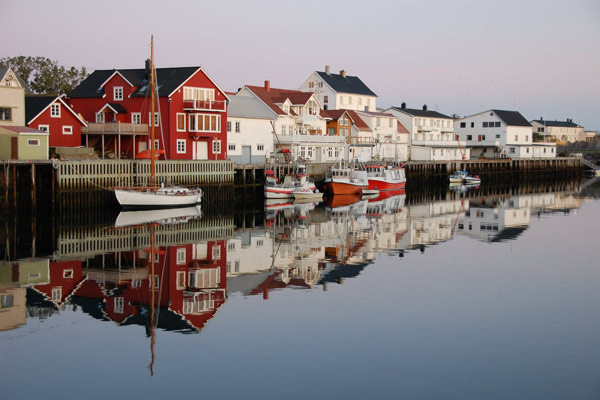
We spent our first two nights in a charming little fishing village called Henningsvær, with a smattering of galleries and cafés. From there, we side-tripped into the main town of the Lofoten, Svolvær, where we took an RIB (rigid inflatable boat, a.k.a. Zodiac) high-speed boat tour bouncing across the waves to the surrounding inlets, fjords, and islands, at speeds approaching 50 knots. It was a thrill ride punctuated with incredible views.

Everywhere we went, we stayed in rorbuer, which are little fishermen’s cabins that stand on stilts above the water. These have been rehabbed to varying degrees to house tourists, and come with modern bathrooms and kitchens. The rorbuer were perfect for relaxing in a rustic environment, enjoying the scenery, and tuning into the pace of village Norwegian life.

Enlarge photo

Enlarge photo

Our favorite stop was the town of Reine, in the middle of a fjord immersed in the most spectacular stretch of Lofoten scenery. Our rorbu there was meticulously renovated, perfectly combining rustic charm and modern comfort (www.reinerorbuer.no). We checked in, stepped in the door to our cabin, and immediately said, “Let’s stay here longer.” (Within minutes, we’d made arrangements to extend our stay.) We never got tired of staring out at the billion-dollar views from our rorbu. Basing in Reine, we took a fjord cruise, rented sea kayaks for a tranquil paddle, and went on intoxicating lakeside and fjordside hikes. It was just a 15-minute drive to the remote fishing village called Å (the last letter in the Norwegian alphabet, and the last town in the Lofoten), where we toured its humble museum and gagged down a taste of cod liver oil. And we strolled along also some fantastic, broad, white-sand beaches. While we saw a few brave swimmers go in the water (mostly kids), even in August we found it too cold to go deeper than our ankles.

The Lofoten feels impossibly remote. It’s improbable that this chain of islands is even populated. But those warm Gulf Stream waters flush schools of cod way up here in the winter, making local fishermen very happy. Rickety-looking wooden cod-drying racks are everywhere.

It’s clear that these days, tourism has eclipsed fishing as the main industry. Even this distant corner of Norway feels civilized — we paid for most everything with our credit card, and everyone we met spoke perfect English. And yet, amenities are sparse. Each village seems to have a catch-all store that combines the bare minimum necessities: convenience store, grocery, gas station, and post office. After stumbling onto a good latte on the first day of our trip, we never found one again. Missing were all the little trappings of a resort area…no ice-cream parlors, tacky trinket shops, Internet cafés, and so on. While this sounds idyllic, we were surprised to find ourselves wishing for some of those comforting little subconscious signposts that we were on vacation. One night, after wandering through a desolate village searching for an after-dinner ice-cream cone, we finally settled for an ice-cream sandwich from the convenience store’s freezer.

The few restaurants we splurged on ranged from excellent (a melt-in-your-mouth Arctic char) to…memorable. We were determined to try bacalao, the dried-and-salted cod dish that’s a local staple. Even dressed up in a flavorful stew, it was tough to swallow. Another night, one of the cheapest items on the menu was whale steak. Feeling adventurous — and despite the server’s description (“quite gamey, similar to elk or reindeer”) and the animal-rights controversy that the menu acknowledged — I went for it. It came out bleeding-rare and reeking of game…which I suddenly remembered makes me gag. In general, food is not the big attraction here. (When we got back to Oslo, we gratefully wolfed down a cheap Indian meal.) And food prices, like all other prices, are almost comically high. When a candy bar or a can of pop costs $5, you really have to do some soul-searching with each purchase: OK, do I really need this?

Enlarge photo

Even though it was the last week of August, and despite the perfect weather, the extremely short tourist season was already grinding to a halt. On several occasions, we were told that something had just closed “yesterday.” One evening, after having confirmed that the village’s lone tavern would be open for dinner, we showed up only to find they had just one dish available: fish soup with cracker bread. (We drove to the next town for something more appetizing.) We did run into several fellow intrepid travelers gasping at the scenery. However, in a full week in the Lofoten, we never once encountered a single other American.

Hairspray and Vikings

I’m back in Edmonds now, finished with research and filming for the year. Like a big-game fisherman, finally back in port, I am pleased that we have six great shows in the cooler.

When filming I don’t give my wardrobe a second thought (obviously). The idea of putting on makeup is laughable. And I’ve never put anything on my hair…but the hair causes me problems. While I’m not picky about other things, I don’t like my hair blowing funny. If the wind is coming at me head-on, it’ll actually give me a good wind-blown look. But if it’s blowing against the grain, we have to wait for the wind to die down before we keep shooting. For a decade we’ve been waiting. We routinely lose great on-camera bits because of the wind and my hair. A couple times I’ve toyed with “product,” but I just can’t bring myself to use it.

As we were wrapping up our last show of the season, we were grabbing some glorious sun in windy Stockholm for on-cameras, and my hair was causing everything to grind to a halt. The weather was changing and we had to get the on-cameras shot. Someone said “hairspray,” and our local guide popped into a fancy hotel and bought a can. Simon, my producer, took me aside and spray-painted it all over my head. I stood on the pier with the wind coming at me from the wrong direction, nailed the on-camera, and the hair was perfect. It was like I’d just discovered hairspray. For ten years I’ve been fighting the wind. Now, as we wound up this shoot, I finally discovered hairspray. I have a new (and unlikely) friend.

Along with hair, I worked on taming Nordic history. I discovered how Scandinavians define their Middle Ages (which they do differently from the rest of Europe, because there was no Roman Empire to fall up in the north). The Viking Age is defined by the first and last Viking raids on England: 793 and 1050 A.D. And in Scandinavia, medieval times are also called the “Catholic Era” — stretching from the end of the Viking Age and the coming of Christianity (around 1050) until the Reformation (1527).

I got some more clarity on Scandinavian history. There were different Viking groups in each country. As Vikings, Norwegians went west to Iceland, Greenland, and America; Danes went south to England, France, and the Mediterranean; and the Swedes went east into Russia. (The word “Russia” has Viking roots.)

While Swedes went abroad readily, they were slower to open their doors to non-white immigrants. But Sweden has come a long way when it comes to accepting immigrants, as a popular story illustrates. In 1927 a black man worked in a Stockholm gas station. For Swedes who hadn’t traveled, he was the first black person they’d ever seen, and people journeyed from great distances to fill their car up here, just to get a look at him. (Business boomed, and his job was secure.)

Photos: Navigating Norway

As a TV producer, it’s a challenge when my crew sees a gorgeous view and I want them to wait for a better view that I know is just up ahead. After driving all day across Norway, from Oslo to the fjord country in the west, we descended from the mountains, and this was our very first fjord sighting. Even though I knew better vistas awaited, the crew had to get out and film the sight. This is the farthest point inland of Norway’s longest fjord — Sognefjord.
Enlarge photo
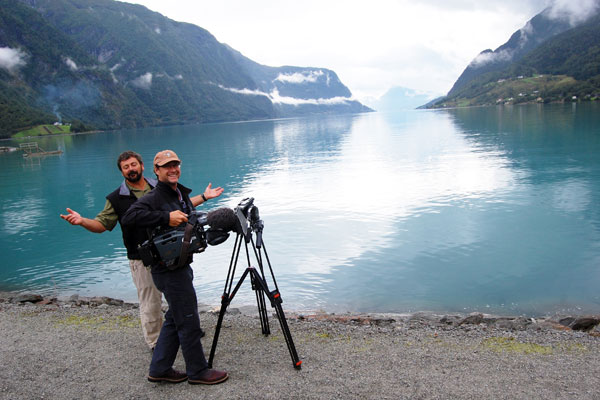
When the sun came out, we made sure we were in position for vistas like this to show off the fjord’s wonder. Simon Griffith (producer) and Karel Bauer (cameraman) worked tirelessly for 20 days last month, helping me bring home three exciting new shows on Scandinavia.
Enlarge photo
A big part of my research work is running down leads. Most are dead-ends. At the end of a busy day on the fjords, I followed one such lead up a gravelly road to a cluster of 27 abandoned farmhouses — once a goaty gang of farm families, then abandoned, and now coming back to life. Thanks to Lila, who’s monitoring this project, Otternes Farm is a place where travelers can connect with Norway’s past on a breathtaking perch high above Aurlandsfjord. It’s in our upcoming TV show and covered in the new edition of our Scandinavia book.
Enlarge photo
For years, I’ve told the story about the eureka moment I had as a 14-year-old kid in Oslo’s Vigeland Sculpture Park. I noticed how my parents were loving me so much, and I looked around and saw a vast park speckled with others’ families — parents loving their children just as much. Right then it occurred to me how our world is filled with equally lovable children of God. While I’ve traveled with this wonderful truth ever since, I’ve never been able to capture that feeling on film. And every time I’m in Oslo I try.
Enlarge photo
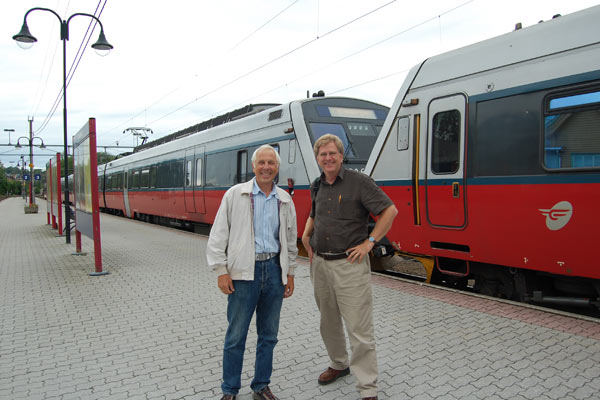
As a teenage ragamuffin vagabond slumming through Europe (with high-school buddy then and co-author buddy now, Gene Openshaw), I’d pop in on relatives in Norway. It was a much-needed depot for a bit of family warmth and some good food (notice the bulging bag Gene is toting). Thirty-five years later, Uncle Thor still meets me at the train station in his little town of Sandefjord. While I no longer need the free food, I still enjoy the dose of family warmth just as much.
Enlarge 1973 | Enlarge 2009