Here you can browse through my blog posts prior to February 2022. Currently I'm sharing my travel experiences, candid opinions, and what's on my mind solely on my Facebook page. — Rick

The First Steves on South American Soil

Jackie Steves is guest-hosting her Dad’s blog with 17 posts in 17 days. Follow the adventures of Andy and Jackie Steves as they — the first Steves to venture into South America — report on their experience.
Enlarge photo

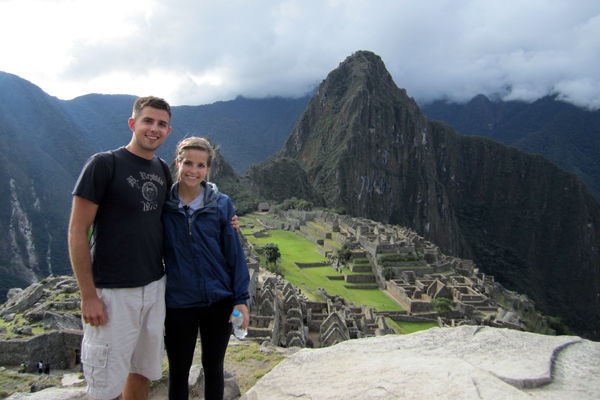
At 7 in the morning, a full 24 hours after our initial departure from The States, my brother Andy and I finally reached our destination: Cusco in Peru, the capital of the magnificent ancient Incan Empire.

Our hostel had sent instructions that a cab ride from the airport should not exceed 10 sol (about 3 US dollars). Our guidebook also told us not to hop into just any cab on the street for risk of kidnapping, even if the cab looks official. A taxi official directed us to a cab driver with whom Andy was careful to pre-negotiate. He insisted on 25 sol. I said to the driver, a bit tongue-in-cheek, but also trying to guilt-trip him, “You know, our hostel warned us that you would try and trick us.” Andy laughed and then mumbled to me in the back seat that it was probably worth the safe ride into the city. I guess we’re grateful for any sense of security after hearing all kinds of stories from friends and relatives about the dangers of travel in South America.

Our drive into the center of the city introduced us to Peruvian architecture: squat buildings, walls of stacked blocks of stone, and glass shards on top of fences for a security system. Messages graffitied on the sides of houses ranged from political endorsements, to advertisements for telephone companies, to written cheers for their favorite football players.

Our hostel had an awesome interior courtyard with a ping-pong table and beanbag chairs for socializing. The place is decorated with quirky furniture and vibrant wall murals.

Once we set out, it took us less than a block before we scored a curious tourist’s treat! On the Plaza San Francisco, we witnessed hundreds of small boys dressed up in military-esque uniforms, all lined up marching in goose-step behind a shabby out-of-tune band. They start training them at a young age for the couple of years of universal conscription. The boys’ out-of-sync step made the scene far more adorable than discerning.

Enlarge photo

The Incans esteemed Cusco so highly that they believed it to be the navel of the world. At the center of this navel, they constructed sacred temples around what is today Plaza de Armas, the main city square.

The Catholic Spanish constructed a cathedral on Plaza de Armas. The artwork of this cathedral is different from European Cathedrals. Crucifixes depict Jesus wearing bright pink, blue, or green skirts, with beads and sequins made of precious metals. The altar decoration is somewhere between tacky tin and extravagant silver. The large Last Supper painting has a roast guinea pig on a platter in the middle of the table who — I have to agree with my guidebook — “steals the show.” It’s curious that in every crucifix Jesus is portrayed, not of Middle Eastern or even Incan race, but as Caucasian.

I used the chilly night temperatures here as an excuse to buy a hat and gloves, made by local nuns, as souvenirs. The proceeds go to five social projects, including abandoned children, sexually abused women, and girls’ education. I would agree with Andy that the hat is dorky with its long tassel, but I still like it a lot!

We found a coca shop where we tried some coca chocolate and coca tea. I’m not a huge fan of the bitter lemony taste. Coca is the leaf used in cocaine and Coca-Cola. Drinking coca tea and chewing it can’t get you high, but it can help prevent altitude sickness. We’re feeling the 11,000-foot altitude here and hope this stuff will help Andy’s dizziness and my headache. The Incans worshipped coca for its plethora of uses.

At the Inca Museum we learned that these ancient peoples (a completely isolated civilization when the Spaniards found them) were tremendously developed, basically only lacking the wheel and the arch.

An Irish pub was next on the agenda — training wheels on the going-out-in-South-America bicycle. We asked to share a table with a couple we discovered were Norwegian. At the table next to us sat four Irish girls. By coincidence, we were sandwiched between groups of our own heritage. We shared travel itineraries with these friendly Europeans over Cusqueña (the popular beer in Cusco). Already on the first night I was feeling good about our upcoming adventure.

South America Isn’t Europe

My kids, Andy (23) and Jackie (20), are heading for South America. And, for the next 17 days, Jackie will guest-host my blog, with daily reports on their adventures in Peru, Argentina, and Brazil.

Why a South America trip on a European travel blog? Four reasons come to mind:

The spirit of our work at Europe Through the Back Door is to inspire people to turn their travel dreams into smooth and affordable reality by equipping themselves with good information and an expectation to travel smartly. As Andy and Jackie venture south of the equator, I hope you’ll join me in following their adventures. They are unescorted, don’t speak Spanish, have virtually no international travel experience outside of Europe, and will use non-Rick Steves guidebooks as they follow their wanderlust. They plan to travel both smart and well. They’re basically doing what any of us could do (though likely with a lot more late-night clubbing tossed in).

A photo from my Asia Through the Back Door days.

Enlarge photo

I’ve long said that Europe is the wading pool of world exploration and that many of my favorite destinations and experiences are beyond Europe. Ages ago I wrote a guidebook called Asia Through the Back Door by simply adapting my Europe tips to my experience traveling in the Far East. For me, Europe was a fun and easy first stop to making the world my friend. As we follow these youthful adventures through Jackie’s candid reports, I hope we can envision ourselves taking the experience and confidence gained in Europe and using it (with a youthful vigor) in more distant corners.

I hope Jackie’s hosting of my blog will also cause parents to consider the value of young people gaining self-confidence and a broader world view by venturing beyond our borders — whether that be Europe or into more challenging places. As any parent knows, it’s both scary and exhilarating to see your children outgrow accompanied trips and fly away on their own. I’m betting this trip will be a rite of passage, and Andy and Jackie will come home with a better understanding of both themselves and the world around them.

Finally, I have a patriotic motive for turning my blog over to Jackie. My theme this season — inspired by all the Quran-burning, foreigner-fearing, anti-intellectual legions in our country — is this:  “Fear is for people who don’t get out much.” Given the mesmerizing power of our media, it’s understandable that elderly Americans might be riddled with paranoia. (Observing my parents and my friends’ parents, I have a theory that people who can’t work or don’t have DVRs are limited to watching TV live, and 24/7 news is always there for them.) But even young people are susceptible to the fear-mongering that’s wracking our great nation. It’s my hope (but I could be wrong) that Andy and Jackie’s experience will help inoculate them to this new and virulent strain of pest in our society. And it’s also my hope that travel adventures can help us all better recognize the good and the joy in our world and then — rather than fear it — celebrate it.

With that, I’m going to step back and give the bully pulpit to my daughter. South America, here we come!

Random Scraps

I’m back home now after a great travel season. On the road for four months of the last five, I marvel at the experiences I enjoyed and am thankful for the work I was able to accomplish. I did my share to update our various guidebooks (with work in Italy, Hungary, Prague, Vienna, Salzburg, Munich, Spain, and England) and produced the last three shows of our new series (Basque, North Spain, Helsinki/Tallinn), which debuts nationally next month.

Settling back into my office, I look ahead at an exhilarating year with my staff, designing our new content into usable material to help Americans travel smarter than ever.

I have a few random scraps in my blog notes file that must get their day in the sun:

In Vienna, if you die in the hospital you are automatically an organ donor. It’s like a wrecking yard of human bodies.

In Conwy in North Wales, the fisherman’s harbor was fixed up by EU money, but EU regulations require that fish must be transported in refrigerated trucks. Those trucks couldn’t fit through the gate to the new harbor, so they set up shop in the next town. Now Conwy has a fine fisherman’s harbor…with no fishermen.

Windsor, which is just under the landing path of planes coming into London’s Heathrow Airport, is a delightful town at night. It has inexpensive B&Bs (compared to London prices), a wonderful pedestrian zone along the Thames River and in the shadow of the hulking Windsor Castle, and an enticing array of small restaurants. Windsor gave me a peaceful and charming last night in England before flying out.

I am a sucker for old, historic, black-and-white photos. Many small and charming towns have no museums or organized way to let people know what they were like a century ago. But a few hotel lobbies, pubs, and cafés collect and display old photos, serving as a small history gallery for visitors. While it may sound weird, I find this is a plus when I consider recommending a place.

If this offends you, so will Blackpool.
Enlarge photo
Blackpool daze.
Enlarge photo
Backstage with Christopher, aka “Hope.”
Enlarge photo

For silly and personal reasons (which I won’t share), I included Blackpool in Europe’s Top 20 Destinations in the special edition Smithsonian magazine we recently produced with the wonderful people on that staff. Visiting Blackpool last month, I was hoping it would charm me in the gut-bomb, white-trash way only Blackpool can. But the place depressed me. Two men greeted me by showing me their new tattoos that still made their butt cheeks all red. And it went downhill from there.

I desperately needed a couple of good B&Bs to recommend in my Blackpool chapter. I found a great one, but the woman who runs it was furious at me for my industrial espionage methods of research. (I drop in and say I need a room. They show me a couple as if I’m a prospective customer. Then, once I’ve seen how they treat travelers without knowing who I am, I tell them I don’t really need a room and that I’m researching for a guidebook.) She just stopped talking with me, so I couldn’t complete my research interview to get the information on the hotel I needed to write up a new listing. It was strange to be essentially thrown out of a hotel that I’ll still write up and recommend and send lots of business to in the coming year via my guidebook.

Blackpool is a study in people watching. For a long time I observed a woman, in a carnival-like trance, digging dreamily into her piggy bank, dropping in coin after coin in hopes of winning a tiny teddy bear.

The people of Blackpool are so impressed by the goofy tableaux that line their main drag (big, garish, cartoon-like installations that are strewn with little electric lights). I can’t imagine that they were impressive, even back in the 1960s when they were set up. But then I went to the Funny Girls drag show, had a wonderful time, met one of the performers — a gorgeous Filipino named Christopher — who “absolutely loves my show.” And I remembered what Blackpool was all about: unbridled, unpretentious, lowbrow fun.

As I say in my guidebook, the Cumbrian Lake District in North England is beautiful, but its beauty is even more striking when coming from crass Blackpool. Keswick is my slam-dunk favorite home base for exploring the Lake District. Intending to freshen up my hotel and B&B listings, I spent a morning visiting new places. I toured a great guesthouse, thinking I was incognito. When I told Gillian (who ran the place) who I was, she said, “You’re not going to insult my carpet, are you?” Startled and confused, I asked what brought on that random comment. She said that her friend was in my book, and I described her place as “good in spite of the tired, kitschy carpet,” and she considered that insulting. It was funny to me because I didn’t even think she knew who I was, much less how I described the carpet in a competing B&B.

Now that I’m home, people ask where I’m heading next. I have no idea. While I’ve yet to give it a thought, I know I’ll spend next April, May, July, and August in Europe. But right now, I do know that until then, I’ll be home. I’ll be enjoying the challenges and rewards of my work and becoming something more than a temporary local — with gusto.

9/11 and Other Numbers

This month we Americans — all 300 million of us — remember the tragic loss of 2,973 lives, when terrorists attacked our nation. In the more than 3,000 days since that terrible event, hardly a day has gone by when 9/11 hasn’t colored our response to what life has dealt us since. We have mourned together the loss of these innocent victims of this horrible act. And we have been reminded of the fragility and preciousness of each of those lives. I think it’s safe to say that the loss of these nearly 3,000 Americans has changed each of us in some way. And our collective response to the tragic event has changed us even more.

On this ninth anniversary of 9/11, as I remember our loss, I challenge myself to consider other human tragedies that have occurred since then — the loss of lives, the causes, the grief, and how they might have been avoided or minimized. I meditate on proportionality; on our response to each of these tragedies — and on how the desperation and suffering of the poor, dark, and dirty, uncovered by news media, plays out in our hearts.

In 2004, more 4,000 people — mostly civilians — died during the Second Battle of Fallujah in Iraq.

Each year since 2001, between 11,000 and 17,000 Americans have died in alcohol-caused car accidents.

Every day, more than 25,000 poor children die from diseases rich children don’t get.

Every year since 2001, an average of 30,000 Americans — most of them innocent victims — have been killed by firearms.

Since 2007, Mexico has lost more than 22,000 people to the war on drugs.

In 2010, an earthquake in Haiti killed nearly 230,000 people. In 2005 and 2008, earthquakes in northern Pakistan and China’s Sichuan Province took approximately 75,000 and 70,000 lives, respectively. These earthquakes likely would have caused far less death and destruction in lands with First World building codes.

In 2004, an estimated 230,000 people perished in the Indian Ocean tsunami. In 2008, more than 130,000 people died when a cyclone swept through Myanmar.

Since 2003, about 300,000 have been killed in Darfur.

Imagine the horror in little Honduras when Hurricane Mitch struck 12 years ago. Approximately 20% of that nation’s 7 million people were left homeless, while 70% of the country’s transportation infrastructure was demolished. Mudslides killed more than 6,000 people. In a horrifying instant that few of us here in the US even noticed, a land with 3% of our population lost more than double the people we did on 9/11.

As we remember 9/11, some might think it wrong to ponder how and why we pay attention to human tragedy near and far. I’ve been thinking about how good and caring people notice suffering selectively — by proximity or race or religion and how and why we respond to some and not to others.

I think of who the innocent victims were in New York on 9/11 and how their loved ones have grieved. Then I think of the loved ones who survived each of the other tragedies listed…and how they grieved. A New York office worker crushed in concrete…a Honduran family drowned in mud…an Iraqi child riddled with shrapnel…a Californian widow joining Mothers against Drunk Driving.

On this anniversary of 9/11 (as I try to ignore the sick media circus of Quran-burning threats), I think of those who lost loved ones on that terrible day. And I also can’t help but think of a million poor Afghan refugees barefoot and cold in tents just over the Pakistan border as another winter sets in — collateral suffering with barely an army blanket of compassion tossed their way. It’s a thoughtful time…I hope.

The Spain Show Title Finalists

What a great response to my request for ideas on a better title for my Spain show. Thanks a lot. My favorites so far: Spanish Serenade, Spanish Splendor, Viva España, Spellbinding Spain, The Spirit of Spain, and Spain: Sunny, Spicy, Spectacular.

All of these fit the program. Do you have a favorite?