Here you can browse through my blog posts prior to February 2022. Currently I'm sharing my travel experiences, candid opinions, and what's on my mind solely on my Facebook page. — Rick

Buenos Aires: Balcony Views into the "Paris of South America"

Jackie Steves is guest-hosting her Dad’s blog with 17 posts in 17 days. Follow the adventures of Andy and Jackie Steves as they — the first Steves to venture into South America — report on their experience.

La Boca.
Mausoleums at Recoleta Cemetery.

Upon arrival in Buenos Aires, we learned it was a historically cold day. Great, just what I did NOT pack for.

As in Machu Picchu, we met up with a local guide arranged through Wildland Adventure. This time it was the “Four Balconies Tour,” a metaphor for “balcony” views into four major neighborhoods of Buenos Aires.

The tour began in the heart of the city, Plaza de Mayo. Bank employees marching in a protest and setting off deafening firecrackers gave us a characteristic impression of this square where most historic events happen. Around it is situated the executive government building, the city government building, the national bank, as well as the national cathedral.

We visited La Boca, a historical port neighborhood of bright candy-color houses. It used to be tenements housing families crammed into single rooms and cooking on their balconies. Now it’s commercial and touristically tacky, with dressed-up tango couples asking to take a picture with you.

We perused the famous cemetery in Recoleta, a cemetery unlike any other I’ve seen before. The deceased are not buried beneath the ground, but housed in stone and marble mausoleums, big enough to walk inside. The mausoleums are decorated with classical statues, labeled with family names from a gamut of countries representing the diverse immigration to this city. Those buried here are wealthy, important, famous, or all of the above. The corpse of Argentina’s most loved and most hated first lady, Evita Perón, calls this cemetery home.

What struck me as most impressive about this city were the green spaces and the skyscrapers. The city’s lungs are a plethora of sizeable parks with grand old trees. The city’s complex skyline is punctuated by a pleasing variety of architectural feats, from classical echoing London or Paris, to gleaming modern cubic towers.

Bopping and Twirling Around Cusco

Jackie Steves is guest-hosting her Dad’s blog with 17 posts in 17 days. Follow the adventures of Andy and Jackie Steves as they — the first Steves to venture into South America — report on their experience.

We took the train, then bus back to Cusco. We suffered through cold showers — the hostel had run out of hot water to rinse off our Wayna Picchu hike sweat. Then we put on our beer jackets with a couple of Cusqueñas (Peruvian beer) to warm up. We met a trio of hilarious Brazilians who whet our excitement for visiting Rio de Janeiro.

In a hostel like ours it’s a matter of minutes before you’ve made 10 friends. That’s how friendly everyone is. Introductions usually go something like this:

“Where are you from?”
“Have you been here long?”
“Where else have you been / are you going?”

Then you usually proceed to share travel itineraries, with envy on both sides. Most everyone I’ve encountered has either just been to Machu Picchu or is about to go. For lots of backpackers, Bolivia is on the itinerary. Our three-week trip is definitely on the short side. Other people are going all out with South America during a period of two months to a year. It’s also not uncommon to meet people who are doing a world-wide tour (usually from England, Australia, or New Zealand), and South America is only one continent among many they will visit. Andy and I agree that it’s definitely a different demographic here than what you encounter in European hostels.

I would love to do a sociological study of the social dynamics of hostels. It reminds me of the first week of freshman year of college. You are rewarded for being warm and outgoing. Arrogance or snobbishness is punished because you simply won’t make friends. The social dynamics are so great that many are satisfied by staying in at the hostel bar and hanging out with other travelers (although only really great, fun hostels pull this off).

Tonight, with our exhaustion at having woken up 20 hours ago, staying in at the hostel bar was just what the doctor ordered. I made friends with the bartender, who was an absolute clown. And he made me his Pisco sour (the characteristic Peruvian cocktail) of which he was very proud.

Andy was either tired or has grown too old/mature/boring to dance with me. So while he sat and observed, I took on the dance floor. Oh, how I love the dancing style of Europeans and South Americans — bopping around, totally dorky by American standards — but I can definitely dig it. So I bop around too. I alternated between French friends and Brazilian friends. Andy faded off to bed. Pretty soon I grew dizzy from dance partners twirling me around (they have a thing for twirling it seems) so I wished everyone good night as well.

The next morning we visited Koricancha, an ancient Incan temple that the Spanish built upon to convert into a convent, Convento de Santo Domingo. We viewed some Catholic paintings a few centuries old. Since these Spanish Catholic-inspired paintings were done by Incan artists, Incan spiritual symbols were incorporated to create a unique Peruvian flavor.

This museum didn’t do much for us, but that is probably a testament to the value of a guide — which we lacked. It’s like the Spaniards and the passing of time stole the spirit of the Incans by taking all their treasures and destroying some of their productions. A guide is invaluable to serve as a figurative and verbal restoration of that splendor.

Enlarge photo
Me and my juice lady friend.

Enlarge photo

We ambled through various neighborhoods and perused the San Pedro market. The conditions of the market seemed far from sanitary. The meat row stank of bloody beef. Mangy dogs patrolled the aisles. A whole grocery-store-variety of commodities was crammed into single stalls. Milk from large canisters was ladled into take-away bottles. Old women stooped sleeping, images of decay. Toddlers with dirty faces and clothes waddled about freely; some even crawled on the grimy ground. Desperate for business, vendors hassled us, urging us to consider buying their wares. In the midst of it, a Catholic shrine, sticking out like a white sheep, framed in that silver tin metal, encasing an image of the Virgin mother and the childish hearts and flowers characteristic of the sacred imagery here.

Three rows of fruit juice vendors pleaded for our attention. I decided I’d like to try one for the cultural experience. I perused the rows, seeking the one that looked the cleanest. I chose a smiling woman who had just finished serving a local. I requested pineapple and mango. She peeled and cut the fresh fruit and pushed it through her blender. Then she dumped a can of milk in — yuck. She handed me the finished orange product and I tried it. Pretty good. But as I took a few more thick, creamy sips, I couldn’t get the disgusting thought of canned milk out of my head. I felt terrible, but I handed her back the glass, with most of it remaining, and paid. I pretended I really enjoyed it and made the patting-the-full-stomach sign.

As we moseyed back to our hostel, we passed stand upon stand of the same souvenirs. The only souvenir I would like to take home is one of the local toddlers. How do Peruvians make such adorable babies? Even Andy noticed their absurd cuteness.

The fact that the world of those backpacking through Peru is small was reinforced when we ran into the American couple we met in Ollantaytambo at the restaurant where we ate dinner. This was not the first time we re-encountered people we met days before. We ran into the same Irish girls we met our first night in Cusco three days later at the restaurant where we watched the World Cup in Aguas Calientes. On our first day at Machu Picchu we met a couple of American guys whom we ran into twice in Aguas the next day and a third time the following day in Cusco! A small world, at least for travelers in Peru.

Up in the Clouds on Wayna Picchu

Jackie Steves is guest-hosting her Dad’s blog with 17 posts in 17 days. Follow the adventures of Andy and Jackie Steves as they — the first Steves to venture into South America — report on their experience.

Heavenly sunrise seen from Wayna Picchu.

Enlarge photo

Hikers scaling Wayna Picchu.

Enlarge photo

Enlarge photo
Enlarge photo
Enlarge photo

Aguas Calientes, the town just below Machu Picchu, where we’re staying, doesn’t have much to offer, while having too much to offer for tourists. Restaurant after restaurant boasting Mexican food and “four-for-one” Happy Hours. Stall after stall of the same selection of souvenirs: comical Incan figurines, tacky silver jewelry, knitted hats and gloves, and bright traditional cloth shoulder bags and tablecloths.

Our alarm went off at 3:20 the next morning. Despite having just a few hours of sleep, I was wide-awake, the kind of wide-awake you are when a big day awaits you. We hurriedly packed our bags and left them behind the hostel’s front desk.

As we ran downhill to the bus stop, we heard music still bumping at the club — that’s how early, or late, it was. At 3:40 in the morning there was already a line for the buses that were not set to depart until 5 am. We arrived in the knick of time because in the next several minutes the line sprouted a few blocks longer. We were all desperate to be among the 400 admitted to hike up Machu Picchu’s sister mountain, Wayna Picchu.

The same precarious switchbacks our bus had navigated the day before couldn’t irk us the second time because all we could see out the window was the night’s pitch black.

As our bus (we managed to get on the first one!) rolled to a stop at Machu Picchu’s entrance, a line had already formed of those more ambitious than ourselves who had climbed the stairs up from Aguas Calientes. We won a stamp on our ticket that would admit us into Wayna Picchu at 7 am. That gave us some time to do the mini one-hour hike to the Incan bridge.

Andy remarked a few times how majestic Machu Picchu was at this hour. We were literally up in the clouds, as we could see some clouds below us. The surreal mistiness led me to exclaim, “Oh my gosh, it’s like we’re in heaven!” When Andy said he caught my exclamation on video (on his camera), I laughed, realizing how much I was under the spell of my surroundings.

We entered Wayna Picchu and slithered past a few groups of people. The sun was rising from behind the eastward mountain, casting glimmering illumination on patches of mountains. The clouds floated across the panorama, and we vacillated between making progress to reach the top and needing to stop to take it all in. The glory of it all shed me and Andy of our young-20s cool so that we became babbling brooks of awe and amazement.

The trail turned into StairMaster on steroids. We fell into a rhythm of scaling the never-ending staircase while panting from altitude and exertion. At times the path turned into a climb requiring two hands.

We finally reached the very summit, and a panoramic view made every step worthwhile. When Andy and I sat at a distance from each other, it occurred to us that the awesomeness triggered a need for personal meditation. (Are you sick of me going on about this mountainous beauty? I’m sorry, but you should know it is not exaggeration because all of this comes from a girl who is not a fan of the outdoors and is often at fault for taking natural beauty for granted.)

We didn’t want to descend the way we had come and have to navigate around the ascending hikers, so we chose the long route back, via the Gran Caverna (Great Cave).

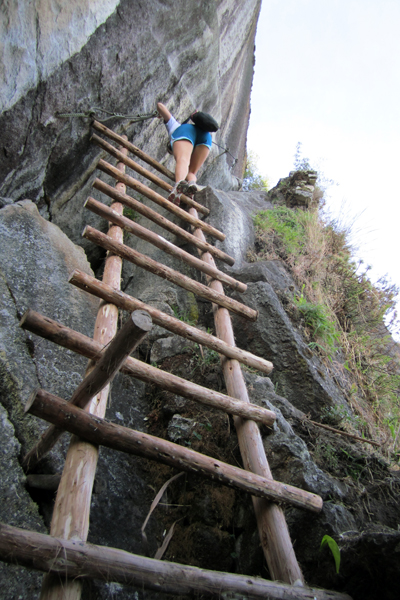
At one point we descended a huge wall of stone by stepping down a series of little notches while being suspended above thin air by holding on to a cable for dear life. We also had to climb down a 30-foot slippery wooden ladder. To cope, I shut off my rational thinking process in order to get through it. Afterward I praised God that Andy and I survived. It would have been easy to slip off, for a foot to blunder, or for the ladder to break. It was probably the scariest thing I’ve ever done. Doing that without a carabiner in the States would probably be illegal.

The Great Cave wasn’t much, but I suppose Machu Picchu and Wayna Picchu are hard acts to follow. I have never climbed so many stairs in my life — up, up, up, down, down, down, up, up… Both our knees began to shake with fatigue.

We made it back to Machu Picchu with wobbly exhausted legs, soaked through with sweat, but very satisfied with ourselves. Initially, waking up at 3 am for a four-hour hike was not appealing to me. I was just going along with Andy. But with hindsight I’m totally glad I did it.

We made it back down to Aguas Calientes to watch the World Cup final over lunch at a restaurant. Every building in town was blaring the game. Andy and I don’t get into spectating soccer much, but the excitement of the international crowd around us was contagious.

Peru’s Machu Picchu Comes Alive and Blows My Mind

Jackie Steves is guest-hosting her Dad’s blog with 17 posts in 17 days. Follow the adventures of Andy and Jackie Steves as they — the first Steves to venture into South America — report on their experience.

Jackie, Wilfredo, and Andy At Machu Picchu.Enlarge photo

Wilfredo, a guide we found through the Seattle travel company, Wildland Adventure (with whom our family did a Costa Rica tour two years ago) picked us up early from our hostel in Ollantaytambo. He took us to one of the World Wonders, Machu Picchu, via train to Aguas Calientes, and then by bus up precarious switchbacks to the “lost city.”

 We shared a train car with 32 women who appeared to be worshipping crystals. Their leader came around saying in a hokey Zen voice, “We will now seek to reach a higher level of consciousness by focusing the positive energy on our bellies.” I struggled to stifle a laugh. Andy was pretty uncomfortable when the women began taking turns giving each other sensuous head massages. I nearly cringed at the clash of their tones — half spoken in hokey Zen tones, the other half spoken in raucous Southern twang.

We were careful to reassure our guide that not all Americans were this bizarre in spiritual practice, nor this obnoxiously loud. He said with a smile that he knew that, but that these kinds of spiritual groups do have substantial presence in the tourist industry here.

I was sad to hear that the Peruvians were swindled out of a huge portion of the money coming in from the booming Machu Picchu tourist industry because PeruRail (the train everyone must ride to get there) is actually owned half by Britain and half by Chile.

Such money swindling away from the Peruvians is a tragic theme running throughout their history. There was all the exploitation by the Spanish, especially in the taking of gold, silver, and other precious exports. Recently there have been strikes against the selling of Peru’s oil to other countries, where it can be priced higher such that Peruvians cannot afford even their own oil. Protesters are urging the government to nationalize the oil industry so that private companies would have to stop this practice.

I have never had a better guide than Wilfredo (and I’ve taken a lot of tours in my 20 years of travel to Europe and elsewhere.) Not until this trip have ancient ruins intrigued me because for me that history seems so distant. Wilfredo succeeded at bridging that gap of time so that I could actually appreciate the building techniques, spirituality, and lifestyles of these ancient peoples.

The impeccable stonework used to construct Machu Picchu’s temples.Enlarge photo
Andy and I beside condor rock sculpture.Enlarge photo

The site upon which Machu Picchu was built was chosen very specially and intentionally. It lies between four soaring mountains, each perfectly positioned in the four directions — north, east, south, and west. As a people whose God is the sun, one can imagine they were very in tune with the sun’s path from East to West. They built four small temples at the summits of each of these surrounding mountains. They also worshipped water, and it helped that the site’s location made it possible for them to capture water flow from glaciers above them and direct it through their clever viaduct system.

Wilfredo pointed out evidence of the difference between various groups’ handwork. Some walls were made of rectangular stones while others were composed of stones to fit together more like puzzle pieces. The stonework varied from uneven (the houses of the commoners) to absolutely perfect (the temples).

Wilfredo also showed us stone representations of the three worlds: the upper, the middle, and the underworlds. The underworld has to do with the wisdom from which we are born. The middle world is our existence on Earth. And the upper world is when one dies and goes to live with the Gods.

The condor bird is worshipped as well for being the carrier of souls to the upper world when humans die. My favorite single feature of Machu Picchu was this large natural bedrock formation shaped as soaring wings. The Incans built off of this by carving a bedrock beneath it into the bird’s head.

The ruins of Machu Picchu, this incredible man-made construction, evoke in me ambivalent feelings. I am half overwhelmingly impressed with the awesomeness of their creation. Yet, I am half overwhelmingly depressed at all the back-breaking work these small ancient people endured. They must have had faith as strong as a diamond to be compelled to devote such a colossal effort to erecting these perfectly neat stone temples on the peak of this towering mountain. While they had impressive stone masonry techniques, it was still incredibly intensive to cut stones with the straight-line accuracy they did and haul mounds of bedrock. I have scarcely seen a modern-day Peruvian as tall as my own five feet and seven inches. And according to evolution the temple-builders were probably even smaller! All I can say is Machu Picchu is a mind-blowing accomplishment.

Wilfredo provided the most perfect cherry on top as the finale to our Machu Picchu tour. “I would like to play you a tune.” He pulled out a recorder made of amber wood and from it he produced the most beautiful melody I have ever heard come from a wind instrument. Perhaps it was my majestic surroundings that made it all the sweeter. Wilfredo’s traditional tune was like a condor via which I was transcended to a higher serendipity — it was that utterly beautiful.

After reluctantly bidding adios to Wilfredo, we ate our sack lunches in the ultimate picnic setting, on a grassy plain just above and overlooking the ruins. Nearby llamas, kept as natural lawnmowers, trimmed the grass.

Breaking Away from Europe as a Certified Backpacker

Jackie Steves is guest-hosting her Dad’s blog with 17 posts in 17 days. Follow the adventures of Andy and Jackie Steves as they — the first Steves to venture into South America — report on their experience.

Incan Ruins in Ollantaytambo leading up to a sun temple.

Enlarge photo

This is the first time I can legitimately identify as a backpacker. When I was little I wore a backpack, but that doesn’t count since I was with the family. During my past couple of independent Euro trips, I’ve actually used a rolling bag. While I don’t enjoy a sore back, something about bearing the weight of my belongings on my shoulders gives me a sense of independence and strength, as if I could conquer the world (but not like what the Spaniards did to the Incas because that was not nice).

We stopped at a supermarket, one of my favorite windows into any given culture. Time and again, Andy and I have remarked on the freshness of food here. To watch the cutting of fresh whole fruit at a restaurant in Lima’s airport nearly struck us as odd (shows how starved we are in the States for legitimately fresh fruit). This supermarket was another manifestation of fresh. Inside the entrance, you pass a fresh-squeezed orange juice stand, as well as a fresh farm milk stand.

We took a five-passenger car to Ollantaytambo, sharing it with a nice young Argentinean couple. The two-hour ride only cost $3 per person! Can you imagine being able to pay a few dollars for a two-hour taxi ride in the States?

We drove through rolling Peruvian hills resembling Colorado countryside — dry but also green in parts. We passed construction, where men worked with pickaxes and shovels, just like roadwork we saw in the city. Peru’s roads — from its most modern city to its rural back lanes — are handmade.

Our small tires bouncing on a bumpity cobblestone road announced our arrival in Ollantaytambo, a town in the sacred valley below Machu Picchu that boasts ancient Incan ruins as well.

The “hearty Peruvian fare” of chicken, rice, and quinoa soup I ordered for dinner was good, but bland.

We befriended a couple of Minnesotans (who are here volunteering to help local flood victims) and a few local goofballs with whom we went to Gansos (Spanish for geese), one of the only bars in this small town. This bar did not disappoint — drinks cheap as dirt and an upstairs decorated with hammocks, swings, tree houses, funky Bob Marley wall decor, candlelight, and a fire pole to slide drunkenly downstairs at the end of the night (good idea?). Downstairs five drummers provided the beat for our night out.