Here you can browse through my blog posts prior to February 2022. Currently I'm sharing my travel experiences, candid opinions, and what's on my mind solely on my Facebook page. — Rick

Favela Funk Party — Getting Down in the Ghetto

Jackie Steves is guest-hosting her Dad’s blog with 17 posts in 17 days. Follow the adventures of Andy and Jackie Steves as they ‘ the first Steves to venture into South America ‘ report on their experience.

We will miss this colorful, spirited city.

Enlarge photo

Enlarge photo

Our last full day south of the equator was bright and clear. Cramming all of Rio’s important sights into the space of two days paid off by affording us a leisurely day. We metroed to the Hippie Fair in Ipanema. All the things I wanted to take home with me were too big to carry: a hammock, big bright painted murals of the favelas with jazzed-up colors, and intricate wooden chairs.

We bused it down the coast a bit to Posto 9, perhaps the most famous stretch of beach in the world. This was right by the bar where “The Girl from Ipanema” had been seen and written. The sand around it was carpeted in towels and beach chairs. I wondered out loud why people would come here if they had the option of less crowded beaches. Andy astutely pointed out, “It’s all about seeing and being seen.” Yes indeed, women showed off their tanned assets in itsy-bitsy thong bikinis. Men showed off their football-toned bodies in little Speedos many American men wouldn’t be caught dead in.

We walked along the water’s edge checking it out. We had our sights set on Leblon Beach, just south of Ipanema, quieter as well as very nice, in an upscale neighborhood.

The clouds cut our beach time a bit short, and we walked the several miles all the way back to our hostel enjoying a mild temperature and the promenade running all the way along the beach bustling with active locals.

We had grown to love small hole-in-the-wall restaurants here that serve simple fare of meat, rice, French fries, the occasional pizza, and big bottles of local beer.

We had heard quite a few hostel friends rave about the fun they’d had at the “Favela Funk Party.” We were very speculative at first. Going to a party in the slums? Gruesomely violent images from the film City of God surfaced in my imagination. Our friends would reassure us about safety and how the facilitating company totally takes care of you. If it’s safe enough for them to run, and tons of tourists partake without trouble, then it must be safe. So we paid our 30 dollars for a ride on what we decided would surely make for a memorable cultural experience.

They corralled us all into a big van. I agreed with Andy that it felt like a hen (English bachelorette) party with the majority of passengers excited, talkative British girls. The only exceptions were two very nice Brazilian cousins from south of São Paulo. The guy running the service clearly got a kick out of shuttling gringos to favelas because he gave us a sarcastically ominous pep talk and issued a spat of semi-serious rules. About 20 minutes into the ride, as we entered what looked like the favelas, all the loud high-pitched British voices were suddenly dampened.

They unloaded us right in front of the club, and I felt like we were a young naïve school of fishes in a scary sea of young people we didn’t know what to think of or how to act around. We entered the big warehouse of a club and a headed immediately for the VIP area upstairs that we gringos had special access to. When Andy wanted a drink we had to first go buy a drink ticket from the vendor person who sat behind protective glass. It was by no means a full bar, just a few basic options.

We took on the dance floor with a bit of trepidation. Soon it felt just like any other club, except that our white faces stuck out a bit and the local guys were shirtless. For several songs lines of these shirtless guys danced a choreographed line dance. Hip-hop/line dancing is definitely something I haven’t seen before. They were good! And fast!

We ran into our favorite Ilha Grande girlfriends again! Again, small backpackers world! By 2 or 3 am the fabulously flamboyant MC invited about a dozen people on stage for a dance-off. They really know how to shake it. By 5 am I was so danced-out I slept the whole van ride home.

The next day, during our last few hours, we strove to soak up as many final Rio sun rays as possible. Today, Copacabana (our own neighborhood) beach. This time we knew how to get our hands on the beach chairs, how to order my new favorite açai smoothie at a corner juice stand, how to stand our ground in the aggressive undertow of the surf, and how to pay a cheap price for a beautiful lunch at a hole-in-the-wall restaurant where all the neighborhood’s grandpas like to hang out having beers all times of day. It finally felt like we knew how to work this city, and now we had to leave. But I plan to stow away these insights because I definitely want to return to my new favorite city, the lovely Rio de Janeiro.

Rio Knows How To Have Fun: Samba, Carnaval, Lapa

Jackie Steves is guest-hosting her Dad’s blog with 17 posts in 17 days. Follow the adventures of Andy and Jackie Steves as they ‘ the first Steves to venture into South America ‘ report on their experience.

Elvarado met us once again the following morning for a full-day tour. He drove us in his car to our first stop: the Christ the Redeemer Statue on Corcovado Mountain. Rio is such a fascinating sight of a city I would be content just riding around all day watching it out a car window.

The wind parted the clouds just long enough for us to have a few Kodak moments. I love this statue. While many crucifixes show a suffering, slouched, dying Christ, this one is strong and resolute, showing that while Jesus was crucified, he was actually not defeated. Sacrificing his life was a tremendous feat of strength, and the bold posture of Christ the Redeemer is a great representation of that.

On the tram ride back down from Corcovado (through reclaimed tropical forest), a quartet of samba musicians played for us. A few Brazilian passengers on board raucously joined in a fun verbal interplay. When the man singer passed out a shaker, I realized the interactiveness of this musical genre. I envy Brazilians for their playfulness and tendency to spontaneously break out in group song/dance.

Elvarado drove us north along the coastline, breaking to show us his favorite beaches. Each of Rio’s beaches has its own personality ‘ anything from famous to secluded, wealthy to poor, wild waves for surfers to calm surf for kids.

Maracanã, their beloved football stadium that holds such a sacred space in Brazilian hearts, didn’t do much for me and Andy, who have very little to do with soccer since we stopped playing in middle school. It is fun, however, to marvel at a city that is so wholly devoted and in love with a single sport. While in the States, the most popular sport seems like a toss-up between baseball, American football, and basketball, here one sport dominates. That’s soccer.

Everything is an all-out team sport for Brazilians: their overwhelming shared love for soccer, their breaking out in joint song, and their devotion to putting on the world’s biggest three-day party every Mardi Gras ‘ Carnaval.

We visited their Sambodromo, a long, massive, one-sided concrete stadium. Its sole purpose ‘ to house the Carnaval parade. Seats are very plentiful, but their extremely high price demonstrates how much Cariocas prize their celebration. In the small, adjacent museum we saw a few examples of the extravagantly showy costumes worn by the samba schools in the parade, made new each year! We also viewed a video recording of the event ‘ unreal! Puts all other parades I’ve seen to shame.

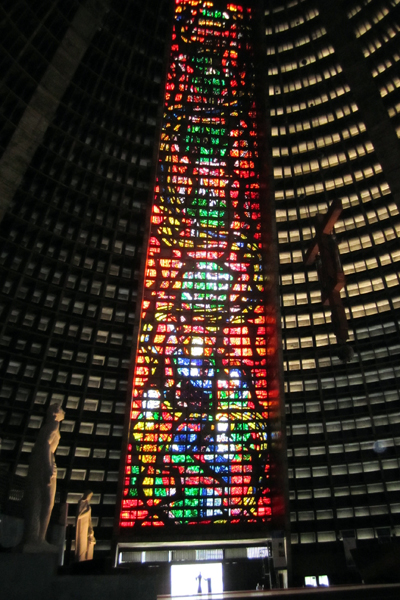
I had apprehensions about this huge space-rocket-shaped construction that claimed to be a cathedral. They were all dispelled, however, once I walked inside the Nova Cathedral to see a bath of natural light colored by gloriously large stained-glass windows on all four sides soaring up to a great height as if in praise of God. The shape that reminded me of a rocket ship actually represented a bishop’s hat. A great wooden cross was awesomely suspended over the altar. Among the sculptures of saints decorating the quadrants of the cathedral, that of St. Francis particularly spoke to me with its dynamism and grace.

Our final destination with Elvarado was Sugar Loaf Mountain, yet another high viewpoint of the city. You know you are in a truly beautiful city when two of its main tourist attractions are high above on the mountains to offer views of Rio. We rode two cable cars up to this funny-shaped mountain. Clouds interfered to limit our visibility, so the $25 we each paid was a bit of a waste on this cloudy afternoon.

Despite being exhausted from getting only a couple of hours sleep the night before, we knew it was our last night to see Lapa in action (the next night was a Sunday and then we would fly home on Monday). So we rallied to return to our new favorite nightlife hotspot for the second night in a row. We shared feijoada, the traditional meat and black bean stew here. Salty, but good. We had finally found out that most entrées here were plenty for two people, which really helped our budget. We wandered around people-watching and peeping in on bars with samba bands playing. If only the nightlife was like this in Georgetown (where I go to school)!

The Christ the Redeemer Statue on Corcovado Mountain. Elvarado and Andy looking out upon Leblon Beach.
Sambodromo, the Carnaval parade’s main venue. Nova Cathedral.
One of four huge stained-glass windows inside the Nova Cathedral. St. Francis statue inside the Nova Cathedral.
The Lapa Steps by Selarón. Sugar Loaf Mountain.

Experiencing My New Favorite City: Rio de Janeiro

Jackie Steves is guest-hosting her Dad’s blog with 17 posts in 17 days. Follow the adventures of Andy and Jackie Steves as they ‘ the first Steves to venture into South America ‘ report on their experience.

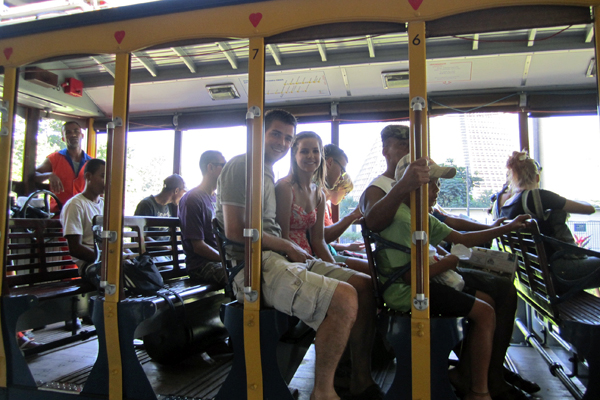
Andy and I on the rustic old-school tram running from the city center up the hill to Santa Teresa.

Enlarge photo

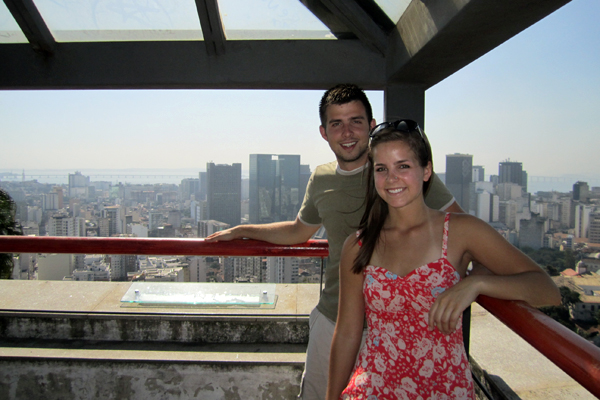
The view from the top of Parque das Ruínas.

Enlarge photo

The Lapa Steps by Selarón.

Enlarge photo

For dinner back in Rio we metroed to the world-famous beach, Ipanema. Public transportation (the subway and the buses) here is extremely convenient. It helps that the city sprawls along the water in a line.

After sundown, the promenade that runs along the beach is still a stream of beautiful fit Brazilians walking, running, rollerblading, bicycling, flirting, and playing. On the sand just below, beach volleyball and soccer are still going too.

As we perused restaurants, we missed how cheap Argentina and Peru had been. Brazil was no cheaper than the States, it seemed.

In the morning our guide, Elvarado (again, hired through Wildland Adventures), picked us up at our hostel to take us on a Historic City-Center tour. He recounted a history that resonated with those we heard in Peru and Argentina ‘ of natives, European conquest, struggle for and achievement of independence, turbulent politics during the 20th century, and finally a brighter picture of better governance and prosperity in the new millennium. But Brazil stands out from the other two for being colonized by Portuguese instead of Spanish and for experiencing a peaceful transition to independence. Today the president, Luiz Inácio Lula da Silva, has a 90 percent approval rating for applying smart economic policy to pull many out of poverty ‘ along the lines of distributing loans to motivate production. A woman is next in command in Lula’s party, so in a few months, when his two terms have run out, Brazil is expected to have a female president!

We visited a few monuments and churches. Most memorable was a Franciscan convent ‘ a church interior excessively and magnificently clad in gold.

We walked for hours, stopping every once in a while at the very convenient juice shops on nearly every other corner. They make the most refreshing smoothies out of all kinds of tropical fruits. They also serve coffee, cakes, sandwiches, etc. You usually just stand at the bar while you have a snack. I tried an açai smoothie, which I thought was far better than anything I’ve ever had at Jamba Juice.

Besides a female president, Rio has a lot to look forward to. They are working hard to improve their city, by cracking down on crime and developing infrastructure, in anticipation for the World Cup in 2014 and the Summer Olympics in 2016.

Elvarado took us to the neighborhood where he lives, Santa Teresa, by way of old rickety tram. This quieter residential town is smack-dab in the middle of the greater metropolis, and the very old tram that rides up the hill from the city center passes through scenic jungle surroundings. The 10-minute ride was like transporting us into story land. The setting: bohemian hill town populated by artists and intellectuals who all take care of each other’s kids and take time to stop and chat to whomever they meet while strolling the cobblestones. The Great Depression led to the abandonment of the grand abodes once owned by some of Rio’s upper class. The ’60s brought hippies to reoccupy the dilapidated hillside mansions.

We stopped at the neighborhood bar so Elvarado could say hi to three of his friends: a sculptor, a professor, and a fellow tour guide, who were having their midday beer. This bar doubles as a convenience shop, with a rainbow of essentials arranged like a grand piece of artwork against the wall behind the bar.

We couldn’t get far before Elvarado would run into another friend, this time a tiny old woman with a weathered potato-skin face and a big, crooked-tooth, lipless smile that made my day. They embraced and spoke words we couldn’t understand. Elvarado went on to explain that she was their neighborhood’s Carnaval queen, a woman always loved and respected by all.

We climbed hills and stairs to Parque das Ruínas, the ruins of a hilltop mansion inhabited 80 years past by an extremely wealthy female patron of the arts. At the very top of her house was a panoramic view of the city from her balcony! And I thought we were spoiled with the Puget Sound view from our house. This view was something else. The expansive bay set off by mountains, a sprawling dance of skyscrapers. She would have grand parties up here, but this house too fell into disrepair following her death and was even inhabited by homeless people for a few decades. I’m pretty sure I wouldn’t mind being homeless if I got to crash up here!

We descended what look like normal stairs as you walk down, but when you turn around you see an explosion of color in a mosaic that turns the stairs into a playful marvel. This long flight of stairs is tiled by Selarón, a Chilean artist. He’s toiled for decades, picking tiles from his ventures all over the world to add to his masterpiece. His signature icon, which you see in many of the tiles he paints himself, is a dog with a pregnant woman. Pictures of the artist himself, with a huge flamboyant mustache, show him to be as quirky as his characteristic symbol. Despite the fact that the stairs look complete, all filled in with tile, it is actually always a work-in-progress, which he calls his “great madness.” A fun fact we learned: hip-hop producers Snoop Dogg and Pharell filmed parts of their “Beautiful” music video on these steps.

I thought my own quirky dad would appreciate this bizarre artist and his tile festival of stairs as much as I did, so I picked him up a signature tile of Selarón and a postcard. The 10 reals ($5 US) that I paid will go toward funding Selarón’s work.

We parted with Elvarado at the bottom of the stairs to tackle a couple of museums on our own. The Museum of Fine Arts had an impressively innovative floor of modern art I particularly enjoyed. The Historical Museum enlightened us on the indigenous natives of Brazil, the country’s history of slavery, and many other important topics.

At the hostel we met a whole crew of fun backpackers (Irish, Moroccan, British, Italian) and shared taxis to Lapa, the neighborhood downtown that has fantastic street parties on Friday nights. What a scene! The four blocks were absolutely teeming with young revelers. Where cars would usually go stood stands upon stands of food and drink.

We observed a mesmerizing African drum show. Twenty-some drums, an orchestra of percussion. Even gringos couldn’t help moving to the beat.

Next we came up to a couple of guys performing Capoeira, an Afro-Brazilian art form invented by slaves to secretly practice fighting by disguising it in the form of a dance. It involved crazy acrobatics like I’ve never seen! They’re figuratively fighting, but it’s actually a beautiful dance with incredible coordination and skill.

I was a kid in a candy store on the streets in this part of Rio ‘ so many cool sights to drool at. We explored for hours, beers in hand. We even ran into our friends from Ilha Grande!

Brazilian Boat Party: Pinching Myself Thinking I'm in Some Blissful Dream

Jackie Steves is guest-hosting her Dad’s blog with 17 posts in 17 days. Follow the adventures of Andy and Jackie Steves as they ‘ the first Steves to venture into South America ‘ report on their experience.

After a short night’s sleep we went at it again ‘ this time it was an all-day boat party. We and all our new friends were babbling brooks of joy at being on a boat, sipping caipirinhas, and being driven around to Ilha Grande’s most gorgeous lagoons. We felt like we belonged in a movie or a music video.

When we got to the first lagoon Andy was the first to jump in. Within a matter of minutes everyone (about 30 20-something-year-olds) followed suit except me and Italian Tweedledumb, Paolo. He confessed to me with a big adorable grin, “Don’t tell anyone, but I don’t know how to swim.” But that didn’t stop him. Soon he was paddling around down there with a life jacket like a three-year-old. I think people found a way to jump off almost every possible perch on the boat.

Andy, Tweedledee Ian, and Tweedledumb Paolo with caipirinhas in hand at the helm of the boat.

Enlarge photo

The roof of the boat was a big flat platform, perfect for a dance floor. This was the most surreal party ‘ I think for all of us. I was chatting up top with one of the Brazilians who helps run the hostel, Frederico, when a man in a small motor boat drove up alongside our boat. Frederico asked me if I liked coconut. When I said yes he called down to the man below in Portuguese. The man threw up a coconut. Frederico pulled out a pocketknife, whacked off the top of the coconut, tossed in a straw, and gave it to me. The all-natural refreshment couldn’t have been more fitting.

At one point the Brazilians turned off the music and joined all together in song and dance. They really know how to make their own fun. Just the sight of them all singing and dancing made me extremely happy.

The bar turned out a continuous flow of caipirinhas. You would think they would mass-make these ahead of time for the sake of ease, but instead the cocktails were ever so fresh, made from limes they chopped the moment before they threw them in your cup so they could only make four at a time, with two regular-size shakers.

The next morning our time in paradise expired. Andy kept asking, “Are you sure you don’t want to stay a few more days?” I could stay the rest of my life so happily here, but I was also very excited to see Rio.

Ilha Grande: Island Paradise off the Coast of Brazil

Jackie Steves is guest-hosting her Dad’s blog with 17 posts in 17 days. Follow the adventures of Andy and Jackie Steves as they ‘ the first Steves to venture into South America ‘ report on their experience.

We were five and six of six packed into a five-person car when we got picked up from our hostel the next morning. One was the driver, a middle-aged man with kind eyes. Two was a soft-spoken Asian-American from San Diego. Three and four were lively, talkative, 19-year-old British girls. Soon they revealed themselves to be the crazy hooligans they were. One of them mentioned getting a split lip when she instigated a fight with a cab driver she disagreed with. She proceeded to break off his windshield to whack him with it, and while her friends wrestled with him, she went to grab the key from the ignition. The driver surrendered the argument. One of their other stories showed another reason they weren’t to be messed with: When a few guys pissed them and their friends off, they got them kicked out of the hostel. Then they called around to other hostels so the guys were barred from most places in the city and had to sleep on the street.

Without asking the driver, one of them turned on the radio to blasting volume. At a rest stop they immediately started chain-smoking and drinking beers. It was only noon. One of them wore high heels, Daisy Duke jean shorts, an absurd wide-brimmed sun hat, and a tank top hanging so low her nipple peeked out on occasion. They had Andy and I nonstop laughing as they talked about their travels and their schemes on how to swindle money from their parents to extend their trips. They provided entertainment the rest of the car ride, singing and dancing along to popular music. I almost envied them with the insane stories they told so casually like it was nothing. While they both looked like they could use a good shampoo, teeth cleaning, and facial, they certainly had style with panache.

We transferred to a boat to be ferried over to Ilha Grande, pure underdeveloped paradise. Yellow-sand beaches, rustic Pirates-of-the-Caribbean ambience, people lazing away in hammocks, a harbor speckled with small weathered sailboats, absolutely no cars, and nothing more than a dirt trail stringing the town together. It didn’t bother us that our six-bed dorm room was dingy and crammed because maximum time would be spent in the sun.

Do you see what I am saying?

Enlarge photo

Andy and I followed the dirt path and the sandy shore into town. Restaurant owners were wheeling their food supplies back with them from the small grocery. It was the kind of small town where nightlife was going out on a stroll and bumping into all your friends. We had our own happy hour with French fries and caipirinhas, the typical cocktail of Brazil, consisting of a rum-like liquor, sugar, and lots of lime.

Andy remarked, “This is where I would honeymoon.” I seconded that. It surprised us that big developers had not yet commercialized and overdeveloped this haven. We were grateful its more natural, virgin magic was protected and intact.

Our dinner was all-you-can-eat Brazilian barbeque back at the hostel’s restaurant. The hostel’s youthful employees sang behind the bar while they cut bread, sliced tomatoes, and grilled chicken.

The hotel’s surroundings again had that rusty, jungley Pirates-of-the-Caribbean feel. So did one of the male employees, who looked like he could be straight out of the movie with a big, crooked smile, nearly black skin, long messy dreads, and a rum-drunk laugh.

We all sat at long wooden tables with chill Jack Johnson playing over the speakers. I met a sweet Swedish girl who met her Aussie boyfriend on the road a month ago and had been traveling with him ever since. We met a British Tweedledee, Ian, and his Italian Tweedledumb, Paolo, whose grins and jokes kept us laughing all through dinner.

Not long after the people had cleaned their plates of food, we all started making our way to the dance floor. Jack Johnson was replaced by the rave techno music they love so much down here. Some local Brazilians drifted in. Dance dynamics turned crazy so that even the shier backpackers broke out of their shells. Dance-offs and this one Brazilian goofball swinging from the ceiling beams all made for a wild, fun dance party.