Here you can browse through my blog posts prior to February 2022. Currently I'm sharing my travel experiences, candid opinions, and what's on my mind solely on my Facebook page. — Rick

Via Ferrata — Scared Silly on the Iron Cableway from Mürren to Gimmelwald

I’m very careful not to list something in my guidebooks that might encourage our travelers to do a physical activity that’s out of their league. My favorite valley in the Swiss Alps has a new outdoor experience called a Via Ferrata, or “way of iron” — and, while locals were saying, “It’s great…no problem,” I decided to check it out personally.

I enlisted my B&B host, Olle, to join me. We hired a local guide, put on harnesses, and set out for what proved to be the highlight of my entire trip — and one of the biggest scares of my life. For the next several nights I awoke clutching my mattress. Here’s how I described it for the upcoming edition of our Switzerland guidebook:

Klettersteig Via Ferrata—Mountaineers and thrill-seekers enjoy a 1.25-mile steel cable essentially running from Mürren to Gimmelwald along the cliff. A Via Ferrata (literally “way of iron”) is a cliffside trail made of metal steps drilled into the cliff with a cable running at shoulder length above it. Mountaineers equipped with helmet, harness, and two carabineers make the three-hour journey always clipped to the cable. While half of the route is easily walked, several hundred yards are literally hanging over a 3,000-foot drop. I did it and, through the most challenging sections, I was too scared to look down or take pictures. Along with ladders and steps drilled right into the cliff, the trip comes with three thrilling canyon crossings — once by zipline (possible with guide only), once on a single high wire (with steadying wires for each hand), and finally over the terrifying hanging bridge (which you can see from the Gimmelwald-Mürren gondola ride, just above Gimmelwald). For a peek at the action, search “Via Ferrata Switzerland Murren” on YouTube. While experienced mountaineers rent gear (25 SF from the Gimmelwald hostel or Mürren’s Intersport) and do it independently, most should hire a licensed mountain guide (95 SF per person including gear and donation to the Via Ferrata, in small groups of 4 to 8, tel. 033-821-6100, www.klettersteig-muerren.ch, info@be-je.ch).


Convalescing in the Swiss Alps

With each television shoot this year, what could have been an easy job became demanding and stretched me to the max because the weather went south on us.

Mentally and physically fried after three weeks of guidebook research and TV production in Paris, I escape the big city, taking the train to the Swiss Alps. (En route, I email my editorial staff back home, saying I’m skipping Interlaken and that they’ll have to get someone else to update that city for our Switzerland guidebook. I need that Interlaken time to rest up.)

In Gimmelwald — a high-altitude village quaint and quiet as an Advent calendar — I check into the B&B of Olle and Maria Eggimann. Rustic and humble on the outside, perfectly cozy and charming on the inside, it feels made-to-order for the business at hand — convalescing and recharging.

Parked in my top-story window, gazing out at the village drenched in pristine nature, it occurs to me I’m part of an alpine cliché.  I marvel at how the best way to really enjoy the Alps is as a kind of cultural shock treatment — zipping here directly from Paris.

From my perch, I survey the village. Chocolate log cabins are buttressed by a winter’s supply of firewood lovingly stacked all the way to the eaves. Grassy fields radiate a vibrant green, as if plugged into the sun. Feeling part of the village — standing sturdy yet small under monster mountains — I marvel as nature puts my world properly in its place.

Leaving my shoes in the mud room and stepping into Olle’s slippers is like leaving my world and entering his. Now it’s purely people-to-people — the essence of travel — and we talk.

Appreciative of the hospitality I always receive here, I encourage Olle and Maria (as I do with each visit) to come to the States and visit. Maria says, “Now you’ve asked three times. We say you need three invites from an American before they really mean it. Now that our children are on their own, perhaps we will come.”

We talk about their experience as teachers in the village school. In the nearly 20 years they’ve been teaching here, the worldview gap between village kids and city kids has essentially vanished. A generation ago, village kids had more isolated views. Today they are as worldly as city kids — but you still know who’s who because city kids use umbrellas, while village kids just put up their hoods.

We talk of how running a B&B can try your patience. Olle recalls how one guest came to him distraught that her electronic noisemaker was burned out and wondered if they could loan her one. Olle asked, “What’s a noisemaker?” It makes nice sounds like birds and waterfalls so you can go to sleep. The need for such a device had never even occurred to Olle and Maria. We opened the door and stepped out onto the porch to enjoy a pianissimo lullaby of bird call, rushing water, and the calming rustle of leaves in the breeze. The same guests also needed an iron and ironing board, as their clothes were wrinkled. When preparing to go up on the mountain lift to the top of the Schilthorn, they asked how long the ride would be, and then, “Is the gondola car heated?”

Student Travel Report from Andy Steves — As He Begins the Third Season of His “Weekend Student Adventures”

On my run this morning, I jogged out along the bay to one of Dublin’s lighthouses. It was a beautiful, sunny day — the type you wouldn’t normally associate with Dublin. On my way back, I came across a mother and her three young children. One — sippy-bottle in hand — threw out her arms, blocked my path, and demanded, “Wot’s the pahs-w’d!?” “Pretty please?” I panted. The gates opened, and she let me pass.

Experiences like these only serve to remind me just how similar we all are — even across oceans, generations, and cultures.

I’m busy in Europe now, traveling from foreign study campus to foreign study campus, giving talks. Like my dad did when he was my age and starting his business, I give practical talks to students about how to travel. A byproduct of my lectures: A good number of attendees sign up for my tours after learning more about me and my traveling style.

I’m writing this while flying to Paris for a talk I’m giving tomorrow. This will be the first of 20 lectures on about 20 campuses I’ve scheduled in the next month.
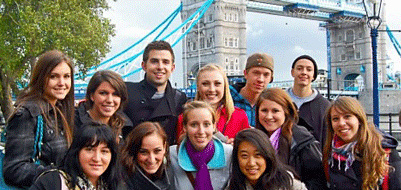
This semester marks the beginning of our third tour season (and second year) of my up-and-coming student tour business, Weekend Student Adventures. My mission: to design three-day-weekend tours for students to Europe’s greatest cities that are more than a pub crawl—still fun…but with a focus on real cultural experience and efficient sightseeing. In our first term, we took 85 students. Last spring, over 250 joined our tours. And this fall, I’m hoping to again triple our bookings to 750.

Student travel can be richly rewarding or, frankly, an expensive waste of time punctuated by lots of hangovers. And I’ve enjoyed being steep on the learning curve now for a few years.

From couch-surfing in the Jewish Quarter of Prague to changing my flights on the go as a new speaking opportunity opens up in London, I live and run my business out of my backpack. Modern technology enables me to run my business out of any coffee shop offering free Wi-Fi, anywhere in Europe.

My dad likes to share stories of writing daily postcards home so that his parents could monitor his whereabouts. He mentioned something about an “aerogram.” I don’t remember the last time I filled out a postcard…and I still don’t understand what an aerogram is. Rather, I’m video-Skyping with my friends in Japan, Ulster, and NYC, with my sister in Washington DC, and with my mother back in Seattle.

Technology has transformed the backpacking culture such that friends are kept updated by the minute about what their traveling buddies are doing halfway around the world. Hostel reservations are done not by phone or fax, but by email or direct booking. Trip research, planning, and mapping are done online. When on the streets, I capture a map on my iTouch, and I’m navigating smartly anywhere I go — for free. This new style of travel is called “Flashpacking.” I got my dad up to speed on this recently during an interview on his radio show.

But there’s a danger to all this technological ease. While the digital age makes travel more efficient and communication much easier these days, it can also take away from the social experiences that really enrich your travel experience. I’ve been in hostels that actually rent out iPads. Rather than conversing, everyone in the common room was zoned in on their device — connecting not with the fascinating people from around the world that are sitting right next to them…but with the Internet.

Recently, I’ve challenged myself to travel more and more with my senses. I’ll close my eyes and feel the uneven cobblestones of Rome beneath my feet, smell the fresh baguettes coming out of the oven in a Paris boulangerie, really listen to the bell towers in the medieval cities across Europe, and taste local specialties in a way that stirs my spirit like a local. Doing this simple exercise brings travel down to a basic level — with your eyes closed, you take nothing for granted, and every other sense becomes more vivid.

As a tour guide and organizer, it’s my challenge to break travelers out of their comfort zone — to connect with the city they’re in. In my talks, I challenge students to give their trip a personal, experiential goal that fits their interests. For me, my passion for biking and Italian cooking has provided the perfect way to connect with Italy beyond the famous and obvious tourist sights. Whether a wandering backpacker or a student on a foreign study program, if you make a point to connect with the culture you’re visiting, you will. And, unfortunately, if you don’t…you won’t.

Of course, for students, culture lives in the bars and night scenes just as vividly as in the great palaces and museums. They say New York never sleeps. Well, neither do European cities. The trick is to find where the locals go for fun after dark. For young people, this is when the real, living culture awakens. And the friends I make while out are locals as well as other travelers from all corners of the planet. For an American student, meeting a young Brazilian in Europe is as great an experience as meeting a young European in Europe.

Part of the fun I’ve had leading my groups around Europe is to help them enjoy the nightlife…and then get them out of bed in the morning to experience the rest. Each minute is an opportunity, and there are none to waste.

This fall, I have 28 tours scheduled — each offering three days of student fun for a great price (just €250) — in Paris, Rome, Amsterdam, Barcelona, Dublin, and Venice. If you know of any students studying in Europe this term, please let them know that my website, WSAEurope.com, is packed with ways they can invigorate each weekend with new experiences, new friends, and lifelong memories. Grazie!

Scampering Down Eiffel’s Staircase

The Eiffel Tower is notorious for its lines. You’ll likely wait to go both up and down by elevator. While the elevator is worth whatever wait is necessary for going up, I actually prefer to take the stairs down. There are three levels. While the stairs are not open to the public between the second level and the top, the stairs between the second and first levels, and between the first and the ground, are wide open. It takes three minutes to bop down the stairs between these levels…as demonstrated in this less-than-smooth video. Let’s go!

If you can’t see the video below, watch it on YouTube.

A Flat Tax and “the New Austerity,” or…?

At Europe Through the Back Door, our tour program just sold its 11,782nd seat for our 2011 season — topping our best tour sales year ever (2007). Despite our antsy stock market and doom-and-gloom news stories, it seems that our economy is gaining some confidence. And yet, at the same time, our local symphony and arts center are in financial crisis.

As a way to celebrate, to give back to my beautiful hometown of Edmonds, and to spark a little conversation about why a society as affluent as the USA is cutting education, neglecting our environment, and defunding the arts while our wealthy class is doing better than ever, I’ve decided to make a donation of $1 million (in $100,000-a-year payments over the next decade) to our local symphony and arts center. This sum represents the money I’ve gained in the 10 years since the Bush tax cuts for the richest Americans (those of us earning over $250,000 a year) took effect.

I believe those who say that “’job-creators’ can’t afford to pay 38 percent rather than 35 percent on their marginal income over $250,000” are either misguided or intentionally dishonest. I also believe a false austerity is being foisted on our society, and its long-term consequences are bad for the fabric of our democracy.

My local paper, The Everett Herald, has picked up the story. Judging from of the comments, some conservatives may choose to see my gift as evidence that the wealthy will fund the arts with the money they save with lower tax rates. But the problem is that for every wealthy person who chooses to dig deep and bail out organizations that are in need, dozens more are pocketing their profits and not following through with their much-ballyhooed prediction that “the private sector will provide.” The beauty of a more progressive tax code — as we all enjoyed in the prosperous, Clinton-led 1990s — is that the burden of funding the finer elements of society is spread fairly among those who can pay. Imagine worthwhile local causes not having to nervously wait for a generous donation — which, all too often, fails to materialize.

With my donation, I hope to challenge people to imagine how a tax code that goes a little harder on the wealthy could be a virtually painless way to help balance our national budget while helping our communities enjoy a few fine points like schools, parks, libraries, symphonies, and arts centers. It’s just so German, Dutch, and Canadian.