Here you can browse through my blog posts prior to February 2022. Currently I'm sharing my travel experiences, candid opinions, and what's on my mind solely on my Facebook page. — Rick
Here are four photos (with captions) relating to Athens and Istanbul. Do I understand correctly that nearly all Mediterranean cruises start and stop in these ports: Barcelona, Rome, Venice, and Istanbul?
Athens' port, Piraeus, is busy with both ferries and cruise ships. It is well-connected to downtown and all the ancient Greek sites by subway. But Greece is dealing with a bit of economic chaos these days, and on the day we were there, all the public transit was on strike. To show their support, the taxis went on a solidarity strike that day, too. So anyone planning on going into town on their own was in a fix. Shore excursions sold out that day. While I was impressed with Athens' cruise port, apparently it's not big enough to work as a place for cruises to start or finish, so officials are scheming to build a big new one. With Greece's economic challenges, no one knows when — or even if — that will actually happen.
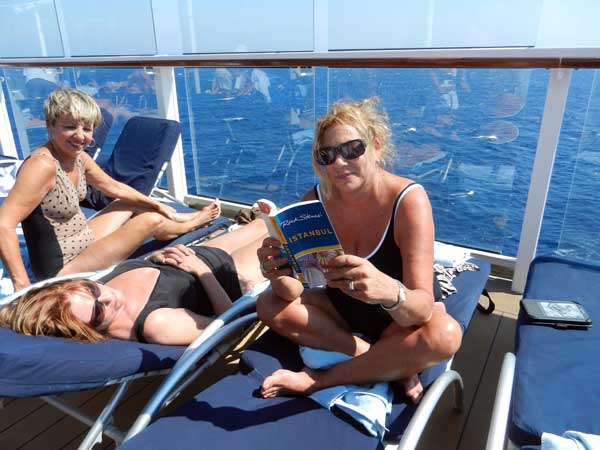
While for many on the ship, the cruise experience was just a floating Vegas, lots of people were on board to mix the fun of cruising with some serious sightseeing. I was impressed by how many people were packing our new Mediterranean Cruise Ports guidebook or one of our city guidebooks. While working on their tans, travelers were prepping for their next port of call. I'm learning so much on this trip; I can hardly wait to huddle with my staff and fine-tune our cruise ports guidebook for its second edition. I'll admit that I've gained a greater appreciation for cruise travelers — from a book-sales point of view — on this trip.
Istanbul is my vote for the most exciting port on the Mediterranean. Ships tie up right in the center of town. It's a 10-minute walk to the Galata Bridge and just a few minutes to the tram that'll jostle you just about anywhere you want to go. And from so many places in this fanciful urban jungle, you can peer out and see your big, shiny ship in the distance.
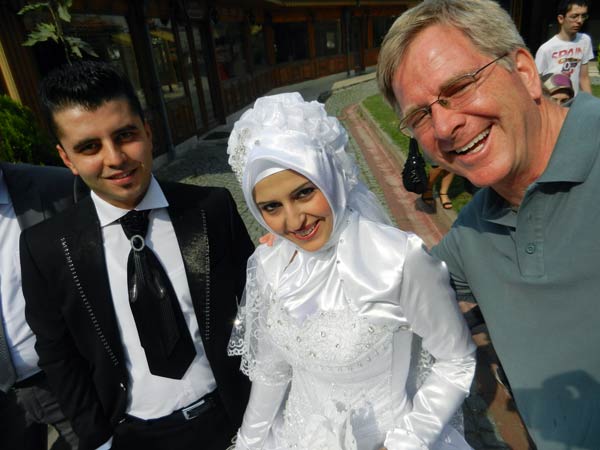
In Istanbul many ships spend the night in dock, giving you a day and a half in Istanbul — and a chance to really enjoy the after-dark scene. Getting away from the touristic crush is easy. At a café over looking the Golden Horn a bit from the center (and therefore without much international tourism) we met a happy Turkish couple who invited us into their photo shoot and wedding album.
The problem built in with cruising is that you hit port with literally thousands of people at the same time. Many of these people are into shopping and gambling as much as they are into travel. In fact, for many, travel is just a way to clean your consuming palate between more rounds of shopping and gambling.
In two weeks of cruising across most of the Mediterranean, congestion wasn’t as big a problem as I expected. But still, the sightseeing focus is on the clichés; everyone seems to do and get excited about the same things at roughly the same time.
The Greek island of Santorini is spectacular and seems to live off of the cruise industry. Its main town of Fira is high above the port. To avoid the long line for the gondola back down to the port, we just hiked half an hour of donkey-pie-strewn switchbacks.
If you can’t see the video below, watch it on YouTube.
Each cruise line has its fans and caters to a different market segment. Shorter trips have a younger clientele while longer ones are filled with retirees. But each ship seems designed to fit a certain style of passenger too. Our first cruise (Royal Caribbean) was glitzy, colorful, and youthful. Its slogan was “We are the nation of why not?” This second cruise (Celebrity) was more elegant. I wouldn’t say stodgy at all. In fact, while it had a more dressy, affluent, and mature demographic, there was plenty of action. But from this video (which you can compare to a similar one on the other ship I shared last week) you can see the stress was on elegance and quality design. … In your experience, which cruise line offers the most enjoyable ambiance and clientele?
If you can’t see the video below, watch it on YouTube.
Here are four photos (with captions) designed to give a little behind-the-scenes look at “the day at sea” and the ship itself. By the way, it’s fun for me to read people’s comments. Some say I make it look horrible and others worry that I’m “pro-cruising.” I’m actually neither pro- nor anti-cruising, any more than I’m pro- or anti-eating Thai food. Cruising is just an option that works really well for a lot of people, and I’m learning about it. With this series of entries, I’m just doing my best to keep an open mind, not be “elitist” as an independent traveler, share what I learn, and have some fun.
By the way, I started this month of cruising weighing in at 212 pounds. On my last cruise blog — in a couple weeks or so — I’ll be reporting on my embarkation weight. We’ll be having a contest to see if anyone can guess how much I’ve gained…or lost.
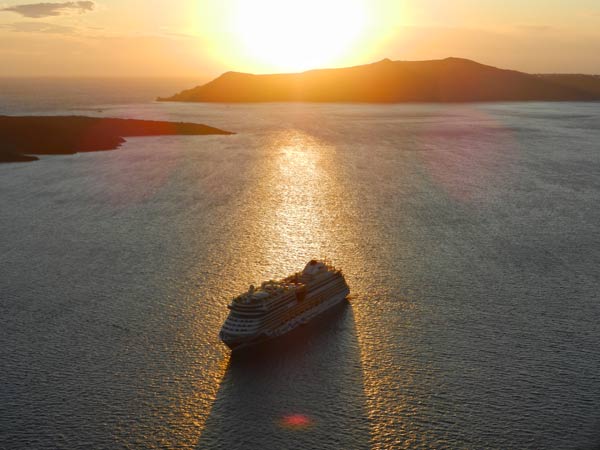
Because there are so few ports where cruises can start or finish, there are almost always days at sea. At least that seems logical as ships have to travel in long hops to make the various itineraries work from Barcelona, Rome, Venice, or Istanbul. While it's hard for me to relax on the ship when we're in port, I love a day at sea. But even relaxing on the ship is not always easy; there are always people to meet, people to avoid, things to eat, and more than enough entertainment scheduled. In fact, an important skill for cruising is to pace yourself and not try to do everything. But when I'm at sea, the sunset is one event high on my list... It seems the most romantic sunset spots are on the Mediterranean. This shot is from the Greek island of Santorini. Where was your favorite sunset?
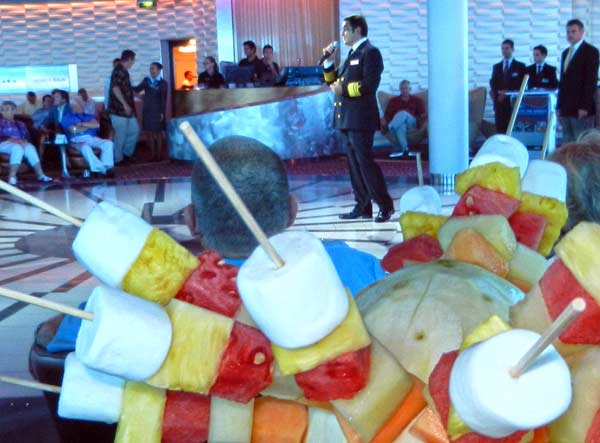
Cruise lines know which passengers are the frequent cruisers, the big shoppers, and the big gamblers. These get a special status that includes "face time with the stripes." There's something about the culture and clientele on a cruise ship that gets a thrill out of socializing with the officers. While there are literally half as many crew members as there are passengers, the officers — people with stripes on their jackets — are a special elite. And it seems a big part of their work is to hobnob with the VIP passengers. Here, the captain is hosting a special wine and dance get-together in a room that was far more elegant than the snacks. Does it seem I'm pro-cruising? Selling out? What do you think?
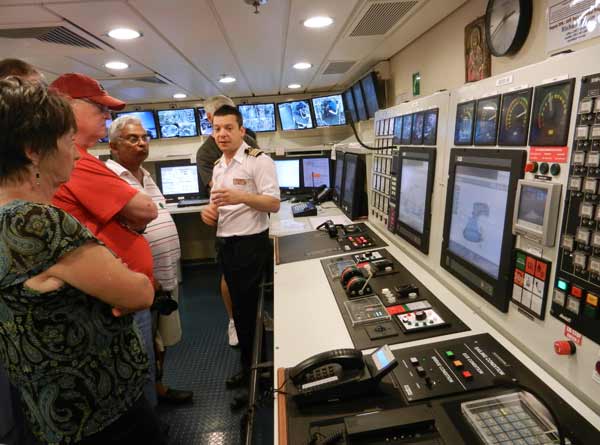
I took every chance possible to get behind the scenes. The ship is an amazing machine — a nearly billion-dollar investment, it seems impressively computerized and automated. I listened to the crew explain how the heat of the engines distills 100 cubic meters of salt water into fresh water every hour, and how the newfangled Azipods (with 18-foot-wide propellers turning a hundred times a minute) propel the ship without a standard shaft. Feeling 100,000 horsepower engines pound my earplugs further into my head as we stepped through sliding, watertight metal doors, I climbed the steep ladders that led into the vast engine rooms with a real respect for the working of this floating city.
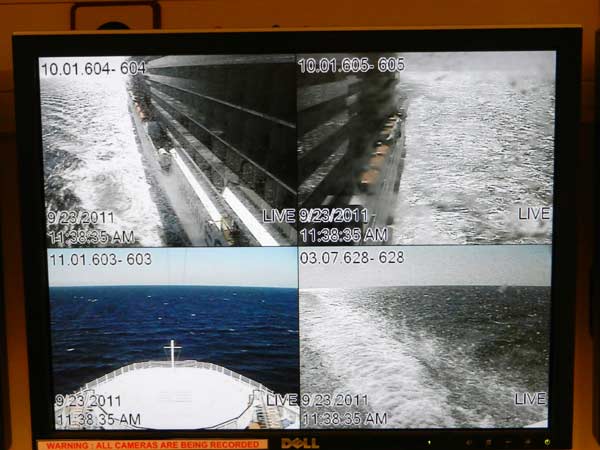
In the engine room, as on the bridge, computer screens show views of all four directions from the ship at once. The captain can see everywhere at all times. The main propellers can pivot 360 degrees, and there are three tunnels bored across the hull in the bow with a propeller in each — giving the pilot an ability to thrust the bow right or left. And, when necessary, the ship can be "at anchor" without dropping the hook but by locking in its GPS coordinates. When activated, this system can keep the ship stationary — moving less than 10 meters in any direction.
Nearly all Mediterranean cruises start and finish in these ports: Barcelona, Rome (Civitavecchia), Venice, or Istanbul. So cruise travelers will generally have a little extra time in these great cities. We just finished one cruise (West Mediterranean) and have a day free in Rome before catching our second cruise (covering the East). Beware: There’s a lot of experience among cruise travelers, and it is shared generously. One lady I met on the ship was a veteran of a dozen or so Mediterranean cruises. She said, “The key in Rome is to leave the crowds and eat with the locals, so I dine on Navona Square.” To me Piazza Navona is about as touristy as Rome gets. But as a night spot, it has a centuries-old magic.
If you can’t see the video below, watch it on YouTube.