Here you can browse through my blog posts prior to February 2022. Currently I'm sharing my travel experiences, candid opinions, and what's on my mind solely on my Facebook page. — Rick

The 99% Rules

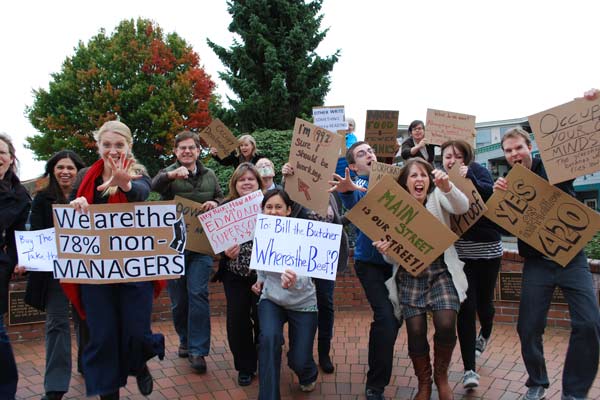
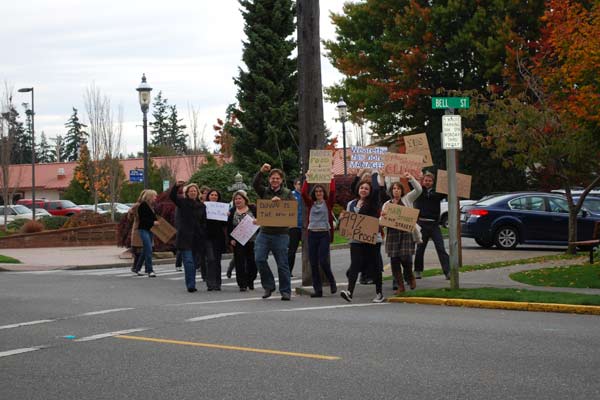
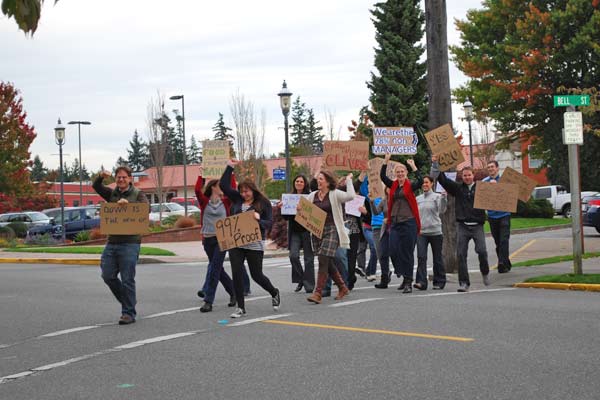
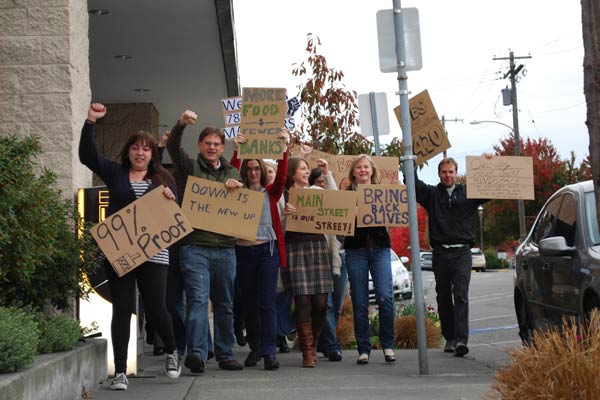
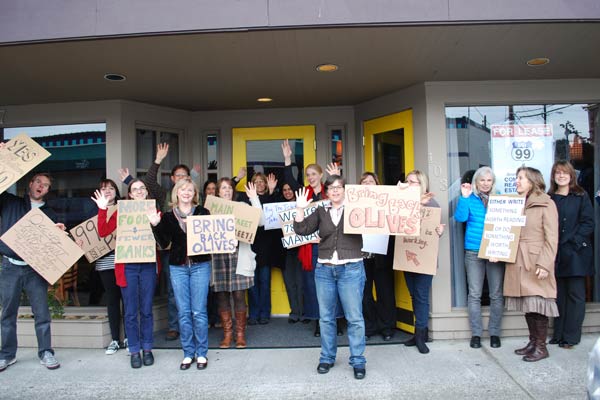
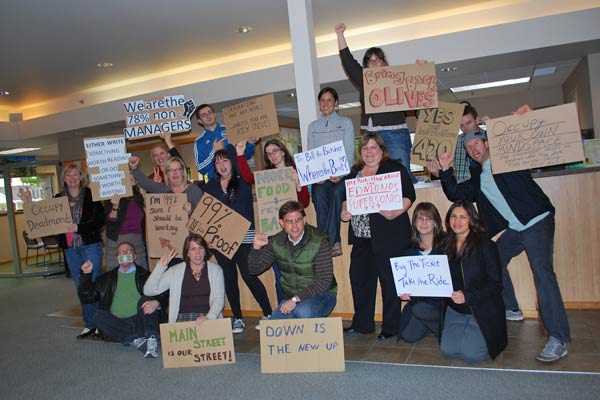
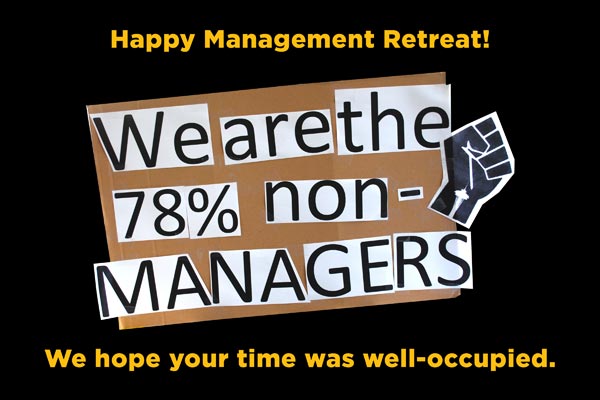
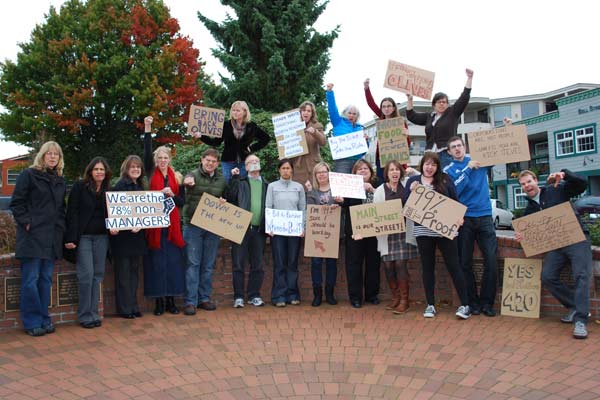
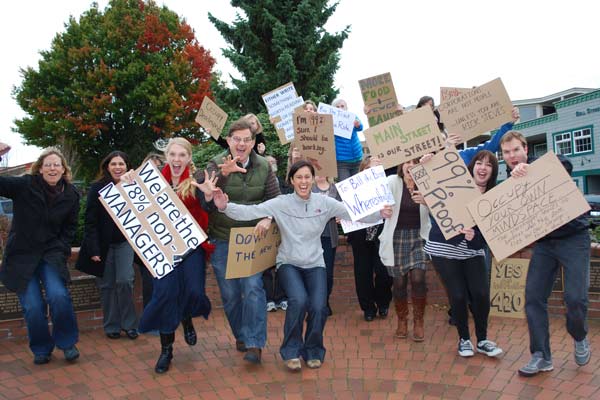
Every time the Management Team of Europe Through the Back Door takes off for our retreat, the remaining staff cook up something crazy. This year, they were swept away with “Occupy Wall Street” euphoria. When I returned, my office was covered with placards reminding me that, while we may call ourselves the Management Team, the 99% (or, in this case, the 78% of ETBD non-managers) rules.


ETBD’s Annual Management Team Retreat

While travel is my favorite “business activity,” I also own and run a corporation employing 80 people and, occasionally, I need to stay home and work in that capacity.

Each year we have a Management Team Retreat, in which our 17 department heads join me at a fun getaway location outside of Seattle for a day and a half of brainstorming and fine-tuning, reviewing the last year and looking ahead to the next. I just got back from our 2011 retreat, and I’m feeling very good about things at Europe Through the Back Door, Inc. Here’s a review of some of the issues we hashed out:

Our tour program sold 11,845 seats in 2011, our best year ever. Tours are selling at an even better clip for 2012 — and 52 percent of those signed up so far are return travelers. We like those numbers, and we love our alums. The big change in 2012 is smaller tour size — by popular request, we cut the maximum capacity of about half of our tours from 28 people to 24. This unavoidably comes with a commensurate increase in prices, but apparently our travelers recognize the beauty of smaller groups. We shot our new tour promo video in 2011, and this winter, we’ll be editing that footage into a much-improved new video to replace our eight-year-old one (which has served us well). And we’re planning our biggest tour alumni party/tour guide summit ever for January 14 2012.

We are having fun with the Web, widgets, and social networking, and look forward to more in the future. Smart content management and communicating with travelers in groups vs. one-on-one emails is a big paradigm shift for us. The TV section of our website has a new widget that lets people type in their zip code to see when my public television series is playing in their town. Except, perhaps, for our shipping department (which has to do all the work), we all like our new monthly Facebook-only blowout sales (in which we lose money, but have over a thousand people give our shopping cart a whirl).

Our Rick Steves Audio Europe™ app — new in 2011 — has been a big success (with about 80,000 downloads). We are busily working on the 2.0 version, with lots of improvements, and are determined to keep it free for our travelers (even though it’s quite expensive to produce). We’ll be adding lots of exciting new content distilled from our radio program in the coming months, and I hope to produce new audio tours to Vienna and the Rhine River in 2012.

For 2011, our new Rick Steves’ Mediterranean Cruise Ports guidebook and our three new Pocket Guides (to Rome, Paris, and London) are all selling well from the start. Our publisher assured us that making a small, punchy, and colorful pocket version of our full-blown city guidebooks would not cannibalize sales of that book, but tap into a big market we were missing (and other publishers already doing “Top Ten”-type guidebooks were enjoying a free pass). Sales figures confirm his wisdom. The Mediterranean Cruise Ports guide is doing so well, we have a Northern European version in the cooker.

I reiterated my commitment to the notion that “content is king.” We’ll let others worry about the endless ways to redesign and amplify, and we’ll focus on generating the best travel content (written, audio, and video) in the business. Our electronic books are dominant; on iTunes, 8 of the top 10 bestselling Europe guides, and 16 of the top 20, are ours. Still, our electronic revenue amounts to only about 10 percent of our print revenue. In the world of guidebooks, print still rules.

I will continue to spend four months a year traveling in Europe, spending two-thirds of the time researching our guidebooks, and a third of the time filming new TV episodes. I’ll be making two big trips in 2012: In April and May, I’ll research in Lisbon, Madrid, Toledo, Barcelona ,Venice, Veneto, and the Cinque Terre, and then film two TV shows. Then, in July and August, I’ll research Vienna, Germany, and the Low Countries, and film three TV shows. I’ll also be traveling to the Cinque Terre to be sure we are doing what we can to help its flood-ravaged villages. In our endeavor to help boost their recovery, we’ll be establishing a hotline-type info service for Cinque Terre-bound travelers (in conjunction with our Italy guidebook) with a monthly update on places to eat and sleep as they open up.

In 2012, I’ll film a new Venice show, a show on the Veneto, and three new “how to travel” episodes. These will replace the ten-year-old trio we have out now — lots has changed (I hear they even have a common currency now). Other TV specials for 2012 include a two-hour pledge special called Hidden Europe featuring a dozen gorgeous, underappreciated, and offbeat destinations (due out in March of 2012); our one-hour special Europe: A Symphonic Journey (just filmed last month and due out in September of 2012); and a one-hour prime time special on Rome (October of 2012). The premiere of our Rome special will coincide with the release of our new, 15-episode seventh series.

I made it clear to the staff that, as a co-sponsor of I-502 (a bill that I believe will make Washington State the first in our nation to legalize, tax, and regulate marijuana in the 2012 elections — see www.newapproachwa.org), I will be dedicating a lot of energy to that project. (In a few days, I’ll be posting a report from a related convention I recently attended.)

People asked about my retirement plans. I can’t imagine that. We’re having too much fun and this work is too gratifying to think of slowing down in the foreseeable future.

P.S. While the cats are away, the mice will play. Every year when the managers go on our retreat, our staff cooks up some clever mischief. With a spirit of “Occupy Wall Street” rebellion in the air, we were a little concerned what this year would bring. On Friday, I’ll fill you in on what they came up with…
Vernazza Evacuated

In the week since devastating floods and landslides hit Italy’s Cinque Terre, I’ve heard from many friends in the region. They tell me that the communities of Vernazza and Monterosso are in for a bleak, backbreaking winter of digging out and rebuilding, but they are determined to come back. This evening, Vernazza has been completely evacuated in anticipation of heavy rain in the next few days. Only the military is allowed in the town. An American-based fund for relief and reconstruction is being set up, and I hope to have details in a few days at www.ricksteves.com/news (where you can also see photos and videos of what’s happened). Keep Vernazza in your travel dreams.

A Late-Night Walk Through Vernazza…Before the Flood

I was in Vernazza last May, updating my Italy guidebook. At 10 p.m. one night, after a long day of research, I enjoyed wandering through this magical town, playing with my iPhone video camera. I never could have imagined that the street I was walking on would, just a few months later, be under 6 to 12 feet of mud and rocks. At the end of my stroll, Chef Claudio at Gambero Rosso joins me in marveling at how Vernazza is indeed “molto bella.” Then he says ciao and grazie…sending his best wishes to all the Americans who keep this town employed. As the rubble from last week’s heartbreaking disaster is being cleared away, we look forward to doing that again. Learn more at www.ricksteves.com/news.

If you can’t see the video below, watch it on YouTube.

A Violent Rain Buries an Italian Friend

Thirty two years ago, I met two American college girls while hitchhiking in Switzerland. They were studying in Florence, and I asked them their favorite place in Italy. They surprised me by naming a place I had never heard of before: Cinque Terre. Curious, I headed south and discovered a humble string of five villages along Italy’s Riviera coast with almost no tourism…and, it seemed, almost no contact with the modern world.

After falling in love with what I consider the most endearing stretch of the Mediterranean coastline anywhere, I’ve gone back almost every year since. Of the five towns, spindly, pastel Vernazza has always been my favorite. Over three decades, I’ve grown up with the people of Vernazza, watched a young generation carry on with their traditions — and seen the town go through years of hard work to develop into a thriving haven for travelers looking for that pristine stretch of Italian coastline. Once rugged and magical, it became…comfortable and magical.

Then, on Tuesday afternoon, a torrent of rain came down and a flash flood thundered through the town, gutting nearly every business, and filling the ground floors with mud.

To learn more about what has happened, to view pictures of the aftermath, and to read message-board comments from people who were there, see my online November Travel News.

I spent four nights here last May, updating our guidebook chapter to the Cinque Terre. At the end of my stay, as I got on the train for Rome, I found myself actually thinking of Vernazza as a person…and as a friend. Of all the towns I know in Europe, this is the one that is, for me, a human puzzle in which I’ve figured out nearly all the pieces. I believe I know more people in Vernazza than in all of Spain. This week, as I read emails from Vernazzan friends and look at the horrifying photos and videos of the disaster, I feel I’ve lost a friend. In fact, looking at the photos — store fronts ripped off and fishing boats crumbled on rocks — I get this ghastly feeling that these are photos of a crime scene…and that nature has murdered my friend.

A routine I’ve long enjoyed with each visit has been to walk slowly from the top of town to the bottom, just before midnight. I’d savor the rhythm of the pastel colors and imagine the town back when a stream rushed down its middle. At some point, generations ago, the stream was put under the pavement. But it still flowed, draining water from the terraced vineyards that surround the town on three sides. I’d always stop at one point along the street where I could actually hear the soft sounds of that water still flowing beneath the road, from vineyards to the sea.

And this week, with a freakishly intense rainstorm — like a misplaced monsoon — torrents of water funneled from the surrounding mountains into the town carrying rampaging tons of mud and debris. That narrow street became a riverbed again, and Vernazza met a fate almost similar to Pompeii: the entire ground-floor of the town was buried.

Today, many of its people are evacuated, there’s no water or power, no communication, and the town is cut off from the rest of the world as roads and train lines are still being dug out. Businesses that Vernazzans had worked all their lives to build are washed away. Its church now houses only a mucky lagoon.

One of the joys of my work is sending travelers to Vernazza. And today I read an email from one Vernazzan who fears they may not rebuild and it could become a ghost town. But I think people are determined to dig out and bring life back to both Vernazza and its neighbor Monterosso. (The other three towns of the region — Riomaggiore, Manarola and Corniglia — because of their luckier topography, got through the storm essentially unscathed.)

I had planned to visit the town next April to film an updated version of my TV show on the region. Then I realized, there may be nothing to show. I was thinking I’d have to put the TV shoot on hold. But then I thought: no, I need to take the crew to the Cinque Terre and show the world the resilience of its people, the natural beauty of the region, and how its communities will carry on.

How can we help? Those who care about the region can donate money. (I don’t feel comfortable with collecting money, and it’s too early to clearly see which relief organizations will be involved.) 

I think, most importantly, the best thing we can do is keep Vernazza and Monterosso in our travel dreams and incorporate them into your next trip. Tourism is the life blood of these towns and, while they need and will get government aid along with charity from friends in the short term, they will need to rekindle their thriving economy in the long term. That involves you and me.

Along with not abandoning the towns of the Cinque Terre, we need to keep in mind that violent weather devastates many more “ugly sister” towns on our planet, where few people notice or rush to their aid. This happens in wealthy corners of our world — like Europe and the USA — and it happens in corners of our world where desperation is the grinding, day-to-day norm. And while many in America feel that acknowledging and addressing climate change is just too expensive for their bottom line, climate change is a reality. And its violent weather packs an even bigger punch, with more devastating consequences, in the developing world.

What will I do? I can keep singing praises for the Cinque Terre. I can dedicate the same promotional energy to it in the coming years that I have in the past decades — even if there will be a hard and ugly time of healing. And I will work to help explain to climate change deniers in our society that it is not “just a theory,” and its victims are real people.