Here you can browse through my blog posts prior to February 2022. Currently I'm sharing my travel experiences, candid opinions, and what's on my mind solely on my Facebook page. — Rick

Thoughts on Good Travel: Eat the Cheese, Smell the People


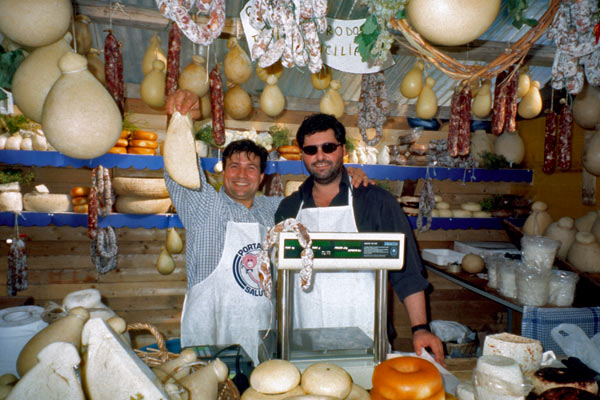
Cheeseboys
These Sicilians are evangelical about their cheese. If I didn’t stop the car and get out, I would never have met them.

When we travel, it’s important to balance our desire to stick to a set itinerary with the freedom to embrace spontaneity. It takes discipline to let serendipity trump carefully laid plans.

For me, a fundamental goal in my travels is to have meaningful contact with local people. When an opportunity in this regard presents itself, I jump on it. Driving by a random cheese festival in Sicily? Stop the car. Get out. Eat cheese. Experience it. Hiking through England’s Lake District and popping into a pub for a drink? Don’t sit at a table. Sit at the bar, where people hang out to talk. Dinnertime in Mostar, Bosnia? Don’t go to the touristy riverside places again. Turn away from the cutesy Old Town and head out to “The Boulevard” — the front line of the recent sectarian troubles — and be the first American tourist to eat at a new local eatery. Talk with the owner about how Muslims and Croats are now (tentatively) coexisting in peace. Connecting with people is what enlivens your travel experience.

As both transportation and communication speed up, it’s more important than ever to slow down and smell the roses…or even the people. I was sitting solitary on a bench enjoying the floodlit facade of the cathedral in Reims, France. It was dark, and I was munching on a late dinner — a rustic baguette with cheese. Suddenly the bum on the next bench leaned over and offered me a swig from his crumpled-up plastic bottle of red wine. I didn’t take it…but the gesture and his smile, juxtaposed with that glorious Gothic facade, warmed my meal and helped complete an experience that gave me a memory I’ll enjoy for the rest of my life.

Especially when you get out of your comfort zone, you replace general stereotypes and media-created images with more accurate impressions from firsthand experience. Before going on my recent trip to Iran, I figured people there would be angry at an American they’d meet on the street. What I found reminded me that only by actually going someplace in person can you understand the sentiment of people living there. We were stuck in a traffic jam one day in Tehran. I was just sitting patiently in the back seat of our car when the man in the next car motioned to our driver to roll down the window. He handed over a bouquet of flowers and said, “Please give this to the foreigner in your back seat and apologize for our traffic.” While certainly not what I expected, this was typical of the warmth and friendliness I experienced throughout my adventure in a country that is supposed to be our enemy.

Like skiing with bent knees makes the moguls fun, good travelers enjoy the bumps in the road. They risk making mistakes, get out of their comfort zones, and have a positive attitude. I like to say that if things aren’t to your liking, change your liking.

Making and Selling Great Guidebooks: The Focus of Our Annual Publisher’s Summit

With about 40 guidebooks selling strongly across the US, our publisher (Avalon Travel) makes time each year to come up to Edmonds for a summit and brainstorming conference. We’re so thankful to have a partnership where we combine our talents with theirs. After a festive party at my house with a dozen of my staff and a dozen of their staff actually talking about something other than making–and selling–great guidebooks, our Avalon friends have flown back to their home office in the Bay Area. They left us feeling synchronized and stoked for a great 2012. You, my traveling readership assembled in our virtual Facebook Hall, are the closest thing I have to a stockholders meeting, so here’s a dry–but, I hope, interesting–summary of the guidebook world and how we fit.

Rick Vintage
For thirty years now I’ve been seeking out Europe’s back doors. While I no longer wear my “I’m not a tourist, I live here” tee-shirt, I still travel with the same philosophy. (This cool door, which graced the cover of my guidebook Europe Through the Back Door in its third edition in 1982 is from the ruins of “King Arthur’s castle” at Tintagel in southwest England.)

The year 2011 was a big one. At the start, the giant retail chain Borders was sick but still floating, while our cruise guidebook and color pocket guides were just ideas. At the end of the year, 600 Borders stores were gone, but our new books were a reality. In the wake of the Borders collapse, electronic sales did not take up the loss of overall retail sales in the book industry–but our guidebooks saw no drop in sales (meaning we gained in market share). Our new Pocket Guide series (starting with Pocket London, Pocket Paris, and Pocket Rome) and our Mediterranean Cruise Ports book are in the bookstores and selling strongly today. In fact, in January our cruise book logged in at number 12 on the national list of the top-30 guidebooks.

Currently, of the best-selling travel guidebooks in the US, the top-30 titles are dominated by guidebooks to Disneyland and Hawaii–and by Rick Steves books. While Frommer’s and Fodor’s are still there, Dorling Kindersley, Lonely Planet, and Let’s Go (which used to be larger players) have no titles on the list.  While print is a smaller part of the Lonely Planet mix–and they are well-distributed worldwide–in the US market for guidebooks about Europe, they have faded dramatically. If you take out Disney and Hawaii, Rick Steves guidebooks hold the big majority of the top-30 spots on the list.

You could make the case that the last four years have been the biggest in publishing history since Gutenberg. First, the economic crisis really shook things up; 2008 saw a big drop in sales industrywide. Then the Kindle (which is just four years old) and its ereader competition changed the way people read. The phrase “There’s an app for that” became a part of our lexicon. Millennial Generation travelers, who are value-oriented and get their information in different ways, are coming on strong and are a market segment to be respected.

With the advent of ebooks, it’s exciting to follow trends in publishing. Overall for 2011, print sales were down 6 percent while electronic sales grew, varying widely from genre to genre. For example, while about 50 percent of fiction sales are ebooks, children and travel ebooks are still only 10 percent of sales. Although romance readers are gravitating to tablets, guidebook readers still prefer print. As fiction goes electronic and travel stays print, the travel genre is of relatively more importance to brick-and-mortar bookstores.

Meanwhile, we’re ready for the future. The powers in electronic guidebooks are Rick Steves (Avalon’s parent company, Perseus, is enthusiastic about being a force here), Frommer’s (whose new head is a futurist with a passion for moving beyond print), and Lonely Planet (now owned by the BBC).

With each annual meeting our publisher brings us their wishes for new books, although the list is getting smaller since we’re satisfied that we’ve covered Europe well. The 2013 publishing season will likely see a new Rick Steves’ Barcelona and a Rick Steves’ Northern European Cruise Ports–and in the pipeline are new Pocket Guides for Athens, Florence, Venice, Amsterdam, Istanbul, and Prague. The biggest untapped market is not covering new destinations, but introducing more people to the destinations we already cover, in part by making it easier for them to purchase and download guidebooks while they’re on the road.

At the end, we all agreed to hold the line on prices as much as possible, that my gang will continue to focus on generating good content while Avalon will publish and distribute it (as they do so well), and that Europe as a destination fits the teaching soul of the Rick Steves enterprise.

Having sat through a day and a half of meetings, it’s clear to me that the brand “Rick Steves” would be nothing without the hard work and wonderful talent of our co-authors, our editors here in our office, and our good friends at Avalon Travel. Here’s to great guidebooks making happy travels for 2012!

Rick Steves’ Road Trip USA: 20 Cities in 20 Days this March

For 30 years, I’ve spent all my travel time overseas…mostly in Europe. Finally, it’s time I saw the good old USA. On March 3rd, I’m setting off on a 20 cities in 20 days road trip, giving talks in mostly smaller cities and towns — all the way from Seattle, Washington to Tallahassee, Florida.

I’ve never been so excited about an upcoming trip — not only to be bringing my travel lessons to smaller cities, but to actually be driving across the entire USA. For the last few years, I’ve noticed that every time I’m hired to give a talk in a “smaller market” — places like Fort Wayne, Indiana, Fort Smith Arkansas, or Peoria, Illinois — I encounter lots of local pride, a super friendly welcome, and an auditorium packed with enthusiastic travelers. I was enjoying these middle-America gigs even more than my regular stops in the big cities.

So, for 2012, rather than do my usual “8 major markets in 8 days” tour of the big PBS stations during March pledge drive season (which I’ve been doing for more than a decade), I’m thinking bigger and smaller at the same time. On this year’s 20-day trip, I’ll have fun helping support smaller public TV and radio stations, giving lectures, and making impromptu stops at independent book stores that rarely get a travel writer visiting in person. I’m thankful for all the hosts who have already made it easy for us to book exciting events at each stop along the way. (My schedule is jammed packed.)

Beyond all that, my “Rick Steves’ Road Trip USA” agenda is to inspire people to get out and see our beautiful world — and to inspire myself to explore and appreciate the great diversity and hospitality of my own country. Our Road Trip USA page will track my journey, and I’ll be blogging daily right here. And, each night along the way, I look forward to giving talks that help Americans enjoy maximum thrills for every mile, minute, and dollar they have for their next vacation.

If you live along my Road Trip route, tickets are now available at each stop. If you have friends and family who live nearby, share the news. And, wherever you live, I hope you’ll travel along with me virtually.

Hop in, buckle up, and hang on. It’s going to be a fun ride.

Happy travels – in Europe and the USA.

Rick Steves' Road Trip USA

Marijuana Policy Behind the Scenes: My Notes from a Drug Policy Reform Conference

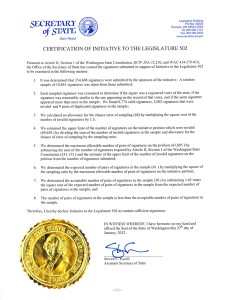
With a group of respected and caring citizens, IOfficial-Certification have co-sponsored Initiative 502 in Washington State (New Approach Washington), which will legalize, tax, and regulate the sale of marijuana for adults. We worked very hard last year to gather more than 350,000 signatures. Last month, we turned them in, and last week, our state government certified that we had gathered enough good signatures. This means that (unless our legislature simply accepts the initiative outright), I-502 will be on the ballot in November of 2012.
I’m working with a wonderful group of activists who (like their counterparts did in the 1930s to end the prohibition against alcohol) endeavor to end the US government’s war on marijuana. We believe that it’s not a question of if the USA will stop sending pot smokers to jail…it’s a matter of when. While there are many good reasons to be waging this battle, for me this is a matter of civil liberties and pragmatic harm reduction.

As with the laws against booze during Prohibition, people are realizing that the laws against marijuana are causing more harm to our society than the very drug they criminalize. When alcohol was finally legalized, no one was saying, “Booze is good.” Rather, they were deciding that the law was bad, and that it made more sense to tax and regulate alcohol as a recreational drug and to take the money, violence, and crime out of the equation — to treat its abuse not as a crime, but as a health and education challenge. I believe that is what’s happening now in our country with a reconsideration of laws criminalizing marijuana use. And I believe Washington State will become the first state in the country to actually legalize, tax, and regulate marijuana this November. I will be working hard between now and then to help make that happen.

I am excited and proud of our work. The people on our team see this not as a “pro-drug use” crusade, but as a “smart drug law” crusade. I’ve been a board member of NORML for ten years, and during that time I’ve attended many drug policy conventions around the country. I just returned from a very good conference put on by the Drug Policy Alliance and co-hosts including the ACLU, Open Society Foundations, and the International Drug Policy Consortium. I thought you might enjoy an insight into what people discuss at such an event. So, for your interest, I’ve typed up some of my rough notes. I should stress that I don’t necessarily agree with all these points — I simply found them thought-provoking, and hope you might, as well.

Notes from the International Drug Policy Reform Conference
November, 2011, in Los Angeles

The system (as established and maintained by the USA) is rigged to prevent change. Drug policies are dictated by the UN. If a country is decertified (which can happen, for example, if it legalizes marijuana), the US Congress is required to vote against them in trade policies (causing an expensive trade war). Another example: Our drug czar is required by our government to vote to keep drugs illegal.

If an individual state passes a law that takes a course different then the federal law, the USA’s ability to impose its drug laws on the rest of the world will be diminished. The paper tiger of UN drug treaties will then change as the USA is forced to reconsider its war on marijuana

Or: Rich countries in the north can ignore the USA and UN. But in the south, poor countries will likely continue to follow regressive drug laws to protect relations with the USA, Japan, or Russia. They know they can lose their foreign aid and favored trade status if they buck US drug policy dictates.

While the USA enforces UN treaties on the rest of the world, it can ignore them domestically because our constitution prohibits us from having to follow any international laws.

“UN” is a four-letter word in DC. The UN is held just below the French in contempt. The UN was 60 nations at first. Now it’s 200 nations. The USA hates the “one nation, one vote” element of the UN. We are more comfortable with World Bank and IMF (because votes are weighted and the USA can throw its weight around).

UN votes are public, so consensus is extorted. With private voting, like for secretary general, many countries would oppose the USA on drugs. But it’s too costly and dangerous to do so publically, especially for a poor or Third World country. So when drug policy is brought to a vote, little countries comply with the USA.

When it comes to the rest of the world, we don’t have a weapons shield. We have a news shield and an ideas shield. “War is God’s way of teaching Americans geography.”

The USA even wants to prohibit indigenous people from chewing cocoa leaf.

While the Dutch have to keep drug laws on the books due to international conventions (i.e., US indirect threats and pressure), they have a system of just ignoring them (like Seattle does with I-75 — letting enforcement of marijuana laws be the last priority). The Dutch justice system has the option to enforce a law only if it’s considered in the national interest.

Because the illegal drug trade is so profitable, there is an established elite class of big-time drug merchants in drug-producing countries throughout the world. “Narcotecture” is the name of fancy mansions of drug dealers in poor countries like Afghanistan. Current drug laws are enriching organized crime throughout the world.

The UN is west-centric, with our values of individual over common good. Where we might celebrate “civil liberties,” someone in Taiwan exercising what we might promote as a basic freedom can bring shame on their grandparents or community with their action.

To people outside our country, we Americans live in the belly of the drug-war beast. Countries with compassionate and “harm reduction” policies like Portugal provide a beacon of hope.

Portugal’s “Law 30”
Portugal’s “Law 30” decriminalized the consumption of all drugs in 2000. They recently had a ten-year review, and even though a conservative government has since replaced the more progressive government that established this law, the law is considered good. Even former opponents of the law agree that its benefits far outweigh its harms. “Law 30” will continue to be Portuguese law of the land.

Portugal was repressed by a dictatorship until 1974. With freedom, people embraced their liberty. Activities like drug use spiked (temporarily). In 1999, a group of experts came together to find a solution to this problem. They determined that the “war on drugs” was a “war on people.” With the goal of establishing a legal framework for harm reduction, in 2000 they made their law decriminalizing the consumption of all drugs.

Like in the USA, 1% of Portugal’s population (100,000 out of 10 million) were using hard drugs. The Portuguese consider a drug addict not a criminal, but a sick person.

With their ten-year review studying drug consumption trends from 2001 to 2009, they found the following: “And nothing bad happened.” The big negatives some predicted did not materialize. They experienced none of the expected “drug tourism” (young backpackers didn’t converge on Portugal as the new drug mecca).

Statistically the number of people who’ve tried various drugs increased a little (possibly because it is more comfortable to admit it after the change in laws). There was no change in use rates from when drugs were illegal.  Over the decade, there was a reduction in use by young people (age 15-24). Among that age group, recreational use went up in 2003 (immediately after the new law went into force) and then dropped back down in 2005. Portugal now has fewer people with HIV and more people in treatment. The police like it as they can now focus on violent crime. The burden on Portugal’s prisons and criminal system is less. And the relationship between the Portuguese government and its drug-using population went from enemy to advocate. The slight increase of consumption in Portugal after this law was similar to increases in Italy and Spain during the same period; therefore, it was likely a regional trend not related to their law change.

Netherlands
Changes recently introduced in the Netherlands seem designed to add restrictions to coffeeshops: They must now be 350 meters from schools rather than 250 meters. The THC must be limited to 15%. This distinction means that, legally, there are two kinds of pot — one harder and one softer.

The Dutch make a firm distinction between hard and soft drugs. With their model, Dutch use of heroin is very low. The problem with the coffeeshop model of retailing marijuana is “the grey area” (the back side, wholesaling, which has never really been addressed and is just kind of ignored by the Dutch system). The Dutch cannot deal with the reality of wholesaling because that would break international trade agreements (put on all countries via the UN by the USA), and that would be very expensive.

With pressure from outside (so foreigners don’t come in and smoke), some in the Dutch government are trying to make coffeeshops become clubs only for locals rather than commercial sales points. Only locals with membership cards could enter. This is unpopular in the Netherlands because officials fear crime will go up, and cities like the status quo. On this issue, it’s more progressive urban areas against the conservative rural votes in their parliament.

Marijuana Law Elsewhere in Europe Varies
In Switzerland, it’s a civil offense with a fine but no crime.

The Czechs are free to grow their own.

The Belgians can grow one plant per person on their own or, more efficiently, by joining cannabis clubs.

Spaniards can retail seeds and gear but not actual marijuana. They can grow it in conjunction with marijuana clubs.

Greece’s prisons are full, and 40% of its prison population is there on drug charges. As they have no money, in the future treatment will increase, and incarceration will decrease. While you can get a fine now for smoking marijuana, trends in Greece are towards allowing home growing and personal use.

For the Swedes, not taking drugs is a matter of willpower: “If you are weak and partake, your biology changes and you then get addicted.” Therefore, Swedish drug policy is regressive v.v. other European nations.

Most of Europe has the option to not enforce existing laws: “opportunistic” or “expediency” principle. In the USA, if the law exists, it must be enforced. (It’s the same in Germany, so heroin was made legally a medicine in order to allow “café fix” maintenance centers.) Europe wants science over ideology.

USA: The impact on European media of California’s recent Prop 19 debate was much greater than Portugal’s Law 30. Europeans understand that the problem (the war on marijuana) emanates from the USA. The success of I-502 in Washington State would be huge in Europe. In Seattle, I-75 is de facto decriminalization. These are the kinds of actions that are viable within today’s parameters. If I-502 passes, this very well may be the start of a big change in international laws.
My USA Today Editorial Promoting Study Abroad

Something I feel very strongly about is the value of students incorporating a little world travel into their university experience. That’s why I’ve been working as a spokesperson for NAFSA: Association of International Educators.

Last week, we created a little buzz in the foreign study community with an editorial I wrote in USA Today. I thought you might find it interesting, so here it is:

Rick Steves: Study Abroad Is a Good Investment

Even in challenging economic times, making sure that study abroad is part of our college students’ education is a vital investment. If we want a new generation of leaders and innovators who can be effective in an ever more globalized world, sending our students overseas is not a luxury. It’s a necessity.

I believe that our national security rests upon the foundation of a well-educated electorate with a broad and sophisticated worldview. Ninety-six percent of humanity lives outside our borders — and we risk being left in the dust if we don’t know how to effectively engage the world. It’s critical to deal smartly with the emerging economic and military powers of China and India, and we must better understand the intricacies of Islam. While Germany is increasingly going wind-powered, the Dutch are building up their dikes and Africa is fighting a growing desert, we need policies more insightful than “drill, baby, drill.”

Fear vs. understanding

There’s a lot of fear in our society today. Students who travel learn that fear is for people who don’t get out much. And they learn that the flip side of fear is understanding. Travelers learn to celebrate, rather than fear, the diversity on our planet. Learning in a different culture and place allows us to see our own challenges in sharp contrast, and with more clarity, as we observe smart people in other lands dealing with similar issues.

American college students understand the value of study abroad. Four out of every five first-year students aspire to study overseas. But at any given time, only about 2% of students are able to. Educators are particularly concerned that the lack of opportunity for students from poor socio-economic backgrounds will cause a “global divide” between students who’ve benefited from a global education … and those who haven’t. And students for whom foreign travel is not easily affordable are the ones who benefit most from the experience. As a society, we can help enrich the education of our younger generation, and brighten their futures, by making this experience more accessible. The Paul Simon Study Abroad Act, currently being considered in Congress, would dedicate $80 million annually to incentivize study abroad, with the goal of encouraging a million American students from a wide range of backgrounds to study abroad each year.

No better time to invest

Is now the time to be devoting precious public funds to sending college kids overseas? Absolutely. Our world is one big, rapidly evolving marketplace. Employers crave graduates who are flexible, multilingual, and comfortable in multicultural settings. Study abroad sharpens these skills and helps keep American workers competitive.

In spite of its financial turmoil, the European Union recently expanded its Erasmus Program, which helps students study abroad. That’s because the people of the EU understand that globalization is like the weather: Regardless of what you think about it, you have to live with it. And when it comes to stoking trade, building international partnerships, and simply co-existing peacefully, Europe understands that study abroad is a smart investment.

Americans who want our next generation to be hands-on with the world — grappling constructively with international partners against daunting challenges that ignore political borders, working competitively in a globalized economy, and having enthusiasm rather than anxiety about other cultures and approaches to persistent problems — can get on board with the movement to help our students get a globalized education.

Encourage the young people in your lives to get a passport and see the world as a classroom. It’s good for America. And it’s fun.