Here you can browse through my blog posts prior to February 2022. Currently I'm sharing my travel experiences, candid opinions, and what's on my mind solely on my Facebook page. — Rick
Two weeks ago I set off in a comfortable GMC Yukon SUV for an epic Seattle-to-Florida road trip. Far north of the Yukon, on that same day, my little sister, Jan, set off on a journey that makes my adventure look like a trip to the mailbox. Behind 14 happy dogs, she left Anchorage for Nome, on the 1,050-mile-long Iditarod race.
Of course, even qualifying for the Iditarod is a huge accomplishment, and finishing this dangerous and grueling race is a personal victory. And Jan is about to do that. So far 50 teams have finished, 13 have dropped out or scratched, and three are still on the trail.
While Jan’s bruised, battered, and sleep-deprived, her spirits are soaring as she sets off on the last 70-mile leg of her journey. Like a nervous mother, I’ve been checking in, via the excellent Iditarod website, to see how she’s doing.
It’s fun just reading about the stations — wind-blown communities of corrugated tin igloos, with a couple hundred bundled-up residents who wait for each musher with warm bowls of soup — and about the terrain between each station. Talk about a travel adventure… I’m dreaming of interviewing Jan on my radio program once she’s back home in Seattle. I’ve got so many questions.
Today, Jan embarks from White Mountain to a station called Safety, across perhaps the most treacherous stretch of the entire race. When windy — gale-force winds routinely whip off the Bering Sea here — this can be treacherous — even deadly. When the weather turns bad, mushers are advised to grab a shelter and wait it out. This morning the weather is calm and sunny, though 16 degrees below zero. I’m so relieved, as I imagine my sister is.
The last couple of days, while busy with travel and lecturing, have offered me scant time to get out and enjoy the towns and their people. In Des Moines, Matt dropped me at the airport and I flew to Dayton, Ohio, and then to Little Rock, Arkansas, where I met back up with Matt and the car.
My impression of Dayton was of a town with an innovative spirit that had once been a proud leader, and had then taken the kind of economic hits that walloped towns all over the Rust Belt.
The late 19th century was a heady time of inventiveness and industry here. I saw the bike shop from where the Wright Brothers “invented the airplane in 1903 and perfected it in 1905.” My proud local friends made it clear that while Kitty Hawk, in North Carolina, got all the fame, the brainwork originated here in Dayton.
Dayton is where, in 1879, a local merchant, concerned that employees were ripping him off, devised a box in which to register the cash coming into his shop. He went on to establish the National Cash Register (NCR) Company — once a huge employer here, in a thriving city where the Miami and Erie Canal helped bring goods to market. But NCR recently took its cash and skipped town, and the industrial canals have been antiquated ever since the advent of railways. Abandoned in the 1870s, the Miami and Erie Canal was eventually filled in. The Great Dayton Flood devastated the city in 1913, when the Miami River overflowed its banks (it’s now a model in flood control). Other claims to fame: In 1933 this was the birthplace of the Soapbox Derby, and among former Yugoslavs, Dayton is a household word for the peace accords carved out here, which helped quell the violence wracking their society.
Enjoying a moment to survey the packed auditorium for my Dayton talk, I overheard a young couple, who’d arrived 20 minutes early to find the place nearly full, saying, “Wow, it’s tough to compete with old people. We should’ve gotten here earlier.” Throughout this trip I’ve noticed how retired people arrive half an hour early, and younger people pop in at the last minute.
Flying down to Arkansas, I met Matt at the Little Rock Airport, and we popped into the inspirational William J. Clinton Presidential Library. Taking the tour in this beautiful building overlooking the Arkansas River, I was struck by how much history happened in the eight years of the Clinton presidency, and how important it is to have a smart person for our president. This was my first visit to a presidential library, and I noticed how it effectively gives its man a positive spin. There was no mention of sex scandals, and plenty of focus on Clinton’s charisma, eloquence, and vision. Locals seem to agree that the Clinton Library has been a real boon to little Little Rock. It made me nostalgic for the 1990s.
Driving north, toward Conway, we found ourselves in a world of flags, Coke, and God. Conway is a railroad town on the Arkansas River with a humble old center made of brick. Though they tore down their historic train station, a bank was built a block away to look like a classic small-town American train station. At the edge of the one-story-tall old town center is Toad Suck Square — something locals love to talk about, along with their Toad Suck Daze festival. While the origin of the name is murky, I was told it may have something to do with men sucking on beers and swelling up like toads. Speaking of sucking, I could see how the coming of big-box stores had sucked the life out of many of Conway’s small family-run stores.
Surveying from the former lovers’ lane high above Conway, I noticed how the town filled a basin between two ridges — and that, rather than tall buildings, the city’s skyline was towering signposts advertising Motel 6, Wendy’s, IHOP, Express Lube, and the Waffle House.
Making those phones ring at small PBS stations all around the U.S.A.
My visit to University of Central Arkansas was a busy one, with a lecture to students on travel writing, a lunch talk for supporters of the local public TV station, and a couple other events on campus. Then we gathered with supporters of the university at a grand and elegant home for a cocktail party (permitted in this dry county because it was private residence). Walking down the red-brick, carpet-like walk leading to the elegant porch, with its towering white columns, I was swallowed up by a wonderful and enthusiastic crowd of leading local citizens and travel enthusiasts. Later, taking a moment away from the happy commotion to enjoy a little quiet, I stepped onto the back porch and sat quietly, feeling the humid atmosphere of this tropical bit of America, appreciating how the porch was designed to catch the cooling breeze, how delightful a lazy rocking chair can be, and how the unfamiliar birdsong reminded me I was far from home.
I had never been in a dry county before. The human craving for alcohol creates interesting challenges here. Things are changing now, as Faulkner County is becoming “damp.” Bars and eateries can serve alcohol if they are technically clubs, letting patrons join by simply signing in. Back when the ban on alcohol was strictly enforced, locals noticed how the restaurant scene and entertainment scene were hugely disadvantaged. They’re yet to recover.
Ever since World War II, when so many beer-loving men were out of the country fighting, and women voted in the ban on booze, the people of Conway have had to drive to “last-chance” liquor stores waiting just over the county line for their beer runs. Opponents of the ban noted how young people would drive to the next county to drink…and then die in car accidents because they then had to drive home. The Faulkner County economy suffered from the loss of booze-related sales tax, and employers couldn’t lure in talented workers if there was no chance of a nice beer at the end of a long work day. Now, with the recent “dampness,” people attribute the relatively strong economy in part to the new availability of alcohol.
Party time hospitality in Arkansas
At dinner, chatting with a woman who ran a restaurant that had been one of the first in Conway to serve wine, I was impressed by her courage. She had been threatened by the local pastor, who’d said that whenever there was a fatal alcohol-related accident on the roads, she’d be partially to blame.
When dessert was served and I was called upon to give my talk, I was actually feeling a little buzz from my wine — ironic, as this was my first time lecturing in a dry county. I talked slowly and softly, hitting hard my message about Travel as a Political Act. It was a thrill to share these ideas to such a smart and engaged crowd, many who, it seemed, were new to some of these ideas.
Tomorrow we go to Memphis or Nashville. I get them mixed up, but that’s about to stop.
After driving through rural Iowa — the humble, hardscrabble towns, the golden hills, and the quiet farms — coming into Des Moines is like entering the Manhattan of corn country. It feels busy, cosmopolitan, and a different world.
While its shiny golden dome marks the state capitol, Des Moines feels like the capital of the agricultural world. Appropriately, it’s the home of the World Food Prize. Dr. Kenneth Quinn, former US Ambassador to Cambodia, heads this organization inspired by hometown hero Dr. Norman Borlaug, who’s considered the father of the so-called Green Revolution that dramatically boosted agricultural production worldwide.
Borlaug, who started out as an Iowa farm boy, designed a strain of wheat that overcame the famines that wracked India and Pakistan in the mid-1960s. Because of Borlaug’s “miracle wheat,” those once-hungry lands became robust exporters of food. Borlaug is known (especially here in Des Moines) as “the man who saved a billion lives” — quite possibly more than any other person who has ever lived.
Knowing about my work with Bread for the World, the gracious hosts of my evening lecture, Iowa Public Television, organized a private tour of the newly renovated World Food Prize Hall of Laureates. I was guided by Ambassador Quinn himself, whom I had met here two years ago while attending the annual World Food Prize conference when my friend and president of Bread for the World, David Beckmann, received the award.
In the 1890s, the City Beautiful Movement was sweeping across the USA, and the people of Des Moines gave their city a stately set of Neoclassical buildings overlooking their river. With new parks and pedestrian-friendly zones playfully ornamenting a newly heightened levy, this part of town feels ready to bust into a boisterous future. The former library has recently been turned into the World Food Prize Hall of Laureates, a palace celebrating heroes in the war against hunger.
The building is really as sumptuous and filled with symbolism as the great palaces I’m accustomed to seeing in Europe. But this is from the 20th century, and all about food and Iowa. Under its awe-inspiring dome, four grand pillars each have a theme, celebrating the world’s four great crops: wheat, corn, soy, and rice. Above, as if carved on an ancient Greek temple, a frieze trumpets the Norman Borlaug quote, “Food is the moral right of all who are born into this world.”
Iowa really is enthusiastic about nourishment. The World Food Prize, awarded with great fanfare here each year, is considered the Nobel Prize for food and agriculture. The state is the birthplace of 4-H (the youth organization with more than six million members) and of Herbert Hoover. Although to many people, Hoover is most associated with the Great Depression and the unfortunate “Hooverville” shanty towns that popped up during his presidency, he’s better remembered among Iowans and throughout Europe as the man who, earlier in life, had spearheaded the feeding of hundreds of millions of desperate people in the wake of World War I. During that war, Hoover popularized the slogan, “Food will win the war.”
The World Food Prize Hall of Laureates celebrates both Iowa and feeding the hungry. A highlight was visiting a mural in the basement painted by Harry Donald Jones and overseen by Grant Wood (the man who brought us American Gothic), originally created in the 1930s during the New Deal as part of Roosevelt’s Works Progress Administration. The hard-hitting mural, with heavy socialist and worker’s-party overtones (the kind of art right-wing governors in other states try to paint over these days), is entitled A Social History of Des Moines. After seeing this beautifully restored treasure, I left ready to sing the unofficial state anthem: the Iowa Corn Song.
If you can’t see the video below, watch it on YouTube.
In the last couple of days, our Road Trip USA has taken us from Oklahoma City to Kansas City to Omaha to Des Moines. While there’s a majesty about driving across the breadbasket of America, visually, it’s all pretty much the same.
Between Kansas City and Omaha, we took the back roads, enjoying Loess Hills National Scenic Byway. The gentle monochromatic farm country — with golden rolling hills, grandfatherly barns, and tires swinging in the breeze from backyard trees — is a land of silos and heavy farm machinery. The population is sparse. A good trick-or-treater with a fast bike might hit eight houses if he got an early start.
Sunbeams break through the clouds gliding over the golden fields, sweeping my eyes past power lines and silos to the horizon. Windmills spin a reminder that there’s a thriving modern world out there somewhere.
Towns seem fragile. Pondering the wave of destructive twisters that recently ripped through states just east of here, I imagine that a cruel tornado bearing down on these tiny farm communities must think, “Munchies!” American flags break the muted colors, almost daring twisters to blow them down.
I’m charmed by the idyllic old homes in this land where it seems more money has to be spent on heavy machinery than on houses. “Skylines” are silos. And, within a few blocks of Main Street, softly rolling hills blanketed in corn-stubble corduroy stretch in all directions.
March is sleepy time in farm country. Wondering what’s in the countless gray silos, it occurs to me how clueless I am about this culture. I later learn that none of the corn we see is the sweet and wonderfully edible corn I’ve always enjoyed on the cob. It’s “field corn,” grown for industrial purposes: feed for cows, ethanol, and corn syrup (which, truth be told, is the staple of processed American cuisine).
The economic metabolism of these small farm communities is barely enough to keep a single restaurant in business. In many towns, the only eatery is the local tavern. Page two of small-town newspapers is filled with the police report listing a log of arrests. In this very orderly-feeling world, the majority of arrests are for disorderly conduct.
In Elk Horn, Iowa, I could have enjoyed making a photo essay of the cute and classic rocking-chair porches. But I was hungry, and there was no restaurant open. When I stopped a man (who talked like a young Jimmy Stewart) to ask him for advice, he said, “Just down the street on the left there’s Vittles — oh, this is Tuesday. It’s closed. You can get a breakfast pizza at the gas station mini-market.” A few miles down the road, near Winterset (John Wayne’s birthplace), we found a great little diner.
A big-city person from the coast might wonder about living here. For some humble communities, the best brag they can muster is, “It’s a great place to raise a family.” But I suspect there’s a richness and a focus on what really matters here that those in more sprightly urban areas might not appreciate…or miss altogether. While these communities may feel low-energy, the omnipresent Veterans of Foreign Wars halls, American Legion halls, and cemeteries decorated with as many American flags as flowers remind visitors that the heartland not only feeds America — but it defends America, too.
While I didn’t have time to tour Kansas City and Omaha, my meet-and-greets, TV station appearances, dinners, and evening lectures were delightful. Talking to turn-away crowds at Unity Temple on the Plaza in Kansas City (with the University of Missouri—Kansas City, co-sponsored by the Cockefair Chair and Kansas City Public Television) and Joslyn Art Museum in Omaha (with NET, Nebraska Educational Television), I found myself energized by smart, enthusiastic, and very receptive audiences.
One man affirmed my belief that packing light is freedom by reminding me that the Latin word for “baggage” is impedimenta. Two women drove four hours from St. Louis for my Kansas City talk and wore T-shirts declaring their love for traveling “through the back door” with my guidebooks. And a German-language class, complete with fun posters, filled the first two rows in Omaha.
Drivers - Matt Yglesias and Keith Stickelmaier with Rick
My favorite moments were meeting little kids with their parents who were regular viewers of my TV show. With 10-year-old star-struck eyes, they couldn’t believe they were meeting the character they only knew from their TV sets. The love of their parents — working so hard to give these kids a broader horizon — was an inspiration.
Today, Matt flew in to relieve Keith as my driver and partner in this (so far) very smooth road trip. After driving 2,895 miles from Seattle to Omaha, and after 60.5 hours behind the wheel (an average of 6 hours per day for the last ten days), Keith gave the keys to Matt. And we continue on our trans-America, Seattle-to-Florida road trip. Thanks, Keith, for a great drive. Welcome and good luck, Matt! Next stop: Des Moines.
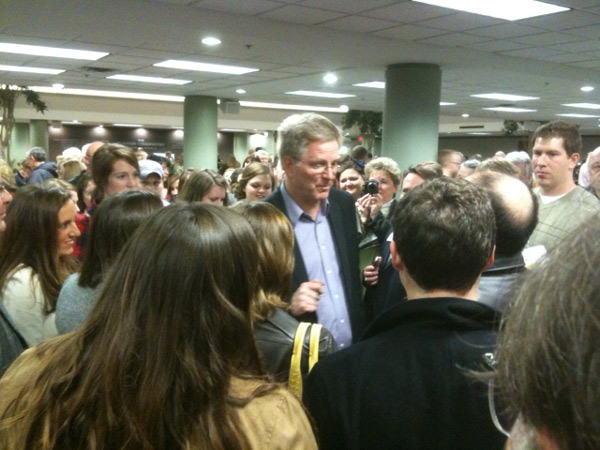
Enjoying an enthusiastic crowd at Oklahoma Christian University after my Travel as a Political Act talk.
I love the way the big cities of the Great Plains, from Edmonton and Calgary in the north to Oklahoma City here in the south, erupt with shiny skyscrapers out of the flatlands. In Oklahoma City, the Devon Energy Center sticks up like a stiletto, dwarfing other buildings on its skyline.
Oil, which makes the local economy somewhat recession-proof, is clearly a big deal in Oklahoma. It’s the only place I’ve been where oil rigs pump alongside the airport runways. They even have oil rigs on the state capitol grounds.
American Indian culture is also an important part of Oklahoma’s cultural makeup. This was the place where tribes from across the region were resettled in the “Trail of Tears” of the 1830s Oklahoma license plates, which call the state “Native America,” feature an Indian archer. Today, 9 percent of the population is Native American, casinos are big, and the city will soon open the American Indian Cultural Center and Museum, which will be the top facility of its kind in the country. High atop the state capitol dome stands a stirring statue of an Indian aptly named “The Guardian.”
But move over, Indians. In 1889, Oklahoma was the home of the great land run. With the firing of a gun, white settlers raced in from Arkansas to grab up free land: Stake it, live it, work it…and it’s yours. Some land-hungry ones cheated and left sooner than the gun went off. They were called “sooners.” This beautiful state — so full of friendly people — is the only place I can think of where the university mascot is named for cheaters: The University of Oklahoma Sooners. To this day, some of those settlers’ families — sooners and laters — still live on those original homesteads.
Oklahoma City is a heartwarmingly proud city. People just seem really good here. And they come together impressively to make their city better. In the 1990s and early 2000s, MAPS (the Metropolitan Area Projects) rejuvenated the riverbank and the old industrial Bricktown. A charming canal, complete with riverboat tours, winds through a park-like green belt, gracing the city with a dimension never before enjoyed.
The memorial at the site of the bombed-out Murrah Federal Building is a powerful stop in Oklahoma City.
After Katrina hit, the New Orleans Hornets made Oklahoma City their temporary home for a couple of years. They were supported so enthusiastically that it was clear the city was ready for a pro basketball team. So they took my city’s Supersonics…and it’s been a huge success. Now the “Oklahoma City Thunder,” my former Sonics constantly sell out games.
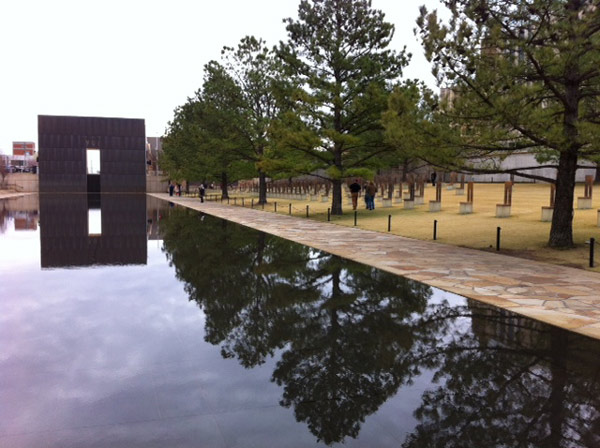
An essential stop in Oklahoma City is the moving memorial at the site of the 1995 bombing of the Murrah Federal Building. With its reflecting pond, thought-provoking field of 168 empty chairs (one for each victim), and a fence still fluttering with cards, ribbons, and photos of remembrance, the Oklahoma City National Memorial — with its rangers always there to tell the story of the horrible event — is very well done.
I spent my evening at Oklahoma Christian University, a delightful little campus with 2,200 students (each given a MacBook Air upon arrival, included in their tuition). The school has a passion for foreign study — both sending their students abroad and hosting students from around the world. They have a special relationship with Rwanda, and my hunch is that an entire generation of future Rwandan leaders will be Oklahoma Christian University alums. While buildings on campus are named for benefactors with little concern for double-entendres (Fails Hall dormitory, Payne Athletic Center, and Mabee Learning Center), I was impressed by the caliber of the student body, the teachers, and the community leaders who all work to make their school excel.
The new federal building in Oklahoma City, across the street from the one destroyed by a car bomb in 1995, is designed with security in mind.
Oklahoma’s lieutenant governor, an avid traveler and a fan of my TV shows and guidebooks, made a point to come to the VIP dinner before my talk. It was a delightful gathering. Joining 30 couples who seemed to have everything right made me forget for a moment that the world is not so tidy. One sweet lady asked me, “What’s the topic of your talk tonight?” I said, “How travel broadens your perspective.” She responded, “It certainly broadens your fanny.”
After dinner, I was rushed around back of the auditorium and heard thunderous applause. I had missed my introduction by ten seconds and needed to step immediately onto the stage to face 1,200 people packing the hall.
After a bit of a rocky start, I spent the next two hours respectfully challenging this mostly Christian crowd of Oklahomans to let travel complicate, carbonate, and broaden their worldviews. I talked about how, to me, “sanctity of life” is more than a fetus. I outlined how we could deal with structural poverty abroad by exercising soft power — both doing Jesus’ will and making our country safer at the same time. And I got to confront the issue that while God may bless the USA, it’s hard to understand how the 4 percent of humanity who are Americans can be “exceptional” in God’s eyes when God loves all his children — not even the poor and unwashed, but especially the poor and unwashed. Although the organizers of the talk had prepared me to be careful with the politics here, university leaders thanked me afterwards for bringing these challenging ideas to their student body. It was a thrill.
I finished the evening (after most people’s bedtimes) with an extended Q&A session with the honors students and foreign study students in a smaller hall. That night, while cruising through the channels back at the hotel, I stumbled onto the new HBO Sarah Palin movie, Game Change, and couldn’t stop watching it. This capped a fascinating evening.
Rushing down breakfast in the hotel lobby with Keith the next morning, we were both bleary-eyed. It turns out he had also stayed up until 1:00 a.m. watching the same movie. We hit the road at 9:00 and drove the most boring stretch of the trip so far — Oklahoma City to Kansas City via Wichita. Wichita was quite desolate on a Sunday morning. The city may have a strong faith, but, according to my Starbucks app, Wichitans don’t seem to revere St. Arbuck. So, in a driving rainstorm, we pushed on to Kansas City.