Here you can browse through my blog posts prior to February 2022. Currently I'm sharing my travel experiences, candid opinions, and what's on my mind solely on my Facebook page. — Rick

New Orleans: Where the Good Times Roll All Year Long

I think I had more fun in New Orleans than any city I’ve visited in the USA. While full of tourists, it’s also bursting with culture and a contagious love of life that seems to thrive oblivious to its many visitors. At the airport, volunteers slip the famous bead necklaces over your head, like a lei in Hawaii, and greet you with “Laissez les bons temps rouler”–Cajun for “Let the good times roll.”

I was having a long-overdue father-daughter rendezvous with Jackie as a kind of pre-graduation party weekend (she finishes up at Georgetown University this May). Neither of us had been in New Orleans before, so it was all equally new.

New Orleans--a great place for a father-daughter getaway.

Canal Street, famous as “the widest street,” separates the high-rise modern city from the delightfully characteristic, grid-planned French Quarter. The French Quarter seemed filled with spirited, one-off shops, bars, and restaurants–and almost no chains. Our hotel, the International House, was perfectly located–near great restaurants, a five-minute stroll from French Quarter (where I wouldn’t want to sleep as it’s so crazy), and with a wonderful staff. Getting tips from Stephanie at the help desk, I thought New Orleans would be the best city in which to be a concierge. There’s so much to recommend, and things are so accessible, cheap, and fun-loving.

The must-sees for us: a Mississippi cruise on the steamboat Natchez, Bourbon Street, Frenchmen Street, the thriving French Market, Jackson Square with its history museums, great food, lots of blues and jazz in the bars, and an eye-opening tour of the Ninth Ward to see the Hurricane Katrina damage–and progress made in the seven years since the disaster.

Tips: Take advantage of the freedom to carry your drink out of the bar. They all have “Go Cups,” and it just seems right in this alcohol-fueled city to be strolling with some booze in hand. Seek out and enjoy better restaurants–either classy or bohemian-chic. While the good places always have a line, we found sitting at the bar got us in immediately and made for a fun experience. Bring a sweater, as people here seem to love having their air-conditioning on strong.

For evening entertainment, there is a world of action. Like Memphis and Nashville, the music scene is a mobile feast. Stroll the streets known for live music, and pop in wherever you hear a sound you like. There’s generally no cover–just buy a drink and drop some cash into the musicians’ big tip jug. While Bourbon Street is exhaustingly and depressingly bawdy, rowdy, and alcoholic, it’s worth strolling just to imagine how crazy it must be during Mardi Gras.

We made a point to walk the length of Bourbon Street at the end of each night on our way back to the hotel. The antebellum, wrought-iron balconies were lined with revelers tossing those “girls gone wild” beads; they shouted their cat calls just as they would if it were Mardi Gras. I enjoyed Frenchmen Street much more. There must have been 10 bars with live music and all but a couple without cover charges. Don’t neglect the street-music scene here either. Two of our favorite groups were just jamming in doorways. And the “Sixty-Year-Old Rapper with a Bad Knee” sang his theme song balancing atop someone’s front-yard fence.

To give the city context physically and historically, we took the standard, two-hour bus tour ($25, leaves twice a day, picks up from hotels, great live guide) which gave a fine, “once over lightly” of the city. To get a historical context (and to imagine the French Quarter when it was actually the French Quarter)–head for Jackson Square, which is named for our seventh president, Andrew Jackson, the hero of the Battle of New Orleans–the last time we fought the British. Flanking the stately St. Louis Cathedral are two historic buildings–the Cabildo and the Presbytere–now housing the city’s top museums. You’ll get the standard history–and there’s lots of it, including the Louisiana Purchase story (its final documents were signed in one of these buildings) and a powerful exhibit describing the deluge of suffering and chaos that came with Hurricane Katrina in 2005. And to finish your orientation, relax on the steamboat Natchez–a characteristic paddleboat that cruises down the Mississippi and back. Its great narration explains the importance of the river historically as well as pointing out interesting sights along the way (2 two-hour cruises daily, $25).

At the city museum, the piano of Fats Domino is displayed in the way it was found after Hurricane Katrina ruined his home.

It’s hard to imagine the chaos, horror, and destruction of Katrina seven years ago. But a tour of the poor black neighborhood which was essentially destroyed by the flooding is both fascinating and emotional. The Ninth Ward was cut off from city services by an industrial canal built in the 1920s to connect Lake Pontchartrain and the river. All over New Orleans, the fanciful wooden domestic architecture is charming–and the Ninth Ward is no exception. Even the poorest homes were built with panache.

But today, vast swaths of the neighborhood remain overgrown, boarded up, or simply gone. After the hurricane, homes built on a concrete slab left only the slab. Homes built on stilts in anticipation of flooding left absolutely nothing.

By contacting the Lower Nine Organization (www.lowernine.org), we enjoyed a private tour by car with a person dedicated to rebuilding this sad neighborhood. While there’s been plenty of construction and lots of good-spirited relief work and volunteer labor, there are plenty of bureaucratic frustrations and still plenty of abandoned homes filled only with black mold. “Katrina Crosses”–markings spray-painted onto doors by rescue workers that indicated in a kind of tic-tac-toe code what was checked at that address (and if there were any casualties)–still remain. Walking past houses awaiting stripping and rebuilding, it’s hard to imagine those days when street signs were swept away, refrigerators were hot boxes of food turned to mold, and most of the population was holed up in Houston evacuation camps.

In New Orleans' flood-devastated Ninth Ward, new homes are built on stilts...just in case

I can’t remember enjoying eating anywhere in the USA as much as in New Orleans, which could have been thanks to trusting Jackie’s restaurant selection. The guidebooks seemed to agree with the locals about the best places, and we went four for four. August, the flagship restaurant of famous local chef John Besh, was delightful for high cuisine, a rich setting, wonderful service, and a chance to enjoy traditional dishes with the very best local ingredients. Ordering three courses and sharing, we were surprised to see the servers bring the split portions on separate plates. They brought each dish out at the right tempo and with a loving explanation. Boucherie, in an uptown bohemian-chic neighborhood a short taxi ride from the center, filled a big, old home with great local dishes, elegantly served but without pretense and at a painless price. The Ruby Slipper and Elizabeth’s were both great for breakfast. They were crowded, but the dishes–mixing in seafood like I’ve never seen at breakfast–were worth the wait. At the Ruby Slipper we just slipped right into the bar, and at Elizabeth’s we enjoyed a 45-minute wait by taking a neighborhood walk.

That stroll–like New Orleans itself–came with just a twinge of danger (the city has more than its share of muggings), a dash of history (a memorial to the parish’s WWI dead), a good measure of dogged pride in the century-old wooden homes with stay-awhile front porches and lovingly crafted eves, the promise of a meal I’d never forget, and a reinforced levee, the symbol of a determination to survive.

Florida!

Crossing the Florida state border, we made it to our last gig (for public television in Tallahassee) with about 15 minutes to spare. From our experience, American roads are really good–and so are its cars. I’m sure I’ll be doing another road trip next year. This was just too much fun. Thanks for following along.

If you can’t see the video below, watch it on YouTube.

How I spent my 72 driving hours

During our road trip, I generally did the limo thing, sitting in the back with my writing gear during the 72 hours our panel said we actually drove. The time passed so fast. My hours were spent editing the new 31st edition of “Europe Through the Back Door,” writing this blog, doing interviews on the phone, and enjoying the view. We brought a Frisbee and only managed to toss it around once. That was in Iowa.

If you can’t see the video below, watch it on YouTube.

Atlanta: Naked Dogs and Peach Trees

Atlanta is clearly the Manhattan of the South. It’s CNN slick, Coca-Cola fueled and funded…and thriving. While famous for its peach trees, I’d give it points for lack of creativity as 52 streets have “Peach Tree” in their names. Locals claim that the towering Westin Peachtree Plaza is the tallest all-hotel skyscraper in the Western Hemisphere.

I love Atlanta’s impressive skyline. It’s “topper happy” with its flashy skyscrapers sporting attention-grabbing tops (especially fun to see when enthusiastically floodlit at night). Enjoying the view, I thought of Shanghai’s skyline and how a Bedouin who suddenly strikes it rich decorates his new Mercedes like a camel.

And, speaking of Bedouins, Atlanta’s venerable Fox Theater is an acid trip of faux Moorish and Egyptian design. Its nearly 5,000 seats gather under a big, fake Bedouin canopy as part of the ceiling glitters with stars. The opulent theater, opened just two months after the stock market crash in 1929, was created by the then-powerful Shriners. They designed it with exactly as many seats as their 1929 membership in Atlanta. The theater still sports its original furniture, has its own conservation department, and is like a museum. It hosts Broadway plays all year long.

Across the street is the also venerable Georgian Terrace Hotel. This is where I learned why they call Atlanta the “Phoenix City.” While it was burned in the Civil War–and burned several times since–it keeps rebuilding. As it’s shown little interest in keeping its historic buildings, for generations now nearly everything in town has been torn down and rebuilt.

The Fox Theater, the Georgian Terrace, and an old apartment building across the street were destined for the wrecking ball when a gang of conservation-minded locals finally mobilized to save the three major buildings in Atlanta that dated from before World War II–and had any significant history. (On the other hand, Savannah, with its “pirate architecture,” had the good fortune to be spared by General Sherman, who gave the town to President Lincoln as a Civil War Christmas present. Its historic district is beautifully preserved.) At the Fox they’re still smarting from the fact that “Gone with the Wind” opened at another theater across town. And they’re still all abuzz about the world premier reception with Clark Gable and Vivien Leigh at the Georgian Terrace.

I love dropping by a classic diner or hamburger joint in a new town. Here in Atlanta, it’s got to be The Varsity. It’s a huge and thriving place with a staff that famously asks, “What’ll ya have?” and serves up their signature “Naked Dog” and “Frosted Orange.”

We all agree: There's nothing like a Frosted Orange at Atlanta's Varsity drive-in.

Driving south from Atlanta, I was struck by how humble small-town Georgia is. Stopping by a place called the Salt Lick (which was offering free samples of their beef jerky and boiled peanuts–mushy but spicy), we were told there’s not another restaurant for 15 miles, so we ate there. Bringing me my plate of fried green tomatoes, our waiter said, “Anything 10 miles off the interstate is a ghost town unless it’s military.” The interstate is to small-town commerce in the 21st century what the railroad was in the 19th century.

While perhaps dangerous, it’s still fun to make general observations and imagine what it’s like to live here. A rural Georgian road trip features very good roads dotted by gas stations, farms, liquor stores, churches, fast-food joints, BBQ shacks, billboards promoting predatory lawyers and joining the Marines, Coca-Cola everywhere, and more churches.

People line up for free Cokes in Macon, Ga.

Stopping by Macon, a major town on the road to Tallahassee, we enjoyed a hot and muggy stroll. While the metabolism of the town center felt deadly, there were lots of people converging on the main drag. We asked someone with a Styrofoam plate filled with potato salad and fried chicken what’s going on. They said, “It’s the Cherry Blossom Festival. Where you been?” Volunteers at folding tables were handing out lunches to people who didn’t know exactly why but were happy to stand in the long line. A woman in a red trailer was rhythmically passing out plastic bottles of Coke, and across the way a long line of people waited for free pink ice cream–the color of the festival.

There was free, pink ice cream in Macon, Ga., thanks to the local cherry blossom festival.

Crossing the border into Florida, we noticed an immediate change in the economy. Tallahassee and its county felt like a fragrant, garden country club in comparison–lush vegetation, crisp and prosperous neighborhoods, elegant old homes, and a thousand people jamming a theater in anticipation of the final talk of my tour.

Crossing the border into Florida with my driver Matt Yglesias.

Rhythm and Ribs in Tennessee

There are three stars on the Tennessee flag, each representing a very different region — mountains in the east, highlands in the middle, and lowlands in the west. And there are cultural differences to go with the topography.

Driving down Tennessee’s I-40, we stayed in Memphis, visited Graceland, checked out the town of Jackson, and then arrived in Nashville. The next day, veering south, we lunched in Chattanooga and crossed the border into Georgia, visiting the Chickamauga Civil War Battlefield (5,300 acres of “military park,” the scene of the last major Confederate victory of the Civil War). Then we were on our way to Atlanta.

Memphis, with its smart, little skyline, overlooks the Mississippi River. It was one of the first cities to fall in the Civil War, so it wasn’t destroyed but occupied. After the war, freed slaves came and helped power the local factories, mills, and cotton shipping. Its industrial wealth shows itself in fine, old neighborhoods filled with grand, “Four Square” houses — two-story homes of equal width and depth, many with a breezeway right through the middle that vents the four, equal quarters.

As this has long been an African American center and an industrial powerhouse, it’s where black and white culture come together musically, too. Rock ‘n’ roll has its roots in African American and blues music. And Memphis is therefore logically the city for blues and rock ‘n’ roll — and the home of the man who helped black rhythm and blues enter white culture, Elvis Presley.

Driving by the Heartbreak Hotel and RV Park, we arrived at Graceland the moment it opened and enjoyed the requisite pilgrimage to the home of Elvis. (All morning, I couldn’t stop singing Paul Simon’s “Graceland.”) The Graceland complex is a Venus flytrap for Elvis fans. There are six separate sights on the admission ticket. To both enter and exit most of them, you pass through gift shops. I couldn’t help but notice that all the customers were white — and nearly all the help was black.

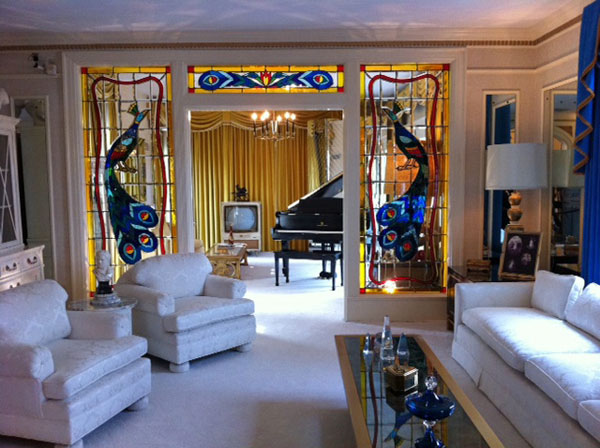
The mansion itself was nowhere near as gaudy as I expected. Elvis bought it when he was 22 for $102,000. It’s a stately mansion with big white pillars out front.  Like so many nice homes in this part of the country, it overlooks a sprawling and fun-loving estate. The interior is a trip back to the 1970s — shag carpets, mirrored ceilings, all the finest low-tech accessories of the age with Elvis’ flair for fancy. While my house in the 1970s was tiny and humble compared to Graceland, the decor, furnishings, kitchen, and so on were remarkably similar.

Welcome to My World: Elvis Presley’s living room at Graceland.

Driving across the South, you notice a huge contrast between country and city. I love the old Johnny Cash/June Carter version of “Jackson” and couldn’t bear to drive by Jackson, Tenn., without side-tripping through…just to mess around. “Jackson. Jackson.” Listening to Nancy Sinatra and Lee Hazelwood sing the tune, I studied the town, one of several “Jacksons” in  the South that could be the title town. Small poor towns seem to have little energy and nearly no momentum while big cities (like Nashville and Memphis) are dashing ahead.

In the countryside we’d see billboards encouraging kids with little future to join the Marines. Churches, which all seem to sport the same skinny, spikey, white spires, advertised, “Fishers of men: You catch ’em, God cleans ’em.” I passed a company called “Praise the Lord Mini-Storage.” Vast Walmarts stood like dominatrix giants while major intersections were fast-food-chain wastelands. I’m getting good at a game I invented:  predicting if I’ll see any Starbucks in a town before turning on my app that locates nearby outlets. Not a Starbucks anywhere in or near “Jackson town.”

Nashville was my favorite stop since the Rockies. There just seemed to be a exuberance and a love of life that showed itself in the people — both on the arboretum campus of Vanderbilt University (where I gave a couple talks) and the honky-tonk bar scene.

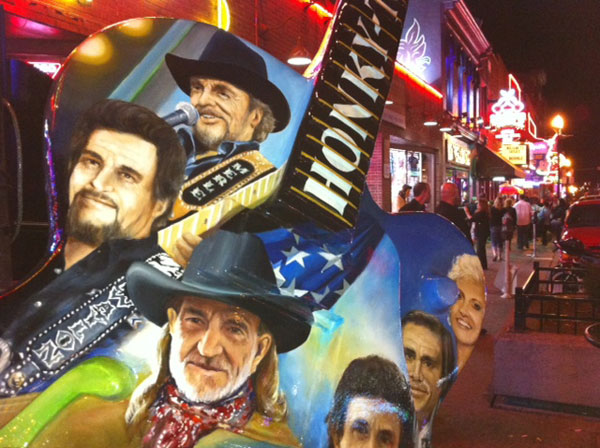
If I lived here, I think I’d make a habit of dropping by Lower Broadway for a weekly pub crawl. Eight or 10 groups were playing the night I was there. Each was distinct and both musically and visually enthralling. We’d pop into one bar and fall in love with the group. Then do the same next door…and next door…and next door. I’ve never liked country music. And here, suddenly, it’s intoxicating. I went home with three CDs wondering if bluegrass will sound as good in Seattle as it does here.

Nashville’s Lower Broadway is a can-can of country music fun.

After a quick review of our many options, we grabbed a sloppy BBQ dinner at Rippy’s. The waiters and waitresses wore T-shirts that read, “You pull my pork, I’ll rub your ribs.” As they served us our six “bones” and hot corn cakes, we were serenaded by a pop country duo that reminded me of Lucas and Mark McCain (if you remember “The Rifleman”).

Six "bones" and a beer in Nashville.

Lickin’ my fingers, I noticed how this is a distinct and thriving culture. People get real eye contact while immersed in the music. Everyone seems to know the lyrics of tunes I’ve never heard. People have Southernness in common, yet each state has its own accent, history, and favorite songs. When a song celebrating Louisiana girls was sung, Louisiana girls jumped up and shook their beers as if riding a bronco. There’s absolutely no pretense. One woman with two small children and no husband parked her kids one at a time at my table and danced with the other…cute little tennis shoes rattling on her belly. It’s real musical talent, lots of beer, and an audience hungry for fun.

Across the street, we were lured into a place where you go to get your honky tonked and your bush wacked. I’d swear it was the Marlboro Man singing classic country smooth as can be. The light hit him in a way that his body faded away.  Three elements popped like some advertising icon: his white cowboy hat with a rim making that perfect swoop, his blond guitar, and the shiny mic on a stand that cut straight up the middle. The songs were favorites. He and his band would stop playing, and everyone around me would sing a cappella anthems I had never heard. Expert dancers were two-stepping while the band created a pool of music. As the dancers swirled, they broke the dike, and it cascaded all around me…country music.

My favorite stop was Layla’s Bluegrass Hillbilly and Country Inn. The wooden floor was shaking with fun, and I knew this was the spot for my next beer. I grabbed a stool that let me teeter back and forth to the beat. Just as I settled in, my eardrums were pierced by a woman’s scream when the band asked, “Do you want some Ricky Skaggs?” The group was tight, playing and looking like hillbilly ancestors of Amy Winehouse, Jethro Tull, and James Taylor.

I couldn’t help but admire how the various stringed instruments — the banjo, violin, guitar, and string bass — must have evolved.  They complement each other with a sophisticated brilliance that I would have never attributed to bluegrass. People swapped in and out of the band like some big family. Band members traded instruments just for fun. Taking turns riffing effortlessly, it seemed to me that fingers were scat singing on frets.

The guitarist came in after an instrumental interlude singing, “I’d fill up my shotgun with rock salt and nails.” A man at the bar hollers, “Sing you bastard!” Clinking beer bottles with a guy next to me, I said that this makes me wanna be a hillbilly. He said, “The happiest day of my life was the day I sold my snowblower and moved from South Dakota to Tennessee.”

Layla’s Bluegrass Hillbilly Inn: Sing you bastard!