Here you can browse through my blog posts prior to February 2022. Currently I'm sharing my travel experiences, candid opinions, and what's on my mind solely on my Facebook page. — Rick

My Free Audio Europe App Version 2.0 is Now Available

My second-greatest satisfaction comes from giving you information that can help you have a smarter, happier trip. My top satisfaction is doing it for free!

I am very happy to announce that an expanded and improved update of my free Rick Steves Audio Europe™ app for iPhone, iPod Touch and iPad — Version 2.0 — is now available from the App Store.

During the past year, my Audio Europe™ app has given more than 100,000 travelers free access to my audio walking tours of the top sites in London, Paris, Venice, Florence, Rome and Athens — plus 200 tracks of information and interviews from my public radio program, Travel with Rick Steves.

My latest version of Rick Steves Audio Europe™ adds a significant amount of new content: eight new audio walking tours covering Vienna, Salzburg, the Rhine, Assisi and Ephesus; plus 26 new radio features on Ireland, the Netherlands, Eastern Europe, Scandinavia, Germany, Italy and Portugal — including new travel interviews with Paul Theroux, Ken Burns and Nancy Pearl.

My app’s ease-of-use also improves with the new version. Audio tour maps and scripts can now be viewed from the player and no longer require printing. The expanded track descriptions include photos, and tracks can be shared via Facebook, Twitter and email — you can even order and download a Rick Steves e-book directly to your device (not free)!

If you already have my app on your smart phone, updating to the new version is a snap. New users can get Version 2.0 from the App Store (search for Rick Steves) or visit Rick Steves Audio Europe™ to learn more.

If you have an Android device, you can enjoy the same content updates now, but without the extra usability features which are coming soon.

Loin of Cod with a Nice Glass of Catalan Red

After a long and tasty evening of researching tapas bars in Madrid, our last stop was my favorite. At €18 the dinner we ordered wasn’t cheap, but when shared, and paired with wonderful €4 glasses of wine, it was both a great value and, it seems from this vantage point, may become a lifelong memory. I learned a good trick from Jorge, my guide: In a tapas bar, order your glass of wine first, before ordering any food, and wait as if expecting a free treat (which is expected by locals but often not given to clueless tourists) — and you’ll get a small plate of some delicacy for no extra cost. Then order your food. This stop (where we shared the dinner, and had two glasses of fine wine and the small starter plate) cost us about $15 each.

If you can’t see the video below, watch it on YouTube.

Pondering the Societal Big Four at Madrid’s Royal Palace

Standing on the square of the Royal Palace in Madrid, it occurs to me that there was a master plan to its layout. I consider it Europe’s third greatest palace (after Versailles, near Paris, and Schönbrunn in Vienna) — over the years, while updating my Spain guidebook, I’ve probably visited it at least ten times. And I always learn more to shuffle into the book, and find it a joy to see.

If you can’t see the video below, watch it on YouTube.

Chin Up — The Economic Crisis Could Be Much Worse

I’m one week into my spring trip and things are going great. Things seem a bit slow in restaurants, and I saw a poster that claimed the Portuguese are eating 10 percent more chicken and 10 percent less beef. But both Lisbon and Madrid seem to have spent all the money they borrowed well, as the cities seem more people-friendly and enjoyable than ever. My Lisbon guide, who recently returned from a trip to the States, mentioned how striking it was to see “so many old Americans still working” — and agreed that Europeans have it pretty good, even though they now have to work a little longer before retirement.

As usual, April in Iberia is chilly and a bit wet. While I was in line to rent a bike, the women in front of me decided not to rent one because it was starting to rain. Knowing April is known here as the “month of a thousand rains,” I rented the bike anyway, and within minutes the rain had stopped and the sun struggled to peek out. All day long the weather flip-flops.

Marveling at how exhilarating I found the little quirky cultural differences in Lisbon, my Portuguese guide recalled the highlights of her visit to America (when she came to our guides’ summit last winter): seeing skyscrapers, riding in a yellow school bus we’d hired for a city tour (she knew our school buses from so many American TV shows), and buying an actual baseball glove.

Brazilians are not the favorite clients of Portuguese guides. The Portuguese get lots of tourists from Brazil and have plenty of connections with their former colony. They are gearing up for lots of Brazil, as that country will host the 2014 World Cup and the 2016 Olympics. Most of the Brazilians with enough money to vacation in Portugal are the higher-class elites, and they live with lots of servants. Because Brazil is a “culture of servitude,” guides here find that Brazilians treat them like “the help.”

Upon arrival in Madrid, when I pulled out my old mobile phone to buy a Spanish SIM card, the lady in the shop commented on its age by saying, “That’s from before the war” (that is, it’s old as the hills  — it’s a reference used by older Spaniards who recall their Civil War).

To stay up on the news while in Europe I no longer need the International Herald Tribune — long the traveler’s best newspaper. Instead I enjoy a few minutes every day in the hotel with my iPhone functioning as an iPad (in airplane mode with the Wi-Fi on to avoid any costs) and listen to headlines and my choice of Morning Edition and All Things Considered stories with my wonderful NPR app — just as I do at home.

I find that more and more I’m enjoying YouTube video clips while on the road to bring my sightseeing to life. In Madrid the main square, Puerta del Sol, is jammed on New Year’s Eve. In Lisbon’s salty Alfama district, there’s an insane bike race from the castle down through the steep Alfama streets to the riverfront. In Switzerland I reviewed other people’s videos of the Via Ferrata near Mürren, after my near heart attack experience inching across that same cliff. And in Pamplona I enjoyed seeing lots of bulls run.

But the only place to see photos of the poor matador who took the bullfighting equivalent of a left hook to the chin is the bullfighting bar on Madrid’s Plaza Mayor. (He survived…but I bet his mother made him promise to stay out of the ring after that.)


Economic Crisis in Portugal: In Cod We Trust


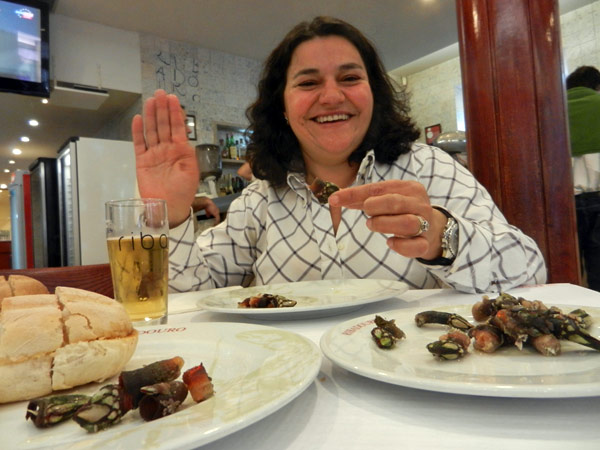
Back in Lisbon, the first thing I eat (with my wonderful guide, Cristina Duarte): barnacles. I love barnacles.

On my last visit to Lisbon, people were scampering to finish projects funded by the European Union. There was scaffolding everywhere as the buzz was, “This is the end of the easy money — use it or lose it, quickly!”

I should have known then, but there’s no free lunch — even in the European Union. Today, Portugal has come to its day of reckoning. The money has dried up, and the interest due on the debt is crushing the local workforce. Portugal’s 11 million people produce about $240 billion annually — nearly the same as Louisiana. But Portugal has about 14 percent unemployment. It once exported dried cod; now its top export is people.

Major projects in Portugal are not just stalled. They are stopped. The TGV-style bullet train from Madrid to Lisbon, Lisbon’s new airport, planned freeway expansion…all nice ideas…all stopped.

Last night, as we walked the newly pedestrianized streets of the Barrio Alto district, things were relatively quiet, even though 50,000 locals were packing the Lisbon stadium for the big, crosstown-rivals soccer match. During our stroll, my friend told me, “In pre-euro days, with the escudo as our currency rather than that deutsche mark in disguise, when there was no money for chocolate milk, we just made due with white milk. Until 1974, when we won our freedom from Salazar (Portugal’s Fascist dictator was overthrown in the “Revolution of the Carnations”), we were on the donkey system. Then we got the fever. With the EU, dazzled by German standards, we were encouraged to have faith in debt. Portugal was made drunk economically by those cheap European loans.”

Today Brussels sends the Portuguese not money but the “Troika,” a trio of managers from the EU, IMF, and European Central Bank who enforce austerity measures to get things on a sustainable track. That means higher tolls on more highways, a new 23 percent tax put on all restaurants, higher deductibles for hospital visits, and cutbacks in health care. Utilities such as electricity are being privatized. Retirement was just raised from 65 to 67 years. And the Troika made the government rescind a worker-friendly scheme of the revolution which took a year’s wages and broke it into 14 “months” rather than 12 to give workers a “bonus” each summer and Christmas. Now workers making over €650 (about $800 a month) get only 12 months’ pay. As this was never really a bonus but just a forced savings account, this amounts to about an 18 percent cut in pay.

Local politicians are fighting despair. To the Troika, the Portuguese, compared to the Greeks, are considered very quiet workers with a nice reputation and good behavior; they’re willing to take their medicine responsibly.

As for the traveler, despite the economic downturn, it’s wonderful to be prowling the streets of Lisbon after dark. Trendy and stylish little bars and restaurants are working hard for their customers. On my first evening in Europe, I’m already back in my research groove.