Here you can browse through my blog posts prior to February 2022. Currently I'm sharing my travel experiences, candid opinions, and what's on my mind solely on my Facebook page. — Rick
“This is my friend, Diego who I met through airbnb.com. I had a great time staying with him in his very comfortable apartment while in Barcelona. And at only 25 euros a night, a great value and great travel.”
I just spent a weekend at the NAFSA: National Association of Foreign Study Advisors convention in Houston with my son, Andy. I was actually working for Andy at his booth, and enjoyed seeing how, in two years, he has really established himself in the minds of university foreign study program advisors across the USA.
As Andy (with his Weekend Student Adventures business) is more hands-on with student and budget travel than I am these days (he lives out of hostels running his business from his laptop in Europe for half the year), I ran the script for my upcoming three-part series on travel skills by him. (I’ll be updating my ten-year-old travel skills shows this summer, for debut on public television this fall.)
I gave Andy my rough script, and he shared some great comments on how I can be more up-to-date and tuned in to the way younger people travel. Here are Andy’s suggestions:
Bikes: While there are many public bike rental systems across Europe that work very well for locals, often times they require “chip and PIN” debit cards, and even national social security numbers to set up an account. For this reason, it’s unlikely your American viewers will be able to get in on the great deal if only in town for two or three days. For instance, in Barcelona, you need to have a national ID card to subscribe to the service (€45/year), and then your rides are free for the first 30 minutes. Locals take longer jaunts by checking in and out at multiple stations along the way before the time goes over the limit.
Credit Cards vs. Debit Cards: Using a credit card almost always comes with a higher percentage transaction fee compared to a debit card — 5 percent compared to 2.5 percent or so. Keep in mind that your daily withdrawal limit is in US dollars, but you have to convert that to euros — they’re different!
Recreational Reading: When discussing how to prepare for your trip, make a point to include listening to podcasts, too. There are great podcasts about all sorts of topics related to your upcoming trip.
Car Rental: For a backpacker, renting a car is hardly ever the cheapest option for getting around. The daily fee may be enticing, but the inevitable extras make it far more expensive then you were led to believe. You’re paying for your independence through tolls, gas, and parking. Remember, Europe is dotted with automatic speed guns and cameras that will issue a ticket and track you down even across the pond. I got photographed speeding and got a $100 ticket with a $100 service charge added on by my rental company.
Estimating Metric: For rough conversion from kilometers to miles, two-thirds does it: 30 kph is 20 mph, 100 kph is 60 mph. For Celsius, room temp (71 degrees F) is 20 degrees C.
Internet and Phoning: Cybercafés are getting more and more dated. Most travelers use Wi-Fi devices — in either cafés or hostels. Smartphone users beware the huge fees when you roam. Before my plane takes off from the States, on my iPhone I switch “on” Airplane Mode, switch “off” Cellular Data, and switch “on” Wi-Fi. This prevents me from racking up hundreds in phone bills for data usage. “International data plan” options offered by your provider are hardly ever a good deal.
Communicating with Loved Ones Back Home: Skype and FaceTime are key and cheap (or free). If you are both online and have iPhones, you can enjoy a FaceTime connection across the street or across the ocean for the same price — free. Otherwise, Skype is a good standby. In either case, the key is having a good Internet connection, as you have to be online.
Events: Take your trip to the next level by paying attention to and researching event schedules on the route you want to travel: sporting events, concerts, festivals, special exhibits, and other celebrations are invaluable experiences that will really make your trip unforgettable. Chasing down events that interest you help you connect with locals who share the same passion, whether it’s catching the Tour de France, or experiencing a special photography exhibit by your favorite photographer.
Beggars: Along with thieves, a common distraction technique is for young women to beg for you to sign a seemingly reasonable petition (like “against drugs”). These are just ways to distract you while their partners pick your pocket. Never stop for them.
Dress Code: European adults generally don’t wear shorts, no matter how hot it gets. If blending in is a priority, bring your swimsuit, but leave the shorts at home.
Hosteling: References to IYHF (the International Youth Hostel Federation) are dated. People book hostels through Hostelworld.com. Hostel rooms are generally either mixed or female-only — no exclusively male dorms. CouchSurfing.com and Airbnb.com are both popular these days. I don’t think I’d ever follow a local who picks me up at a train station home. Airbnb.com is safer — you can agree on the price, cash never trades hands (it’s done automatically), and you can read reviews to make sure it’s what you’re looking for.
Free Walking Tours: While you don’t get a licensed guide, and your “guide” is generally an expat student who has memorized a script, these “free” tours can be a great value. They are advertised all over the place, provide little personal attention, and are often entertaining, but emphasize stories over the strictly academic. They’re known to take some liberties with historical events and characters. And they are based on tips. You will be hit up really hard for a tip. Still, I use them all the time and enjoy them.
Cheap Flights vs. Sleeping on the Train: People don’t sleep on the train like they did in the old days. In your TV show, you should do a bit on discount flights: how to find a budget flight, search engines, booking flights online, encountering a difficult experience at the airport, how to play their games (baggage fees, fees for checking in at the airport, printing boarding passes before to save on more fees), etc. Also, be sure to factor in additional costs for the transfer between the airport and downtown. Some flights may cost €20, but the bus to and from the airports costs €35.
I have become strangely attached to writing this blog. It bullies more time from me than I ever imagined it would. I simply enjoy sharing the fun of my work with so many traveling friends. In a fun way, we are all travel partners.
Some people have emailed us assuming that I don’t actually write these blog entries or read the responses. As my staff can assure you, I jealously guard my responsibility to personally write everything that we put on this page. Except for the rare guest blogger, I write every word you see. (I do have an editor proof my writing. The thinking among my staff: If you saw how poorly I spelled, you might think less of my guidebooks.) And I eagerly look forward to reading your responses. I rarely respond back, because that would suck me into an entire new arena — and I need to draw a few boundaries. (While my staff does make announcements for me on Twitter, I have little interest in tweeting.) One reason I enjoy this blog is that I can be unguarded, candid, and even reckless from a marketing point of view…and just call it fun. I feel like my traveling blog friends are a kind of special inner circle, and it’s refreshing to be able to call it like I see it. I hope you enjoy being part of it all.
On a related note, I’m looking for someone to help me manage all of this content we’re producing. In order to amplify everything we’re doing to as many travelers as possible, we have to have a cutting-edge tech staff. And we need some help.
We’re looking for a full-time Web Producer to fill a new position on our Marketing Team. The Web Producer will oversee and coordinate activities related to our website content, design, and usability, which will include planning, production, testing, maintenance, and analysis. The Web Producer will report to the Marketing Manager and will also supervise our Web staff. This person needs to be really talented, hardworking, and experienced. For details and instructions on how to apply, please visit my Job Openings page.
Wrapping up my spring trip, I found a few stay observations and lessons gleaned from my time in Spain and Italy. When I’m researching my guidebooks, I pick up lots of fun bits, but they don’t all make it into the books. As I never know what will find a niche in a book until I work over the chapter, I tuck every thought that flutters by into my satchel. Here are a few fun fragments from the cutting-room floor:
Chatting with the owner of a thriving new eatery in Madrid, I commented on the speed at which the restaurant scene can change here. He noted, “Before the Internet, it took five years for a restaurant to get off the ground. Now, you can kick-start it with an Internet promotion, and it’ll be full in a month.”
Discussing the difficult aftermath of the Spanish dictator Franco and marveling at how everyone wasn’t against his fascist policies when it came to personal liberties, I asked my friend, “Who wouldn’t want freedom when Spain was evolving from fascism to democracy in the late 1970s?” The answer was brilliantly simple: “Only those who didn’t want others to have freedom.”
Flying from Madrid to Barcelona on Iberia Air, for the first time in my life, I was really mad at an airline. They had configured the seats so tight that I literally couldn’t fit my knees into my space. The experience reminded me of an evening I once spent alone with a wrench on a tour bus. I was meeting a tour group the next morning, and the bus I hired came with too many seats jammed into it. The seats slide on runners tightened into place by bolts. I spent several hours loosening each seat, taking out two sets, and rearranging the positions of the remaining seats. We did that tour with half our storage area under the bus filled with bus seats — but plenty of legroom for all on board.
Stepping off that too-tight Iberia plane in Barcelona, I realized I hadn’t even considered taking the Madrid-Barcelona train, which is now a nonstop bullet connection of less than three hours. In this case, the train would have saved me time, if not money, and given me plenty of stretch-out room…not to mention a delightful look at the countryside.
Even if I'm "full as an egg," there's always room for peppers in a Spanish tapas bar.
A good indication that a bar is a colorful local hangout is that it has the local football (soccer) team poster on the wall — a way for the staff to let customers know who they root for.
In towns with lots of foreign-study programs, you can see American teenagers poaching Internet signals on the sidewalk in front of American chains like Starbucks, KFC, and McDonalds. (These are more likely than European chains to offer free Wi-Fi for customers.) Students, who collect and share passwords and tips, are expert Wi-Fi poachers.
Riding out to the airport in Barcelona, my cabbie was pulled over and fined €50 on the spot for being slow to stop for an ambulance siren. He explained that, with the economic crisis, cops are coming down hard and fast on drivers in Spain.
I enjoy picking up little bits of folk wisdom in my travels. A local guide in Barcelona marveled at the low caliber of leadership in his country, saying, “En el país de los ciegos, el tuerto es el rey.” (In the land of the blind, the one-eyed man is king.) Talking about pain-pleasure ratios between cultures, another friend said, “He who gets up early is helped by God.” His wife countered, “No, getting up early doesn’t speed up the sun.” Later, in Italy, when a restaurateur wanted to give me more and more food, I said I was stuffed. He told me that in Italy, you say, “Sono pieno come un uovo” (I’m full like an egg).
After one of my researchers commented on how people were not that friendly in the Cinque Terre, I asked some locals about it. They talked about their experience in restaurants, saying, “Friendly is not the currency here. Waiters don’t want to know your name. They’re working hard. They’re grumpy to all. I just want them to get my food right.” The humor here is flavored with sarcasm, which can come off mean-spirited.
One year later, the cover of my Venice guidebook is still accurate — but there are plenty of changes inside.
I enjoyed more time than ever in Venice. And it occurred to me that you could pause anywhere in Venice, observe, and, from that single viewpoint, write an article. Leaning against a church’s leaning bell tower as a flock of birds flew just in front of my face, I jotted down a few notes: A group of Russians wandered by — rich men with their platinum-blonde trophies. They were silent but hooked up to their guide with ear buds and a “whisper system.” The crowd in the restaurant looked intentionally disinterested in the music as a roving Romanian accordionist pumped away while sussing out the potential of getting any tips. A solitary local waved his hands while pacing back and forth across a bridge and talking on his cell phone. Next to me, litter was growing out the top of a garbage can like a bum with a bushy head of hair.
As far as I can tell, there are no porn stars on Venetian gondolas. In fact, there are not even lovers on gondolas. Everyone is too busy reading their iPhones or looking into their cameras. Desperate to get someone kissing on a gondola for our TV show, I walked briskly along a canal to get ahead of what I thought was a potentially romantic couple. I got their attention, and motioned to our cameraman and did a charade of kissing as if to clearly ask them to give each other a little kiss as they approached. The man, pointing to the woman next to him, mouthed with silent yet exaggerated motions, “She’s my daughter.”
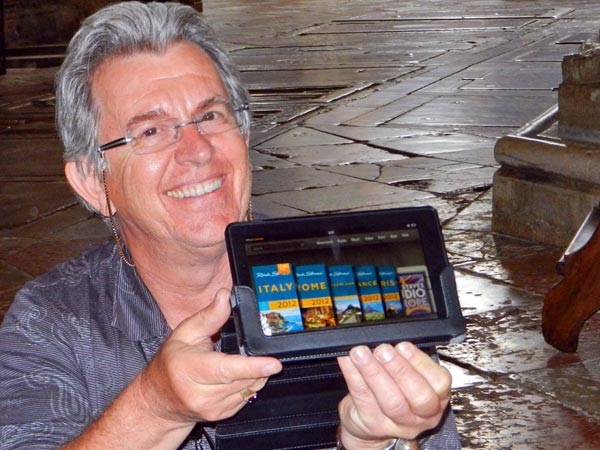
Just walking down the aisle during a flight, it’s clear: We’re traveling in a Digital Age. I was just in the Frari Church in Venice, and it seemed half the visitors were getting their information digitally. This picture is of a traveler taking a short break between the Titian and the Bellini to show me the screen of his tablet — which contained about 20 pounds’ worth of my ebooks.
For those who want to scrunch their travel info into an even tinier package, my publisher, Avalon Travel, has recently launched 73 new mini-ebooks — called Rick Steves’ Walks and Rick Steves’ Tours — that can be read on ereaders and tablets, but are specifically designed for viewing on your smartphone. (Download them to your phone before you go to avoid roaming charges.) Each mini-guide is a self-guided walk or tour that takes you to my favorite sights, museums, and neighborhoods in London, Paris, Rome, Florence, Venice, Amsterdam, Vienna, Budapest, Athens, and Istanbul.
Search Rick Steves’ Walk and Rick Steves’ Tour at your favorite ebookstore for a complete list of individual ebooks. They cost $2 apiece — which is less than the cost of a hotel these days in Italy.
We’re nearly finished filming two new TV shows on Venice. Thinking back over a very productive day, I realize how much I love this work. Our scripts are about 3,400 words per half-hour show. They are split between “on-cameras,” with me talking directly to the camera, and “B-roll,” where we “cover the script” with footage that illustrates what we’re describing. While it’s been called “shooting the nouns,” we think of B-roll as more than that.Today was particularly productive and required a typical dose of on-the-fly creativity from the crew. “On-cameras” (OC) have me working the hardest, and we got six in the can today. Here’s how the day went:
We started early, on St. Mark’s Square. While it’s littered with kitschy souvenir carts and jammed with tour groups most of the day, at 7:30, there is no tourism. The square is clean, with just a few well-dressed businesspeople walking to work, the random jogger, and very focused photographers like us marveling at how the history pops with the architecture and without the modern tourism. The Gothic is so lacy, and the Renaissance so capable. We got a few “walk-bys” to establish me in what looks like a pure, computer-generated Venetian cityscape.
At 8:30, we met our local guide, Michael, who has been instrumental in setting things up in advance for us. He is brilliantly navigating the Byzantine bureaucracy of the city and helping us open all the right doors — some of them literally pillaged from Byzantium.
Giants swinging their huge clappers over St. Mark's Square
We climbed the Torre dell’Orologio, or Clock Tower. This was built 500 years ago, providing the city with an appropriately aristocratic front door and an impressive clock — something any self-respecting city during the Renaissance was expected to have. At the top of the hour, on the rooftop, two bronze giants pivot, swinging their massive clappers — pendulous hammers with which they bang the bells. (Their other “clappers” are big, too, and hang out under their John the Baptist-style tunics.) This is so cool to have on film, and it’s a rare instance when we shoot a sequence before I even know where we’ll splice it in.
The day before, we were atop the higher Campanile (the bell tower just across the square), hoping to shoot an aerial view of the distant causeway — the two-mile bridge that connects Venice with the mainland. It was almost invisible in the haze. Today the air was crisp. The snowcapped Alps were vivid on the horizon — striking when viewed with the elaborately Eastern-looking domes of St. Mark’s Basilica. We asked Michael to beg us into that tower again (“Just one man for five minutes…pleeeze?”) to take advantage of the crisper air. They agreed, but without a tripod. Our shooter Karel went up the Campanile, zoomed in, and the causeway popped crisply — giving us one more tiny but important piece of the puzzle that will eventually be a 30-minute TV show.
At 10:00, we had an appointment at the oldest and most venerable café on St. Mark’s Square, Caffè Florian. I love this place, with its smoke-stained mirrors, white-tuxed waiters, and finicky piano and string quartet, which somehow gets called an “orchestra.”
[60] The venerable Caffè Florian, one of the first places in Europe to serve coffee, has been the place for a discreet rendezvous since 1720. Today, whenever locals want to impress visitors, they take them here for a drink. In these richly decorated 18th-century rooms, Casanova, Lord Byron, and Charles Dickens have all happily paid too much for their prosecco.
[61 OC] Venice peaked in the 16th century. But after the discovery of the Americas and new trade routes outside of the Mediterranean, its power plummeted. As Venice fell, its appetite for decadence grew. Through the 17th and 18th centuries, the Venetians partied, as if drunk on the wealth accumulated through earlier centuries as a trading power.
One challenge was getting a sophisticated-looking clientele for this café, where, historically, people dressed up to visit. The manager lamented how, in the last decade, the café’s elegance and class has been trampled with poorly dressed tourists. (Not unlike me, I must admit.) There’s also a big concern about “discretion.” People come here for a private meeting in public — not to be filmed. We decorated my table with an elegant coffee setting and I nailed my on-camera. Then I trolled for any well-dressed couple who would sit for us. With my bait of free coffee, I managed.
Illustrating the fact that Venice floods and is sinking was a fun challenge. My on-camera (which we didn’t shoot today):
With the right combination of high tide, wind, and barometric pressure, the city floods. Locals are used to it. Elevated walkways are put up, they pull on their rubber boots, and life goes on.
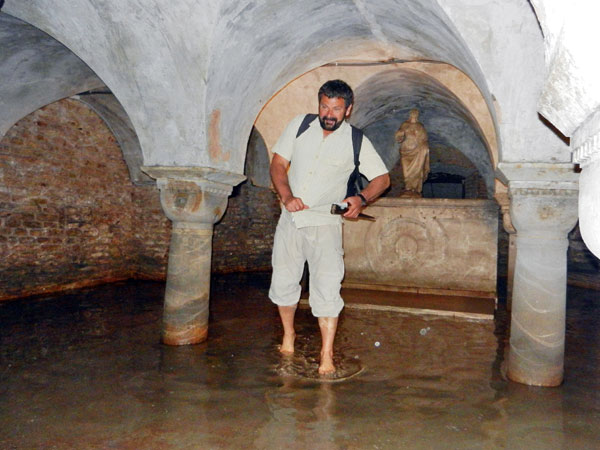
For B-roll, I really wanted to shoot the crypt of the San Zaccaria Church, which floods a lot. We dropped by early in our stay here, and it was beautifully flooded — but we had no permission, so we couldn’t shoot. After getting permission, we dropped by several times again, only to see it dry. Even at high tide, it was curiously dry. This morning we popped in again. This time, the altar was floating on a glimmering platform of water under romantic 12th-century brick vaults. We tossed in a pebble and filmed tiny waves lapping against the altar. It was a powerfully beautiful way to illustrate our point.
Producer Simon Griffith pops off his shoes and wades through mucky crypt water to remove a piece of garbage from the flooded crypt scene.
While we like to show reality, we are also shameless about making things beautiful — taking time to clean up garbage, avoiding graffiti (which is a real problem in Venice), scrubbing pigeon poop off of statues, shooting well-dressed people in a café, and — to be honest — shooting around the poorly kempt ones. Obese tourists, local kids with goofy haircuts, and immigrants selling kitschy knickknacks stay behind the camera.
I am really fascinated by Venice’s “Age of Decadence,” and the tradition of Venetian masks need to be explained in that context. After filming a great mask shop, we took our favorite mask out into the back lanes. The sun was still high in the sky, making it tough to find a place where I could be in moody low light with a picturesque background also in low light (rather than in sunlight, which causes it to burn out on film). We found a fine spot moments before the arcing sun would mess up the light. I looked at the camera (covering my face mysteriously with the delightfully painted mask for the last three words) and said:
[68 OC] Throughout Europe, but especially here in Venice, Carnevale provided a safety valve for people to really cut lose before Lent — a time of austerity leading up to Easter. That’s when rich and poor alike enjoyed a burst of Mardi Gras-style fun, when anything goes…and nobody knows.
Tourists in Venice hardly notice the wellheads that decorate almost every square. We had been “scouting” these for a week, looking for a pretty, graffiti-free stone well on just the right square with good light. We were ready with our B-roll content:
[38] While plenty wet, Venice had no natural source of drinking water. But a thousand years ago, residents devised a clever way of using town squares as cisterns.
At Campo Santi Giovanni e Paolo, we hit the jackpot. Walking up to its wellhead, I explained the cistern system, saying:
[39 OC] The rainwater would flow into these stone grilles, through a sand filtering system, and on to a central well. Only after it devised this safe, local source of drinking water was Venice’s population able to grow.
[40, B-roll, show three more cisterns] Hundreds of these rain-collection systems provided drinking water right up until 1884, when an aqueduct was opened, bringing water in from nearby mountains.
It’s fun to share “aha!” insights, and one of those is the fact that the original “ghetto” was in Venice. I was wishing we could shoot the ghetto’s main square in the early evening for lower light and a more casual ambience, but we didn’t have the luxury to wait. We were determined to cover a lot of on-cameras today, as we have only two days left to shoot (and one of them is supposed to be rainy).
It usually takes us six or eight tries to get the background action, the camera moves, and my performance all right at the same time. As I did my takes, we were stopped by a group of four policemen. (Filming at a Jewish sight in Europe always brings out the security.) I enjoyed the occasion to pull out the permission letter we had obtained — the only time we ever needed to show it. Later, an Orthodox Jewish man stopped to check us out. He listened to my delivery, gave us a smile and a thumbs-up, and walked on.
With the police cool and the Jewish Orthodox man’s approval, I looked into the big lens and said:
[50 OC] In medieval times, Jews — who were the moneylenders of the day — were allowed to do their business. But they were segregated on this easy-to-isolate island, which was a former copper foundry. In fact, the term “ghetto” comes from the Venetian word for “foundry.”
With the ghetto in the can, we headed to the far side of Venice (Zattere) for our “get lost” segment. This is where I really wanted the “magic hour” light (the hour before sunset, when the colors are richest and the harsh shadows are gone).
By now the light was just perfect, and the crew caught me wandering back lanes, looking happily lost. We covered this:
[33] Venice can be mobbed with tourists. But savvy travelers leave the center and explore. Walk and walk to the far reaches of town. Don’t worry about getting lost. Keep reminding yourself, “I’m on an island, and I can’t get off.”
For my next on-camera, I was envisioning using a favorite hotel’s canalside café terrace. The café was closed but, since the hotel is in my guidebook, they were happy to set up a couple of tables literally hanging over the edge of the city, with the vast lagoon beyond me.
We needed to populate the background and, thankfully, we bumped into a fine “PBS-looking” couple happily using my guidebook. We offered them drinks and they were happy to sit behind me. I assumed the hotel’s business card would come with a map (as most do), but it didn’t. So I had to hike for a few minutes to find a restaurant whose card had a little map for my show-and-tell. Then we were ready to shoot the on-camera.
Sipping my spritz, I said:
[34 OC] The worst-case scenario: Your island ends, and you have to enjoy a drink on the edge of town while studying your map. Invest in a good map. If you do lose your way, pop into any business and ask for their card — it comes with a map and a prominent “you are here.”
All week, we’ve been trying to capture romance in Venice. For 30 years, I’ve marveled at how Venice pumps up the romance in people. I even had an unforgettable “Stendhal syndrome” experience (where someone literally goes crazy over the overwhelming beauty of an experience) with one tour member back in the 1980s — an incident that has become company lore at ETBD. But these days, people seem to be so distracted by their electronic gadgets that they hardly notice each other. Even on the ultimate romantic ride in Europe, a gondola (which people pay $130 for a ride), we rarely saw two lovers enjoying a threesome with Venice.
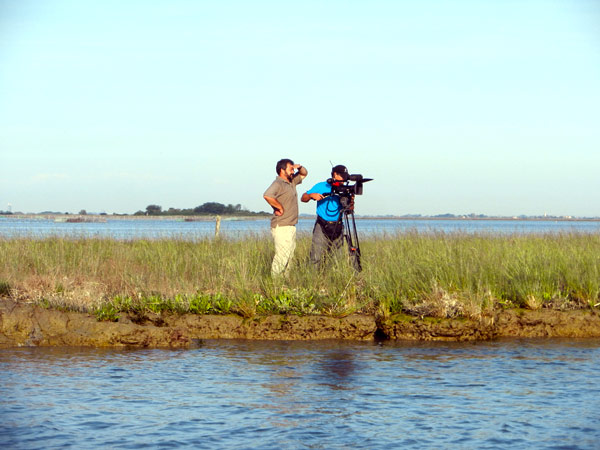
The hardest-working, most talented crew you can imagine — looking for a beer on a marshy island in the lagoon of Venice.
The final on-camera on today’s wish list was showing how great the vaporetto water buses are for simply joyriding, while also illustrating the contrast between the midday/rush-hour mobs and the easygoing joy of riding at quiet times. We have all been really struck by how Venice is two cities: one garishly touristic, and the other so romantic and tranquil that it makes you go fortissimo in describing it.
Apparently they’re phasing out the vaporetti with seats up in the bow where, for years, I’ve recommended sitting to enjoy the dazzling Grand Canal can-can of floating palaces. There are still a few, but every time we hopped on a boat, it had no front seats. It was nearly 8:00, and the sun was going down. We were all getting tired. I really wanted front seats, but time after time, the boat we drew had none. Finally, we framed a shot of me enjoying the ride from the standing point mid-boat. The light was gorgeous. Gondolas glided by. And, leaning against the cleat with its beefy and classic old hemp rope, I said:
[30 OC] Not only is it handy public transportation, the ride’s great for sightseeing — especially late in the day or early…when there are fewer crowds.
Updating our script back at the hotel later that evening (my nightly chore), it occurred to me what a productive and fascinating day we enjoyed — and how much I love Venice. After twelve similarly rewarding days, we’ll fly home with two new shows on Venice. Stay tuned this fall as we release season seven of Rick Steves’ Europe (with 14 exciting new episodes) across the USA on public television.