Here you can browse through my blog posts prior to February 2022. Currently I'm sharing my travel experiences, candid opinions, and what's on my mind solely on my Facebook page. — Rick

Go, Greeners, Go

Last week, I had one of the most joyful experiences of my life: shaking the hands of 1,200 jubilant new graduates on a stage surrounded by towering cedars and overlooking the main square of The Evergreen State College in Olympia, Washington.

These students had chosen me to help celebrate their big day by sharing my take on success and their futures with a commencement address. After I had given the speech, the college president invited me to shake a few hands as the students came up to receive their diplomas. I couldn’t stop. One by one the students processed up the ramp and across the stage, beaming with a sense of accomplishment and pride.

Being Evergreen (where freedom and individuality are celebrated and whose mascot is a geoduck), half of the students ornamented their green robes and mortarboards with funny or outlandish accessories. While there were plenty of plain old hardworking students, the procession sparkled with a festival of variety — veterans, vamps, grannies, moms with little kids in their arms, Native Americans, nerds, anarchists, jocks, stoners, and flamboyantly gay people. Looking into the eyes of nearly every graduate in that carnival of humanity, I was inspired by a beautiful and consistent thread connecting the amazing variety of people whose hands I shook. They had each worked hard for a degree because they had a mission in life to fulfill — and this day was a springboard for that determined future.

After a thousand handshakes, hugs, and high fives, I realized I was having the time of my life. The president said no speaker had ever stayed to shake hands like this, and I could sit down and relax. But I was an honorary part of the Evergreen family, privileged to be witness to so much joy, and having an absolute blast.

Preparing and then giving the speech was a rich experience. Rather than ad lib from notes, as I would normally do, 24 hours before the event my staff and I decided I’d treat it as a “read essay.” I’ve never read a talk before. In fact, when people read talks (especially pastors reading sermons), I wish they would just follow an outline and speak from their hearts. That’s my standard operating procedure. But preparing for this talk, I had so much I wanted to share in my allotted 20 minutes. The ideas and concepts were complex, and the wording needed to be finely crafted. And I wanted to be positive and uplifting. (I tend to rant.) With the help of my closest friends and staff, I massaged what I wanted to say into a tight essay, tweaked my references and phrasing to be in tune with my audience, “killed a few babies” (editor talk for deleting favorite bits that just don’t quite fit), and came up with a transcript I liked. Giving the talk — which ran 22 minutes — to 1,200 graduating students and three or four thousand friends and family was an absolute delight. If you’d like a traveler’s answer to “plastics,” check this out.

Thanks to the wonderful faculty and 2012 graduates of Evergreen for the honor of being a part of your commencement. If I inspired you half as much as you inspired me, it was a huge success all around.

If you can’t see the video below, watch it on YouTube.
 

Calling for Stops on Rick Steves’ Road Trip USA 2013

Last March, I drove through America’s heartland, giving sold-out talks to large crowds of enthusiastic travelers. From towns high in the Rockies, through our country’s breadbasket, and to the Deep South, Rick Steves’ Road Trip USA was a huge success and thrilling travel.

As I reported on my journey, many of you asked me to include stops in the Northeast and Canada. Well, I’ve listened. In March of 2013, I’ll embark on Road Trip USA: Part II. I plan to start in North Carolina, then travel north through Washington DC, Massachusetts, and Vermont. I’ll then cut west into Canada until I finally dip down into Ohio, Indiana, and Illinois.

Do you live roughly along this route and work with a library, university, performing arts center, or town hall that would like to host me for a travel lecture? If so, please email my publicist at media@ricksteves.com.

Thanks for helping make the next Road Trip USA a hit.

Rick speaking in Boise, Road Trip USA 2012. Photo credit: Tim Tower

Venice: Seduced by la Serenissima

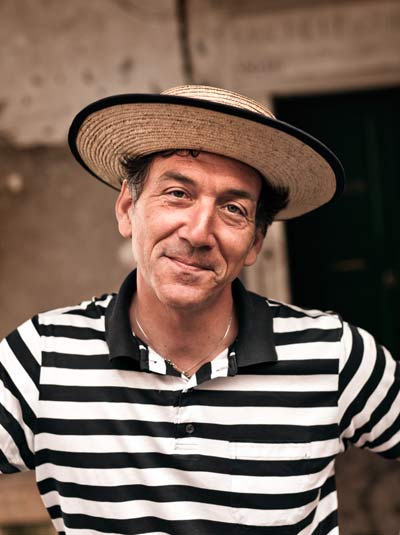
During the past dozen years, our friend Dominic Arizona Bonuccelli (no relation to the suave gondolier in this picture) has traveled all around Europe, taking amazing pictures for us. On three of these trips, he’s been lucky to cross paths with Europe’s most treasured city: Venice. Sit back and enjoy the beauty, the mystery, and the seductive powers of the city they call la Serenissima…

Dominic Bonuccelli photo
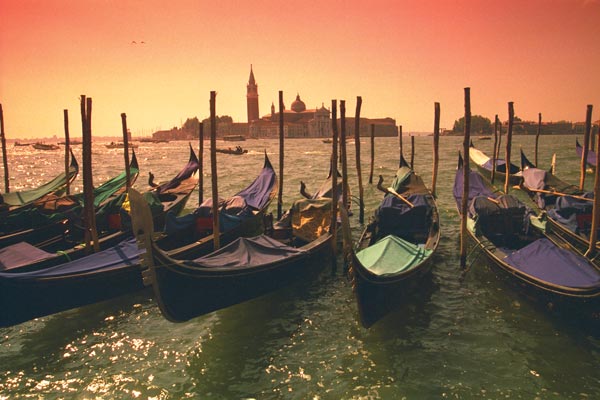
If there is an iconic image of Venice, this is it. You want to be standing on this dock, breathing in the morning air, listening to the softly rocking, splashing sounds of these boats. (Dominic Bonuccelli photo)
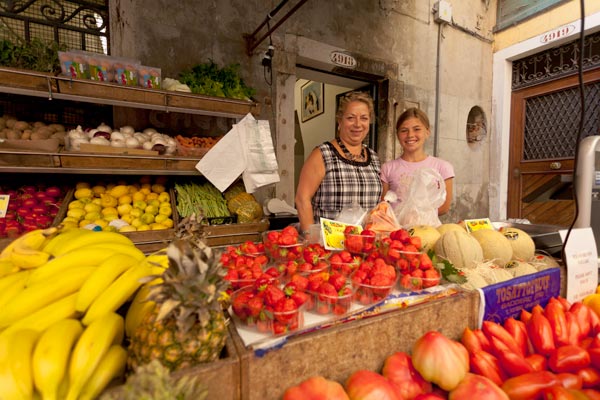
Smile, point and buy from real people. Rub elbows with the real Venice early in the morning. Get up and go picnic-wrangling at the Rialto market. (Dominic Bonuccelli photo)
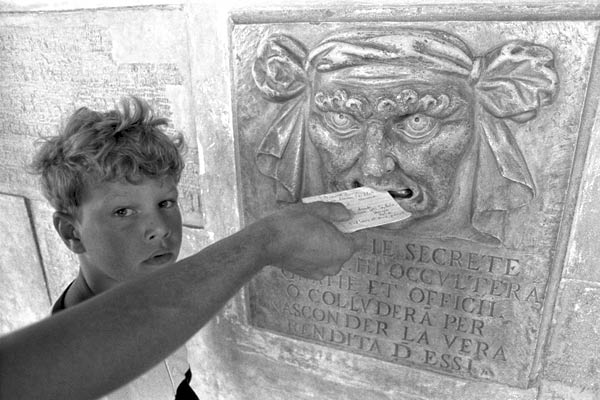
There's a reason he's nervous. This sinister-looking "mail slot" is where upstanding Venetians could slip an unsigned note, informing the authorities of their neighbors' misdeeds. (Dominic Bonuccelli photo)
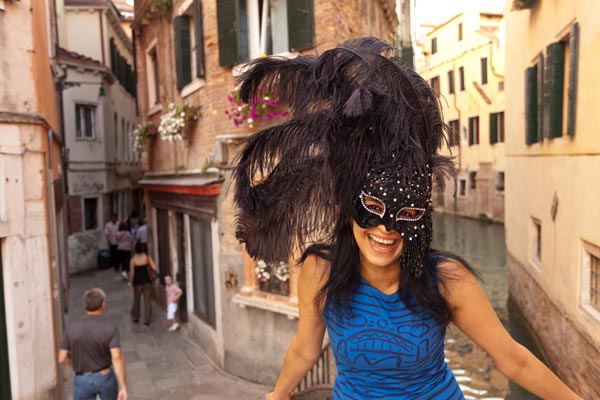
Headdress for success. In centuries past, masks made the pre-Lent Carnevale a little more naughty here. All Venetians became temporarily anonymous, and equal. (Dominic Bonuccelli photo)
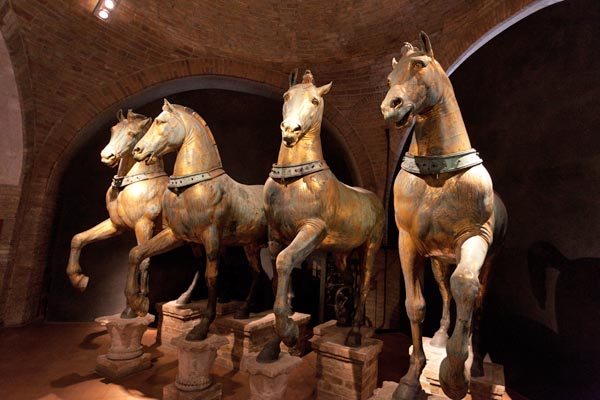
Well-traveled, bronze and beautiful. Cast in bronze more than 2,000 years ago, these life-size horses were hauled away from Constantinople by Venetians during the crusades, then whisked off to Paris by Napoleon, returning to St. Mark's in 1815.(Dominic Bonuccelli photo)
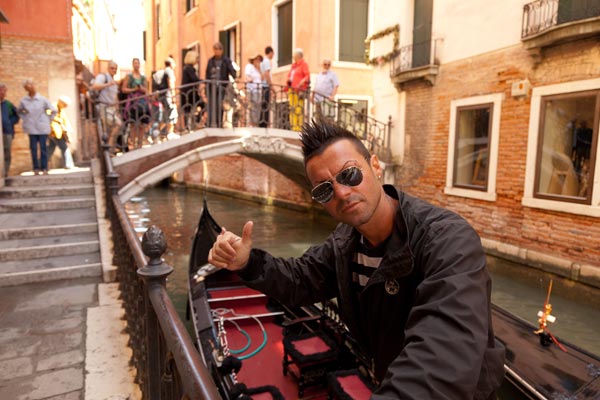
Casanova lived here. It explains a lot. The gondoliers of Venice understand romance from experience...each in his own unique way. Dominic Bonuccelli photo)
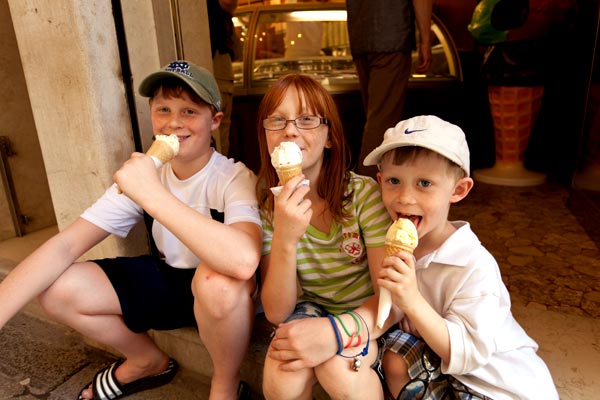
Get plenty of vitamin G. Venice is best explored with long, meandering walks, and nothing refuels the body and spirit like cones of gelato.(Dominic Bonuccelli photo)
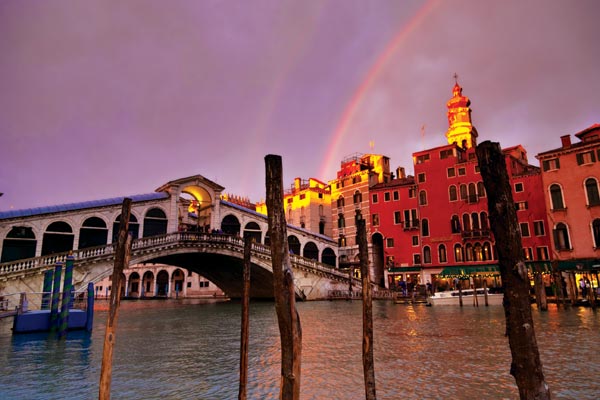
So it's pouring outside. Who cares? A rainbow over the Rialto is enough to make anyone forget about a few layers of damp clothes. (Dominic Bonuccelli photo)
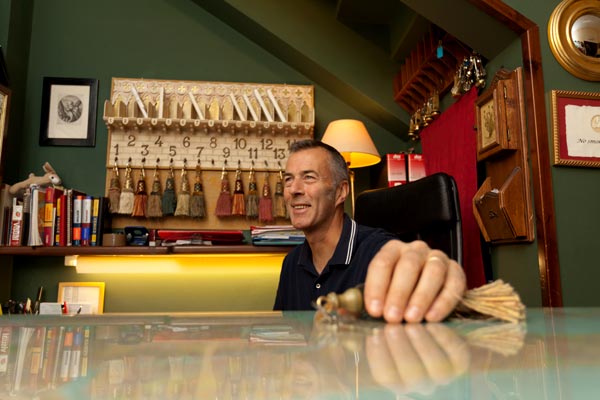
One big hand deserves another. The Pensione Guerrato's hard-working duo of Roberto (above) and Piero (out on his boat) have welcomed Rick Steves' readers and tour members to Venice for nearly 20 years. (Dominic Bonuccelli photo)
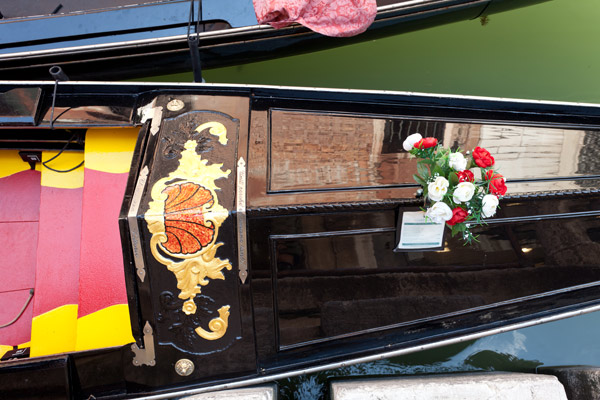
Built in Venice with pride. Six coats of lacquer give gondolas a glasslike finish, reflecting well on the city. (Dominic Bonuccelli photo)
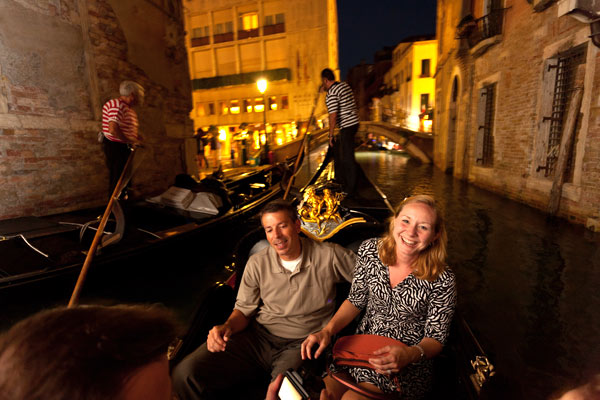
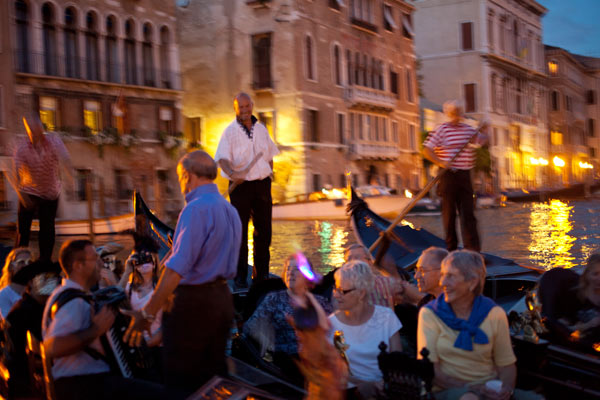
Some enchanted evening. An evening gondola glide through the canals is a must-do in Venice. It just about defines romantic, and you see details of the city that mere pedestrians miss. (Dominic Bonuccelli photo)
Then the moon hits your eye like a big pizza pie. Gondoliers gather their boats around another equipped with a singer. That's amore. (Dominic Bonuccelli photo)
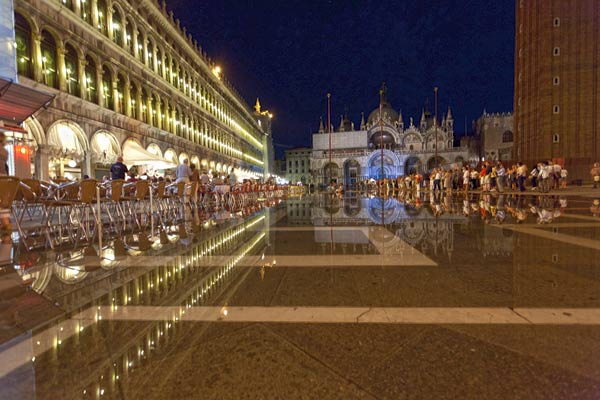
So it's flooding. Who cares? The arrival of aqua alta (high water) steadily nudges the audience away from the orchestra, and creates an array of reflections on St. Mark's Square. (Dominic Bonuccelli photo)
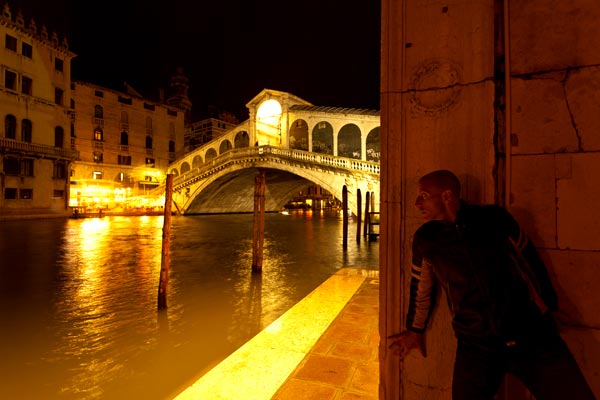
Midnight mischief. Our photographer tries to sneak a peek at the Rialto, and is captured by his own camera. Somebody must have slipped a note... (Dominic Bonuccelli photo)

Greece in Economic Crisis and Your Travel Dreams


Rick Steves checking out the impact of the economic crisis in Greece

With all the news about Greece’s economic problems, people are wondering whether it’s a good time to go there or not. I’ve surveyed my Tour Department and our Greek guides who live and work in Greece, and here’s my report.

We’re running our Athens and the Heart of Greece tours this year as normal (the next tour, going out in a couple of weeks, is full with 23 on board). While Greece tour sales are slow (9 tours in 2012 compared with 14 tours in 2011) and we’re not adding extra departures, we expect each of our tours to go full this year. My guides report that our Greece tours so far this spring have been as smooth and fun as ever — virtually unaffected by the local political and economic events

The big concern among the hotels and restaurants we use in Greece is whether they’ll be able to survive the downturn in tourism as many postpone their travels there, fearing “instability.” And many sights are running on their shorter winter schedules for lack of money to staff the longer summer hours.

People wonder about Greece and the euro. At a recent foreign currency seminar, we were told that if Greece pulls out of the Eurozone and reverts to the drachma, it wouldn’t happen overnight but take place over about a six-month transition. Greece’s parliamentary elections — the results of which will determine the currency direction — are on June 17. If Greeks opt to abandon the euro and go back to the drachma, foreign travelers to Greece should encounter no difficulty using euros at least through the end of 2012. Whenever and wherever I travel, I pack along a few hundred dollars of hard cash in case of a temporary closure of banks or ATMs. I’d advise that when travelling in Greece (or anywhere else).

I’ve reviewed surveys from tour members who completed our Athens and the Heart of Greece tours in the last month. Here are some comments directly from these travelers about the reception they received in Greece and the impact of the economic problems there on their travels:

“We had some reservations about taking our tour to Greece because of the economy and recent rioting there. But while there, we found the people to be so gracious and thankful that we were visiting there and helping them with our dollars in their time of need. Please don’t hesitate to go there! Americans are all about helping others, and the citizens there have all taken a huge financial hit. What better way to make an impact than by contributing to their economy while visiting a beautiful country, enjoying wonderful food, and seeing ancient history.”

“The news media is, perhaps, causing people to remove Greece as a possible destination. After taking our Greece tour, I believe this is a mistake. I hope ETBD helps to encourage a visit to this lovely country. The people are friendly and generous. Sites are accessible, English is spoken well and readily. We had a great time.”

“I felt safe and welcomed among the Greek people. A couple of tour days were very vigorous, but they needed to be in order to see the sites and associated museums. It would have been nice to have more time at some of the ruins, but the Greek government was only keeping them open until 3 p.m. due to budget cutbacks so there was nothing our tour guides could do to alter that situation.”

“After taking our tour, we think this was a great time to visit Greece. The hospitality of the people we met was great, we felt very well taken care of, and our business was certainly appreciated.”

“Greece needs visitors. Sure, we were a little uncertain about going given what the international media has reported on the economic situation. But we found that, other than that one little Metro slowdown in Athens, our tour was perfect. Everyone was gracious and the country is spectacular.”

One of our guides sent me this note from Athens:

Hi Rick. I was asked to send you a few thoughts about Greece. First and foremost, Greece is a safe place to visit. In fact, it’s a good time to visit because you will be made especially welcome. Tourism is Greece’s heavy industry and its leading employer.

It seems to me that US media coverage of Greece has been nothing less than hysterical — just plain silly at times, and woefully lacking in analysis. Greeks are emotional people, and they are given to outbursts of anger — as well as outbursts of joy. Their bad governments in recent times have given them plenty of reasons to be angry. The scenes in Syntagma, the big square immediately in front of the Greek parliament building, are a symptom of this — and act as a release valve. These scenes occur only when the parliament is voting on the hated austerity measures. When you see riots on TV, they are generally the work of a group of anarchists who are limited to Syntagma and know how to get on the news.

The big debate politically is austerity (from the right) versus no austerity (from the left). Until this all sorts itself out, I would recommend that travelers do not wear “Angela Merkel” masks. Regardless of how the debate turns out, and who emerges as the new government, Greeks of all political stripes will take care of tourism, so vital to its struggling economy. The Greeks, a welcoming people at any time, will be doubly appreciative of any visitors in these difficult circumstances.

The main impact on travelers as Greece struggles through this period will be: shorter hours of sights; intermittent strikes; and friends and loved ones back home wondering if Americans traveling in Greece are okay. From my experience, they are more than okay…they are enjoying a wonderful vacation in a wonderful and more-welcoming-then-ever corner of Europe.

Keeping Young People Traveling, Writing, and Engaging with Our Wider World

I was just at the NAFSA: Association of International Educators convention in Houston — a gathering of 8,000 university administrators, teachers, and advisors who coordinate the foreign study industry in the USA (both for inbound foreigners, and for Americans going out to the rest of the world). I enjoyed the honor of giving a 90-minute plenary talk to a huge and packed auditorium, sharing my take on the importance and value of foreign study — now more than ever.

That experience — combined with my recent 20-cities-in-20-days road trip, and my upcoming commencement address at the Evergreen State College in Olympia, Washington — has connected me with the excitement of exposing the next generation to the wonders, complexities, and challenges of our world firsthand.

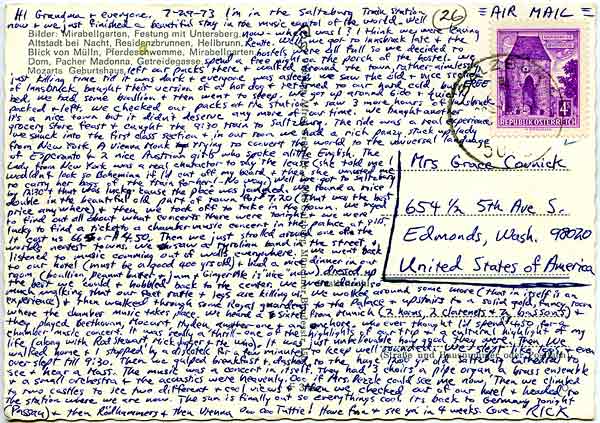
One thing I always encourage young travelers to do is to keep a journal. Along with writing countless postcards (which were ultimately gathered together to make running accounts of my early travels), I diligently filled “empty books” with 200 pages of tiny handwriting from  each of my first ten adventures in Europe and Asia. Of course, these days, kids blog. My kids, Andy and Jackie, have each enjoyed blogging, as has my niece, Nicolina, on her recent street art mission in Brazil.

At age 18, I wrote this postcard to my grandmother from Salzburg. Austrian beer halls were filled with one-legged reminders of WWII, Franco ruled in Spain, it took about nine hours to travel from London to Paris, bars were filled with smoke, pizzerias were considered ethnic restaurants in northern Italy, a two-month Eurail pass cost about $200, travelers would gather at AmExCo offices to share information and collect mail from loved ones back home, and cell phones, euros, and ATMs were unknown. But the magic of European travel was the same then as it is today.

During my March lecture tour, I met John Paul Gairhan, a 15-year-old in Conway, Arkansas, who was excited to be planning his first European adventure. John just began his trip, and following his blog reminds me of the thrilling mix of fun, fear, and fantasy of my first trip at his age. I promised John if he shared an insider’s look at the thrill of a 15-year-old kid from Arkansas enjoying Europe for his first time, I’d send him lots of readers. So travel along with John on his blog.

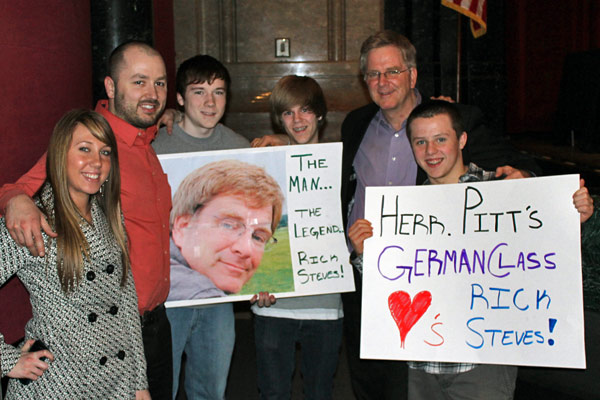
Another highlight of my lecture tour was in Omaha, where I was ambushed by an enthusiastic band of high-school German students. I just received this email from their teacher:

Hi Rick,

I’m the German teacher at Millard North High School you met here in Omaha.  I wanted to thank you again for all that you do.  When I was in college, your travel books and videos were an extremely positive influence on me and how I organized my trips to Europe.  More importantly, I was inspired by and followed your advice that wise travelers remove as many barriers as possible between themselves and the culture they came to visit.

Outside of the classroom, I don’t think there’s any better way to educate oneself but through travel.  I became a German teacher just in the past year and I do my best to teach my students not only an appreciation for other cultures but also a strong wanderlust.  I want them to see life as an adventure for which they must boldly write their own personal script.

Throughout the year, we’ve used your videos on Germany, Austria & Switzerland as a teaching tool.  In fact, you’ve achieved a quasi-cult status amongst my students. I invited my students to attend your lecture here last March and thirty showed up.  Although they were a bit raucous at times, you were kind enough to invite us all on stage for this photograph. Thanks again for coming to Omaha and speaking to our community.

Best Regards,

Jason Pitt and the German language students of Millard North High School

Backstage in Omaha in March, I met this gang of high-school German students, who have a lifetime of travel adventures ahead of them.