Here you can browse through my blog posts prior to February 2022. Currently I'm sharing my travel experiences, candid opinions, and what's on my mind solely on my Facebook page. — Rick

The Quest for Signs

Twelve years ago, we made a three-part Travel Skills Special for public television. We did our best to make it timeless. (As you can imagine, this was tricky. For example, the euro currency was not quite in circulation back then, but posters were up hyping it — so we referred to the euro as if it were already in circulation, and were careful not to film any soon-to-be-retired coinage.) Now we are dedicating 18 days to producing an updated, three-part Travel Skills Special, which is part of our new 14-episode series that begins airing this fall. For me, as a travel teacher, it’s a delight to have reason to get down to the basic skills of travel.

Train Sign

Each Car Is Clearly Marked
Revisiting our Travel Skills Special, I’m impressed at how Europe has changed. Visually, there’s been a huge leap in sleek architecture, aerodynamically designed trains, and electronic signage. With this series, you’ll know to check outside the car: This one, going from Munich to Dortmund, is first-class, non-smoking, and quiet, and prohibits the use of cell phones.

Signs

Can’t Touch This: No, No, No, No, No.
While filming our new Travel Skills Special, we spent a couple of days looking for road signs to help teach the basic tips. It took time because people seem to enjoy defacing road signs with decals and graffiti. This fun bit of urban art in Antwerp might have made our work much easier. But talk about negative!

Your Language Always Makes the Cut
For thirty years, I’ve been taking photos of this kiosk in Bruges (where people buy tickets for a canal boat tour) to illustrate how, when it comes to the language barrier, anyone who wants your money will tell you how to spend it in whatever languages are necessary — and English always makes the cut. Another lesson: Even if you don’t speak the language of a sign, with a little logic and confidence, you and guess the meaning of most.
Old History Enters a Young Mind

One of the best evening hours north of the Alps is the Night Watchman’s Tour in Rothenburg, Germany. There’s a pub in town called Hell. Part of Georg Baumgartner’s tour is a predictable yet really funny joke ending with “Go to Hell.” With each visit to Rothenburg, I go to Hell with Georg for a drink and to catch up.

For about 20 years, Georg has given his tour in English, and then in German, every single night from Easter through October. The Cal Ripken Jr. of tour guides, he’s never missed a night. And, incredibly, his delivery is still as fresh as if he’s just coming up with it for the first time. On this particular evening, I was impressed with a cute little American schoolgirl and how enthralled she was with the stories Georg was weaving. Watching her watching Georg, I was seeing the impact of travel on each of us when we embrace experiences, open our childlike eyes really wide, and take it all in.

If you can’t see the video below, watch it on YouTube.

Back Door Productions at Work

I’m deep into an 18-day shoot with my television crew:  producer Simon Griffith and cameraman Peter Rummel. Rather than focusing on lovely sights, in this shoot we’re updating our three-part Travel Skills Special…while surrounded by lovely sights.

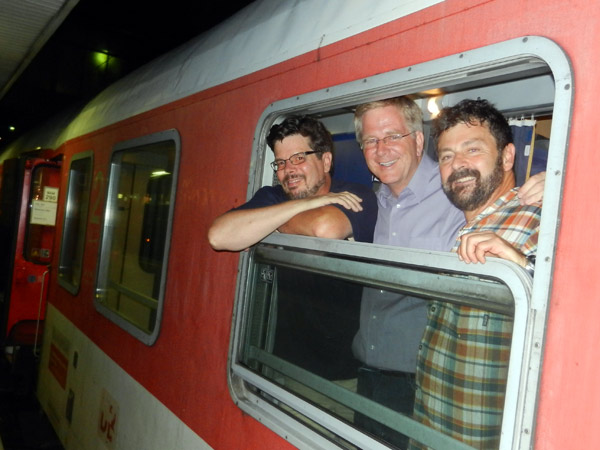
Our Crew, Just Before Bedtime
Most of an entire episode of our Travel Skills Special is devoted to train travel. In this shot, we’re settling in for the overnight train from Munich to Venice.


Alcohol-Testing Our Cameraman
Before shooting in Bavaria, we have our cameraman, Peter Rummel, submit to a breathalyzer. These machines are found at German beer gardens in the countryside (like Andechs), where most people arrive by car. They’re handy for locals who love their beer, but know that Germany’s drinking-and-driving laws are strong and strictly enforced.


ICE Woman and the Bullet Train
For three days, we filmed the how-tos of train travel using Germany as our classroom. It’s a challenge to spend lots of time, hard work, and money producing three half-hour episodes on travel skills that will still be up-to-date in six or eight years. While most of Europe is not yet quite as slick, Germany’s train system is what they aspire to: Futuristic ICE (Intercity-Express) trains cut like bullets through the green and tidy German countryside. And in this photo, “ICE woman” is a clear reminder that they run a very tight ship.

More Sex and Drugs in the Low Countries

On my research trip through the Low Countries, I discovered several examples of the bold Dutch and Belgian approach to challenging social issues.


Dutch Pot Smokers Are Pro-Choice
“Coffeeshops” throughout the Netherlands sell a variety of perfectly rolled marijuana joints. With their Dutch green thumbs and state-of-the-art greenhouse technology, the pot sellers no longer need to import their exotic strains. It may be called “Thai” and it may smoke like Thai… but it’s Dutch-grown, Dutch-taxed, and Dutch-smoked.

Needle Bridge Has Lost Its Edge
Amsterdam once had the grittiest, most disgusting, and most dangerous sailors’ quarter you could imagine: Zeedijk street, right where the city hits the harbor. I remember venturing in here in the 1970s, when shady characters seemed to support every streetlamp and where the police just kept their distance. It was sex and hard drugs and wandering lonely souls. The Dutch decided to do something about this problem to take back this potentially wonderful corner of their city. Forty years ago, they decided to decriminalize the sale of marijuana (in “coffeeshops”), and then clean out the hard drug trade. Reviewing the policy recently, the Dutch have found that pot smoking has not gone up, the population of hard drug users is smaller and aging, and street crime has diminished. Whenever reactionary forces push lawmakers to change this pragmatic approach to drug abuse and tighten up on pot laws, gangs and criminals reappear in the streets, violence and turf wars ensue, and recreational soft drug users need to do business with criminal hard drug pushers. Today, throughout the Zeedijk zone, restaurants flourish — and what was nicknamed “Needle Bridge” is a delightful place to stop for a photo.

Red Light Antwerp — Just a Trip to the Mall
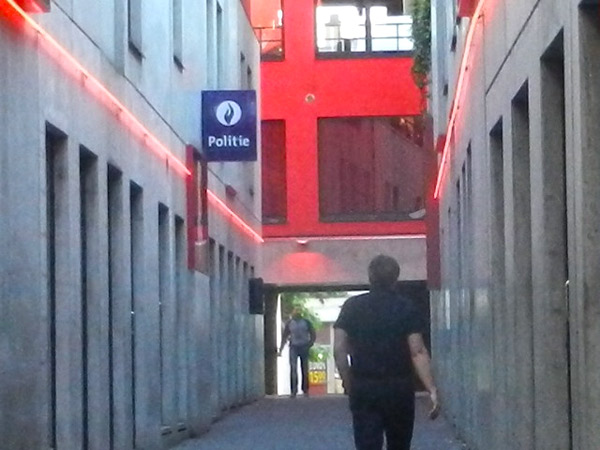
Many American tourists find Europe’s red light districts titillating. There was a time when ladies of the night were loitering around train stations and on the wrong side of the tracks in every sizable city. With stricter law enforcement, modern affluence, and the advent of easy access to porn on the Internet, the tourist rarely sees prostitutes on the street in Europe anymore. In many countries, brothels are allowed and limited to a certain zone. Amsterdam’s Red Light District is shrinking, as city officials are not renewing leases to red light landlords — or are giving them to other, more preferred businesses. Ports (like Hamburg and Amsterdam) are known for their red lights. The most impressive I’ve seen is in Antwerp. About four city blocks are pedestrianized and feel almost like a shopping mall. Here you can see the police station parked right in the middle of all that glowing red. I did notice that, while Antwerp has the biggest and slickest red light district, unlike other big cities, it has almost no sleaze elsewhere in town. In a sense, they cleaned the city up by sweeping it all into a small pile.

Cute Towns and Mighty Delta Works in Holland

When I research my guidebooks, almost by definition, I am always visiting and revisiting the same places. But I also like to take a few days here and there to scout out new places — both for future editions of the guidebooks and for future TV scripts. In the last month, I’ve visited lots of great places for the first time (or, at least, my first time to do research): Leipzig, Wittenberg, Erfurt, Hamburg, Antwerp, Ghent, and the lush lowlands of Holland.

Taking a couple of days to get away from Amsterdam, I enjoyed touring the Dutch countryside. I spent one day visiting the famous Dutch tourist trap towns. My take: Alkmaar — famous for its cheese market and cute…but not cute enough. Edam — full of history, charm, great hotels, and ambience. I love it. Volendam — grotesquely touristic…mix Killarney and Coney Island and then drizzle with herring juice. Marken — on every tourist map, but much less visited because of its relatively remote location (at the end of a five-mile-long manmade jetty). Rounding out my Dutch countryside experience were visits to the city of Delft and the Delta Works. Here are a few photos of places that left me with powerful impressions.


Reflecting on Canal Lilies

I found canals with reflections that would get Monet to set up his easel. Here in Delft, the entire town was twinkling and rippling like water lilies.

Marken Is Good Cute
Marken is a former island, left partially high and dry by the draining of the inland sea but still accessible by ferry. It’s quiet, perfectly quaint, and well-preserved, but not annoyingly crowded like Volendam. Here’s a great day out from Amsterdam: Catch a train with your bike to Edam and enjoy that town for the morning. Roll through the countryside to Volendam, where you’ll catch the ferry to Marken. Enjoy a break there before pedaling along the jetty and through the polder land back to Amsterdam.

Delta Works Needs More
I was excited to see the mighty Delta Works, where the delta of the great rivers that dump into the sea after cutting through the Netherlands are controlled for floods. I assumed there would be an equally mighty visitors’ center…but there was nothing exceptional for the independent traveler to see.


Just like the rubble of Roman ruins, modern engineering marvels can fall flat — unless an enlightening tour by a passionate expert brings them to life. For just that reason, the Delta Works is a huge hit on Day 6 of our “Heart of Belgium & Holland in 11 Days” guided tour. If you’d like to experience this corner of Europe with the advantages of a small group and an expert guide, follow this link: http://tours.ricksteves.com/tours/france-holland-belgium/belgium-holland.