Here you can browse through my blog posts prior to February 2022. Currently I'm sharing my travel experiences, candid opinions, and what's on my mind solely on my Facebook page. — Rick
Climbing through steep fields of freshly cut hay on a sunny late afternoon, and getting to know a local farmer who climbs up and down all day without breathing heavily, gave a new dimension to a Swiss alpine village I’ve been visiting for over 30 years.
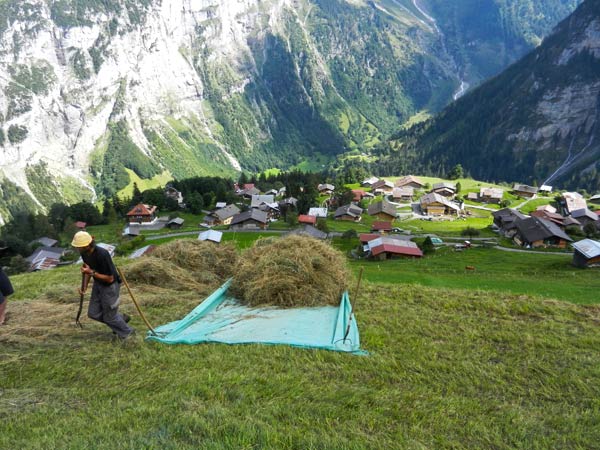
Farmer Peter piles hay onto a tarp tacked to the steep hillside by two pitchforks. The village of Gimmelwald was never developed like neighboring towns because its residents made sure it got rated “avalanche zone,” so developers couldn’t get building permits. Consequently, the town’s buildings are generally inhabited by locals all year long, while buildings in nearby towns (like Wengen and Grindelwald) are owned mostly by wealthy big-city folks who come by just a couple of weeks a year. The consequence: There's no real community in the resort towns, while Gimmelwald feels lived-in.
Farmer Peter and his boatload of hay bound down the steep slopes to an awaiting barn — its doors open wide in anticipation.
While I learn my lines, producer Simon Griffith sits in as my “body double” so cameraman Peter Rummel can frame and set up a good shot. Olle, our good friend from the village, stands by — helping as he always does when we come to town. Moments later, I took Simon’s spot and kicked off the third part of our three-part Travel Skills Special with one of my favorite on-camera show openers ever. It was fun because, rather than looking up at dramatic peaks cutting into blue alpine skies, this time we filmed down into a vast and fertile Swiss valley.
Thirty years ago, as a young tour organizer and guide, I kept my groups in the humble Gimmelwald youth hostel. One day I got a note from Walter Mittler, who invited me to the top of his village to tour his pension and to consider bringing my tour groups there. He convinced me, we moved “uptown,” and Walter’s Hotel Mittaghorn became a highlight of our tour groups’ alpine experience for over two decades. I visit Walter, who was born in 1924 and still runs his little hotel, whenever I’m in town. This time when I called him and asked how he’s doing, he said, “Everything still works.”
Shooting our new, three-part Travel Skills Special was a particular joy for me because I got to revisit many of my favorite and original Back Doors. (We’re building 90 minutes of skills lessons around our “Best of Europe” tour route.) Here, high in the Swiss Alps in the village of Gimmelwald, I got to smell the hay in a whole new way, as we illustrated how traditional lifestyles and livelihoods survive throughout Europe.
If you can’t see the video below, watch it on YouTube.
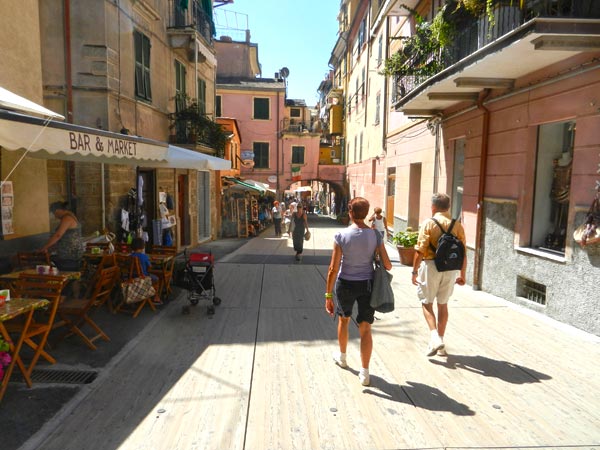
A particularly happy moment for me was taking a late-night walk through Monterosso, down streets and through parks that were once filled with eight feet of mud from the deadly flood of nine months ago. On hot August days, all across the Mediterranean, sweltering piazzas come to life as families come out late at night. At this particular scene, with images of the flood still vivid in my mind, I capped my day with a thankful smile.
If you can’t see the video below, watch it on YouTube.
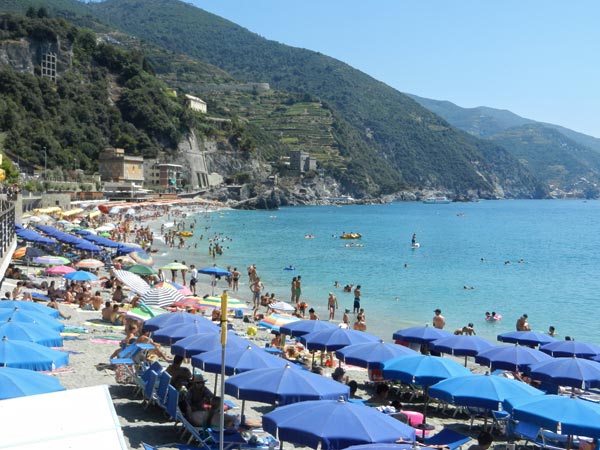
“What flood?” If you lived through it last October, that would be a crazy question about the deluge that devastated two of the five villages that make up the Cinque Terre (my favorite stretch of the Mediterranean). But today it’s easy for a visitor to have the impression that it never happened. We just finished a little filming in Vernazza and Monterosso (the two towns that were hit). Here are a few photos — one sad, six happy — showing the former flood zone today.
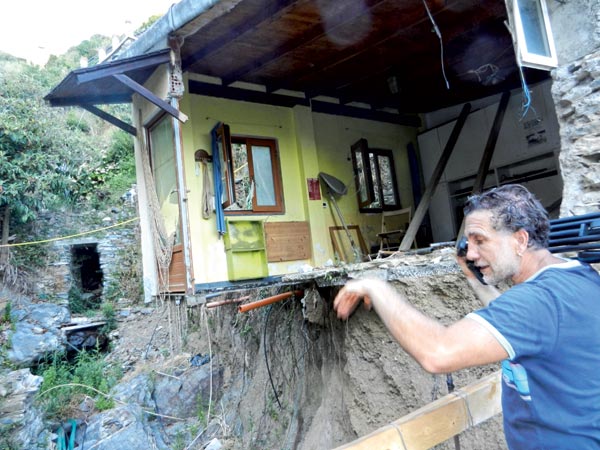
The trails are wide open. In fact, they're better than ever — as locals (like Giuliano Basso, the best dry-stone mason in Vernazza) are painstakingly rebuilding the stone walls and bridges that were washed out. Here Giuliano points out a house built over a ravine that, when the flood hit, was cut in half and left hanging.
The big problem was that the streams, which had been covered by modern pavement as the towns modernized, were clogged and unable to accommodate the flow of the flash-flooding that tore down the surrounding hillsides. Now the capacity to let water flow freely under the streets and down to the sea is much, much greater. And wooden boards on the main street through Monterosso’s old town allow easy access to the streams when necessary.
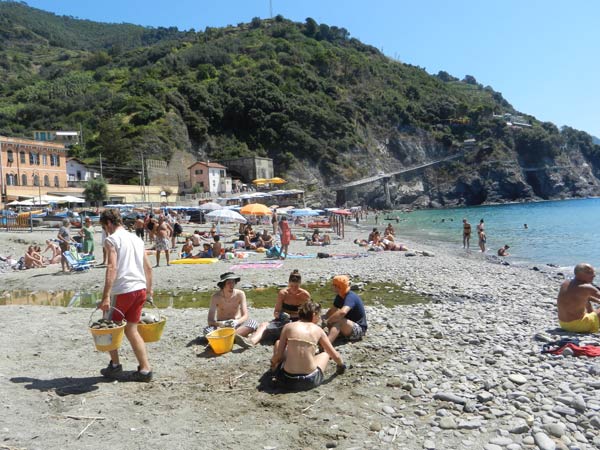
The entire population pitched in to dig out. Even today, you’ll see teenagers having rock-removal parties on the beach, clearing out flood debris to make the beach inviting for the people who fuel Monterosso’s economy: its tourists.
Here on Monterosso’s main beach, the flood is ancient history.
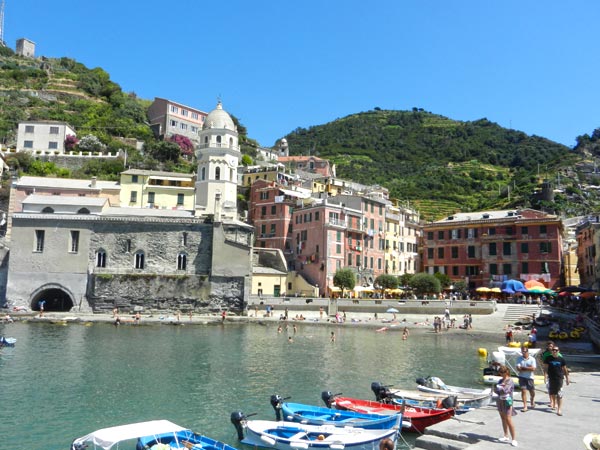
For the casual visitor, Vernazza — hit much harder than Monterosso — feels just fine. While the upper town is still essentially closed, the main drag is jammed with beachgoers.
Three months ago, I was walking on Vernazza’s harbor — over mounds of debris and in the shadow of tractors. Today, the beach is a delight, the small boats bob lazily at their buoys, and the restaurants are thriving.
The people of Vernazza are back in business and life on the Italian Riviera is, once again, very good.
If you’re involved in European tourism and are close to a big body of water, cruising is part of your livelihood. Cruising — on the Mediterranean, in the North and Baltic Seas, and on rivers — is huge. And so are the ships, which becomes clear if you’re standing on Piazza San Marco in Venice. The towering broadside of a 14-story-tall cruise ship — with hundreds of its 3,000 passengers gathered on its top deck to enjoy one last look at the Doge’s Palace — is a spectacle in itself. If you’re not expecting it, this scene can seem like a clip from a disaster movie. Venice is one of the three or four main ports of embarkation for the entire Mediterranean, so there’s a very good chance you’ll start or end your cruise here. The scene in this video — which happens several times most evenings — is one you wouldn’t have seen a few years ago.
If you can’t see the video below, watch it on YouTube.