Here you can browse through my blog posts prior to February 2022. Currently I'm sharing my travel experiences, candid opinions, and what's on my mind solely on my Facebook page. — Rick
Seattle’s KCTS recently produced a TV special celebrating the 50th anniversary of the Seattle World’s Fair (and our Space Needle). Because I enjoyed the fair as a seven year-old back in 1962, the producers sat me down for an interview. It caused me to think about the random events in a person’s life that open them up to our world, and the long-term blessings that can result. Check out this 84-second video. Then think of what in your childhood may have contributed to your appetite for getting out of your comfort zone to enjoy and learn from other cultures. Then, if you like, share it with a comment here.
If you can’t see the video below, watch it on YouTube.
Our crew (left to right: director Simon, cameraman Peter, and host Rick), finished 20 hard days of shooting and production with all our work — the rough footage for three new TV shows — saved onto a single hard drive the size of an iPhone.
It was the last day of my trip — 25 days of guidebook research followed by 20 days of TV production. Finally, my crew flew home with the footage (not actually “footage” anymore — three weeks of filming is contained on a single, massive hard drive). I was free to do one of three things: stay in the room and edit the research I had done; just go out, relax, and have fun in London; or do all my London audio tours. With so many people using my free audio tours, I decided to do that.
It was a strangely entertaining day. I spent it doing the five London audio tours from my Rick Steves Audio Europe app. For six hours I listened to my voice narrating the very best of London, while my brain was finding ways to make these tours better.
My day went like this: Buy a £7 all-day tube/bus pass (a great deal at about $11), catch the Tube directly to Westminster, do my Westminster Walk (Westminster Bridge to Trafalgar Square), walk The Strand to St. Clement Danes Church, and do my City of London Walk (St. Clement Danes to London Bridge) — interrupting it midway to do my St. Paul’s Cathedral Tour. Then have lunch at the Counting House, taxi to the British Museum to do that tour, and then catch a bus to Euston Station to do my British Library Tour. Finally, catch the Tube for the direct ride back to my hotel in South Kensington. Time management was key: The British Library closed at 6 p.m., but my “off-peak” transit pass wouldn’t let me start until 9:30 a.m.
London’s subway was Europe’s first great system and is consequently the ricketiest — but it still works marvelously. With earbuds in my ears as I walked the streets, the constant churn of London — people, local professionals, big tour buses, taxis, and so on — was strangely more apparent. I was a keen observer. With my buds in, no one talked to me. I was invisible. I noticed what a great percentage of people on the streets were also lost in their buds.
Listening to my tour, I caught a few mistakes. Many of them reminded me of the dangers of travel writing anywhere. For example, I just assumed the Thames flowed. But looking into the river, I realized it is tidal and, when things are slack, it just sits there.
My goal for the audio tours is to make them “real time.” I found, for instance, there is a two-minute stretch on the walk from the Westminster Bridge to Parliament Square that could be filled with informative narration so people wouldn’t have to press stop and walk to the next spot.
The monuments of London have never looked so good. It was fun to be here in the wake of the Olympics. Everyone we talked with commented on how the games went swimmingly — but for tourism, restaurants, taxis, tour guides, and so on, it was a quiet three weeks. As is so often the case, profiteering (the threat of prices jacked up during an event) caused many people (like us, who made a point to arrive after the games finished), to stay away during the anticipated, overpriced commotion.
Whitehall — London’s Pennsylvania Avenue — was grand. Security was almost military — guards with machine guns at the ready strolling in front of the gate at #10 Downing Street (and at train stations and Heathrow Airport). Judging by the traffic, it seems the standard, big-bus sightseeing day trips seem to have been driven out of business by the double-decker, Hop-on Hop-off tour buses. In fact, “HOHO” buses seemed as numerous as regular city buses.
Reaching Trafalgar Square, I concluded that the Westminster Walk is nearly perfect. I’m very happy with it. From that point, I realized it would have been convenient if the City of London Walk started there rather than a mile east at the edge of The City. But walking The Strand to that starting point, I realized we left this stretch out for good reason — it’s boring.
It rained as I walked through The City, the one-square-mile, old town center now consumed by the financial district and Christopher Wren churches. It’s liberating to not care about the weather. For three weeks I needed sunshine to make good TV. Now, with the crew gone, I was singin’ in the rain.
For lunch, I dropped by the Counting House, a former, elegant bank building converted into a fancy pub that’s popular with the neighborhood’s professionals. I confirmed my feeling that, while there are plenty of “cheap and cheery” modern eateries in London, this is a great spot for a memorable lunch.
After touring St. Paul’s, I hopped into a cab thinking that would save me time as it was getting late. I was wrong. Traffic was slow, the meter reached £12, and I could have got to my next sight faster — and free — with my all-day transit pass. Still, I enjoyed the British Museum and British Library. Then, brain drained, I hopped the Tube and zipped directly back to my hotel in South Kensington.
It was an exhilarating day — not unreasonable for first timer to do it, too. And it was cheap: about £20 for transportation, the audio tours were free, and the sights were free (except St. Paul’s, which costs £15). Lunch cost £15 with a beer. The total: about £50 for a very full day in London.
All over Europe, great cities are adding great new buildings to their skylines. And great cities are taking old industrial zones — left derelict when shipping moved out to more modern quarters — and gentrifying them. I’ve noticed that what we call “the wrong side of the tracks” is, in Europe, often the wrong side of the river (think London, Rome, Florence, and Sevilla). Amsterdam is digging up its center to build a new north-south subway line which will move much of the transportation clutter across the IJ River to its (until now) undeveloped North Bank. And this side of the river — which will get a huge new boost when the new transit hub opens — is on its way to becoming a smart, new people zone. Free ferries shuttle mostly bikers back and forth from immediately behind Amsterdam’s big central train station. Now when you look over the river you see a striking new building — the Film Museum on the IJ. Here’s my new guidebook listing:
This striking new building on Amsterdam’s skyline is a complex of theaters in an edgy structure overlooking the IJ River. (IJ is pronounced “eye.”) That makes this the Eye on the IJ.
The Film Museum on the IJ
The big news for the skyline of Amsterdam is the arrival of the new Film Museum on the IJ, nicknamed “The Eye.” This striking, sleek modern building heralds the coming gentrification of the north side of the IJ River, immediately across from Amsterdam’s Central Station. The building is a complex of four theaters playing mostly art films with a particular theme that changes throughout the year. There’s also a monthly program of silent films with live musical accompaniment and exhibitions on film-related subjects, a free permanent exhibit in the basement, a gift shop, and a trendy café with great riverside seating on its terrace. Helpful attendants at the reception desk can get you oriented (Free entry, movies-€10, exhibit-€10, credit/debit cards only; daily 10:00-24:00, exhibits open daily 11:00-18:00; from behind the Central Train Station catch the free ferry labeled “Buiksloterweg” across the river and walk 200 yards, www.eyefilm.nl).
Immediately after WWII Vienna was divided among the victorious allies into four zones — like Berlin. That created lots of intrigue which made for a thrilling movie: The Third Man.
When I’m researching in Europe, the challenge is to stop my in-the-street work while there’s still enough time to input what I ‘ve learned, and then fine-tune the writing. From the first day of this trip, back in early July, I’ve been in a hole. I’m still digging out, as I’ve had so much fun traveling that it’s been impossible to completely keep up on the writing end of things.
With a hard-working crew of editors back home — and a publisher awaiting their work — I am but a happy cog in a wonderful guidebook-creating wheel. And if I miss a deadline, it’ll mess up a lot of people. With my Vienna text due this week, I’ve finally finished those chapters. Here are a few major new additions:
The Third Man: A Movie, a Museum, and a Cultlike Following
The Third Man is a classic film set in post-WWII Vienna. There’s a fascinating museum dedicated to the film and the story it tells (open only Saturday afternoons). The movie still plays regularly in Vienna — or you can see it before coming to town.
This is not just another movie. The British Film Institute voted The Third Man “the best British film ever produced.” It’s set in 1949 Vienna — when it was divided, like Berlin, between the four victorious Allies. (After the war, Austria was divided between the U.S., France, Britain, and Russia until 1955.) With a dramatic Vienna cemetery scene, coffeehouse culture surviving amid the rubble, and Orson Welles being chased through the sewers, this tale of a divided city rife with smuggling and under the threat of Soviet rule is an enjoyable, two-hour experience. The movie plays at Vienna’s Burg Kino (€8, in English; 3-4 showings weekly — usually Friday evening, Sunday afternoon, and Tuesday early evening; a block from the Opera at Opernring 19, burgkino.at).
Gerhard and Karin Strassgschwandtner share their passion for The Third Man each Saturday at their museum.
The Third Man Museum is the life’s work of Karin and Gerhard Strassgschwandtner. They have lovingly collected a vast collection of artifacts about the film, Vienna in 1949, and the movie’s popularity around the world. (In 1999 Japan voted it the best foreign film of all time.)
Third Man fans will love the quirky movie relics, but even if you are just interested in Vienna at the start of the Cold War, this is worthwhile. Sections cover the 1930s when Austria was ripe for the Anschluss, the reality of 1.7 million “DPs” (displaced persons) in Austria after the war, the challenges of denazification after 1945, and candid interviews with soldiers. As a bonus, the museum also gives a fascinating look at moviemaking and marketing around 1950. Don’t be shy about asking for a personal tour from Gerhard or Karin (€7.50, Sat only 14:00-18:00, a long block south of Naschmarkt at Pressgasse 25, www.3mpc.net, Facebook: thirdmanmuseum).
Otto Wagner’s Postal Savings Bank
The Austrian Postal Savings Bank, built from 1904-1912, offers a fascinating look into the society as well as the architecture of that age. This was a bank for working-class people. The very concept of a postal savings bank makes storing your hard-earned income less intimidating for laborers than the palatial banks of the 19th century. The bank’s design makes the service it provides feel almost sacred. Wagner believed, “Necessity is the master of art.” He declared, “What is impractical can never be beautiful.” Everything about the design — so gray, white, and efficient — is practical. While it’s textbook “form follows function,” the form is beautiful nevertheless. A product of its age — so giddy with advancement — the building dignifies the technological and celebrates it as cultural.
Architect Otto Wagner helped kick off the 20th century in Vienna with a radical building housing a radical new concept: a bank for people who weren’t rich.
Study the sleek, yet elegantly modern facade: Angles high above — made of an exciting new material, aluminum — seem to proclaim the modern age. The facade, with unadorned marble siding panels held on by aluminum-capped bolts, gives the impression that the entire building is a safety deposit box. The interior is similarly functionalist. The glass roof lets in light while the glass floor helps illuminate the basement. Fixtures, vents, and even the furniture fit right in — strong, geometrical, and modern. The main building is open to the public and still functions as a savings bank. In the back, a fine little museum is dedicated to the architect Wagner with a slideshow providing a visual review of his work (free entry to main building, museum-€6, Mon-Sat 9:00-17:00, just off the Ringstrasse near the Danube Canal at Georg-Coch-Platz 2, www.ottowagner.com).
The Museum of Military History
While much of the Habsburg’s empire was built on strategic marriages rather than war, a big part of Habsburg history is military. And the Heeresgeschichtliches Museum, a.k.a. HGM — built in 1860 by Emperor Franz Josef as an arsenal — tells the story well with a thoughtful motto (apparently learned from the school of hard knocks): “War belongs to museums.” You’ll wander the wings of this vast museum practically all alone. On two floors you’ll see a rich collection of artifacts and historic treasures from Empress Maria Theresa to military genius Prince Eugene to Franz Josef. I found the 20th-century section particularly interesting. It includes an exhibit on Sarajevo in 1914 (with the car Archduke Franz Ferdinand was riding in — and the uniform he was wearing — when he was assassinated). For WWII buffs, there’s a look at Chancellor Engelbert Dollfuss (and the pre-Hitler Austrian fascist party), the Anschluss when the Third Reich absorbed Austria, and the devastation of World War II (€5, includes audioguide, daily 9:00-17:00, located inconveniently outside the Ringstrasse, a 10-minute walk behind the Belvedere Palace near the new Central Station at Arsenal Objekt 1, www.hgm.or.at).
In 1914 the Habsburg Archduke Franz Ferdinand took a trip to Sarajevo in Bosnia to assert his family’s reign on that hard-to-rule corner of Europe. He was assassinated in this car, setting off World War I.
Before Hitler brought the swastika to Austria, the country was ruled by Engelbert Dollfuss, a dictator whose fascist symbol tried to be swastika-like.
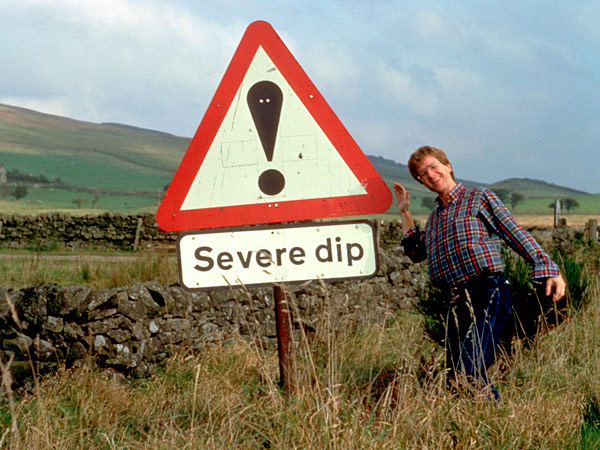
Some would call me a severe dip, but the area just north of Hadrian’s Wall is boring.
We Americans get the shortest vacations in the industrial world. With so little time, the pressure is on to make all the right choices when planning a trip. But how to select the right destination? It ultimately depends on your interests and your tastes — and what your experienced travel writer tells you.
It’s my job to sort through all the travel-industry superlatives and “top 10” lists. Readers naturally want to know the Best, but it’s just as important to know the Worst. With that in mind, I’ve pulled together a round robin of my candid opinions on the best and worst European destinations. Here goes:
Let’s start with the British Isles and its dullest corner, southern Scotland. It’s so boring that the Romans decided to block it off with Hadrian’s Wall. But don’t skip Hadrian’s Wall; it covers history buffs like me with goose bumps (or goose pimples, as the English say).
London, York, Bath, and Edinburgh are the most interesting cities in Britain. Belfast, Liverpool, and Glasgow are quirky enough to be called interesting. Oxford pales next to Cambridge, and Stratford-upon-Avon is little more than Shakespeare’s house — and that’s as dead as he is.
Extra caution is merited in southwest England, a minefield of tourist traps. The British are masters at milking every conceivable tourist attraction for all it’s worth. Stay away from booby traps like the Devil’s Toenail (a rock that looks just like a…toenail), Land’s End (you’ll pay, pay, pay), and cloying Clovelly (a one-street knickknack town selling useless goodies).
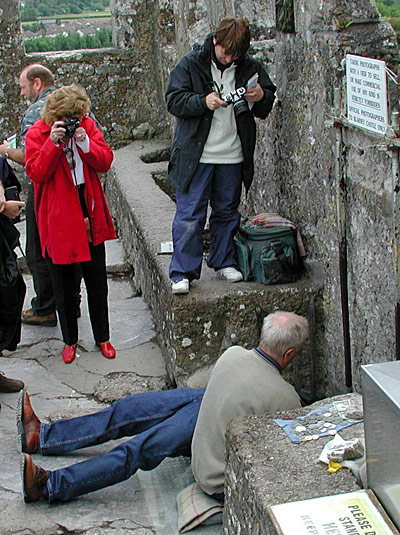
This is not a crime scene, unless you consider time wasted in the Emerald Isle to see Ireland’s ultimate tourist trap (the Blarney Stone) a crime.
Tune out the hype around Ireland’s Blarney Stone (slobbered on by countless tourists to get the “gift of gab”), Spain’s Costa del Sol resorts, and the French Riviera in July and August. These are among Europe’s most overrated spots.
Geneva, one of Switzerland’s largest and most sterile cities, gets the “nice place to live but I wouldn’t want to visit” award. It’s pleasantly situated on a lake — just like Buffalo is. While it’s famous, name familiarity is a rotten reason to go somewhere. If you want a Swiss city, see Bern or Luzern instead.
Germany’s famous Black Forest disappoints more people than it excites. If it were all Germany offered, it would be worth seeing. For Europeans, any large forest is understandably a popular attraction. But I’d say the average American visitor who’s seen more than three trees in one place would prefer Germany’s Romantic Road and Bavaria, or the Rhine and Mosel country — all high points that cut the Black Forest down to stumps.
After Prague, Kraków (Poland) and Budapest (Hungary) are Eastern Europe’s best cities. Bucharest, Romania’s capital, has little to offer. Its top-selling postcard is a view of the InterContinental Hotel. Norway’s Stavanger, famous for nearby fjords and its status as an oil boomtown, is a large port that’s about as thrilling as…well, put it this way: Emigrants left it in droves to move to the wilds of Minnesota. Your time is better spent at Sognefjord, Norway’s most spectacular fjord. The most boring countryside is Sweden’s (yes, I’m Norwegian).
Europe’s most scenic train ride is the Glacier Express across southern Switzerland. The most scenic boat ride is from Stockholm to Helsinki — countless islands and blondes. Europe’s most underrated sight is Rome’s ancient seaport, Ostia Antica, and its most misunderstood wine is Portugal’s vinho verde (green wine).
Honeymooners should try these tiny towns: Beilstein on Germany’s Mosel River; Hallstatt on Austria’s Lake Hallstatt; Varenna on Italy’s Lake Como; Ærøskøbing on an island in south Denmark; and Gimmelwald, high in the Swiss Alps.
Pondering the vast wonder of the Cumbrian Lake District from the summit of Catbells can be a highlight — literal and figurative — of any visit to northern England.
The most pleasing French château is Vaux-le-Vicomte, near Paris. The best Gothic interior is found in Paris’ Sainte-Chapelle church. The top two medieval castle interiors are Germany’s Burg Eltz on the Mosel River, and northern Italy’s Reifenstein. Lisbon, Oslo, Stockholm, Brussels, and Budapest are Europe’s most underrated big cities.
I’ll close with a lightning round of “ultimates” (what travel writer can resist?): the ultimate medieval walled town in Germany (Rothenburg), prehistoric stone fortress in Ireland (Dún Aenghus), Italian Riviera port town (Vernazza), hike in England’s Lake District (Catbells above Keswick), neighborhood pub in London (The Anglesea Arms), castle in North Wales (nope, I still can’t pick just one)…and pedestrian market street in Paris (Rue Cler).
Having stuck my neck out to say all this, I must add that it’s always fun — and necessary — to reassess opinions (mine have certainly changed over the years). These are just my personal feelings after more than 100 months of European travel. As you sort through these “bests” and “worsts,” go ahead and disagree. (That’s what Facebook comments are for.) And, of course, don’t let any travel writer limit your freedom to find your own ultimates.