Here you can browse through my blog posts prior to February 2022. Currently I'm sharing my travel experiences, candid opinions, and what's on my mind solely on my Facebook page. — Rick

EU, NORML, and Tesla: Kicking Off My Road Trip USA in Washington DC

Overlooking the commotion of the Washington DC Travel and Adventure Show.

Last week, I embarked on my second annual “Road Trip USA.” I had such a wonderful time doing my cross-country trip last year, I just had to do it again — this time focusing on a dozen fine communities in the Eastern Seaboard, South, and Midwest.

My trip this year began in and near our national’s capital. I kicked things off giving two talks at Asbury Methodist Village retirement community in Gaithersburg, Maryland. I could spend the entire year doing talks like these, as “progressive care organizations” pay well to have me give a talk at their facility (partly to attract prospective retirees who may want to move in). And I really enjoy these talks — I find older audiences impressively young at heart.

From there, I spent the weekend giving two talks each day (travel skills and Italy) as the headliner for the Washington DC Travel and Adventure Show. They pay us well to have a booth there and for me to give my talks, as they need to attract lots of people to pay the $10 admission. These talks are challenging for me because there’s a huge crowd and the venue is immersed in travel-fair commotion — noisy booths, other speakers just behind a curtain, and folk-dance shows. Our booth was really lively, and we gave away 3,000 newsletters and mounds of tour promotional material.

I enjoy checking in with the other speakers at these shows. This time, I got to hang out with Arthur Frommer a bit. My travel writing inspiration and mentor is a gracious man, still teaching travel as he has since his first book back in the mid-1950s. The first thing Arthur asked me was, “And how is your son, Andy’s, little tour business going?”

My DC time was also busy because of everything else going on in that city. My daughter, Jackie, just happened to be flying in for an alumni gathering at Georgetown. She needed a place to crash, so she moved into my hotel room for two days. I wasn’t sure how she’d feel sharing a hotel room with her old man — but it didn’t matter, as she spent each night out with her college friends, and I barely saw her.

"Filling up" a Tesla, it's not regular or unleaded...it's AC or DC.
“Filling up” a Tesla, it’s not regular or unleaded…it’s AC or DC.

I enjoyed breakfast with the Egyptian tourism director, who assured me Egypt is stable enough for Western travelers to feel comfortable. (I’ll see if that’s true, in person, next month.) One evening I taped a pledge drive at WETA. The next I went to the European Union Ambassador’s mansion for a party. Jackie couldn’t believe I was heading out to the party without a tie, so I bought one at the hotel gift shop on my way out. That turned out to be a very good move. Ambassadors from nearly a dozen smaller European countries were invited there to meet me over drinks. I enjoyed being lobbied by each of them to give their country — from Belgium to Latvia to Greece — more attention. The EU is underwriting our radio program, and this evening provided a great opportunity for me to connect with them. It’s rare that I meet people as enthusiastic about Europe as a whole (rather than individual countries) as I am. The EU staff is evangelical about Europe.

As I’m newly elected to the board of the National Organization for the Reform of Marijuana Laws, my last DC night was spent at dinner connecting with the director and founder of NORML. The three of us talked about the drug policy reform business and coordinating a good plan to build upon our recent victories in Washington State and Colorado.

My DC highlight was taking a few minutes to test drive a Tesla. Wow. I have never had such an exciting driving experience. Completely electric, with almost no moving parts, no gears, a big bright touchscreen computer terminal for a control pad, and rocket-like acceleration, I felt I was piloting the jet-like car of the future as I zipped giddily around our nation’s capital. (Too bad about the price tag.)
A Random Q&A

I was recently asked these questions, and thought you might enjoy the answers:

We’ll be traveling abroad with our kids in 2013. Is there one must-have item for an international family vacation?
I believe kids should have their own money belt, an expanded “vacation allowance,” and the responsibility to manage their funds and understand the foreign currency. They should also keep (as a precondition for getting the expanded allowance) a trip journal with meaningful thoughts and observations. That will end up being their favorite souvenir.

I’ve noticed that on your PBS show, you often carry a day bag. What’s inside?
In my day bag, I carry a camera, a sweater, an extra pencil, travel notes, my script (when making TV), a small water bottle…and, very often, a small ham-and-cheese sandwich swiped from the breakfast buffet.

When traveling to a foreign country, how important is knowing the native language? Are there any apps or books that you recommend for translation?
While I wish I spoke a foreign language (and Ireland is one of my favorite countries partly because, when hanging out with locals there, I have the sensation that I’m understanding a foreign language), I find that speaking the local language is not important for the basic needs of a traveler. For the same reason, I personally haven’t used a phrase book much, and I don’t think I’d bother with an app. A bold spirit of adventure, a dollop of common sense, and a big smile are all I need to communicate in my travels. These days, you’ll find anyone who’s young, well-educated, and/or working in tourism very likely to speak English.

What new places will you be visiting in 2013?
The West Bank (Palestinian Territories), Alexandria in Egypt, and Reykjavik. This summer, I’ll be taking a Rick Steves’ Scotland tour and expect to learn plenty as I visit some exciting new places with our Scottish guide. I’ll cap my travel year by taking a cruise on the Baltic Sea (working on our new Northern European Cruise Ports guidebook — coming out in its first edition this July). I’ll jump ship in St. Petersburg, Russia, where I’ll spend about five days, then stop by Iceland on my way home for my first-ever visit there.

Skills for Researching Guidebooks

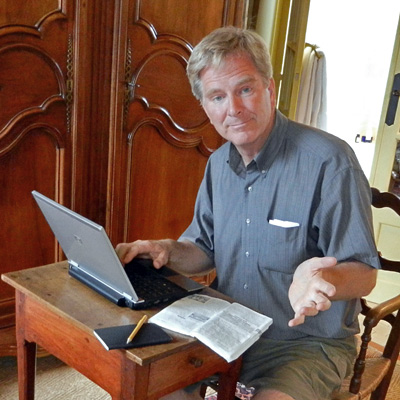
02-23-13 FB Rick LaptopWe are just about the only guidebook publisher who still endeavors to visit–in person–every sight in our top-selling titles every year. (And even our lowest-selling titles get a personal visit every other year.) That’s a lot of territory to cover, and we have a team of talented and hardworking researchers who are preparing to set out on their annual research rounds. While I still enjoy the work and wish I could do it all myself, it’s just far too much for me to cover in the 60 to 80 days I dedicate to guidebook research each year. Each spring, we meet with our researchers to review our strategy and share advice on smart researching. Here are just a few of the tips that came up this year:

Tourist Information
To identify English-speaking locals, look for young people who are well-educated and/or work in tourism.

The TI clerk may freeze up when they realize you’re a “journalist”; therefore, just ask questions as a confused tourist as long as you can.

Many tourist information offices (TIs) are now privatized–and have become ad agencies in disguise. Use them, but be savvy. Recognize when TIs are pushing their own pay phone numbers (when a toll-free alternative may still be available) or talking up hotels and tour companies that buy their favor. Be skeptical of gimmicky sights, restaurants, and activities that advertise in the TI magazines–in many places, a TI seal of approval means only that that outfit gave them money. TI scorn is likely just a blacklisting of small businesses that refuse to buy into their game.

Hotels and Restaurants
When visiting hotels and restaurants, to be sure you have the correct contact details, write your research notes on the establishment’s business card. Cross your 7s–European-style–so you don’t mistake them later for sloppy 1s.

Look for decals on doors of hotels and restaurants to see which guidebooks and organizations recommend them. If it’s in all the guidebooks, that’s a negative.

At a hotel, pretend you intend to sleep there, and ask for only one night. That way, you’ll be considered as “undesirable” as possible, so you’ll be offered the worst-scenario price and see their hardest-to-sell room. Don’t worry about the quality of beds–the days of saggy beds are past. And if we cover something in one listing, it needs to be consistent and specific in all the others.

Walk different routes to maximize your learning about neighborhoods where we recommend hotels.  Also be sure to walk through these neighborhoods late at night to gauge possible lowlife and noise problems. We won’t necessarily delete a place with these problems, but we need to be candid and warn people who might find this a problem. Don’t let hoteliers edit our listings. If they are above a porn shop and don’t want us to mention it, ignore their request. The listing is not a paid ad. They are lucky to be in the book at all.

Museums
List when the museum actually closes, not when they shut the ticket window. If researching during the off-season, be sure to ask about peak-season hours.

Combo-tickets are generally a scheme designed to let mediocre sights that few people will pay to visit enjoy the coattails of sights that everyone will see at any price. The disadvantage of combo-tickets: They cost more. The advantage: You can buy your ticket at the unpopular sight and walk directly into the popular sight without waiting in line (examples: Correr Museum for the Doge’s Palace in Venice; Palatine Hill for the Colosseum in Rome).

Nothing temporary is worth knowing about for your guidebook research. Don’t be distracted by something that won’t be there anymore by the time the book is published.

Be a cultural lint brush. Live the book. Stay on top of your research. Try your hardest not start the next town until all your notes from the last town are carefully typed up. Remember: The quality and thoroughness of the work you do will impact thousands of travelers next year, and will make for more happy travels than you can imagine.

The Delights of Europe through the Eyes of a 20-Year-Old Have a Very Long Self-Life

I spend most of my work time addressing the travel needs of adult travelers and marketing to that segment of our traveling population. My son, Andy, who’s running a tour program for students in Europe, does the same–but for the 20-year-old crowd.

I love watching Andy’s promotional video and putting myself in the mindset of a college-age traveler. I’ve been at this for over 30 years now, and it’s inspiring to see the ways things have changed…and the ways they’ve stayed the same. Today there are dirt-cheap plane flights, disposable cellphones, the same coins in nearly everyone’s pockets, bullet trains, hostels serving gourmet tapas, and no need for travelers’ checks. There’s a tunnel under the English Channel, and you can Skype home to Mom for free. Yet the adventure and thrills of good, old-fashioned vagabonding survive.

As a travel writer and teacher, one of my favorite discoveries is that the journal entries I wrote as a scruffy 20-year-old in 1975 still resonate with the generally much-less-scruffy 20-year-old American exploring Europe in 2013. Today the same timeless magic is there…and it’s a lot more convenient and comfortable to find it. As it was for me a generation ago, students are still awakening to the wonders of our world and establishing the parameters of their worldview.

Immerse yourself in a 20-year-old’s wanderlust for 100 seconds and let this video clip connect you with a vivid and people-filled Europe that has nothing to do with a having lots of money. Smiles spring, taste buds pop, sunsets warm, and the world opens up like a Dutch tulip in springtime…even on a student’s budget. Then, in the Comments, share a vivid, perspective-bending experience you had on your student European adventure…perhaps so long ago.

If you can’t see the video below, watch it on YouTube.

[pageview width=”600″ height=”349″ url=”http://www.youtube.com/embed/5u3TD-r_rWc”]

Thoughtful Consumption in Our Travels

When a country or region is in turmoil, people ask me, “Are there deals to be had for travelers there?” Not that I’m any kind of saint, but when I travel to places in crisis, it’s not to take advantage of their hardship —  but to learn from their reality and to contribute to their economy through tourism.

When I do travel to a place that’s going through hard times, I know I’ll be spending substantial money there — and I try to spend it in a way that helps the locals. Visiting Greece from a cruise ship is easy and fun, but your serious money (accommodations, dinner, and tour guiding) sets sail with you. I remember how, immediately after the fall of the USSR, the Baltic States had lots of “joint venture” businesses — such as fancy hotels that were mostly owned by Germans and Swedes. These slick bits of Stockholm were being planted in Vilnius in hopes of big profits down the road for foreign investors. I always felt better staying in a humbler hotel with local roots.

This April, I’ll be navigating the complex touristic waters of Israel and the West Bank. I asked an Israeli tourism official if he cared that I’d also be featuring the West Bank in my work. He basically said, “We’re happy if you can send Israel and the people in the Palestinian Territories some tourism. It’s really important for our economies. And if it is good for the West Bank’s economic health, then it’s good for Israel, too.” By promoting tourism in the West Bank, I hope to play some small role in helping the struggling local economy…and, in a small way, promoting peace at the same time.

Where would I travel in Europe this year with that ethic in mind? For one thing, I’d be careful not to let hysterical “if it bleeds, it leads” news coverage skew my assessment of where it’s safe to travel. I would also not let the possibility of strikes or demonstrations keep me away from a country that’s facing challenges.

Travelers are like skiers: Some like the smooth, predictable slopes. Others find those a little boring, and prefer a few moguls here and a trail through the forest there. The key to enjoying moguls is to bend your knees. And, if you’re venturing into the forest, you better have the necessary information.

Likewise, the key to enjoying Europe, from Portugal to Rhodes, is to be flexible and to have the right information. As Europe continues to face trying times, I’m not expecting prices to go way down. But the relief-per-dollar my business brings to these places will be way up. That’s why, on my next trip, I’ll be visiting these countries: Egypt, Israel, the Palestinian Territories, Turkey, Greece, Italy, Spain, and Portugal.

Happy — and thoughtful — travels!