Here you can browse through my blog posts prior to February 2022. Currently I'm sharing my travel experiences, candid opinions, and what's on my mind solely on my Facebook page. — Rick

Are Guidebooks Dead?

Rick-Frommer

Last month, three things happened that were interesting to me as a guidebook writer: After Google purchased the venerable Frommer’s guidebook series, they announced that they would no longer keep them in print. I read an article about the “rapid decline of the printed guidebook.” And I got my biggest royalty check ever in payment for my guidebook sales.

A couple of weeks ago, I had a coffee with Arthur Frommer at the Washington DC Travel and Adventure Show. While he sold the guidebook series with his name on it a long time ago, Arthur still gives spirited talks at such shows all around the country. The first edition of his GI’s Guide to Traveling in Europe, which eventually became the groundbreaking Europe on $5 a Day, was published the year I was born (1955). I have a copy of it on the bookshelf in my office as a kind of personal and thankful reminder of how Arthur’s work gave people like my parents the confidence to travel independently through Europe back when that was a new thing for middle-class Americans. You could make a case that without Arthur Frommer opening that door for my family in 1969, I’d still be teaching piano lessons.

I loved traveling with Arthur’s book for a decade (along with the backpackers’ guide, Let’s Go: Europe). Arthur’s personality — his sass, elegance, and Ivy League respect for culture and language — along with his passion for making Europe accessible (first to his fellow GIs, and ultimately to a whole generation of American travelers) inspired me. Way back in 1984, Arthur invited me to appear on his cable TV show and introduced me as “Rick Steves, the new Steve Birnbaum, Eugene Fodor, Temple Fielding of the travel guide industry.” At the time, his prediction seemed a little wacky, but — in part because most publishers have found it’s cheaper to write and update guidebooks by committee rather than employ individual personalities — my generation has failed to produce a class of well-known guidebook writers. Arthur Frommer’s endorsement was a huge break for me, and even though I had a hard time believing it, I used the quote a lot.

ETBD-Frommer

In an age of consolidation, when only big is viable, guidebook publishers are big and few in number. The major guidebook series in the USA are Fodor’s, Frommer’s, Lonely Planet, Dorling Kindersley, and Rick Steves. And for many of these, the future looks shaky. Lonely Planet was owned by BBC in London for less than six years before they unloaded to a tobacco tycoon it for less than half what they originally paid. Its fate is unknown. Frommer’s was purchased in August of 2012 by Google, who recently announced that they will let almost all of their 350 titles go out of print — leaving the company with piles of data to shuffle into its searchable banks, but no bookshelf presence. Dorling Kindersley (or “DK,” publishers of the glossy, illustrated Eyewitness and Top 10 series) is owned by Penguin, and Fodor’s is owned by Random House — and now that those two publishing giants have agreed to a merger, DK and Fodor’s are likely to merge with them, creating more uncertainty.

And the Rick Steves line? We’re as strong and determined as ever. This week, I’m setting out with a band of 25 fellow researchers with the goal to visit in person virtually every sight, hotel, restaurant, launderette, train station, boat dock, and other place mentioned in our guidebooks, as we make them up-to-date for next year.

I think guidebook publishers are challenged in the same way news corporations are. It’s expensive for news services to pay for individual correspondents to bring home the news when it’s just out there on the Internet for all to scarf up — and viewers don’t necessarily respond to more costly, higher-quality journalism. And, in the case of TV news, the limited funds are much better spent on a good-looking anchorperson to read the news rather than quality people to gather it. That’s why top-notch investigative journalism is at a critical low point these days.

Considering the modest profit margin for publishing a guidebook, publishers have a similar problem in hiring trained researchers to actually research their books in person. And new crowdsourcing alternatives to guidebooks (like TripAdvisor, CruiseCritic, Booking.com, Yelp, Urbanspoon, and so on) give travelers the impression that they have all the reviews they’ll ever need from other consumers. With the increasing popularity of these options, a tough business equation has become even tougher.

All of these review-based websites are certainly useful and informative, and I use them myself when traveling somewhere new. But I believe that — just as you wouldn’t want to get all of your news from amateur bloggers — casual online reviewers take a hit-or-miss approach that isn’t always an improvement on an experienced guidebook researcher with a trained eye. Most users reviewing hotels on TripAdvisor have experienced a few dozen hotels in their lives; a professional travel writer has inspected and evaluated hundreds, or even thousands. And, while these sites are particularly helpful for sleeping and eating, they do virtually nothing to explain what you’re seeing when you get there. Guidebooks’ sightseeing advice, self-guided museum tours, and neighborhood walks help you engage with and understand the place you’ve traveled so far to see, with a depth that crowdsourced websites don’t even attempt. For all of these reasons, I find crowdsourced sites a handy tool to enhance, but not replace, the information I learn from a good guidebook.

Complicating matters is the advent of digital, non-print formats, which challenge traditional book-business thinking. But, while ebooks seem exciting, print sales still dominate (for now, at least); only about 15 percent of total guidebook sales are electronic.

Are guidebooks dead? Not yet, that’s for sure. I’m flying to Egypt and the Holy Land as I write this, my bag heavy with Lonely Planet, DK, and Bradt guides to Egypt, Israel, and the Palestinian Territories. The question can be interpreted in two ways: Will people still be traveling with good old-fashioned print guidebooks in tow? And is the entire concept of a guidebook (whether in print or electronic) still viable? My take: For another decade, travelers will be toting print editions of guidebooks. Slowly, print will be replaced by digital. There will be a battle between various electronic information services, including guidebooks. Many users will opt for GPS-driven, crowd-researched apps. But plenty of others will still use guidebooks in their futuristic digital format — probably souped up with streaming video and GPS features. And, God willing, I’ll still be out there making sure mine are accurate and up-to-date.

 

A Tie? Let’s Give Away TWO Trips to Europe!

Tour Scrapbooks can tell more about an experience — honestly — than mere marketing. (photo by Terry Deem)

This week I gave away two European tours when I only had to give away one. I couldn’t help myself. These travelers really earned it.

Every spring, I offer a free tour to the winner of our annual Tour Alum Scrapbook Contest. Anyone who travels on one of our 40 European tour itineraries has a chance of winning if they take the time to express what their trip was like in an original online scrapbook. The creativity and enthusiasm of this year’s first and second place entries (as determined by a fine group of judges in my office) was so engaging that I had to override their ranking and declare both entries grand prize winners.

That’s what cost me the extra tour, and it’s worth every penny.   To page through the top four finishers (and get an irresistible taste of our Spain, Turkey, Best of Europe and My Way Europe tours), visit my scrapbook winners page.

Does this inspire you to scrapbook your own trips?

Tweaking Your Julekake

European-Christmas-book-cover

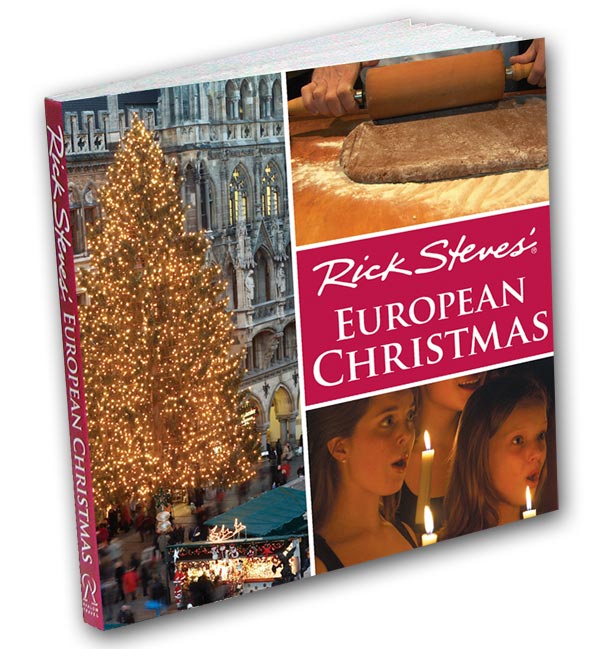
I am thankful that our Rick Steves’ European Christmas special has become a standard part of public television holiday scheduling. Most stations run it each Christmas. I brag that for everything we eat in the program, there’s a recipe in the companion book, Rick Steves’ European Christmas. Making this book, we collected European recipes throughout our Christmas travels. We simply converted their grams, milliliters, and Celsius to teaspoons, cups, and Fahrenheit for American cooks. But I’m no cook, and I just trusted what my European friends told me. And over the years, I’ve wondered — did we do it right? Do the recipes work?

When our publisher asked us to print a new, improved edition of the book, my staff reminded me that no one had ever really tested these recipes. Obviously, that needed to be done. So the cooks on our staff rose to the challenge and volunteered to actually cook up each of the Christmas treats (just in time for Easter).   After scouring local markets for ingredients (some harder to find than others), our tour-guide cooks donned their aprons at home and baked up a sleighful of holiday goodies, from mince pie, Christmas pudding, and gingerbread, to panettone (Milanese sweet bread), panforte (dense Italian fruitcake), and julekake (Norwegian Christmas cake). They served beef tenderloin with good French wine, sipped hot German glühwein, and dipped bread in a communal pot of bubbling Swiss fondue.

The test kitchen results are in. It turns out that the book’s recipes are pretty darn good. We’ve rewritten a few for clarity, but most needed just a couple tweaks here and there. Among the changes for the new edition, we’ll adjust the baking temperature for the panettone, cut the Christmas pudding in half (really, who needs four pounds of the stuff?), amp up the citron and dried fruit in the julekaka, and do a better job of explaining how to prepare the perfect beef tenderloin.

European-Christmas-cookie

The test cooks have my appreciation — and later in 2013, when you can try out the updated recipes for yourself. And let me be the first to wish you a merry Christmas!


It’s Finally Here: Rick Steves…the Song

A fun part of my work is being parodied or otherwise becoming part of other people’s creative projects. I stumble into lots of examples of this. And, while I’ve heard several songs about myself, this one — which I just discovered today — is my favorite. Congratulations, Brenton Haack. I’ll take your lyrics in the most positive light possible. Happy travels!

Click to listen: https://soundcloud.com/brentonhaack/rick-steves


Stick to Your Day Job, Comrade Steves

The thought-provoking wealth distribution video I posted a few days ago stirred up more comments than anything else we’ve ever posted. Of the over 700 comments on facebook and this blog, there were many constructive suggestions, lots of questions, and — as usual — plenty of anti-government sentiment. Thanks for all of your comments.

The most common question: What can we do? There’s the obvious: Avoid needless wars. Cut back on military spending. Open up our economy for investment and growth. Go back to a more progressive tax code, as we had under Reagan and Clinton. And defend the inheritance tax (without which we encourage a future generation of idle-rich kids).

And then there’s something nobody seems willing to seriously consider: Why not institute a small but inescapable wealth tax? Imagine if just having a “net worth” here in the USA cost 1 percent of that net worth every year? If you sat on a pile of wealth (say $10 million) for 20 years, it would cost you 20 percent of that wealth ($2 million) to keep it in a country where it’s not scary to be rich. (Anywhere else on the planet, someone that rich would spend at least that much just on security.) I’m sorry, but I wouldn’t pity a person once worth $10 million now only worth “only” $8 million if it makes our country a stronger and healthier one.

Many asked why, if I care so much, don’t I just give more taxes? That’s kind of silly. We need to respond to this challenge as a society. A few caring, patriotic, wealthy people giving what all wealthy people should give would accomplish nothing. If being wealthy in the USA came with a higher tax obligation (as it did for most of the 20th  century), we could — assuming smart use of that money entrusted to the government — create a better society. Remember, not long ago our tax dollars took us to the moon and built the Interstate Highway System.

What can we do? In short, I’d say support a return to a more progressive tax code. Making it more expensive to be rich would not deter hard-driven capitalists (like me) from investing and working hard to get rich — and, assuming they’re at all patriotic, it certainly wouldn’t drive them out of the country. I believe anyone who says otherwise is either mistaken or dishonest.

For all those who say, “Why don’t you just stick to travel writing?”, “I’ve been a loyal customer for years, but with this post, you have lost me,” and “Stick to your day job, comrade Steves,” I say life is political. We have to live with the political decisions we make as a society. And so do people struggling in our country, people struggling south of our border, and people who will be struggling generations from now with the mess we leave them. Politics is like stewardship. And I believe in thoughtful stewardship.

If you missed this wonderfully intriguing little video clip, check it out below. Meanwhile, next week, I kick off my spring travels overseas — reporting from Egypt, Israel, and the Palestinian Territories.

If you can’t see the video below, watch it on YouTube.