Here you can browse through my blog posts prior to February 2022. Currently I'm sharing my travel experiences, candid opinions, and what's on my mind solely on my Facebook page. — Rick

Alexandria, Egypt’s “Pearl of the Mediterranean”

Most tourists in Egypt visit only Cairo and Luxor. Few visit Alexandria, just a three-hour drive away — the country’s second city, and one of the great cities of the Mediterranean. Egypt’s historical capital for almost a millennium, today the “Pearl of the Mediterranean” is a favorite summer getaway for locals who appreciate its cosmopolitan flavor and cooler climate. It’s like Cairo in its mega-millions intensity, but cleaner and quieter, and facing the Mediterranean instead of the Nile.
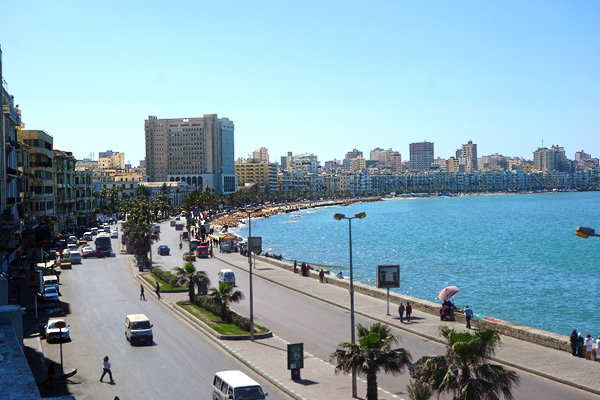
Alexandria, with a panache unique in Egypt, jams 5 million people up against the Mediterranean.

Alexandria, founded in 331 B.C. by Alexander the Great, is a fabled place. Queen Cleopatra ruled from here, back when the city was, along with Rome, one of two in the ancient world with a million people. Back then, it rivaled Rome as a cultural and intellectual capital. Alexandria’s awe-inspiring lighthouse (or Pharos) — one of the seven wonders of the ancient world — marked its harbor, and its legendary library was the world’s largest. No ship could dock here without giving up its books to be copied for this, the ultimate repository of knowledge. Tragically for all of civilization, the library burned (likely around 48 B.C.), and today only its legend — and a fragment of a single scroll (now kept in Vienna) — survives.

History has been harsh: No trace of Alexander’s day survives, Cleopatra’s city is now under the sea, the library is long gone, and the lighthouse has tumbled (the only surviving image of it is engraved on a coin). Of its ancient wonders, only a hint of Alexandria’s street plan, a few archaeological digs, and the towering Pompey’s Pillar survive today.

The nearly 90-foot-tall Pompey’s Pillar, carved out of a single mighty piece of granite, was shipped 500 miles from Aswan down the Nile to this spot 1,700 years ago. It stands like an exclamation mark, reminding all who visit that today’s city sits upon what was a mighty urban center of a million ancient Egyptians.

The Alexandria National Museum (with wonderful treasures from the time of the pharaohs, a small bust of Alexander, and fine early Christian art) tells the city’s story in an old mansion that once housed the US consulate. Alexandria gave Rome a toehold on Egypt. This is where St. Mark arrived to introduce Christianity to the land. The invading Muslims bypassed it for Cairo. In the Middle Ages, famine, civil wars, earthquakes, and disease left the once-mighty Alexandria just a village of 10,000. Then, in the 19th century, the city enjoyed a resurgence — becoming one of the liveliest ports on the Mediterranean, with a cosmopolitan mix of Greek, French, English, and Italian influence. By World War II, 40 percent of the population had come from other countries. But then, with the anti-colonialism of the 1950s, foreign interests were nationalized, and most of the foreigners who brought such vitality to the city fled.

Today, Alexandria’s early-20th-century grandness is musty and caked in this generation’s dirt. The city is a teeming and thoroughly Egyptian metropolis of about 5 million. It feels spirited, young, and progressive. In fact, Alexandria helped spearhead the revolution of 2011.

Alexandria is a long and skinny port town, just two miles wide but stretching 12 miles along the seaside Corniche — which feels like Nice’s Promenade des Anglais hurled into a Blade Runner furnace. The wistful Cecil Hotel, built in 1930 and overlooking the harbor, gives the visitor a comforting home base with a nostalgic touch of belle époque elegance.

p36-DSC00948

Alexandria’s top attraction is its futuristic modern library. Norwegian-designed and built in 2002 with a dazzling reading room accommodating 2,500 readers, it stands near where the fabled ancient library stood (bibalex.org shows off all its wonders). While the library is a delight of modern architecture, the highlight of the city for me was exploring the Anfoushi old town. More on that tomorrow.

Open Letter to Egyptian President Muhammad Morsi

Dear Mr. President,

I am a Protestant Christian, and a burden I bear all my life is what’s called the “Protestant work ethic.” I was just in your wonderful capital city, and my work ethic drives me to make a suggestion.

Because I care about Egypt very much, I feel I must say that Cairo is in such a shambles that it’s in danger of demoralizing caring people, killing any civic pride that still exists, and even driving your best citizens to emigrate to a country where abandoned cars don’t block streets and sidewalks for months on end. While arguably just a cosmetic problem, this is also very bad for your tourism industry — which could use a little help.

You command a big military. I understand that all men serve (the uneducated for three years and the educated for one year). Consider this move, which could well inspire Cairo to be proud of itself: Shut down the city for three days. Declare war on the junk clogging your city’s veins. Mobilize everyone. Send in the army. Tell everyone that anything left on the street will be taken away. And then flush out your great but crumbling city. Clear out collapsed buildings, remove abandoned and stripped old cars, tear down broken and vandalized phone booths, truck away the broken chunks of concrete, and pick up all the trash. While you’re at it, replace the crumpled and rusty dumpsters with nice new ones with city slogans on them (as in London). Challenge your citizenry to use the dumpsters, and pay to have them emptied every week.

In my travels, I’ve seen firsthand how a similar approach has succeeded in both Istanbul and Tangier, Morocco, in recent years. You’ll quickly recover your investment in increased tourism revenue, and your people will think of you as someone who can get something done that impacts their lives in a positive way.

Good luck!

Rick Steves

Some great cities are people-friendly. Rather than people-friendly, it seems Cairo is garbage- and abandoned car-friendly. But that can change.


Surround-sound Egyptian Market

All over the world, markets come with the charming and melodic song of merchants selling slicers, dicers, bras, and knock-off DVDs. A stroll down this lane in Cairo takes the sound of commerce to new heights. Give this a listen.

If you can’t see the video below, watch it on YouTube.

Cairo Social Club

How does an Egyptian rise above the insanity of the streets? Get an education, hope you can marry into a good family (weddings are still generally arranged between families, and after the match is made, the hope is that love may grow), move into the suburbs, and join a social club.

Anytime you have a chance to enjoy a good home-cooked meal with new friends — especially in a developing country — jump on it. While Egyptian apartment flats are caked in soot on the outside, inside they can be filled with love and delightful hospitality...not to mention great food.
Anytime you have a chance to enjoy a good home-cooked meal with new friends — especially in a developing country — jump on it. While Egyptian apartment flats are caked in soot on the outside, inside they can be filled with love and delightful hospitality…not to mention great food.

My friend, Tarek (who runs Egypt and Beyond Travel), and his wife, Heba, invited us to dinner. Afterwards, we dropped by their family’s social club. Social or sports clubs are like an American athletic club crossed with a society club. A steep membership fee shapes the clientele. Each club has its own personality and status.

The club is great for all generations. Kids just park their bikes inside the sprawling, park-like grounds (which offers more greenery than you’ll see anywhere in town). It’s perfect for birthday parties and swimming lessons. There’s competitive fencing and tennis. While you couldn’t imagine jogging out on the exhaust-filled, potholed streets, in your club there’s a fine track. The adults-only areas provide a man-cave escape for a quiet game of backgammon, or a place for women to have a coffee klatch or sit in a circle and knit.

Because they’re considered high-class and family-friendly, clubs don’t allow alcohol or shisha smoking. Friends — often neighbors who’ve been coming here together since childhood — gather to watch the big game on a nice TV. Membership stays in the family and can be passed down. Tarek’s club is run by former military people — something members are thankful for, as this stratum of society understands how discipline is the necessary flipside of freedom.

Egyptians who can afford it enjoy social clubs — delightful parallel worlds behind protective walls.

With this gathering of well-bred, upper-middle-class and wealthy families, many “romances” are arranged, and begin with a practical foundation of logical compatibility. Tarek, who’s as modern as can be, explains why he’s thankful his marriage was arranged. His explanation actually had me thinking that perhaps my strong belief in love leading to marriage, rather than vice versa, could be ethnocentric. Injecting a women’s perspective, Heba added, “You could fall in love with a man who doesn’t deserve to be loved.” As I marveled how someday their darling five-year-old daughter will be a great catch for some guy, Tarek said, “We’re friends with a wonderful family. Laila’s marriage is already arranged.”

One of my favorite souvenirs is seeing firsthand how universally powerful the love between parent and child is.

Photo by Trish Feaster (for her Egypt blog, see http://thetravelphile.com/).