Here you can browse through my blog posts prior to February 2022. Currently I'm sharing my travel experiences, candid opinions, and what's on my mind solely on my Facebook page. — Rick
Hebron, while not very important politically and very conservative, is the biggest city and has the largest economic impact in Palestine. Its population generates about 30 percent of the West Bank’s economy. Because it has the tomb of Abraham, it is holy to both Jews and Muslims…and there lies the problem.
If you can’t see the video below, watch it on YouTube.
Frankly, Palestine is not a very pretty place. In hopes of scouting somewhere that looks good for our TV camera, I searched for natural zones. One place stole my heart — a natural preserve for hiking near the village of Battir west of Bethlehem. A fine trail snaked along terraces that defined this terrain in the time of Jesus. These 3000-year-old “Biblical Terraces” were lined with stately and graceful olive trees.
I also looked for beauty elsewhere. Like many Westerners, I’m fascinated and perplexed by the tradition of women needing to be covered in public for modesty. While it’s certainly not unique to Islam, you notice it a lot while traveling here. For Muslim men, it’s a sin to look lustfully at a woman who’s not your wife. Around here, hair is sexy, and in the strictest of Muslim societies, women carefully cover up every strand in public. (Of course, in the privacy of their own domestic world, they are welcome to be as sexy as they like for their husbands.)
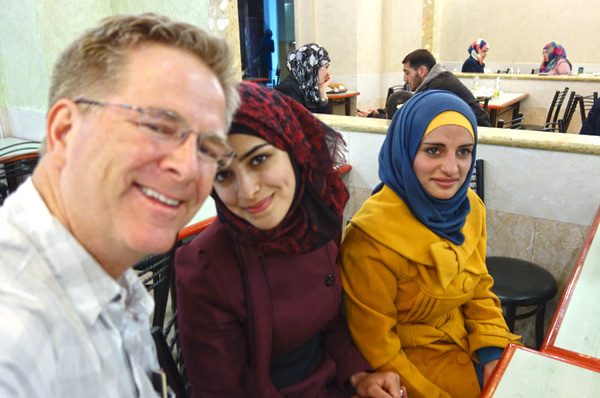
Three-thousand-year-old terraces and olive groves provide a peaceful pathway near Bethlehem. The olive tree, a symbol of steadfastness and faith in the future, has great significance in Palestinian society. The tree of poor people, it gives without taking. You plant it for your children, knowing that they will plant it for their children, too.Happily for many men, the scarf — while meant to downplay a woman’s beauty — has morphed into something stylish and sexy in itself. Women can be technically proper with their faith while still looking good. These days, scarves are worn like peacock tails. For many women, much care is put into coordinating their scarves, nail polish, hand bags, and lipstick.Modesty requirements are not unique to Muslims. Some conservative Christian women are expected to cover their heads in church. Some ultra-Orthodox Jewish women are expected to shave their heads and to wear a wig in public. And many Muslim women cover their heads. This woman, while technically covered, is dressed to kill.Many restaurants have a main room for men and a family room for women and children. My guide talked this place into letting us eat in the family section. I was surrounded by shy and demure young women wearing gorgeous scarves. My guide — a good-looking, young, and single guy — would never dare connect with a strange women in this environment. He wouldn’t even try. And if he did, he’d be shunned. But I amazed him by getting eye contact with Jasmine, joining her for a few flirtatious minutes and taking a photograph.In Palestinian society — like all around the Mediterranean in both Christian and Muslim lands — women stick together in public and so do the guys. These women in the conservative city of Hebron are sporting peacock scarves yet sticking together. Far more women wear scarves in Hebron and Nablus than in the more cosmopolitan Palestinian cities of Bethlehem and Ramallah.Young Palestinian men live with strict codes of conduct. In traditional families they’re expected to marry into their religion (Christian or Muslim), many marriages are arranged, and any physical romance comes very late in the game. In a few communities, mothers-in-law even expect to see a bloody sheet after the wedding night. I saw a couple walking down the street holding hands, so I asked my guide about it. He said, “They’re engaged. I saw the ring.”
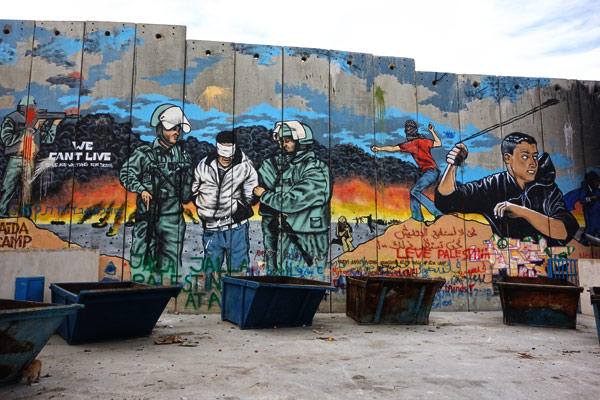
In the last decade Israel built a wall separating it from the Palestinian Territories in order to stop Palestinian terrorists from getting into Israel, and most people in Israel attribute the dramatic drop in violence since then to this barrier. Since the wall’s been erected, terrorism within Israel has gone down about 90 percent. While it has angered people around the world who care about the plight of the Palestinians, many Israelis would say, “Sorry about the inconvenience, but what’s a matter of convenience for Palestinians is a matter of survival for us.” While the wall is generally nicely finished on the Israeli side, on the Palestinian side it’s rough concrete punctuated by fortified towers. The concrete provides a big and inviting canvas for angry Arab artists and fascinating viewing for any visitor.
When Israel celebrates its Independence Day each spring, the same event is mourned as “The Day of Catastrophe” on the other side of this wall. While Israelis celebrate their independence by setting off fireworks and having big family BBQs, charred towers like this one are a reminder that, on the other side of the barrier, the anniversary is remembered differently — for example, it’s an excuse for angry Palestinian teenagers to stack tires against these symbols of occupation and set them on fire.Much of the art along the wall has a David and Goliath theme, with slingshot-wielding boys tormenting well-armed troops.There’s a big culture of hero- and martyr worship in Palestine. This woman, Leila Khaled, won notoriety by hijacking a TWA plane flying from Rome to Tel Aviv in 1969. Is she a terrorist or a freedom fighter? It really depends on who you ask.In this mural the imprisoned Fatah leader Marwan Barghouti is lionized. I was told that there’s a very good likelihood that the extreme Hamas party could beat the more moderate Fatah party in the next Palestinian election, which could in turn radicalize the West Bank as Hamas has radicalized Gaza. Moderates claim that if Israel would let Barghouti — the only Fatah leader with any charisma — free, Barghouti could help things stay on a moderate course. Many wonder why, if Barghouti could help moderation and Hamas would bring more extremism, Israel refuses to release Barghouti.
Israel has granted a certain amount of autonomy to the Palestinians, but with significant restrictions. The West Bank of the Jordan River, is divided into pockets of land classified into three zones: Areas A, B, and C. The land in Area A, while a relatively small percentage of the geographic area, contains most of the Palestinian cities and towns, and is free — it’s entirely controlled by the Palestinian Authority. The parts designated as Area B are mostly filled with infrastructure surrounding and connecting the islands of autonomy which combine to make Area A. Area B is under Palestine civil authority but is largely off-limits to Palestinian security forces. It’s mostly controlled by the Israeli military and seems to be designed so that if there’s trouble in any island of Area A — for example a terrorist attack emanating from that community — that community can be locked down and isolated in a snap by Israeli troops shutting down Area B. By shutting down Area B, the vast majority of the Palestinian population is bottled up in isolated urban islands throughout the West Bank. Area C, holding most of the West Bank’s uninhabited land, is under complete Israeli authority. While Area C is kind of a part of Palestine, there can be no Palestinian building in Area C without a permit from the Israeli Civil Administration — and that’s usually difficult to get. A problem with Area B is that, since Palestinian security forces can’t really work there and Israel doesn’t care to enforce Palestinian laws, it tends to be a more lawless place…and also serves as a convenient garbage dump.
Frustrating as the restrictions are, it is important to remember what an historic accomplishment it is that that the land in Area A is free and self-ruled, and has been since 1994.
I was told that the First Intifada led to the Oslo Accords, which established Areas A, B, and C as a transitional arrangement scheduled to be phased out in five years. When the deadlines were ignored, that lead to the Second Intifada (more violent than the first). And all that bloodshed meant the zone system became permanent, and the wall-and-settlement program was implemented.
Area C also includes Israeli infrastructure — like this fine highway — which cuts through the West Bank connecting Jewish settlements in Palestine with Israel proper. Palestinian license plates are green and Israeli plates are yellow. When times are good all cars are allowed. In troubled times, traffic is yellow plates only.
For Palestinians, living within the strict confines imposed by Israel after the Second Intifada can be frustrating. Both established and “flying” (temporary) checkpoints can make traveling from one Area A community to another very difficult. (Although during my visit, checkpoints seemed unmanned, and traffic was passing through without stopping.) For security reasons, Israel doesn’t allow Google to map the area. There is no reliable mail service between the West Bank and the rest of the world (many Palestinians keep an address with a friend in Jerusalem to work around this — but forget about getting any Amazon.com purchases delivered within Palestine).
Many hilltops in the West Bank are now covered with new, planned Israeli communities called “settlements.” They are connected to Israel by secure, well-built roads.
While most young people and professionals have smartphones here, there’s no 3G allowed in Palestine. As smartphones need an Internet connection to fully function, nearly every restaurant and café provides free Wi-Fi. Israeli settlements buried deep within the West Bank have 3G, so some Palestinians mooch off of this by getting an Israeli SIM card.
A big bold red sign marks the point where any road in Area B passes into Area A. It declares that passing this point is dangerous and that it is illegal for any Israeli citizen to do so. My hunch is that Israel’s concerned its citizens may be kidnapped by Palestinian extremists and then held for ransom in an attempt to negotiate the release of Palestinians detained in Israeli prisons. With this clear warning, Israel can, in good conscience, have a policy of not negotiating for hostages. Many believe a sad by-product of this policy is that it keeps people fearful and separated, and makes people-to-people connections more difficult between the two sides. I get the sense that the majority of people on both sides would like better relations. Walls and checkpoints are hurdles for this.
Here’s a spin tour of Bethlehem’s Manger Square, which fronts the Church of the Nativity. Sorry about the noisy wind buffeting. For my blog videos, I like to go with just one on-the-fly take.
If you can’t see the video below, watch it on YouTube.