Here you can browse through my blog posts prior to February 2022. Currently I'm sharing my travel experiences, candid opinions, and what's on my mind solely on my Facebook page. — Rick
There are camps throughout the West Bank where refugees from the Israeli/Arab wars live. The biggest, with over 23,000 people, is in Nablus. It’s across street from Jacob’s Well, where Christians believe a Samaritan woman offered Jesus some water and he revealed to her that he was the Messiah. (One of the only surviving Samaritan communities lives today in a tiny, tight-knit group on a hilltop above Nablus.) While the camp’s original, three-by-three-meter platting for tents survives, the actual tents were replaced by concrete structures long ago — and these go up many stories. The density is horrible, and there’s little privacy. It’s a land of silent orgasms.
This political art, typical of paintings decorating the wall separating Israel and Palestine, comes with powerful symbolism: Along with the Dome of the Rock (sacred to Muslims), the broken wall, and the olive branch, is a key — what refugees took with them when evacuating their hometowns decades ago.In several places around Palestine you see big keys symbolizing the determination of refugees who left Israel to return to their home villages.In the very poor refugee camp of Balata kids don’t have computers or the Internet at home. But they can spend a few pennies at the Internet shop on the main street. I popped in to see the action. Nearly all the boys were playing violent shoot-‘em-up computer games. One cute little boy turned to me and said, “Shalom.” Another, just as cute, turned away from his terminal, looked up at me, and said, “F*** you, rich man.” Part of me was impressed.
Nablus hosts the Balata Refugee Camp. With more than 23,000 registered refugees, it’s the largest United Nations-administered refugee camp in the West Bank, and it’s now 63 years old. While most Palestinians would disagree, some point out that Israel has had many refugees and assimilated them into their prosperous society while Palestine — and the Arab world — keeps the West Bank refugee camps in squalor in order to stir public opinion against Israel. Others point to the horrible conditions here as an example of the injustice Palestinians are living with every day. Regardless of your perspective, one thing is true: In 1948, when the families now living in Balata left their homes in Israel, they thought it would be for a short time. They locked up and took their keys. They still keep those keys — and they still hope to return.
If you can’t see the video below, watch it on YouTube.
Nablus is the second city of the West Bank in population and, like so many cities in the Middle East, it goes way back. The name is an Arabic version of its original name, Neapolis (New City) — it was founded by Roman Emperor Vespasian in A.D. 72. It’s a socially conservative city and feels that way. They say if you go to Egypt you must see the pyramids, and if you go to Nablus you must eat kunafeh — a shredded wheat, cheese, and syrup-soaked delight. I’m not one to put desserts in the category of ancient wonders, but kunafeh was the tastiest treat I’ve encountered so far in the Middle East. I made a point to eat it everywhere I could.
My guide, Husam, took me to Tanoreen, which must be the best restaurant in Nablus, where we enjoyed a fine city view and a local feast — chicken and vegetables cooked in a fire pit…and sweet kunafeh.Like any Palestinian city, the skyline of Nablus is dotted with black water towers. Palestinian buildings can be identified by the gear on their roofs. While Israeli settlers have running water whenever they like, Israel controls and limits water service in the Palestinian Territories. Consequently Palestinians have black water tanks on their roofs and top them off whenever the water is running. Each community has its concerns: They say the first thing an Israeli considers when building a house is a bomb-hardened safe room, and the first thing a Palestinian considers is building a cistern. Along with solar panels, Palestinian rooftops also sport satellite disks to connect to Arab and international satellites, which serve as their window on the world.
Nablus was considered a capital of terrorism during the Second Intifada. Its residents hit Israel hard, and Israel hit back hard. Its old town streets still show bomb damage. Today, Nablus feels unrepentant, and the town center is decorated with posters of what locals call martyrs. Looking into the eyes of these young men (many of them just teenagers) and seeing how they are portrayed heroically in such posters — and then imagining the anger and hopelessness of the poor street kids today — made me feel sad…and not very optimistic. But there’s always ice cream.
Visitors are welcome to tour both the mosque and the synagogue at the Tomb of the Patriarchs. Here is a quick walk through the synagogue and a peek at the tomb of Abraham. Look for the bulletproof glass that separates the Muslim and Jewish sides of the much-venerated tomb.
If you can’t see the video below, watch it on YouTube.
Hebron is a fascinating place. With about 250,000 people, it’s the largest Palestinian city and the commercial capital of the West Bank. Its people, while very conservative, seem to have some Crusader blood — you’ll see some blond hair and blue eyes. While the old town thrives with commerce, there is a palpable unease that makes just being here stressful. That’s because it has the Tomb of the Patriarchs — where Abraham, Isaac, and Jacob are all buried — which makes it holy for Jews, Muslims, and Christians…and sharing this peaceably is tricky.
The people of Hebron are seen as a bit different. They speak more slowly. Perhaps because of their Bedouin heritage, they have a tighter tribal community, and, I’m told, this is the only place you’ll find fresh camel meat at the butcher’s.
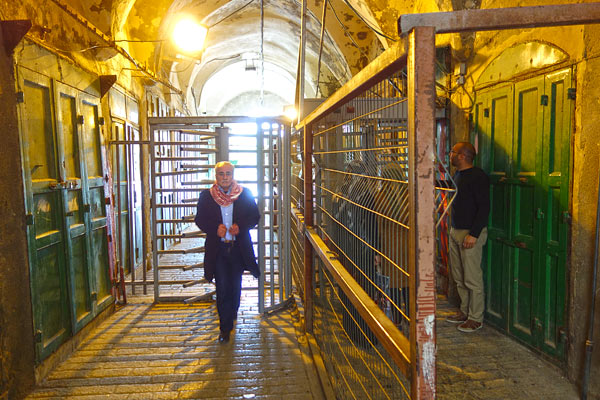
You see and feel the tension in Hebron. The center of the city is literally Jews atop Muslims — as both communities are committed to staying close to the patriarch Abraham whose tomb lies in the center. While Arabs take the ground floor, a group of about 400 Jewish settlers (many of whom are American) live above them. Because of the violent history of this town, there is a large contingent of Israeli security forces to protect the Jewish settlers. Going through security turnstiles and walking down the boarded-up “ghost street” was not enjoyable. While people choose to live here to be close to their patriarch, I wondered what Abraham would think about the inability of his feuding descendants to live together better.
A daily part of life in strife-torn Hebron is for residents to go through security turnstiles like this.
While this is a tough place for a Jew to live, those who do are driven by their faith, believing it’s important not to abandon the burial site of their patriarchs, the second most holy site for them after Jerusalem. The Tomb of the Patriarchs marks the first Jewish possession in the land of Israel. Abraham purchased the burial plot almost 4,000 years ago as explained in Genesis 23. Many times the temple here has been “repurposed” as a church or a mosque. Jews could not go beyond the seventh step on a staircase outside the building from 1267 to 1967. Since 1967, Jewish worshippers have had full access to the holy site. In 1994, during the Muslim holy month of Ramadan, a Jewish settler gunned down 29 Muslim worshippers here. Since then, the holy spot has been divided — half mosque and half synagogue — with each community getting a chance to pray at the tomb of Abraham separated by bulletproof glass.
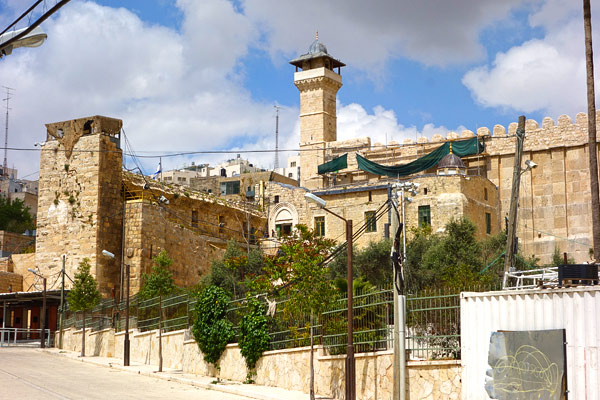
The Tomb of the Patriarchs is holy for both Jews and Muslims. It holds the much-venerated tombs of Abraham, Isaac, Jacob, and Sarah. Much of the building is an old Crusader church built on top of an enclosure from the time of King Herod. It is split to function as both a mosque and a synagogue.Like they pray at the Western Wall of their destroyed temple in Jerusalem, Orthodox Jews pray at the foundation wall of their temple in Hebron. As at the Western Wall, the stones here are “Herod Stones,” quarried and cut during the reign of King Herod and each with a distinctive carved border.In the Sanctuary of Abraham or Ibrahimi Mosque you can see a minbar. It’s a staircase representing how teachers spread the word of the Prophet Muhammad — a standard feature in mosques. This one is a rare original from the 11th century made of inlaid wood and no nails.The memorial tomb of Abraham comes with bulletproof glass and barred windows so that his two sons’ feuding descendants — Jews and Muslims — can respect his grave.