Here you can browse through my blog posts prior to February 2022. Currently I'm sharing my travel experiences, candid opinions, and what's on my mind solely on my Facebook page. — Rick

Idea Butterflies: Random Thoughts from My Notes

When I travel I collect ideas like butterflies as they flutter by. I jot them down, never knowing if they will find a place in something yet to be composed. Here are some random, thought-provoking “idea butterflies” I caught but didn’t know what to do with. I’m not saying they are right, so all you hair-trigger partisans should hold your fire for this one. These are just some ideas I found interesting and wanted to share:

p50-ramallah-mosque-and-flag

I was told that 400 years of Ottoman control — followed by European colonialism — destroyed the social fabric of the Middle East. In other words, much of the frustration we have with the lack of progress in the Middle East is due to centuries of occupation, colonization, corruption, and dictatorship brought on by the Ottomans and the West.

When I consider the many extreme political ideologies that I believe undermine peace — from fringe groups in the USA to fundamentalist organizations that inherit power for lack of any good competition in places like Egypt and Iran — I find that many have a foundation in religious passion. When you travel, you understand how fundamentalism (whether your religion’s or someone else’s) can lead to fear and violence.

I was once told that a “massacre” is when at least five people are killed by force without fighting back or without an opportunity to fight back. It occurred to me that this is arbitrary…but then I wondered, what makes a “massacre?”

Someone explained the rise of Islamists throughout the region this way: Autocrats and dictators have long kept the left-wing opposition in their countries weak by giving conservative religious groups room to grow and organize politically. Suddenly, with the Arab Spring, the dictators are gone, but there’s nothing organized on the left. So the right-wing religious groups (as we see in Iraq, Egypt, Syria, and Gaza) grab power over the less-organized, secular left. Also, in many troubled places like these, locals wanting freedom have a choice: the USA-supported faction or the religious right. The effect is just the opposite of what the neocons who brought us the Iraq War predicted: a “domino effect” yes…but of right-wing fundamentalist Muslim “democracies” almost inheriting power by default.

Islamists — from Cairo to Kabul — are smart. They build outside of politics. Over time, they infiltrate society by providing people what governments should (e.g. decent schools and a social safety net). Today, there are more veils on the street than ever. Even girls from modern secular families feel the pressure at school, and many come home requesting that their parents get them scarves. They just want to fit in.

A person in a poor and ramshackle city told me, “I remember my first time in USA. I saw old people bagging groceries. We have only a little money, but our old people will never be treated that way.”

You meet far fewer tourists in the West Bank than elsewhere, but those you do meet are really interesting.

Life in the Desert, Life in the Dead Sea

A big part of Palestine is desert, and much of it is below sea level. Nearly any tourist here will stop at the Wadi Qilt viewpoint for a look at the vast and awe-inspiring Judean Desert. Nomad communities fill dusty gullies with their ramshackle huts and tents. Children and sheep dogs follow their flocks of goats and sheep as the herds search for something to munch on. Modern water pumps are caged in and surrounded by barbed wire—a reminder of what is the most important natural resource around here. And desolate monasteries cling to remote cliffs as they have for 1,500 years. From this viewpoint, you drive down to the ancient city of Jericho and, continuing on as your ears pop, you come to the bottom of it all: the Dead Sea.

The Monastery of St. George, built on cliffs above a natural spring, dates to the 6th century. For 1,500 years, its monks have lived lives of isolation and meditation inspired by Jesus.
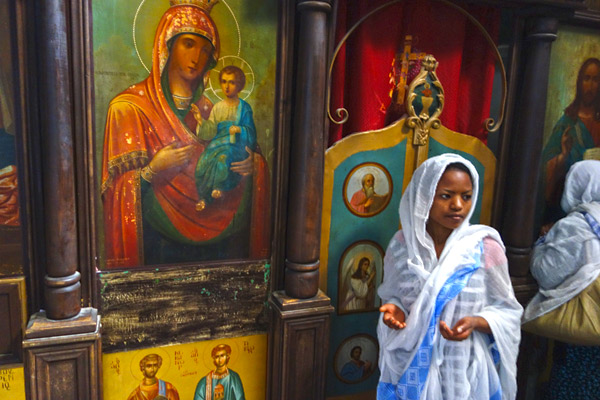
The Monastery of St. George is Greek Orthodox. Lots of pilgrims, especially from Ethiopia and Greece, hike here, light candles, and gaze at its icons for inspiration.
Palestinian Christians come to the Monastery of St. George too. While less than 2 percent of Palestine is now Christian, those who are come from families that have lived here as Christians since the 1st century.
The Dead Sea is the lowest place on earth — about 1,400 feet below sea level.  There is no ocean beach, lake, or riverbank in the West Bank where a Palestinian family can easily take their children. While Palestinians like to think part of the Dead Sea is in their territory, in reality, Israel (along with Jordan) controls its entire shoreline. When times are relaxed, Israeli guards give Palestinians access. Packed with bromine, magnesium, and iodine, it's one of the saltiest bodies of water in the world (about 33 percent). Tourists are more than welcome here, and they enjoy bobbing like corks in the super-salty water.  They also like rubbing its magically curative, black mud on their bodies. My guide took home a bag for his fiancé, as women believe the mud's minerals make their skin younger and more beautiful.
The Dead Sea is the lowest place on earth — about 1,400 feet below sea level. There is no ocean beach, lake, or riverbank in the West Bank where a Palestinian family can easily take their children. While Palestinians like to think part of the Dead Sea is in their territory, in reality, Israel (along with Jordan) controls its entire shoreline. When times are relaxed, Israeli guards give Palestinians access. Packed with bromine, magnesium, and iodine, it’s one of the saltiest bodies of water in the world (about 33 percent). Tourists are more than welcome here, and they enjoy bobbing like corks in the super-salty water. They also like rubbing its magically curative, black mud on their bodies. My guide took home a bag for his fiancé, as women believe the mud’s minerals make their skin younger and more beautiful.

Ramallah and the Tomb of Mahmoud Darwish

Growing up, the only Palestinian I was aware of was Yasser Arafat. But a thoughtful museum at the tomb of the Palestinian poet Mahmoud Darwish introduced me to the author and poet who wrote the Palestinian Declaration of Independence. Darwish, who died in 2008, worked with Arafat but used a pen rather than a gun as his weapon.

If you can’t see the video below, watch it on YouTube.

Ramallah, Palestine’s De Facto Capital

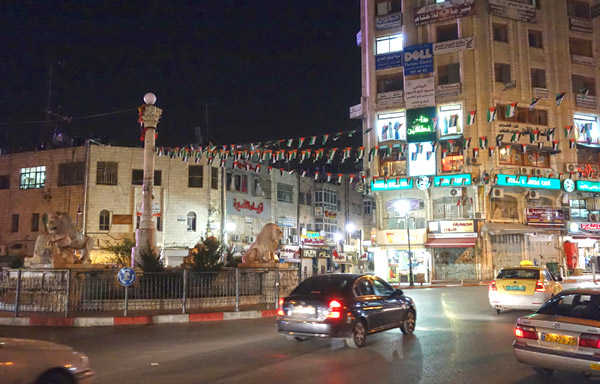
Ramallah is the boom town of the West Bank. As, bit by bit (under the settlement policy of Israel), the likelihood of East Jerusalem being the capital of Palestine is fading, Ramallah is emerging as the de facto capital of the country. It feels secular and relatively sophisticated, and there’s no question that it’s Palestinian. The PLO headquarters is here. Yasser Arafat is buried here. And it’s busy with NGOs and international agencies working on Palestine’s problems. As many Palestinian Americans have moved back home and live here, there are lots of American accents. The city of 70,000 people sits at about 3,000 feet above sea level. Its name means “God’s Mountain,” and it was cold when I was there. As it lacks the trouble-causing religious sites — and is more liberal and cosmopolitan than other Palestinian cities — it was the most relaxed place in the country for me.

Coming into Ramallah, a road was closed off with chunks of broken concrete. A few tires were burning in the distance. And a group of teenage boys were throwing rocks at an Israeli police station. It’s what some kids do here for a little "excitement" after school.
Coming into Ramallah, a road was closed off with chunks of broken concrete. A few tires were burning in the distance. And a group of teenage boys were throwing rocks at an Israeli police station. It’s what some kids do here for a little “excitement” after school.

Ramallah is considered the most cosmopolitan city in the country; there's nightclubs and fun after dark.
Ramallah is considered the most cosmopolitan city in the country; there’s nightclubs and fun after dark.

In Ramallah I slept at a friendly and comfortable hotel called Beauty Inn. Their breakfast was delightful.

Sadly, Christian churches throughout the Middle East are suffering from the rise of extremist Muslim groups. The Lutheran church in Ramallah is built like a fortress.

My guide, Iyad Shrydeh, took me to everyone’s favorite ice cream joint, Rukab’s, for a bowl of delightfully stretchy Palestinian ice cream.

Downtown Ramallah was the most sophisticated, cosmopolitan, and relaxed urban scene I found in Palestine.

Perhaps the number one sight in Ramallah is the tomb of Yasser Arafat. While, to many, Arafat is just a terrorist, regardless of what you think of him, he was instrumental in raising awareness of the plight of his people. I found that, while many Palestinians believe Arafat squandered some opportunities for peace that they would love to have now, nearly all respect him as an important leader who committed his life to forging a free Palestinian state.

Yasser Arafat led the Palestine Liberation Organization and — whether you consider him a terrorist or a statesman — he raised awareness of the struggles of his people.

Very Fresh Chicken Plucked While You Wait

In the Balata Refugee Camp, mothers send their sons out for chicken, and they bring home a very fresh bird ready to cook. The boy selects a bird from the cage. The butcher slits its throat, drains it, and tosses the bird into a spinner to remove all its feathers. Then he guts it, washes it, and puts it in a plastic bag. The cost: about $4 a bird. Palestinians call the spinner a “ma a’ta” — the same word they use for the turnstile they have to go through at various security checkpoints. To them, whether you’re a chicken or a human being, the ma a’ta robs you of your dignity. Warning: There’s some graphic content in this butcher shop video.

If you can’t see the video below, watch it on YouTube.