Here you can browse through my blog posts prior to February 2022. Currently I'm sharing my travel experiences, candid opinions, and what's on my mind solely on my Facebook page. — Rick
I enjoyed updating our Istanbul guidebook’s Grand Bazaar chapter. While the main streets of the vast market are jam-packed with cruise groups and other tourists, explore into the back lanes and you find yourself far from the tourist scene. I was able to peek into amazing and surprising worlds. At this shop I was impressed by complexity of making a simple gilded ribbon for fancy local clothing. In Istanbul, when you stumble into something interesting, it generally comes with a warm welcome and the offer of a cup of tea.
If you can’t see the video below, watch it on YouTube.
While I was in Cairo, I kept thinking the Egyptians should check out Istanbul. Both are megacities with over 10 million people. Both come from a poor and chaotic recent history. While Cairo struggles, Istanbul is zooming ahead. Just driving into town from the airport, I noticed landscaping along the highway (with fences to keep people out of the new gardens) and a clear delineation between people and traffic zones. While the architecture was still ramshackle/charming, there was almost no litter. It felt like northern Europe from a tidy point of view.
Istiklal Caddesi is the main drag through Istanbul. Strolling it from one thriving end to the other is a joyful ritual for me every time I’m in town.The historic and touristic center of Istanbul between the Blue Mosque and the Hagia Sophia church (shown here) is now virtually traffic-free, with blossoming trees, refreshing fountains, and a mix of strolling visitors from all over Europe and the Middle East as well as locals. I had to just sit on a bench and marvel at the almost Parisian elegance of the scene.
Finally, after over a month in the Middle East, I’m heading west. For the next few weeks I’ll be in Europe again (Turkey, Italy, Spain, and Portugal). As soon as I left the Middle East, I was struck by the advertising. What I saw was interesting to me: Many Americans find a modest scarf — and a society where women cover up in public — so offensive, while people (men and women) from a more sensitive society travel to the West and are offended by how we treat our women. Here in the West, everywhere you look, women are naked in order to sell things. Strip them down and put them in a bucket — or let them help you sell hats.
In my travels, I try to understand people who are different than me. I start with this assumption: I don’t completely understand the context in which they live their lives and the culture that shapes their values and customs. It’s fun. It opens up my world.
During my week in Palestine, I was in the care of three great guides: Husam Jubran (hjubranus@yahoo.com), Kamal Mukarker (kamal_mukarker@hotmail.com), and Iyad Shrydeh (iyadsh_2004@yahoo.com). Each is a proud Palestinian who works routinely with American tourists. They are all licensed guides (charging $300 a day, possibly with a car) who work like any guide in Europe. The big difference is that most of their clients are religious or political tourists. Frankly, I can’t imagine enjoying a trip here without the help of professional guides like these. With Kamal, Iyad, and Husam, I felt safe and got the absolute most learning out of each day.
With a guide in Palestine, you’re likely to find yourself invited into a family’s home for dinner. I had a great evening with Kamal (seated next to his mother). His mother is also a guide.
Traveling through the Holy Land, my heart is a shuttlecock, swinging from sympathy with Israel to solidarity with Palestine. I’m saddened by the people — like some who post on this blog and on Facebook — who are so hardened on one side or the other that they cannot allow themselves to find empathy with the society they consider the enemy. Even if one side is the enemy, it’s not the entire society but just its powerful or just its extremists. And the young generation on each side is simply living with the history it inherited. As is so often the case in tough situations like this, most people would be willing to find a way to coexist peacefully but extremists can only get traction by blasting out the middle and making things more radical.
Travelers entering Israel get a visa — but it’s a separate sheet of paper clipped into your passport so that after your trip there’s no evidence that you’ve been in Israel (which is nice if you’re visiting some extreme Islamic countries). Palestine uses the same coins and currency as Israel and, strictly from a passport point of view, is like being in the same country. While crossing the border is complicated for Palestinians, for a Western tourist it’s easy. Phones and ATMs work in Palestine as if you’re in Israel. There is plenty of good guidebook information for independent travelers in Palestine — either as part of Israel guidebooks or as books solely on Palestine. (Please note that I did not go to Gaza which is a much less tourist-friendly situation.)
When I consider the challenges facing the Holy Land, I think of the importance of Israelis and Palestinians having ways to connect. I’m haunted by the devastation the people of France and Germany suffered in World War I, and I’m equally haunted by the fact that few Germans and French on the front lines had ever met someone from the other country in 1914. I believe if they had met, studied, drank, and danced together, they would have found a way to avoid the slaughter.
Whichever side of the separation wall your heart resides on, you should be concerned that — as a result of the wall — people on both sides will not get to know each other. They will not understand that they all root for the same soccer teams. Israelis and Palestinians who are soccer fans, curiously, root for the Madrid and Barcelona teams — but they don’t even know the other side does the same thing. There’s no way mutual fans of Real Madrid could be mutual enemies.
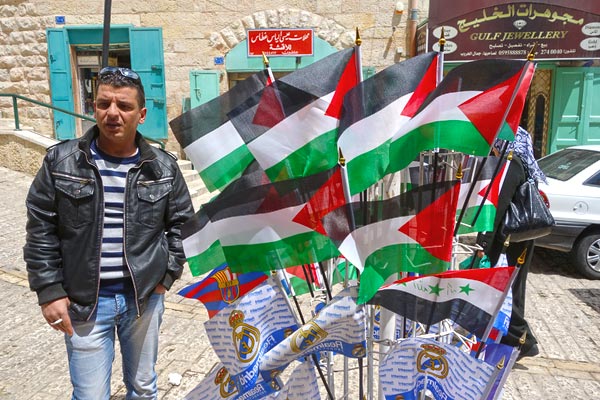
In addition to Palestinian flags, this vendor is selling flags for FC Barcelona and Real Madrid — soccer teams that are extremely popular in Israel. I’ve also heard Muslim Palestinians and Israeli Jews refer to each other as cousins. While these days that might be a bit optimistic, both clans have the great patriarch Abraham in common.
There’s a place on the Palestine side of the wall where passengers can conveniently change from a Palestinian car to an Israeli one. When I left Palestine, my Israeli driver waited there for my Palestinian driver to drop me off. I’ll never forget their handshake — in the shadow of an ominous Israeli watchtower painted black by the flames of burning tires and with angry Palestinian art on the wall. These men were each beautiful, caring people, caught in a problem much bigger than either of them. The exchange was little more than a suitcase shuttling from one back seat to the other. I watched as they quietly shook hands, looked into each other’s eyes, and said a solemn and heartfelt “Shalom.” After my week in Palestine, driving 300 yards through that security gate into Israel was like driving from Guatemala to San Diego. And I thought, “With all these good people, on both sides, there has got to be a solution — and a big part of it will be grassroots, people-to-people connections.”
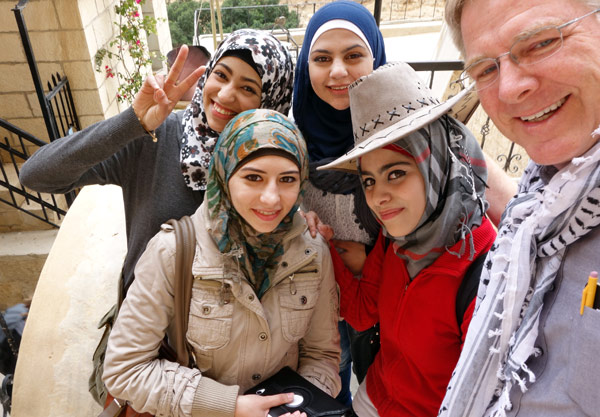
As always, by traveling to a country that seems hard to get your brain around, you realize it’s filled with people just like you and me (but who really know how to wear a scarf). Consider a trip to the Holy Land. And when you do, visit both Israel and Palestine. Do it for peace.
I was having dinner in Bethlehem with a Greek Orthodox Palestinian family and two older German women who were retired Lutheran pastors. The Muslim call to prayer interrupted our conversation. We went out on the third-floor balcony to hear the confused cacophony of sounds coming from minarets on all sides.
Bethlehem’s skyline is decorated by silent steeples and singing minarets. The minarets crank up the volume and play five times a day.
My Greek Orthodox friends said the volume for the call to prayer in Bethlehem is particularly loud — it’s a kind of resistance to annoy the Israelis. They said about the man who sings the call to prayer: “It feels like this man lives with us. Five times a day he wails. Even God wants to sleep, but there’s nowhere to hide. In the summer, we must keep the door open, and it’s like he’s right here in our house. Early in the morning, the man who sings the call to prayer changes the words and adds, ‘It’s better to pray than to sleep.’ But we think God can wait for us. We Christians wake God only on Sunday.”
When the call to prayer finished, we continued our conversation about living on the wrong side of a “separation wall.” The German women reminisced about 1989 and the fall of “their” wall. One pastor recalled watching West German Chancellor Helmut Kohl cry for joy and thought, “Oh, how silly.” Then, when what had just happened sank in, she found herself crying too…she said that she fell to the carpet and cried all night for joy. These women come to Palestine every year and — 24 years later — the “wall tears” they now shed are of sadness.