Here you can browse through my blog posts prior to February 2022. Currently I'm sharing my travel experiences, candid opinions, and what's on my mind solely on my Facebook page. — Rick

Sevilla: The Home of Flamenco Can Terrorize a Child

Updating the flamenco scene in Sevilla for my Spain guidebook, I had the occasion to pop into concerts in five different venues in town. Sevilla is the best city in which to experience flamenco. While the concerts are designed for tourists, they are real and riveting, and a great value. Here’s my latest report on the much-changed flamenco concert scene in Sevilla:

In Sevilla, you basically have three flamenco options: serious — yet still touristy — flamenco concerts, where the singing and dancing take center stage; even more touristy shows that have a bar and/or food (scurrying waiters can distract from the performers); and — least touristy — casual bars late at night, where you can catch impromptu or semi-impromptu musicians at play.

Serious Flamenco Concerts
While it’s hard to choose among these three nightly, one-hour Flamenco concerts, I’d say enjoying one is a must during your Sevilla visit. To the novice viewer, each company offers equal quality. They cost about the same, and each venue is small, intimate, and air-conditioned. For most, they are preferable to the “shows” listed later; compared to those, these options are half the cost, half the length, half the seats, and earlier in the evening. (While you can hear flamenco for free in various bars around town — also described later — that scene ignites very late.) My recommended concerts are careful to give you a good overview of the art form, covering all the flamenco bases. At each venue, you can reserve by phone and pay upon arrival, or drop by early to pick up a ticket. While La Casa del Flamenco is the nicest and most central venue, the other two have exhibits that can add to the experience.
Casa de la Memoria is a strangely wide venue (just two rows deep), where everyone gets a close-up view and room to stretch out (€16, nightly at 19:30 and 21:00, no drinks, no children under 6, 80 seats, Calle Cuna 6, tel. 954-560-670, www.casadelamemoria.es, flamencomemoria@gmail.com, run by Rosanna). Their exhibit is one easy, well-described floor, with lots of photos and a few artifacts (€3, or free with concert ticket — but only open 10:00-18:00).
The Flamenco Dance Museum, while the most congested venue (with 115 tightly packed seats), has a bar and allows drinks, and you can visit the museum immediately before the show. It’s festival seating. The doors open at 18:00, allowing you to grab the seat of your choice and spend an hour touring the museum, and enjoy a drink before the show (€20, nightly at 19:00; €24 combo-ticket includes the museum and a show; 10 percent discount off museum, show, or combo-ticket with this book; Manuel Rojas Marcos 3, about 3 blocks east of Plaza Nueva, tel. 954-340-311, www.flamencomuseum.com).
La Casa del Flamenco is in a delightful arcaded courtyard right in the Barrio Santa Cruz (€18, nightly at 21:00 April-Sept, 19:30 Oct-March, no drinks, no kids under 6, 60 spacious seats, the reception at the adjacent hotel serves as the box office, tel. 954-500-595, Ximénez de Enciso 33).

Razzle-Dazzle Flamenco Shows
These packaged shows can be a bit sterile — and an audience of tourists doesn’t help — but I find both Los Gallos and El Arenal entertaining and riveting. While El Arenal may have a slight edge on talent and feels slicker, Los Gallos has a cozier setting, with cushy rather than hard chairs — and it’s cheaper.
Los Gallos presents nightly two-hour shows at 20:15 and 22:30 (€35 ticket includes a drink, €3/person discount with this book in 2014 — but limited to two admissions, arrive 30 minutes early for best seats, noisy bar but no food served, Plaza de la Santa Cruz 11, tel. 954-216-981, www.tablaolosgallos.com, owners José and Blanca promise goose bumps).
Tablao El Arenal has arguably more professional performers and a classier setting for its show — but dinner customers get the preferred seating, and waiters are working throughout the performance (€38 ticket includes a drink, €60 includes tapas, €72 includes dinner, 1.5-hour shows at 20:00 and 22:00, near bullring at Calle Rodó 7, tel. 954-216-492, www.tablaoelarenal.com).
El Patio Sevillano is more of a variety show, with flamenco as well as other forms of song and dance. While hotels may recommend this, they’re just working for kickbacks. I like the others much better.

Impromptu Flamenco in Bars
Spirited flamenco singing still erupts spontaneously in bars throughout the old town after midnight — but you need to know where to look. Ask a local for the latest.
La Carbonería Bar, the sangria equivalent of a beer garden, is a few blocks north of the Barrio Santa Cruz. It’s a sprawling place with a variety of rooms leading to a big, open, tented area filled with young locals, casual guitar strummers, and nearly nightly flamenco music from about 22:30 to 24:00. Located just a few blocks from most of my recommended hotels, this is worth finding if you’re not quite ready to end the day (no cover, €2.50 sangria, daily 20:00-3:00 in the morning; near Plaza Santa María — find Hotel Fernando III, the side alley Céspedes dead-ends at Levies, head left to Levies 18, unsigned door; tel. 954-214-460).

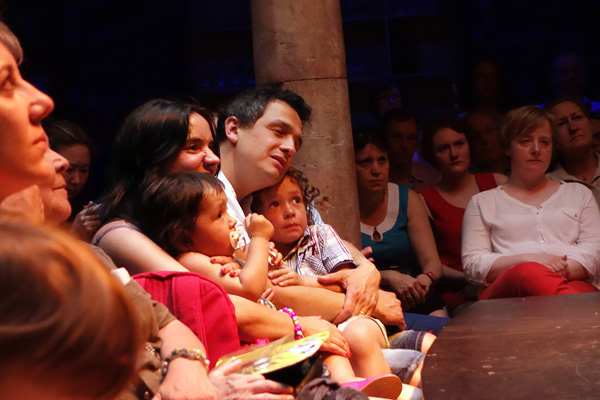
Sitting in the front row of an intimate concert venue with a powerful and intense performance going on, I found myself watching the little children (also in the front row). It helped me experience the dancer — towering, in black, with a demonic expression on her contorted face, long fingernails making her outstretched arms seem even longer and more able to take me into her grasp — from the perspective of the toddlers in the audience. Terrifying.
Parents bringing their children to a flamenco concert do more comforting than actually focusing on the music and dance. These children were terrified by the performance.

In Sevilla, There’s Always a Parade

Sevilla loves a religious procession — carrying statues of saints from favorite churches through the streets on big floats. People from other towns go through their lives never marching. But in Sevilla, these parades are huge.

When you meet a Spaniard, it’s common to ask them which football team they support. Here in Sevilla, you also ask which Virgin Mary they favor. The top two in town are La Virgin de la Macarena and La Esperanza de Triana. On Thursday during Holy Week, it’s a battle royale of the Madonnas, as Sevilla’s two favorite virgins are both processing through the streets at the same time.

I bumped into a street-clogging procession that was actually a practice parade for the kids who carry the float. It’s an honor to be one of the 15 or so young people who stand shoulder to shoulder under the float, shuffling slowly through town.

If you can’t see the video below, watch it on YouTube.

Sevilla — Getting Up to Date with the Best City in Southern Spain


The best stop in southern Spain is Sevilla. The city is a delight from a sightseeing, eating, and live-music point of view. And it’s always changing. After a few days in town with the help of excellent local guides, I am right up to date for the 2014 edition of our Rick Steves’ Spain guidebook. Here are a few updates in advance:

12-sevilla-mushroom Recently Sevilla unveiled a giant, mostly wooden canopy in an attempt to revitalize the formerly nondescript Plaza de la Encarnación. The gigantic, undulating canopy of five waffle-patterned, mushroom-shaped, hundred-foot-tall structures provides shade, a gazebo for performances, and a traditional market hall. It’s nicknamed “The Mushroom,” and, while the market is busy each morning, locals still don’t quite know what to make of the avant-garde structure. (It’s pretty lifeless in the afternoon and evening.) One ramp leads down to the ancient Roman street level (where a museum displays Roman ruins found during the building process). From the basement, a €1.30 elevator takes you up to a terrace for a commanding city view and a big walking loop. Doing this scenic stroll, you feel like you’re walking a roller-coaster track without the train. While “The Mushroom” is a bit newsy, I found it not worth the time or trouble. (You can get a fine view for free from the rooftop bar of the EME Catedral Hotel, across the street from the cathedral.)

2-camera-signAll over Europe, cameras are photographing cars entering central zones where only taxis, locals, and those with hotel reservations are allowed. With hard economic times, traffic cops are enforcing these laws mercilessly with stiff fines. In Sevilla, the hotels recently softened the situation. Scary as the signs are, those with hotel reservations in the off-limits zone can ignore them: Drive to your hotel, park where they tell you, and — as long as your hotel registers your license-plate number within 48 hours — you are legal. But in general, driving in city centers throughout Europe is getting tricky…and potentially very expensive.

13-processionSevilla loves its religious processions. Any time of year, you’re likely to bump into a giant crowd following the slowly plodding entourage of a float with a blaring marching band.

17-Christ-of-PassionThe Church of the Savior (Iglesia del Salvador), Sevilla’s second-biggest church after its cathedral, has a chapel featuring the city’s second most important procession statue. The Christ of the Passion chapel is filled with the sadness of Jesus’ crucifixion. It features a gripping 1619 statue of Christ carrying the cross to his death. For centuries, the faithful have come here to pray, and then kiss Jesus’ heel (up the stairs behind the altar). Like many churches in southern Spain, it’s built upon the site of a ruined mosque. In the courtyard, which served both houses of worship, you can really feel the presence of the earlier mosque. The former minaret is now the bell tower, and the arches, which date from the days of the mosque, are half-underground. The surviving mosque, now underground, functions today as part of the church’s crypt.

16-kiss-heelThe heel of Sevilla’s beloved Christ of the Passion is kissed all day long throughout the year by pilgrims and local Catholics alike.

3-cant-we-get-alongSeeing the faces of statues chiseled out throughout my travels, it seems our inability to tolerate each other has been a challenge for a long long time. Seeing this statue, once again I thought that “Can’t we just get along?” is a universal plea.

Barnacles and Bratwurst at the End of Europe

If you look at the map, it’s clear that Cape Sagres — at the southwest tip of Portugal —is also the geographical end of Europe. It’s understandable that in the days before Magellan and Vasco da Gama, this was considered the end of the world. Today travelers come here just to find the end of the road. The wives of fishermen sell hearty sweaters, knit while their men are at sea. And a small food stand advertises the” last Bratwurst before America.”

9-last-bratwurst

Goose barnacles, called percebes in Portugal, are a delicacy. They are expensive because they're dangerous to harvest — on rocky promontories where the waves are fierce. They’re nice to munch with a beer. And 300 grams with toast and a salad make a wonderful lunch.
Goose barnacles, called percebes in Portugal, are a delicacy. They are expensive because they’re dangerous to harvest — on rocky promontories where the waves are fierce. They’re nice to munch with a beer. And 300 grams with toast and a salad make a wonderful lunch.

Cape-Sagres

It’s Nice When the Chef Caught the Fish

Paulo at Restaurant O Lourenco in Salema, Portugal, knows his fish. Either he bought it himself at the fish auction in the next town, or he actually caught it himself. After lunch, he took me into the locker for a peek at dinner.

If you can’t see the video below, watch it on YouTube.