Here you can browse through my blog posts prior to February 2022. Currently I'm sharing my travel experiences, candid opinions, and what's on my mind solely on my Facebook page. — Rick

Packing Light: Two Months with 24 Pounds in a Carry-On Bag

When I’m packing for a trip, I review the itinerary to see how mobile I’ll need to be. If I’m flying to meet a cruise ship, and then flying directly home from the last port, I can pack heavy. If I’m heading out on a TV shoot and will have a car for the entire trip, I’ll lighten up on the “packing light” stuff. But if I’m going to be changing cities every couple of days and using public transportation (trains and buses) rather than a car, I get serious about mobility and packing light.

Flying home from my two-month spring 2013 trip, I weighed my luggage at the airport check-in desk: 11 kilos (24 pounds). A week before that, I took an hour to photograph each category of my luggage on my hotel bed (to incorporate into my new and improved travel skills lecture).

I’ll share all the details in a later post, (but for now, you can see our “his and hers” packing lists at- Pack Smart and Travel Light by Rick Steves). I will say there are two kinds of people you meet on the road in Europe: those who pack light, and those who wish they’d packed light. I’ve got it down and I love it. What’s your best tip for packing light?
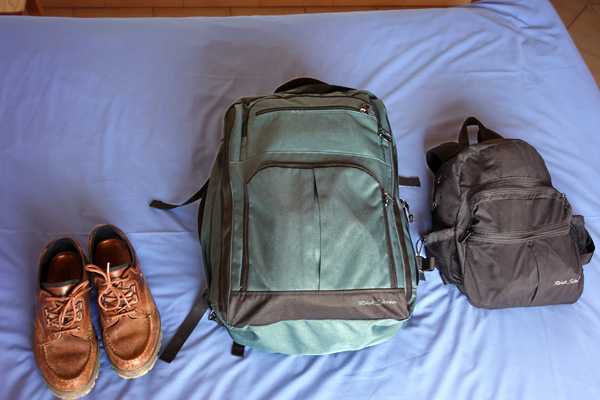
7-bag-on-bedI live out of these two bags for two months at a stretch: My Convertible Carry-On (9″ by 21″ by 14″, $99.99). I helped design this bag…and I love it. And, for running around on the street, I use our cute little Civita Day Pack ($24.99).

8-all-my-stuffPeople ask me, “Exactly what do you pack for one of your two-month trips?” They insist on every detail. To answer that question, I spread absolutely everything out on my bed on the south coast of Portugal. There I was…naked with my camera. And this is it. For a third of my adult life (four months a year), this is my entire material world.

When I fly with just a carry-on bag, I find that things go much smoother.

Granada: The World Is a Classroom

I often imagine the fun of being a schoolteacher in an old European city, with all that history and great architecture around you. Here’s a hardworking teacher in Granada with his class on a field trip to the cathedral. Bring your crayons!

If you can’t see the video below, watch it on YouTube.

Granada: A Romantic View Complete with Music

My favorite viewpoint in Granada (the San Nicolás terrace in the Albayzín, across from the Alhambra) comes with great Gypsy music nearly all day long. You could pop a few euros into the musicians’ hat, sit down with a nice picnic, and enjoy an open-air concert as good as many you might pay for. And the view can’t be beat.

If you can’t see the video below, watch it on YouTube.

Sevilla: Tapas Are All the Rage

Eating in Sevilla is fun and affordable. People from Madrid and Barcelona find it a wonderful value. Make a point to get out and eat well when in Sevilla.

The general system is to eat family-style, sharing everything. Smaller tapas are served at the bar, while larger portions called half-raciones and full raciones are at the tables. While raciones work great for small groups, individuals and couples get more variety with tapas. Fortunately, many places are easing up on the “tapas only at the bar” rule. You can always ask — many places are easing up on this rule, and if things are slow, they’ll let tapas eaters sit at a table.

A clear eating trend in Sevilla is the rise of gourmet tapas bars, with spiffed-up decor and creative menus, at the expense of traditional restaurants. Even in difficult economic times, when other businesses are closing down, tapas bars are popping up all over. (Locals explain that with the collapse of the construction industry here, engineers, architects, and other professionals — eager for a business opportunity — are investing in trendy tapas bars.)  Old-school places survive, but they often lack energy, and it seems that their clientele is aging with them. My quandary: I like the classic típico places. But the lively atmosphere and the best food are in the new places. One thing’s for certain: If you want a good “restaurant” experience, your best value these days is to find a trendy tapas bar that offers good table seating, and sit down to enjoy some raciones.

While you can find tapas somewhere just about any time, the best action starts late. Restaurants generally serve lunch from 13:00 to 16:00 and dinner from 20:00 until very late. Spaniards don’t start lunch until about 14:00 and dinner until after 21:00; at these times, the top tapas bars can get extremely crowded with locals, and it can be tough for English-speaking tourists to find a place — or even order. Tourists wanting to avoid the crush have clear windows of opportunity: If you go early — around 13:30 for lunch or 20:30- 21:00 for dinner — you’ll get better service and a place at the bar.

20-tapas-bar

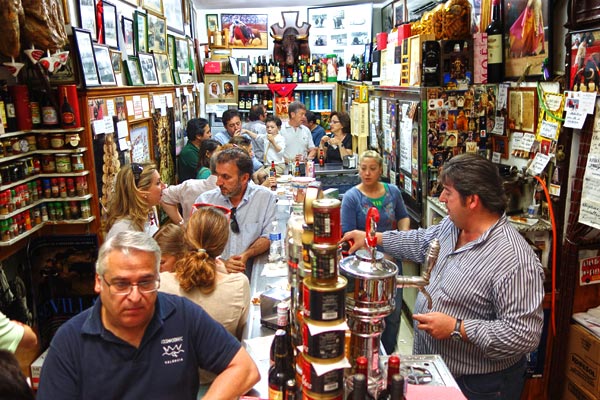
14-grocery-barFor a different twist on a tapas bar, find an abacería. This is a neighborhood grocery store that doubles as a tapas bar. I found a great one, which will star in the next edition of my Spain guidebook: Abacería Casa Moreno is a rare, classic abacería (an old-time grocery store that also serves tapas). Squeeze into the back room, and you’re squeezing back in time — and that includes a steep language barrier. It’s standing-only. Help yourself to the box of pork scratchings on the bar while choosing from an enticing list of €2.50 tapas. They’re proud of their top-quality jamón serrano and queso manchego, and serve hot tapas only at lunch. Rubbing elbows here with local eaters under a bull’s head surrounded by jars of peaches and cans of sardines, you feel like you’re in on a secret (Mon-Fri 8:00-15:30 & 19:30-22:30, closed Sat-Sun, 3 blocks off Plaza Nueva at Gamazo 7, tel. 954-228-315).

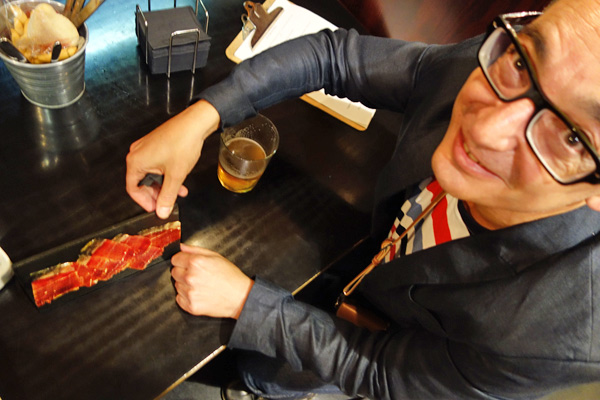
15-sticky-ham-with-guideMy guide demonstrates how quality ham, sliced thin, will stick to the plate when upturned. I’m not sure what that has to do with quality, but one thing I am sure of: When in Spain, life’s too short to eat mediocre jamón. At least a couple of times, pay extra for the best ham on the list.

Sevilla’s Pesky Good-Luck Peddlers

Part of any tourist’s experience when visiting Sevilla is encountering these pesky and persistent beggars. They offer you a tiny sprig of greenery. You say no. They force it on you. You take it and then can’t give it back. They insist on a payment, while telling your fortune on the fly. You finally offer them a few coins to get them to leave you alone. They refuse to take coins, claiming coins are bad luck. They insist on paper. You finally buy your freedom for five euros. Or…you refuse to be intimidated. These are adults who know they are making fools of timid tourists. Have fun with these women, but don’t let them psych you into a costly encounter.

If you can’t see the video below, watch it on YouTube.