Here you can browse through my blog posts prior to February 2022. Currently I'm sharing my travel experiences, candid opinions, and what's on my mind solely on my Facebook page. — Rick

Daily Dose of Europe: A Romantic Breeze in Rome

Let’s go for a nice dinner in Rome. On the menu is filetti di baccalà…Roman-style fish sticks.

Because of the coronavirus, Europe is effectively off-limits to American travelers for 30 days — starting today: Friday, March 13. But travel dreams are immune to any virus. Through this crisis, join me for a quick, daily escape from the headlines as we count down the days until we can head back to Europe.

Anxiety is something I like to sweep away when guiding a tour. And anxiety is not welcome at home either — especially when dealing with a crisis characterized by uncertainty. As we work through these challenging days, I believe a daily dose of travel dreaming can actually be good medicine.

I’ve collected 30 of my very favorite travel dreams-come-true to share as a daily dose of embrace-the-world during a time when we’re unable to physically do that. Share this with your friends. Let each daily travel dream be a small dose of the wonder of our world that you can inhale, swirl around, and really enjoy.
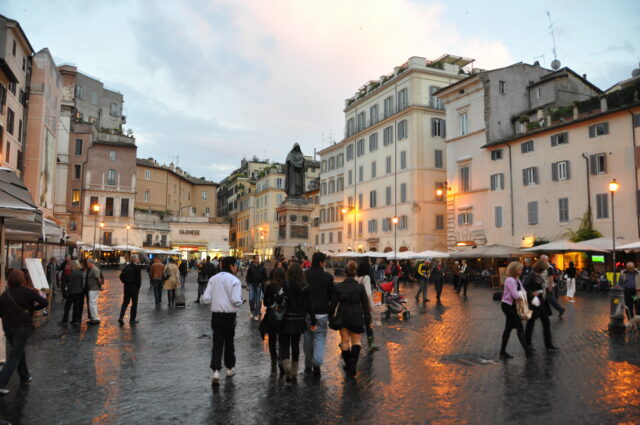
A statue of Giordano Bruno marks the center of Campo de’ Fiori— my favorite square in Rome. Five centuries ago, Bruno challenged the Roman Church and was burned at the stake right here. With each visit, I make a quiet little pilgrimage, staring into the eyes of brooding Bruno, pondering the courage of those early heretics.

When in Rome, I use Bruno as a meeting point. (I like to say, “I’ll be sitting under Bruno.”) Tonight, I’m waiting for Stefano and Paola, who run one of my favorite hotels in Rome. With each visit, they take me on a quest for restaurants to recommend in my guidebook. They’ve promised to take me to a little restaurant they deem perfect. When they arrive, I say Ciao to Bruno and we walk down a tiny cobbled lane to a classic, crumpled little piazza filled with scooters. A stately but tiny Neoclassical white church is crammed into the corner. On the far side, a single eatery is all lit up. The sign above the door says “Filetti di Baccalà.”

“Stefano, you’re right. This is perfect.” I walk ahead, navigating the gridlock of abandoned scooters to get into the restaurant. A long line of tables, covered with white-paper tablecloths and crowded with locals, stretches to a neon-lit kitchen in the back. And there, two grease- splattered cooks are busy cranking out filetti di baccalà…Rome’s answer to fish sticks.

There’s one table open near the back, past an old man in a black suit playing the violin. We limbo by the violinist and grab it. Above our table a weathered sign reads Specialità Filetti di Baccalà 60 lire. The price has been revised over the years in response to the whims of the economy, peaking at 4,000 lire. Today, it’s €5. The harried waiter drops off a simple menu, listing a humble selection of appetizers and salads, but only one main course (filetti di baccalà) and, with his thumb hitch- hiking into his mouth, asks, “Da bere?” (“To drink?”).

Our fillet of cod is about what you’d expect at a top-notch London fish-and-chips joint. We enjoy it along with some breaded and fried zucchini, a salad of greens I’d never before encountered, and a carafe of white wine. Some people might think the meal is nothing special. But buried deep in the medieval center of the city, in a tarnished and varnished eatery without a tourist in sight, the ambience is intoxicating.

The violinist plays Sinatra’s “My Way” to an appreciative crowd. Eventually he makes his way to our table, standing just beyond Paola’s radiant face. It’s a classic Roman moment. Her dark eyes, framed by little black glasses, are locked on Stefano’s. Tiny rings of pearls set in gold swing from her ears. A gold necklace is the perfect complement to her smooth, olive complexion.

Like a hungry camera, my eyes compose the scene: carafe of golden white wine shimmering in the foreground, Paola’s face looking lovingly at her husband in the middle, and the violinist — jaw tight on his instrument but still smiling — in the back. The happy chatter of dinner conversation rounds out the scene.

As if only for Paola, the musician plays a Roman anthem to the night. Paola whispers to me, “This is Ponentino…a special wind, a sweet… ” brushing her hand gently along her cheek in search of the word, “…caressing Roman wind.”

Then she and Stefano face the music, and with the entire room, sing the song:

Rome, don’t be foolish tonight.

Give me the sweet wind to let her say yes.

Turn on all the stars that you have…the brightest ones.

Give me a small flash of the moon, only for us.

Let her feel that springtime is arriving.

Give me your very best crickets to sing to her.

Give me the Ponentino.

Be a partner with me.

Paola translates the rest of the song to me. In verse two, the woman answers: “Rome, give me a helping hand to tell him no,” and so on. But, in the final verse, of course, they get together, creating the love triangle: a man, a woman…and Rome.

With the room still singing, the elegant older couple at the next table look over at us. Seeming pleased that the three of us — a generation behind hers — are enjoying this traditional Roman moment, the woman says, “Bella.”

(This story is excerpted from my upcoming book, For the Love of Europe — collecting 100 of my favorite memories from a lifetime of European travel, coming out in July. It’s available for pre-order.)

No More Europe Trips…for Now

It’s astonishing how much the world has changed in the week since I wrote this message. Italy went into full lockdown. The CDC moved most of Europe (except the UK, Ireland, and Turkey) to “Level 3” travel advisory: Americans should cancel nonessential travel there. And across the US, everything from local schools, to NBA and March Madness games, to theme parks and music festivals have been cancelled. And that’s just as of March 13.

We’ve decided to cancel all of our Rick Steves’ Europe tour departures through April 19, and we are closely monitoring the situation, with a plan to cancel additional departures as needed. If you are booked on a Rick Steves tour, keep an eye on our up-to-date Coronavirus Tour Member FAQ. Our top priority is the health and well-being of our travelers and tour guides, and our sense of responsibility not to contribute to the further spread of the virus. Even though Americans are still technically allowed to visit Europe…you probably shouldn’t.

Cancelling these tours is a hard decision. Sure, we stand to lose a lot of revenue. But much more important to me is that I hate to see so many long-yearned-for travel dreams dashed. And our hearts are going out to our European guides, hoteliers, bus companies, and other partners and friends in the travel business who are suffering financially. In the coming weeks, I’ll be collecting and sharing on-the-ground coronavirus reports from these European friends.

As for me: Even though Turkey is still not included in the CDC travel advisory, it’s pretty clear that I won’t be on the flight I’ve booked to Istanbul on April 12. I have such fun travels planned for this year, but I’ll play it safe, decide closer to the departure date, and take them one trip at a time. I know I’ll get back to Europe — I’m just not sure yet exactly when.

Our tours may be on hold, but Rick Steves’ Europe is not going into hibernation. My office staff of 100 is now working mostly from home, with instructions to take good care of all those whose dreams to travel on a Rick Steves tour have been upended (at least, in the short term), and to keep producing top-quality travel content. Our mood is actually upbeat — confident that this pandemic will pass and Americans will be heading back to Europe before long. And when they do, our team at Rick Steves’ Europe will be ready to inspire, inform, and equip them to have the best trips possible.

In the meantime, we’ll shift into “armchair travel” mode. You probably won’t be going to Europe in the next several weeks — and in fact, you may be stuck inside your house. But that doesn’t mean you can’t dream about your next trip and think back on your favorite European moments. Keep an eye on my blog and Facebook, where (starting today) I’ll be sharing a “daily dose” of my favorite European memories. We all deserve a break from panic-inducing headlines…and travel dreams are immune to any virus.

During this crisis, we stand in solidarity with our fellow travelers and Europe-lovers — and with our European friends who are fighting this same fight. We’ll stand together, remain militantly optimistic, and look forward to the day when we turn those wonderful travel dreams into reality.

Thank you for being part of this community of travelers. And keep on traveling…even if, for now, it’s from home.

Health on the Road in the Age of Coronavirus

Coronavirus has reached Europe — and it’s spreading. There’s no way to predict how the virus will impact travel in Europe in the coming weeks. The crisis may be old news in a month, or it may cause economic activity (including tourism) to grind to a halt through 2020. By any honest assessment, nobody knows for sure.

In the meantime, should you cancel your trip to Europe? I see two considerations: the danger of actually getting the virus, and simply not wanting to risk the possibility of flights being cancelled, sights being closed, and streets being empty. And then, the big question: when to make your decision?

Complicating matters is the reality that our commercial news media, by its nature, sensationalizes the danger of this or any crisis. Before making any decisions, it’s important to take a breath and keep things in perspective. So far this winter, the run-of-the-mill flu has killed about 16,000 Americans…and yet, more than half of us don’t even bother to get a flu shot.

Because Coronavirus is especially high-risk for the elderly and people with compromised immune systems, people in those categories should minimize their exposure. But for the hale and hearty, it’s a more complicated decision. Keep a close eye on updates from the World Health Organization (WHO) and US Centers for Disease Control and Prevention (CDC), who have been carefully tracking the spread of the virus across Europe.

As for me, I’m booked on a flight to Istanbul on April 12. At this point, I haven’t even thought about cancelling. I’m thinking positive and hoping to make my trip. If things change between now and then, I’ll do the responsible thing. But for now, Easter Sunday is, for me, wheels-up.

One thing we do know is that, regardless of Coronavirus news, basic health and hygiene while traveling have become a bigger priority. If you choose to keep on traveling, you’ll want to keep yourself healthy — and be a responsible traveler by taking steps to avoid spreading the virus.

How? We’ve come up with new standards that our guides will use to encourage healthy conditions on our Rick Steves bus tours in 2020. These same strategies are just as applicable for independent travelers:

  • Wash hands frequently, with soap and hot water, for at least 20 seconds.
  • If you can’t wash your hands, use hand sanitizer (60% alcohol or higher).
  • Stock up on packets of tissues (widely available throughout Europe) and alcohol-based sanitizing wipes (less common in Europe, so bring these from home).
  • Cover your mouth when coughing (with the inside of your elbow).
  • Avoid touching your face — the eyes, nose, and mouth are areas where illness can easily spread.
  • Stay hydrated — drink lots of water (tap water is safe to drink anywhere in Europe).
  • Get your sleep.
  • Opt out of activities if you’re feeling tired or unwell.
  • If not feeling well, go to pharmacy or see a doctor. (Your guide or hotel staff can help.)

It remains to be seen exactly how, and for how long, European travel will be affected by Coronavirus. We’re staying on top of the situation and posting important updates on our website. Stay informed, stay healthy, and — if you deem it safe and responsible — keep on traveling.

Is Europe Becoming “Anti-Tourist”?

These days, I’ve noticed that Americans have become very “follow the crowd” in their travels. Our appetite for bucket-list, crowdsourced, Instagrammable travels is funneling countless tourists into the same few places. Consequently, popular cities are feeling crushed by mass tourism, and popular sights are congested to the point where many find them not only less enjoyable… but actually dangerous.

Citizens of over-touristed cities like Barcelona, Amsterdam, and Venice are getting grumpy about mass tourism. And “must-see” sights like the Anne Frank House in Amsterdam, the Gaudí buildings in Barcelona, and Michelangelo’s David in Florence come with discouraging lines.

What to do? The “bad tourism” that residents of overcrowded cities complain about is mostly a result of blitz travelers — those who day-trip in (from cruise ships and in big buses), congesting streets and squares and leaving more litter than money. I find that travelers who stick around to have dinner and spend the night are still appreciated by locals (and valued as part of the economy).

As for the overwhelmed sights: Whenever possible, make a reservation in advance online. Then you won’t be frustrated with crazy lines at ticket offices that close for the day as soon as they sell out. I was just at the church in Milan that holds Leonardo da Vinci’s Last Supper. It would be a chaotic mob, if not for their very smart program of reservations: Only 25 people are allowed inside every 15 minutes. When I arrived, there was total peace and sanity, as about 800 people a day come in at a steady and organized pace. The trick: Book in advance. Be thankful when that is required!

Another tip: Realize for every Anne Frank House, there’s usually a Dutch Resistance Museum a few blocks away — less trendy, never crowded, and often actually offering a richer travel experience. Remember, ninety percent of Europe has no crowd problems.

Finally, we tourists can be a little more considerate in the way we travel. Here’s a video created by an organization in Venice that offers a good reminder for people traveling anywhere to be more thoughtful guests. In fact, that’s a great practical tip: If you want to be warmly welcomed, be deserving of a warm welcome.

Celebrating the 40th Anniversary of Europe Through The Back Door

rick steves at piano

In 1980 I self-published my first book, “Europe Through the Back Door.” It was easy: write out the lectures from the travel class I taught at the University of Washington’s Experimental College, sweet-talk my girlfriend into typing it and my roommate into sketching the photos, drive the 180-page manuscript to the local printer with $2000, and two weeks later pick up 2,000 copies of that first edition.

I’ve updated the book with about a hundred days of travel experience each year since. And this year, we’re celebrating the 40th anniversary of ETBD. It’s the flagship of over fifty Rick Steves guidebooks and an 800-page handbook — what I like to call “the Kama Sutra of European travel thrills.”

The book has more than quadrupled in size, as it’s evolved as much as everything else in the last four decades. This is the book you read before your trip to learn from my experience rather than your own to enjoy maximum travel fun per mile, minute, and dollar. My best travel tip for anyone dreaming of the trip of a lifetime? Don’t go to Europe without reading “Europe Through the Back Door” first!