Here you can browse through my blog posts prior to February 2022. Currently I'm sharing my travel experiences, candid opinions, and what's on my mind solely on my Facebook page. — Rick

Berlin: A City of Memories — and Memorials — from a Horrible War

Berliners look at any mound in a park knowing that it’s rubble from their bombed-out city — bulldozed and landscaped after the destruction of World War II. And each year, more memorials are created to honor neglected victims of past sins. This year, for the first time, I saw the memorials to the Sinti and Roma (Gypsy) victims of Hitler, the homosexual victims of Hitler, and the Aryan wives of Jewish men who successfully demonstrated to free their husbands when they were arrested. Here are a few images of the many different memorials that speckle the streets of Berlin.

The Memorial to the Murdered Jews of Europe

Consisting of 2,711 gravestone-like pillars (called “stelae” and completed in 2005), this memorial is an essential stop for any visit to Berlin. It was the first formal, German government-sponsored Holocaust memorial. And using the word “murdered” in the title was intentional and a big deal. Germany, as a nation, finally officially admitted to a crime.

Monument to the Murdered Sinti and Roma (Gypsies) of Europe

Unveiled in 2012, this memorial remembers the roughly 500,000 Sinti and Roma victims of the Holocaust. “Sinti and Roma” (the main tribes and politically correct term for the group more commonly called “Gypsies”) were as persecuted by the Nazis as were the Jews. And they lost the same percentage of their population to Hitler. An opaque glass wall, with a timeline in English and German, traces the Nazi abuse and atrocities. Visitors enter through a rusty steel portal. On the other side is a circular reflecting pool surrounded by stone slabs, some containing the names of the death camps where hundreds of thousands of Sinti and Roma perished. In the water along the rim of the pool is the heart-wrenching poem “Auschwitz,” by composer and writer Santino Spinelli, an Italian Roma. Dissonant music evoking the tragedy of the Gypsy genocide adds to the atmosphere. Noticing how relatively humble and unkempt this is (with algae mucking up the pond) — and how the “do you speak English?” beggar ladies bussed in by traffickers from Romania hit up visitors here at their own memorial — made me appreciate, or at least ponder, the plight and struggles of a fragmented community with a nomadic heritage that refuses to conform to modern norms and has no organizational center or effective leadership.
Memorial to Politicians Who Opposed Hitler

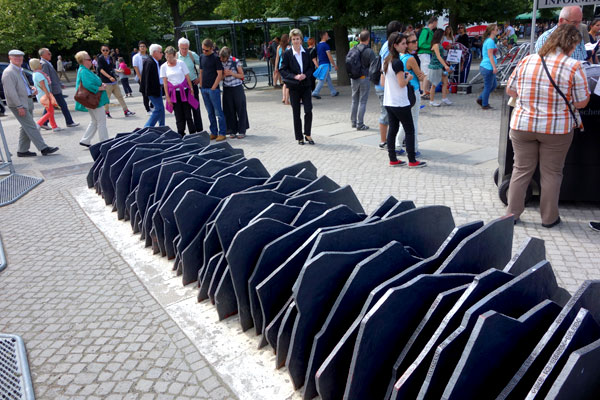
This row of slabs (which looks like a fancy slate bicycle rack) is a memorial to the 96 members of the Reichstag (the equivalent of our members of Congress) who were persecuted and murdered because their politics didn’t agree with Chancellor Hitler’s. They were part of the Weimar Republic, the weak and ill-fated attempt at post-WWI democracy in Germany. These were the people who could have stopped Hitler. So they tried…and they became his first victims. Imagine an extremist takeover of our country and opposition politicians being sent to concentration camps. The meteoric rise of Hitler is breathtaking. Each slate slab memorializes one man: his name, party, and the date and location of his death — generally in a concentration camp. They are honored here, in front of the building in which they worked.

Some People Get Great Joy Out of Burning Books.

The most historic square in Berlin, Bebelplatz, has a glass plate in the middle. Underneath it is a room with empty bookshelves. This is the memorial to the notorious Nazi book burning of 1933. It was here that staff and students of Germany’s top university threw 20,000 newly forbidden books (like Einstein’s, Hemmingway’s, Freud’s, and T.S. Elliot’s) into a huge bonfire on the orders of the Nazi propaganda minister Joseph Goebbels. Look at the giddiness in the crazed faces of the Nazi book burners in this photo. In fact, Goebbels himself tossed books onto the fire, condemning writers to the flames. He declared, “By burning these books, we end the age of Jewish Internationalism and pave the way for a new era for the German soul.” The Prussian heritage of Frederick the Great — who built this grand square — was one of culture and enlightenment. Hitler chose this square to thoroughly squash that idea; that era of tolerance and openness was over. Hitler was establishing a new age of intolerance where German-ness was correct and diversity was evil. A century earlier, the German poet Heinrich Heine had written, prophetically, “Where they burn books, in the end they will also burn people.” In so many ways, a thoughtful visit to Berlin can inspire vigilance against anti-intellectual, fear-mongering forces today that would burn the thoughts of people they fear to defend their culture from diversity.
Site of Hitler's Bunker
Site of Hitler’s Bunker

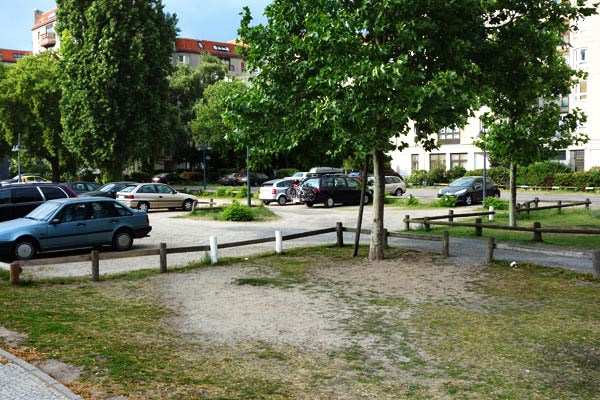
One place where you’ll find no memorial is the site of the bunker where Hitler committed suicide in 1945. It’s just a nondescript parking lot.
Berlin Is Still a Work in Progress

I’m here to update my Berlin guidebook chapter and also to scout for a new TV show. The city is as vibrant and exciting as ever. But it’s too ripped up for TV. Massive projects combined with massive delays and uncertain funding mean the city will be a construction site for the rest of the decade (at least). That’s no problem for a traveler visiting. It’s just a huge disappointment for a TV producer who wants to show the city both looking good and appearing as it will in the future. Construction on a new subway line means much of Unter den Linden — Berlin’s main drag — is torn up. The Humboldt-Forum project and the new entry to the Pergamon Museum will make Berlin’s Museum Island a construction zone for years to come. But all of that adds to the zest and energy that makes Berlin one of Europe’s hottest destinations. Locals are bragging that it just surpassed Rome as the third most-visited city in Europe.

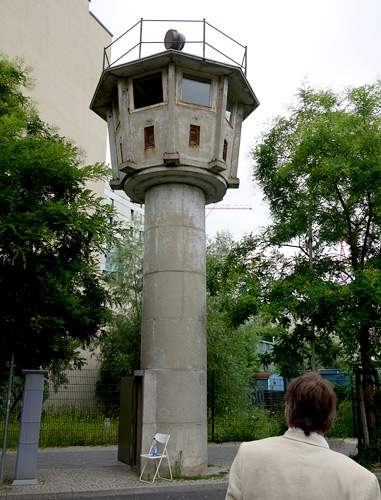
DDR (East German) Watchtower

This was one of many such watchtowers built in 1966 for panoramic surveillance and shooting (note the rifle windows, allowing shots to be fired in 360 degrees — that’s both West and East). It was constantly manned by two guards who were forbidden to get to know each other (no casual chatting) — so they could effectively guard each other from escaping. This is the last such tower still standing (about a block from Potsdamer Platz, on Erna-Berger-Strasse).

Shell Game
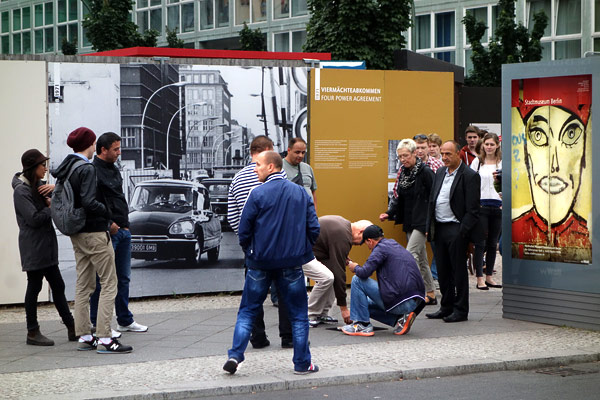
Shell Game

Believe it or not, there are still enough idiots on the street to keep the conmen with their shell games in business. Don’t be foolish enough to engage with any gambling on the street. But it’s fun to watch. They always have a crew of nervous no-necks posted to keep an eye out for approaching cops — and for tourists like me photographing them. I had a guy on me within a minute of raising my camera.

Berlin is the capital of “free” tours

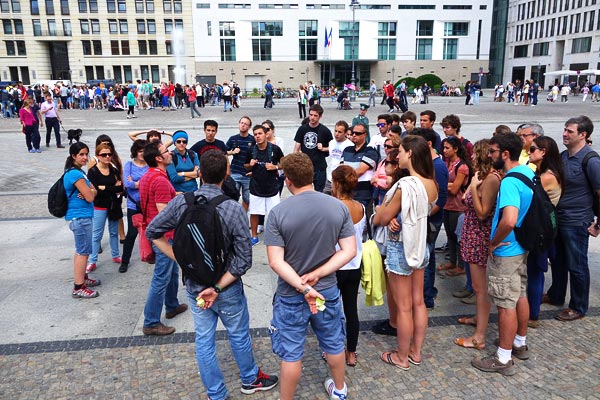
You’ll see companies advertising supposedly “free” introductory tours — which originated in Berlin — all over Europe these days. They are designed for and popular with students (free is good). The system is about the same everywhere: English-speaking students (often Aussies and Americans) memorize the script, then recite it before a huge crowd lured in by the promise of a free tour. What the customers don’t know is that the company actually charges the guide about €3 per person, so the guide has to hustle for tips to make it profitable (and could actually lose money). To make it worth the guide’s time, they expect to be “tipped in paper” (€5 minimum per person is encouraged). The “free” intro tour is then used to push other tours that cost. While the guides can be highly entertaining, few are serious historians — those who’d prefer to go beyond the basic, memorized script typically move on to more serious tour companies before long. These tours are fine for poor students with little interest in real history. But as in many things, when it comes to walking tours, you get what you pay for. What’s your experience with these “free” tours?

Walking Hot Dog Stands

In Berlin, look for the dueling human hotdog stands. Grillwalkers was the original. Grillrunners is the copycat company. Study the ingenious contraption: a harness to cook and sell tasty German sausages, cheap.

Brandenburg Gate Revitalized

For years, my memories of Berlin’s Brandenburg Gate were of an eerie no-man’s land in the middle of the Berlin Wall, with guardhouses and tank barriers and the sad thought of frustrated and wasted lives trapped on the other side, with little reason to hope. Kennedy’s “I am a Berliner,” Reagan’s “Mr. Gorbachev, tear down this wall,” and a rising tide of people power all combined to change history. Today, every time I come to this symbol of a united Berlin, I find a festive, almost carnival atmosphere. On this visit, it was a celebration of fifty years of French-German friendship, and the French police band was sounding great.

If you can’t see the video below, watch it on YouTube.

One Final Duty-Free Gauntlet Before Leaving Scotland

This video clip may show what seems like any old airport, but after two weeks in unpolished Scotland, it came as a jolt to me. At Glasgow’s airport, there’s only one way from security to the gates, and it routes you through the duty-free mall gauntlet.

Having survived this, I boarded my plane and settled in for my flight to London Heathrow, where I was connecting to Berlin. But then they announced that there was a fire at Heathrow, and Europe’s busiest airport was completely shut down. I fly a lot, and I’m amazed how rarely I’ve hit a bump in the tarmac like this. Back in the airport, you can imagine the chaotic scene as everyone scrambled to sort out their plans. This is when I’m really happy I use a living travel agent. I simply called her back home and asked her to get me to Berlin any way but through London. I spent the night at the airport hotel ($100), was booked on a flight early the next morning via Amsterdam, and got to Berlin before noon.

If you can’t see the video below, watch it on YouTube.

Two Types of People in Glasgow

Glasgow is a city where it seems there are two kinds of people: those who live to drink beer and cheer their soccer team, and those who confuse you by having that hard Glaswegian accent yet are cosmopolitan, sophisticated, cultured, and hardworking.

The first Glaswegian I met was from the first group. He was a cabbie who spent the entire ride insulting me for being an American because Yankees don’t go to pubs and drink lots of beer until late at night. If you venture into a rough neighborhood after dark — as I did one night — it seems the entire world is populated by angry people with dead-end lives, like that cabbie. Crammed into bars, they leer at passersby who don’t want to join the mosh pit.

But the next morning, with the sunshine came a world of that second type of Glaswegian: people with vision for making Glasgow an on-the-rise city with a purpose.

p3-buchanan-streetBuchanan Street is part of a Glasgow pedestrian shopping zone called the “Golden Zed” for the way it zigzags through town. Just strolling up this street — listening to buskers, enjoying the people-watching, and remembering to look up at the architecture above the modern storefronts — was a delight.

p2-glasgow-street-artGlasgow’s city center has a stretch nicknamed the “Golden Mile.” Rather than letting graffiti artists mess up the vibe with random or angry tagging, the top street artists are given entire walls to paint. These paintings are almost sightseeing destinations in themselves.

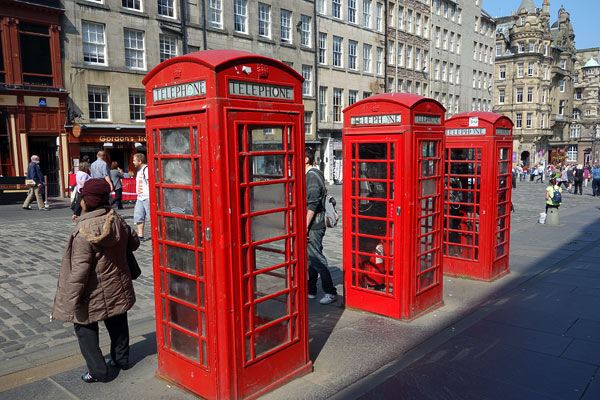
p1-phoneboxThroughout Great Britain, you can see red boxes on the streets that people back in the 20th century would enter in order to make “telephonic” calls to each other. They would put coins in a slot, turn a rotary dial with a sequence of numbers, and then speak through a device connected to the machine by a flexible pipe. These red boxes (which smelled like urine and doubled as handy places for the neighborhood prostitutes to stick their advertisements) were produced for the entire British Isles by a factory in Scotland. Now they are commonly seen no longer on the streets, but decorating nostalgic pensioners’ gardens.