Here you can browse through my blog posts prior to February 2022. Currently I'm sharing my travel experiences, candid opinions, and what's on my mind solely on my Facebook page. — Rick

The Route du Vin in Alsace

The Route du Vin is the Wine Road of Alsace. This region, between the Rhine River and the Vosges Mountains, has historically been fought over between France and Germany. The Germans believe the mountains are the natural border, while the French think it’s the river. It’s interesting to think that this is a kind of continental cultural divide — with Romance cultures to the south, and Germanic to the north. Perhaps that explains how every other city here feels like it’s been rebuilt after a terrible war. Using Colmar as a springboard, it’s easy to tour the region.

The Vineyards of Alsace

Alsace’s Wine Road is blanketed with lush vineyards and dotted with charming towns. You can hike, bike, hire a taxi, catch the bus, or join a minibus tour like I did (a half-day for €60).
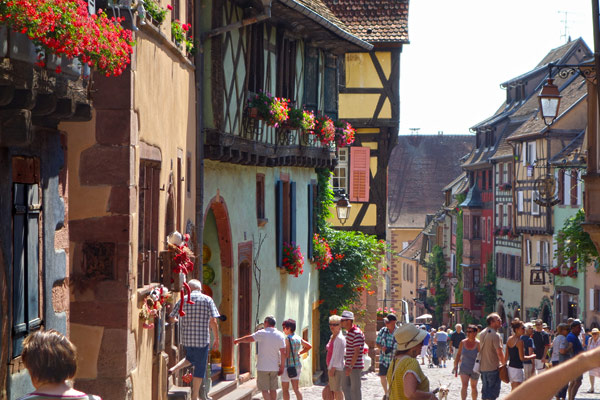
Adorable Kaysersberg

The Route du Vin is dotted with delicious little towns. Kaysersberg is one of the most charming.

Channeling water power in Alsatian villages

Alsatian villages nestle in valleys on small rivers, which medieval villagers hijacked, broke into canals, and used to power their mills. Today, when you explore these towns, it’s fun to imagine what a blessing water power must have been.

The original gourmet

This sign marked the mansion of the Kaysersberg gourmet. I never realized the derivation of the word “gourmet”: Each city in a wine region (like Alsace) had a man appointed to rate and price wines, and serve as the middleman between vintners and the wine-drinking public. He facilitated the sale of wine…and knew that having quality food in association with the wine would help. Eventually he became the man with the finest food in town, or the “gourmet.” The actual job of the gourmet survived in Alsace until the 1930s.

Cutting a Cobble in Colmar

It’s so important to be “heads-up” when you’re traveling. For example, each Tuesday, folk dancers and musicians from a nearby village share their talents on Colmar’s main square. I’m sure there are tourists sitting in their hotel rooms watching TV who would love this fun and free slice of Alsatian culture. They just forgot to ask their hotelier or at the TI if there was anything happening tonight in Colmar.

If you can’t see the video below, watch it on YouTube.

Flip-Flopping Colmar: Wurst with Fine Sauces

I just flew from Prague to Basel and hopped on a train to Colmar, France. I’m meeting the co-author of our France guidebook, Steve Smith, to do some research work, and then we’ll meet our film crew to make two new TV shows in France.

I love Colmar. For years, it was a two-night stop on our “Best of Europe in 22 Days” tour. Today it seems strange to think that the most charming city in the German-flavored corner of France called Alsace would merit that coveted spot on our “grand tour.” When designing the tour, we figured that on a three-week Europe tour, while you’d obviously visit Paris, you’d also want a look at the French countryside. And Colmar offered a way to break the long drive from the Swiss Alps to the grand finale in Paris. As a bonus, it let us include a look at the WWI battlefield sights of Verdun and a stop at a Champagne cave, to boot.

Now, our Best of Europe tours stop in Burgundy rather than Alsace. We made the change because Burgundy is more quintessentially French than Alsace. But if you’re touring Alsace, Colmar is still the best home base. I like Alsace — but it really is a mix of German and French culture, as this is the region that for centuries flip-flopped between Germany and France depending on who won the last war. That’s why you find people here named Jacques Schmidt or Gunter Dubois, and the wurst comes with fine sauces.

Each Tuesday evening, a folk group brings the half-timbered main square of old Colmar to life.
I love traveling through France with Steve Smith, the co-author of our France guidebook. And everywhere we go in France, we meet happy travelers with the book. They are eager to share their experiences — as you can see in this photo of Steve and some satisfied readers — and in our work, we find that very helpful.
I’m starting to see more innovative ways to use your mobile device when sightseeing. These QR codes (which you can scan with your smartphone's camera) are posted at each spot of interest in Colmar. Scan it, and bam! You’ve got the information right there on your screen for free. It’s almost as helpful as our guidebook!
I’m starting to see more innovative ways to use your mobile device when sightseeing. These QR codes (which you can scan with your smartphone’s camera) are posted at each spot of interest in Colmar. Scan it, and bam! You’ve got the information right there on your screen for free. It’s almost as helpful as our guidebook!

Tango Means Embrace

I met my Czech friend, Lída, as a guide in Budapest back in communist times. It was 1988, and things were just starting to loosen up. Lída was leading a group from Czechoslovakia to Hungary, which was the place communists went for a wild escape and a little whiff of the West. Budapest had just opened the first McDonald’s behind the Iron Curtain, Lída was hell-bent on having a Big Mac, and I had the dubious honor of taking her there for her first American hamburger. I’ll never forget waiting an hour — in a line that stretched around the block — for American “fast” food. That evening, we went to hear Bruce Springsteen at the local stadium. With 50,000 rock fans, you could feel freedom ready to combust all around.

Even back then, Lída was crazy about dancing tango. She learned Spanish and began leading tour groups to Argentina to pursue her passion. I remember conspiring with her to mail her American dancing shoes, as the ones in communist Czechoslovakia were second-rate for a serious dancer.

We connect each time I’m in Prague, and now most of Lída’s tour guiding is at home as a mom. But she is still evangelical as ever about her tango.

In this clip, Lída describes the wild romance of dancing all night, greeting dawn in a sweaty dress and roughed-up shoes, savoring the freshness of the new day, and sleeping to the sounds of tango dancers in the studio next door. Then, as midnight approaches, she eagerly prepares to dance the night away again. While I’ve never come close to actually “dancing a night away,” listening to Lída preach the magic of tango makes me want to try.

What’s amazing about this is for an American to walk through the late-night streets of Prague with a Czech person raving about Argentinian culture. The world is a beautiful place, and I’m inspired by how this working-class Czech reaches out to embrace it. In fact, the word tango means “embrace.”

If you can’t see the video below, watch it on YouTube.

Czech Tales of Communism

Prague is a beautiful, historic, and delightful-to-visit city. And if you, like me, are forever fascinated by slice-of-life stories from people who had to live through the Cold War in the Warsaw Pact, it’s even more engaging. Throughout Eastern Europe, guides like my friends who lead me around Prague know how to weave their personal memories of communism into their time with you.

One of my guides talked of the generation gap in the Czech Republic. When she traveled recently to the Grand Canyon National Park in the USA, her older friends asked her excitedly, “What did you bring home?” In the old days, people just fantasized about being able to leave the country to bring home a boom box or a Western camera. To travel just for the experience didn’t make any sense to them…and, in some cases, still doesn’t.

Another guide reminisced about 1989 and how, with the arrival of freedom and the fall of the Iron Curtain, Russian language teachers suddenly had to teach English. There were no textbooks, and Russian teachers took cram courses in English so they could teach their students sentences like “Deez eez my bruder” (“This is my brother”). The fun thing for schoolkids those first few years was that they knew more English from watching Rambo movies than their teachers did from taking the cram courses.

Another guide talked of how, in her youth, she could only dream of drinking a nice cold Coca-Cola. She said, “We couldn’t drink Coke, but we could collect the cans tourists threw away. I had five cans. My friend had ten.”

One of our most popular and impactful tours in our Best of Eastern Europe tour. And many of our Eastern Europe guides — like Honza and Katka, shown here — come from Prague and are beloved by our groups. Honza Vihan is the co-author of my Prague guidebook, and I’m thankful to collaborate with him. With Honza’s on-the-ground, local insights, I’m confident that our book is the best available on the Czech capital.