Here you can browse through my blog posts prior to February 2022. Currently I'm sharing my travel experiences, candid opinions, and what's on my mind solely on my Facebook page. — Rick

Daily Dose of Europe: Fado — The Lisbon Blues  

“O waves of the salty sea, where do you get your salt? From the tears shed by the women in black on the sad shores of Portugal.”

Because of the coronavirus, Europe is effectively off-limits to American travelers for the next few weeks (and likely longer). But travel dreams are immune to any virus. During these challenging times, I believe a daily dose of travel dreaming can actually be good medicine. Here’s another one of my very favorite travel dreams-come-true…a reminder of what’s waiting for you in Europe on the other end of this crisis.

It’s after dark in Lisbon’s ramshackle Alfama neighborhood. Old-timers gather in restaurants, which serve little more than grilled sardines, to hear and sing Portugal’s mournful fado: traditional ballads of lament.

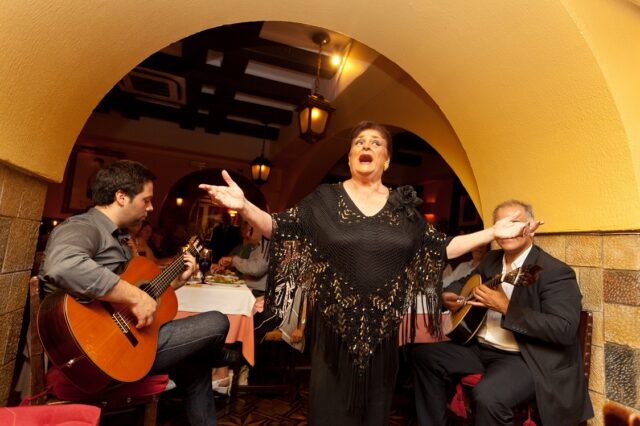
I grab the last chair in a tiny place, next to two bearded men hunched over their mandolins, lost in their music. A bald singer croons, looking like an old turtle without a shell. There’s not a complete set of teeth in the house. A spry grandma does a little jive, balancing a wine bottle on her head. The kitchen staff peers from a steaming hole in the wall, backlit by their flaming grill. The waiter sets a plate of fish and a pitcher of cheap cask wine on my table and — like a Portuguese Ed Sullivan — proudly introduces the next singer, a woman who’s been singing here for more than 50 years.

She’s the star: blood-red lipstick, big hair, a mourning shawl over her black dress. Towering above me, flanked by those mandolins, she’s a fusion of moods — old and young, both sad and sexy. Her revealing neckline promises there’s life after death. I can smell her breath as she drowns out the sizzle of sardines with her plush voice.

The man next to me whispers in my ear a rough English translation of the words she sings. It’s a quintessential fado theme of lost sailors and sad widows: “O waves of the salty sea, where do you get your salt? From the tears shed by the women in black on the sad shores of Portugal.” Suddenly it’s surround-sound as the diners burst into song, joining the chorus.

Fado is the folk music of Lisbon’s rustic neighborhoods: so accessible to anyone willing to be out late and stroll the back streets. Since the mid-1800s, it’s been the Lisbon blues — mournfully beautiful and haunting ballads about long-gone sailors, broken hearts, and bittersweet romance. Fado means “fate” — how fate deals with Portugal’s adventurers… and the families they leave behind. The lyrics reflect the pining for a loved one across the water, hopes for a future reunion, remembrances of a rosy past, or dreams of a better future. It’s the yearning for what might have been if fate had not intervened. While generally sad, fado can be jaunty…in a nostalgic way.

The songs are often in a minor key. The singer (fadista) is accompanied by stringed instruments, including a 12-string guitarra portuguesa with a round body like a mandolin (or, as the man whispering in my ear said, “like a woman”). Fado singers typically crescendo into the first word of the verse, like a moan emerging from deep inside. Though the songs are often sorrowful, the singers rarely overact — they plant themselves firmly and sing stoically in the face of fate.

While fado has become one of Lisbon’s favorite late-night tourist traps, I can still find funky bars — without the high prices and big-bus tour groups — that feel very local. Two districts, the Alfama and the Bairro Alto, have small, informal fado restaurants for late dinners or even later evenings of drinks and music. Handwritten “fado tonight” (fado esta noite) signs in Portuguese are good news, but even a restaurant filled with tourists can serve up fine fado with its sardines.

After thanking the man who’d translated the songs for me, I leave the bar late that night feeling oddly uplifted. An evening seasoned with the tears of black-clad widows reminds me that life, even salty with sadness, is worth embracing.

(This story is excerpted from my upcoming book, For the Love of Europe — collecting 100 of my favorite memories from a lifetime of European travel, coming out in July. It’s available for pre-order.)
Daily Dose of Europe: Ireland’s Dingle Peninsula — The Next Parish Over Is Boston 

Spending St. Patrick’s Day stuck in my house makes me very nostalgic for many wonderful visits to Ireland. And one of my favorite corners of the Emerald Isle is the dreamy Dingle Peninsula.

Because of the coronavirus, Europe is effectively off-limits to American travelers for the next few weeks (and likely longer). But travel dreams are immune to any virus. During these challenging times, I believe a daily dose of travel dreaming can actually be good medicine. Here’s another one of my very favorite travel dreams-come-true…a reminder of what’s waiting for you in Europe on the other end of this crisis.

I once met an elfish, black-clad old man in the little town of Ventry, on Ireland’s Dingle Peninsula. When I asked if he was born here, he paused, breathed deeply, and said, “No, ’twas about five miles down the road.”

I asked him if he had lived here all his life.

He answered, “Not yet.”

When I told him where I was from, a faraway smile filled his eyes as he looked out to sea and muttered, “Aye, the shores of Americay.”

Dingle Peninsula gives the traveler Ireland in the extreme. It feels so traditionally Irish because it’s part of a Gaeltacht, a region where the government subsidizes the survival of the Irish language and culture. While English is everywhere, the signs, songs, and chitchat are in Gaelic. This sparse but lush peninsula marks the westernmost point in Ireland. Residents are fond of gazing out at the Atlantic and saying with a sigh, “Ahh, the next parish over is Boston.”

Fishing once dominated Dingle, but tourists and moviemakers are well onto the region now. Several films feature the peninsula, including Ryan’s Daughter and Far and Away. Its offshore islands were the hideout of an aging Luke Skywalker in the most recent Star Wars trilogy. What had been a trickle of visitors has surged into a flood as word of Dingle’s musical, historical, gastronomical, and scenic charms spread.

About 30 miles around, the peninsula is just the right size for a daylong driving or cycling tour. Hopping on a bike, I assess the gathering storm clouds and zip up my parka. In Ireland, good and bad weather blow by in a steady meteorological parade. A little rain will just add to the experience. Circling these roads is like a trip through an open-air museum. The landscape is littered with a half-million sheep and dozens of monuments left behind by Bronze Age settlers, Dark Age monks, English landlords, and even Hollywood directors.

In the darkest depths of the Dark Ages, when literate life almost died in Europe, peace-loving, scholarly monks fled the chaos of the Continent and its barbarian raids. Sailing to this drizzly fringe of the known world, they lived out their monastic lives in lonely stone igloos or “beehive huts” that I pass on my ride.

Rounding Slea Head, the point in Europe closest to America, the rugged coastline offers smashing views of deadly black-rock cliffs. The crashing surf races in like white stallions.

I ponder the highest fields, untouched since the planting of 1845, when the potatoes rotted in the ground. The vertical ridges of those bleak potato beds are still visible — a barren and godforsaken place. That year’s Great Potato Famine eventually, through starvation or emigration, cut Ireland’s population by a quarter.

I stop to explore the Gallarus Oratory, a stone chapel dating from AD 700 that’s one of Ireland’s best-preserved early Christian monuments. Its shape is reminiscent of an upturned boat. Finding shelter inside as a furious wind hurls rain against its walls, I imagine 13 centuries of travelers and pilgrims standing where I am, also thankful for these watertight dry-stone walls.

When the squall blows over, I continue up the rugged one-lane road from the oratory to the crest of the hill, then coast back into Dingle town — hungry, thirsty, and ready for a pub crawl.

Of the peninsula’s 10,000 residents, 1,500 live in Dingle town. Its few streets, lined with ramshackle but gaily painted shops and pubs, run up from a rain-stung harbor. During the day, teenagers — already working on ruddy beer-glow cheeks — roll kegs up the streets and into the pubs in preparation for another tin-whistle music night. “Pub” is short for “public house.” A convivial mix of good craic (that’s the art of conversation, pronounced “crack”) and local beer on tap complements the music. People are there to have a good time and visitors from far away are considered a plus.

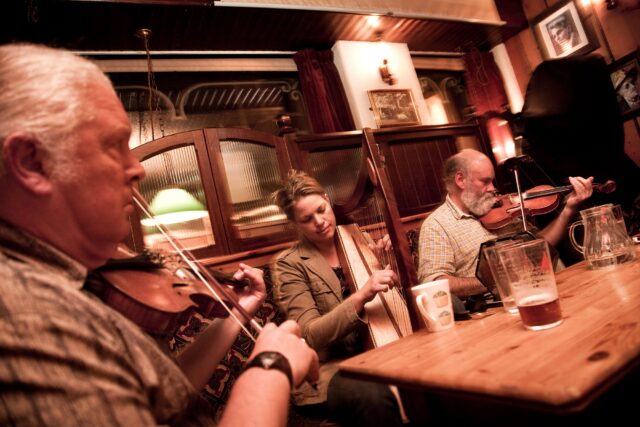
In Dingle, there’s live music most nights in half a dozen pubs. There’s never a cover charge. Just buy a beer and make yourself at home. The Small Bridge Bar and O’Flaherty’s are the most famous for their atmosphere and devotion to traditional Irish music. But tonight — and most nights — I make a point to wander the town and follow my ears. Traditional music is alive and popular in Ireland. A “session” is when musical friends (and strangers who become friends) gather and jam. There’s generally a fiddle, flute or tin whistle, guitar, bodhrán (goat-skin drum), and maybe an accordion.

I follow the music into a pub and order a pint. The music churns intensely, the group joyfully raising each other up one at a time with solos. Sipping from their mugs, they skillfully maintain a faint but steady buzz. The drummer dodges the fiddler’s playful bow. The floor on the musicians’ platform is stomped paint-free and barmaids scurry through the commotion, gathering towers of empty, cream-crusted glasses. With knees up and heads down, the music goes round and round. Making myself right at home, I “play the boot” (tap my foot) under the table in time with the music. When the chemistry is right, live music in a pub is one of the great Irish experiences.

The Irish like to say that in a pub, you’re a guest on your first night; after that, you’re a regular. That’s certainly true in Dingle…the next parish over from Boston.

(This story is excerpted from my upcoming book, For the Love of Europe — collecting 100 of my favorite memories from a lifetime of European travel, coming out in July. It’s available for pre-order.)
Daily Dose of Europe: Pedaling Through Amsterdam

I love Amsterdam. And I love it even more from the seat of a bike.

Because of the coronavirus, Europe is effectively off-limits to American travelers for the next few weeks (and likely longer). But travel dreams are immune to any virus. During these challenging times, I believe a daily dose of travel dreaming can actually be good medicine. Here’s another one of my very favorite travel dreams-come-true…a reminder of what’s waiting for you in Europe on the other end of this crisis.

Sightseeing isn’t just seeing. To get the full experience of a place, you need to feel, hear, taste, and smell it. On this visit to Amsterdam, I’m making a point to focus on sensual travel. It’s a city made to engage all of the senses.

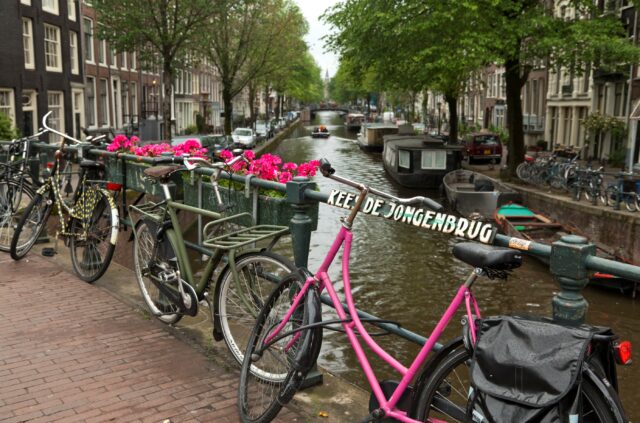
I always rent a bike here. I want to feel the bricks and pavement beneath two wheels. The lack of hills and the first-class bike-lane infrastructure makes biking here a breeze. The clerk at the rental shop must be tired of explaining why they don’t carry mountain bikes in this flat land. When I ask, he responds — in classic Dutch directness — “Mountain bikes in the Netherlands make no sense at all. When a dog takes a dump, we have a new mountain. You pedal around it…not over. It’s no problem.”

I ride off along the shiny wet cobbles, my Amsterdam experience framed by my black bike’s handlebars. I get pinged by passing bikes and ping my bell to pass others. When it comes to bike bells, there’s no language barrier. For my own safety, I wish I had a bigger periphery, as cars, trams, bikers, and pedestrians seem to float by from all directions in silence — their noise lost in the white noise of breezing through this dreamy city on two wheels.

Reaching the Red Light District, I stop to use a classic old street-corner urinal. It’s painted a deep green and designed to give the user plenty of privacy from the neck down and a slice-of- Amsterdam view at the same time. The pungent smells of pot smoke and someone else’s urine compete with the dank smell of the canal. I remember one of the new Amsterdam facts I’ve learned: A handful of people drown in the canals each year. When their bodies are finally dredged up, very often, their zippers are down. They were very drunk and, rather than using the civilized urinal as I did, they used the canal…their final mistake. Across the lane, a woman in a cliché of lingerie eyes me seductively from a window, framed in red. I think to myself, “This is probably the most unforgettable trip to a urinal I’ll ever have in my life.”

Pedaling on, I notice that the Red Light District is now a little more compact than I remember. Spliced in among the windows displaying enticing women are other windows promoting fashion and contemporary art. Amsterdam’s leaders recognize that legalized marijuana and prostitution are part of the city’s edgy charm, but are also working to rein in the sleaze. They’re not renewing some Red Light District leases, instead giving them to more preferable businesses.

Continuing on my ride, it strikes me that much of Amsterdam still looks like it did three or four centuries ago, during the Dutch Golden Age, when this was the world’s richest city.

I continue on to a square called Museumplein where Amsterdam’s three, big art museums are gathered — and selfie-crazed tourists gather around the red-and-white “I AMsterdam” letters, which are as tall as people.

I stop a moment to take in the square. Long lines plague the Dutch Master-filled Rijksmuseum and Van Gogh Museum — both understandably popular. There’s rarely a wait at the Stedelijk Museum, nicknamed “the bathtub” because of the striking shape of its modern architecture. Inside are 20th-century favorites (Dalí, Picasso, Kandinsky) and crazy contemporary art. I’m not a big fan of the abstract style, but the artwork at the Stedelijk is really fun (perhaps really, really fun if you’re into marijuana — sold with a smile in the city’s many “coffeeshops”).

The sounds of Amsterdam’s knack for good living seem to surround the museum district. Underneath the Rijksmuseum, in a public passageway, street musicians seem to be performing everything from chamber music to Mongolian throat singing. Around the corner, a man in a top hat cranks away on his candy-colored street organ. Mesmerized children watch its figurines jingle and jangle to the jaunty music as it slowly grinds through its perforated song boards.

The city’s biggest green space, Vondelpark, is just a short pedal away. I roll by snippets of Dutch conversation — families with kids, romantic couples, strolling seniors, and hippies sharing blankets and beers.

By now my sense of taste is ready for a little attention. Thinking about the options, I consider rijsttafel (literally “rice table”), a ritual dish for tourists in Holland. Not a true Indonesian meal, it’s a Dutch innovation designed to highlight the best food of its former colony — specifically to show off all the spices that in some ways originally motivated the colonial age. The dinner includes 20 dishes and a rainbow of spices with white rice to mix and mingle on your plate and palate. Working your way through this tasty experience, it’s clear why the Dutch called Indonesia “The Spice Islands.”

In the mood for something more historically Dutch, I opt instead for a snack of herring with pickles and onions. Later, I indulge my taste buds at a cheese-tasting class. After a short video that’s somewhere between a cheese commercial and dairy soft porn, I guillotine six different local cheeses studying, smelling, and tasting them with a wine accompaniment.

My final experience: some Dutch booze. While the 20-somethings line up for the Heineken Experience — a malty, yeasty amusement ride of a brewery tour — I join an older crowd at the slick House of Bols: Cocktail & Genever Experience. Here, I learn about the heritage of Dutch gin (genever), and test my olfactory skills at a line of 36 scents. I fail miserably, my nose identifying only one scent: butterscotch. I console myself by designing the cocktail of my dreams at a computer kiosk and taking the recipe printout to the nearby barista, who mixes a Dutch gin drink that’s uniquely mine.

Pedaling back to my hotel, rattling over those shiny cobbles just inches from the murky canals, I’m thankful I turned down that one last gin.

(This story is excerpted from my upcoming book, For the Love of Europe — collecting 100 of my favorite memories from a lifetime of European travel, coming out in July. It’s available for pre-order.)
Daily Dose of Europe: Gimmelwald — The Swiss Alps in Your Lap

Need to get away? The tiny Swiss alpine village of Gimmelwald is about “away” as you can get.

Because of the coronavirus, Europe is effectively off-limits to American travelers through at least mid-April. But travel dreams are immune to any virus. As we work through these challenging days, I believe a daily dose of travel dreaming can actually be good medicine. Here’s another one of my very favorite travel dreams-come-true…a reminder of what’s waiting for you in Europe on the other end of this crisis.

On the train heading south from Interlaken into the high country, the Swiss woman sitting across from me asks where I’m going. When I say “Gimmelwald,” she assumes I mean the famous resort in the next valley, and says, “Grindelwald, that’s very nice.” When assured that Gimmelwald is my target, she leans forward, widens her eyes, and — with her sing-song Swiss German accent — asks, “Und how do you know Gimmelvald?”

The traffic-free village of Gimmelwald hangs nonchalantly on the edge of a cliff high above Lauterbrunnen Valley. This sleepy village has more cow troughs than mailboxes. Gimmelwald is an ignored station on the cable-car route up to the spectacular mountain peak, the Schilthorn. The village should be built to the hilt. But, led by a visionary schoolmaster, the farming community managed to reclassify its land as an “avalanche zone” — too dangerous for serious building projects. So, while developers gnash their teeth, sturdy peasants continue to milk cows and make hay — enjoying a lifestyle that survives in a modern world only by the grace of a government that subsidizes such poor traditional industries.

Gimmelwald is a community in the rough. When I arrive, I take a quick “welcome back” walk—a tour of the whole town takes about 15 minutes. Its two streets, a 700-year-old zig and zag, are decorated by drying laundry, hand-me-down tricycles, and hollowed stumps bursting proudly with geraniums. Grandpas, like white-bearded elves, set aside hand-carved pipes to chop firewood. Children play “barn” instead of “house.” And a little boy parks his toy car next to his dad’s tank-tread mini tractor — necessary for taming this alpine environment. Stones sit like heavy checkers on old rooftops, awaiting nature’s next move. While these stones protect the slate from the violent winter winds, in summer it’s often so quiet that you can hear the cows ripping tufts of grass.

Traditional log-cabin homes line the lanes. Their numbers are not addresses, but fire insurance numbers. The troll-like hut aging near the cable-car station is filled with rounds of Alp cheese, also aging. Small as Gimmelwald is, it still has daily mail service. The postman drops down from neighboring Mürren each day (by golf cart in summer, sled in winter) to deliver mail and pick up letters at the communal mailbox. Most Gimmelwalders have one of two last names: von Allmen or Feuz. I’m told that to keep prescriptions and medical records straight, the doctor in nearby Lauterbrunnen goes by birthdate first, then the patient’s name.

Watching two schoolboys kick a soccer ball just a few steps from the cliff’s edge, I enjoy the thought that there’s nothing but air between Gimmelwald and the rock face of the Jungfrau directly across the valley.

Over there, small avalanches look and sound like distant waterfalls. Village kids have likely learned the hard way: Kick that ball wrong and it ends up a mile below on the Lauterbrunnen Valley floor. My Gimmelwald walk comes with the sweet smell of freshly cut hay. The townspeople systematically harvest the steep hillside, with entire families cutting and gathering every inch of hay. After harvesting what the scythe can reach, they pull hay from nooks and crannies by hand. Half a day is spent on steep rocks harvesting what a machine could cut in two minutes on a flat field. It’s tradition. For locals, cutting the hay is like breathing… and there’s one right way to do it.

Climbing from zig to zag, I witness a first for me: A farmer at the top of town has filled his big blue tarp with a mountain of hay the size of a small car. Directly below him is his barn with a bridge leading to its loft—the door open like the mouth of a hungry child. Nonchalantly, as if he does this every day, the farmer climbs onto the hay and rides it like a sled steeply down the field to the little bridge where his son awaits. Together, they drag the load into the loft and close the door.

To inhale the Alps and really hold it in, I sleep high in Gimmelwald. Poor but pleasantly stuck in the past, the village has a creaky hotel, happy hostel, decent pension, and a couple of B&Bs. Walter Mittler’s Hotel Mittaghorn, sitting at the top end of Gimmelwald, has long been my favorite. The weather-stained chalet has eight pint-sized balconies and a few tables shaded by umbrellas on its small terrace. Everything comes with huge views. Sitting as if anchored by pitons in the steep, grassy hillside, the hotel is disturbed only by the cheery chatter of hikers

and the two-stroke clatter of passing mini tractors. On Walter’s terrace, I grab a table next to a group of Alp-aholics from the village’s youth hostel. While they compare notes on nearby hikes and team up for tomorrow’s adventures, I sip a coffee schnapps and watch rays from the setting sun warm the mountaintops as the moon rises over the Jungfrau.

Suddenly, the bright modern cable car swooshes by with 30 tourists gawking out the windows. Walter joins me with a drink and tells me a local tale illustrating how the Schilthornbahn is good for more than tourism. In Gimmelwald, the modern world began in 1965 with the arrival of the cable car. Before that, mothers ready to give birth had to hike an hour downhill to the valley floor for a ride into Interlaken. Many mothers didn’t make it all the way to the hospital. Just outside of Interlaken, a curve in the road is named for Zita, a Gimmelwald baby… born

right there. Today, the Schilthornbahn remains the all-powerful lift that connects Stechelberg on the valley floor with the mountain communities of Gimmelwald and Mürren on its way to the 10,000-foot Schilthorn summit. This lift shuttles life’s essentials — mail, bread, and coffins — plus skiers, hikers, schoolkids, and hang gliders, along with all those tourists—to and from each community.

The next morning, I decide to start my day by riding the cable car up to the summit of the Schilthorn, which is capped by a restaurant called Piz Gloria. Lifts go twice hourly, involve two transfers, and take 30 minutes. Inside the gondola, watching the altitude meter go up, up, up comes with a soundtrack: my ears popping.

Reaching the top, I head to an unforgettable breakfast. Every table in the revolving restaurant comes with a thrilling and eventually 360-degree view. The experience never gets old. I sip my coffee slowly to enjoy one complete circle. Then, I drop into the theater to see clips from the James Bond movie On Her Majesty’s Secret Service, in which it seems that this same restaurant is blown up. Finally, I go outside for the real thrills . . . to frolic on the ridge. A combination of the thin air and watching hang gliders jump into airborne ecstasy always stokes my pumping heart.

Now it’s time to head back down the mountain. While it’s possible to hike down from the top, I’ve found that the first gondola station below the summit, Birg, is the best jumping-off point for a high-country hike. Leaving Birg, I hike down toward Gimmelwald. Within a couple minutes, I’m surrounded by a harsh alpine world. After skidding through a patch of loose shale, I stop for a moment — just to hear the sound of the tumbling pebbles eventually grow silent and be replaced by the distant tinkling of cowbells and a cascading stream. As I hike gingerly along the edge of a ridge, dramatic valleys stretch to my left and right while, high above, icy Alps pop against a brilliant blue.

If the quality of a church is a matter of how close you feel to God, being high in the Alps just might be Europe’s ultimate cathedral. A day like today, with a perch like this, has holy rollers doing cartwheels and even Lutherans raising their hands.

After a steep descent, I step out of the forest and reach the village I call home. The finish line is a bench that sits where the trail hits the tiny paved lane that marks the high end of Gimmelwald. This bench is one of my favorite “savor Europe” spots: the right place to just sit still and take it all in. Cows munch, ignoring the view. The little resort of Mürren crowns a bluff above me on the left, keeping all the fancy tourists where they belong. Directly across the valley, a river bursts out of a glacier. Below that, in a lonely meadow, an alpine farm that has intrigued me for years still sits high above the tree line, forever alone amid distant flecks that must be cows and goats. Below me, the village schoolyard comes with the happy noise of children at play. Suddenly, Christian, a farmer (and the town’s go-to accordion player), rumbles by. He’s coming back from the fields in his mini truck towing a wobbly wagonload of hay. His kids bounce on top like happy cartoons.

Enjoying this alone is a delight. But sharing this bench with the right travel partner, the sun of a daylong hike ruddy on your smiling faces, is even better. There are many peaks and ridges in Switzerland offering high-elevation thrills…but at the end of the day, I love kicking off my boots in storybook-perfect Gimmelwald.
(This story is excerpted from my upcoming book, For the Love of Europe — collecting 100 of my favorite memories from a lifetime of European travel, coming out in July. It’s available for pre-order.)

Daily Dose of Europe: French Escargot and the Beauty of Terroir

I always used to wonder if all those French food snobs were just faking it. But then I thought about baseball.

Because of the coronavirus, Europe is effectively off-limits to American travelers through at least mid-April. But travel dreams are immune to any virus. As we work through these challenging days, I believe a daily dose of travel dreaming can actually be good medicine. Here’s another one of my very favorite travel dreams-come-true…a reminder of what’s waiting for you in Europe on the other end of this crisis.

Walking through France’s finest vineyards in the fabled Côte d’Or (or “Gold Coast”) of Burgundy, the proud vintner guiding me becomes evangelical.

Pointing to the ground, she says, “A good grape must suffer. Look at this soil — it is horrible . . . it is only rocks. That is why these grapes have character. The roots of these struggling vines are thin as hairs. Searching as much as 30 meters down, they reach, reach, reach for moisture. The vines in the flat fields” — she motions, almost disdainfully, to fields just a kilometer away — “have it too easy . . . a silver spoon in their mouths. It’s like people. The fine wines of humanity, they are the ones who have suffered.”

“Like Tina Turner?” I ask.

“Exactly!” she says.

“The best vintners don’t force their style on the grape. They play to the wine’s strength, respecting the natural character of the sun, soil, and vine…the terroir. They play the wine like a great musician plays classical music. You don’t want to recognize the musician. You want to hear the Beethoven.”

That afternoon, I bike through these revered vineyards, where road signs read like a list of fine wines. Wines here are named not for the grape, but for the place of their origin. The more specific the place name, the higher the quality. A wine called simply “Burgundy” for the region would be a basic table wine. A wine labeled by the village (for instance, “Pommard”) would be better. Those named for the vineyard (such as “Clos de Pommard”) would be excellent and for a certain patch of land within that vineyard (cru or grand cru) the very best.

I head to a restaurant set in a vineyard that I remember from a previous visit, a place called Le Relais de la Diligence. Two years ago, the vines were lapping at its tables. Today, it’s in a wheat field. I’m told that with the whole world making good wines, the French are cutting back on quantity, using marginal land for other crops, and working to build the quality.

Despite the view of wheat instead of grape vines, the food is delightful, as is the wine. I’m struck by the sophistication of the presentation and service as well as the casual atmosphere, with families and even dogs enjoying the scene. (There is a doggy meal printed on the menu.)

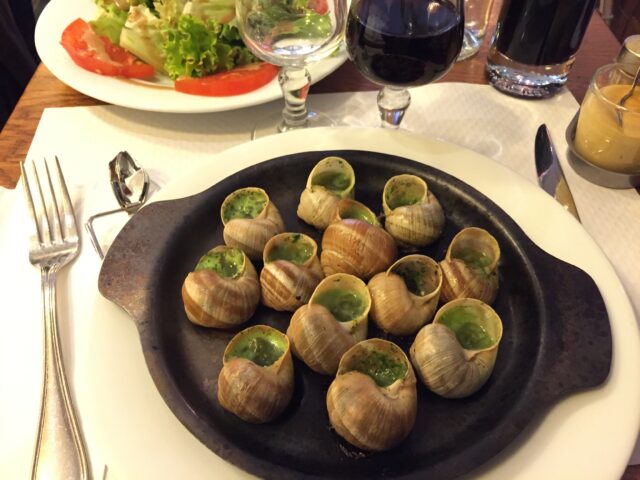
Feeling adventurous, I order the escargot, a classic French dish that’s sourced a little differently these days. Good escargot must grow wild. The great French snail was once so common that early-19th-century train companies hired women and children to clean them off the tracks so the trains could get a grip. Today, the French snail has gone the way of the great American buffalo. As effective chemicals have successfully killed off weeds and undesirable insects, they have also decimated the slug and snail populations. Much of the escargot in France is farmed. Locals know the farmed gray snails are mediocre at best. The top-quality free-range snails most likely last slithered in Poland.

Through my meal, I ponder, not for the first time, whether there is something pseudo-sophisticated about all this finicky French food culture. While buying wine, if you ask what would be good with escargot, the wine merchant will need to know how you plan to cook the snails. “Oh, you’re cooking it that way? Then you need something flinty — a Chablis.” Too bad if you were hoping for a good Chardonnay.

Then I think of the way an American who pooh-poohs the French passion for fine points in cuisine might celebrate the nuances of baseball. Take a Frenchman to the ballpark. All the stuff that matters to me—how far the runner is leading off first base, who’s on deck and how he does against left-handed pitchers, how deep the bullpen is, put in a pinch runner! — is nonsense to him.

The next time I put a little ketchup on my meat and my French friend is aghast, I’ll accept it with no judgment. I’ll just remember that with two outs and a full count, he’ll have no idea how I know the runner’s off with the pitch.

(This story is excerpted from my upcoming book, For the Love of Europe — collecting 100 of my favorite memories from a lifetime of European travel, coming out in July. It’s available for pre-order.)