Correction from an earlier post: I’m sorry I mistakenly posted my friend Steve Caron’s travel agency URL as sinbad.ru. I checked it and a ticket booking site came up, but I’ve since learned that it’s one of those bottom-feeding sites that preys on misspellings. Steve’s business (which is very popular in Russia, and for good reason) is at www.sindbad.ru. You have to watch out for that. If you misspell my URL as ricksteeves.com, you get a sleazy site that tries to book travel from people who are looking for me – but the site has nothing to do with me other than squatting on my misspelled name. Even President Obama has to deal with this. If you go to whitehouse.com rather than whitehouse.gov, you get a site selling sexy lingerie and related products. Keyboard with caution!
Here you can browse through my blog posts prior to February 2022. Currently I'm sharing my travel experiences, candid opinions, and what's on my mind solely on my Facebook page. — Rick
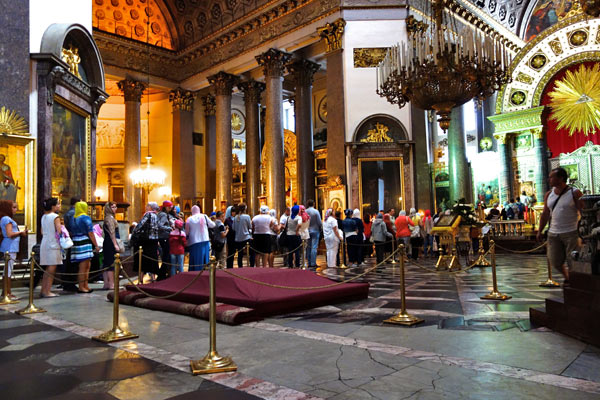
St. Petersburg’s Dazzling Churches
Under communism, the state religion — atheism — tried to silence the faith professed by the majority of Russians. The Russian Orthodox Church survived, but many church buildings were seized by the government and repurposed (as ice-hockey rinks, swimming pools, and so on). Many more were destroyed. Soviet citizens who openly belonged to the church sacrificed any hope of advancement within the communist system. But since the fall of communism, Russians have flocked back to their church. (Even Vladimir Putin, a former KGB agent and avowed atheist, revealed that he had secretly been an Orthodox Christian all along.) Today, three out of every four Russian citizens follows this faith — a high percentage for a country whose government was aggressively atheistic just a generation ago. Photos by Trish Feaster, The Travelphile.com.


Alexander II freed the serfs in 1861. But he gave them no land (no opportunity for building a new life), so they moved to the cities, where the seeds of proletarian discontent were planted (and would burst into revolution a half-century later). For a czar and for the times, Alexander II was a great reformer.

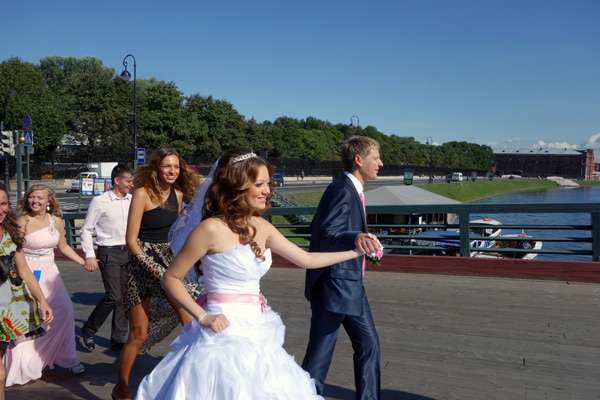
Newlyweds and St. Petersburg: Picture-Perfect
At romantic spots all over St. Petersburg you’ll see newlyweds with their photographers. After the wedding ceremony, newlyweds are practically obligated to drop by a dozen or so picturesque locations for wedding pictures. They’ll occasionally make a traditional toast with Champagne, then break their glasses to proclaim their love. Watch your step.


The Hermitage Museum
Built in the mid-1700s for Peter the Great’s daughter, Elizabeth, the Hermitage was later filled with the art collection of Catherine the Great. The Hermitage’s vast collections of European masterpieces make it one of the world’s top art museums, ranking with the Louvre and the Prado. How does the Hermitage stack up among the world’s top collections of paintings for you? Photos by Trish Feaster, see her blog at The Travelphile.com.


Getting to Know Russia
Talking with Russians and ex-pats living in Russia gives you a special insight into an often misunderstood culture. Here are a few examples:
Knowing how much many societies rely on tourism these days for employment and foreign revenue, I told someone, “Requiring a visa for tourists is no good for tourism and your economy.” He responded, “It doesn’t matter. No one cares. Russia has gas and oil and minerals.”
Discussing the struggles of civil liberties under Putin, I was told, “Stability is a passage to democracy.”
I told my Russian friend that many Americans are against government regulations on business. She said, “We live in a world where those who believe that regulations on business are bad are running our society. And we’re learning that capitalism without regulation is as bad as tyranny.” I said that I believe we’re all on parallel tracks toward pluralism and democracy, and some societies are just farther along than others. Another friend responded, “What you said is incompatible with reality.”
When I asked why the oligarchs are allowed to wield so much power, my friend said, “In Russia there is no ‘why’.” In Russia you don’t ask for logic and you don’t ask why. Certain norms are inbred.
They say 16 percent of the work force is in the security field. There’s an obsession with rules and security that goes back to czarist days. Any deviation is considered deviant, in the negative sense. About one in five Russians is a free-minded liberal who wants change (therefore deviant). The amount of deviation that’s acceptable fluctuates from time to time. The range is very wide now. For example, everyday Russians are allowed to travel for practically the first time in history. And people embrace the world through the Internet. I was told, “Religion was the opiate of the masses in the old days, Vodka was the opiate in Soviet times, and today, the Internet is the opiate of the masses.”

The 1970s and 1980s were a time when thought leaders in Russia — cultural icons like Aleksandr Solzhenitsyn and world-famous scientists like Andrei Sakharov — stood courageously for freedom. Solzhenitsyn’s “Open Letter to Soviet Leaders” inspired me as it inspired millions of Russians in the 1970s. I stumbled upon this monument to Sakharov (who won the Nobel Peace Prize in 1975), and it rekindled the respect and admiration I have for individuals who stood up to the Kremlin during those dark and difficult years — freedom fighters who softened the ground for the fall of Soviet Communism that would follow a decade or so later. Photo by Trish Feaster, see her blog – The Travelphile.com.