Here you can browse through my blog posts prior to February 2022. Currently I'm sharing my travel experiences, candid opinions, and what's on my mind solely on my Facebook page. — Rick
Our work was made much easier by the car and driver provided to us by the Palestinian Ministry of Tourism. It was a long, hot hike down to the Monastery of St. George. Coming up, we were pleasantly surprised by our driver, who managed to drive his car down to a crevice in the mountain, cutting our hike by half.
If you can’t see the video below, watch it on YouTube.
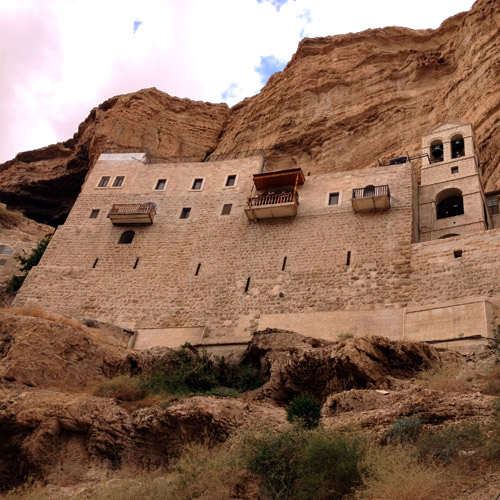
Hiding in folds of the Judean Desert are ancient monasteries which, since ancient times, have given hermits the desolation of their dreams. Orthodox Christians — whether from Palestine, Greece, Russia, or Ethiopia — enliven these monasteries today, as they have since the sixth century. Orthodox Christians maintain a rich and ancient worship style that has not reformed as Catholic and Protestant Christians have. And, logically, their art feels timeless, too. The icons here are a reminder of how, for these monks, the meditation, isolation, and hermetic way of life can all help them to better understand the message and will of Jesus.
The dramatically set Monastery of St. George welcomes pilgrims and tourists alike. For 15 centuries, the faithful have ventured to this spot, hiked into the ravine, quenched their thirst, and nourished their soul.Looking up at this imposing monastery — burrowed into its cliff — it almost seems like a mirage in a parched desert. If you want holy solitude, this is clearly the place.The monks at St. George were very camera-shy. They didn’t want to be “actors.” While they sang to us beautifully off-camera, they told us that filming rooms with just candles was enough.
I’ll continue this Holy Land series until November 21st. Then, to celebrate my homecoming, I’ll give a live, free slideshow lecture on Thursday, November 21st at 7 p.m. P.S.T. in Edmonds, Washington. You can attend in person (registration required)…or watch the live webcast from anywhere in the world (no registration required). Learn more at Rick Steves – Holy Land: Israel and Palestine Today.
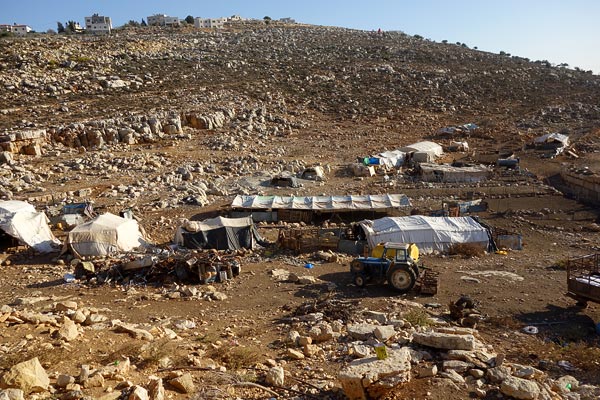
Stopping to visit with some nomads who were living not in the wide-open wilderness, but between the edge of a sprawling city and a curve in the highway, I had a few thoughts about the plight of nomadic people in general. (Please excuse the wind buffeting.)
If you can’t see the video below, watch it on YouTube.
The Judean Desert offers some of Palestine’s most dramatic and evocative scenery. Vast and arid, it’s home to herds of camels, raised for their milk and meat. And it’s home to nomadic Bedouin tribes. Scattered through the Palestinian countryside, like timeless limpets, are the scrappy shacks and goat corrals of Bedouin tribes. These proud families live off the grid with, I would imagine, a near-zero carbon footprint. Yet, like nomads around the world, they are being driven into a world where people have addresses and send their children to school to learn the prevailing values of that society at large. With the political tensions between Israel and Palestine (the walls, settlements, freeway construction, and aggressive water politics), I was told that Bedouin camps are now less mobile and stick to land near roads where they can tap into water mains. After so many centuries, more and more Bedouin families are finally settling down in towns and villages.
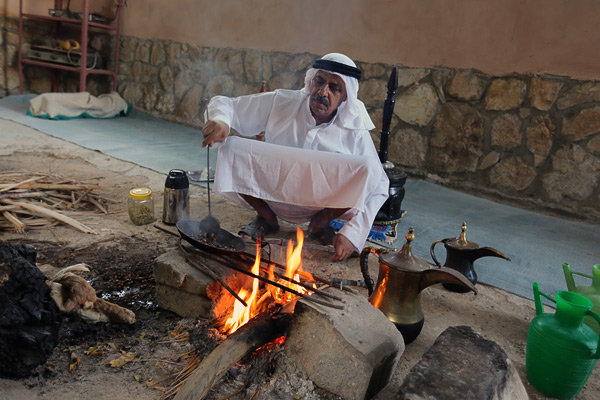
While hardscrabble communities still eke out an off-the-grid existence, their way of life — like most nomadic communities — is dying. With their ability to roam free disappearing and access to water more and more limited, they are, by necessity, evolving.While settling down, many Bedouin families are maintaining their traditions as much as a nomad with a roof over their head can. Water is treasured. Goats are still a source of income. And they’re branching out into agriculture by necessity.Watching the man of the house roast coffee with a reverence for tradition is mesmerizing. Observing him at work, it was clear to me that the dignity of these people and their closeness to the land is emblematic of Palestinians in general. And tasting the coffee as if sealing a new friendship, I, too, became closer to the land.
I’ll continue this Holy Land series until November 21st. Then, to celebrate my homecoming, I’ll give a live, free slideshow lecture on Thursday, November 21st at 7 p.m. P.S.T. in Edmonds, Washington. You can attend in person (registration required)…or watch the live webcast from anywhere in the world (no registration required). Learn more at Rick Steves – Holy Land: Israel and Palestine Today.
When filming, I spend a lot of time sitting in the car while the crew is getting a particular shot. In the Holy Land, there are fascinating things to observe wherever you pull over. And with the luxury of a local guide at my side, all of my questions can be addressed. Roughly a fifth of all Israelis are not Jewish, but Arab Israelis — mostly Muslim. While they have equal rights on paper, most Arab Israelis would say they feel like second-class citizens. But in this clip, our guide Abie explains how, in one interesting way, Arab Israelis have more rights than Jewish Israelis.
If you can’t see the video below, watch it on YouTube.