Here you can browse through my blog posts prior to February 2022. Currently I'm sharing my travel experiences, candid opinions, and what's on my mind solely on my Facebook page. — Rick

Daily Dose of Europe: Cafe Chitchat, Chocolate Cake, and the Vienna Opera

Viennese high culture may be on hold for now. But I’m savoring my memories of a city that knows how to live very, very well.

Europe is effectively off-limits to American travelers for the time being. But travel dreams are immune to any virus. And, while many of us are stuck at home, I believe a daily dose of travel dreaming can actually be good medicine. Here’s another one of my favorite travel memories — a reminder of what’s waiting for you in Europe at the other end of this crisis.

Munching Europe’s most famous chocolate cake — the Sacher torte — in Café Sacher, across from Europe’s finest opera house, I feel underdressed in my travel wear. Thankfully, a coffee party of older ladies, who fit right in with the smoked mirrors and chandeliers, make me feel welcome at their table. They’re buzzing with excitement about the opera they are about to see — even bursting into occasional bits of arias.

Loni, the elegant white-haired ringleader, answers my questions about Austria. “A true Viennese is not Austrian, but a cocktail,” she says, wiping the brown icing from her smile. “We are a mix of the old Habsburg Empire. My grandparents are Hungarian.” Gesturing to each of her friends, she adds, “And Gosha’s are Polish, Gabi’s are Romanian, and I don’t even know what hers are.”

“It’s a melting pot,” I say.

They respond, “Yes, like America.”

For 600 years, Vienna was the head of the once-grand Habsburg Empire. In 1900, Vienna’s nearly two million inhabitants made it the world’s sixth-largest city (after London, New York, Paris, Berlin, and Chicago). Then Austria started and lost World War I — and its far-flung holdings. Today’s Vienna is a “head without a body,” an elegant capital ruling tiny Austria. The average Viennese mother has one child and the population has dropped to 1.8 million.

I ask Loni about Austria’s low birthrate.

“Dogs are the preferred child,” she says, inspiring pearl-rattling peals of laughter from her friends.

Sharing coffee and cake with Viennese aristocracy who live as if Vienna were an eastern Paris, and as if calories didn’t count, I’m seeing the soul of Vienna. Vienna may have lost its political clout, but culturally and historically, this city of Freud, Brahms, a gaggle of Strausses, Empress Maria Theresa’s many children, and a dynasty of Holy Roman Emperors remains right up there with Paris, London, and Rome.

As far back as the 12th century, Vienna was a mecca for musicians, both secular and sacred. The Habsburg emperors of the 17th and 18th centuries were not only generous supporters of music but also fine musicians themselves (Maria Theresa played a mean double bass). Composers such as Haydn, Mozart, Beethoven, Schubert, Brahms, and Mahler gravitated to this music-friendly environment. They taught each other, jammed together, and spent a lot of time in Habsburg palaces. Beethoven was a famous figure, walking — lost in musical thought — through Vienna’s wooded parks.

After the defeat of Napoleon, the Congress of Vienna in 1815 shaped 19th-century Europe. Vienna enjoyed its violin-filled belle époque, which shaped our romantic image of the city: fine wine, cafés, waltzes, and these great chocolate cakes. The waltz was the rage and “Waltz King” Johann Strauss and his brothers kept Vienna’s 300 ballrooms spinning. This musical tradition created the prestigious Viennese institutions that tourists enjoy today: the opera, Boys’ Choir, and great Baroque halls and churches, all busy with classical concerts.

As we split up the bill and drain the last of our coffee, the women take opera tickets out of their purses in anticipation. “Where will you be sitting?” Loni asks.

“Actually I’ll be standing,” I say. “I’ve got a Stehplatz, a standing-room-only ticket.”

The women look at me kindly, perhaps wondering if they should have paid for my cake and coffee.

“A Stehplatz is just €4. So I have money left over for more Sacher torte,” I tell them with a smile. What I don’t say is that, for me, three hours is a lot of opera. A Stehplatz allows me the cheap and easy option of leaving early.

Leaving the café, we talk opera as we cross the street. The prestigious Vienna Opera isn’t backed in the pit by the famous Vienna Philharmonic Orchestra, but by its farm team: second-string strings. Still, Loni reminds me, “It’s one of the world’s top opera houses.” Even with 300 performances a year, expensive seats are normally sold out — mostly to well-dressed Sacher torte-eating locals.

Saying goodbye to my new friends, I head for the standing-room ticket window. Cackling as old friends do, they waltz through the grand floor entrance and into another evening of high Viennese culture.

(These daily stories are excerpted from my upcoming book,  For the Love of Europe — collecting  100  of my favorite memories from a lifetime of European travel, coming out in July.  It’s available for pre-order. And you can also watch a video clip related to this story: Just visit Rick Steves Classroom Europe and search for Vienna.)
Daily Dose of Europe: Cockcrow on Hydra

Greece has many famous islands. But my favorite is off the beaten path — the terrain of donkeys, roosters, and cats: the traffic-free isle of Hydra.

Europe is effectively off-limits to American travelers for the time being. But travel dreams are immune to any virus. And, while many of us are stuck at home, I believe a daily dose of travel dreaming can actually be good medicine. Here’s another one of my favorite travel memories — a reminder of what’s waiting for you in Europe at the other end of this crisis.

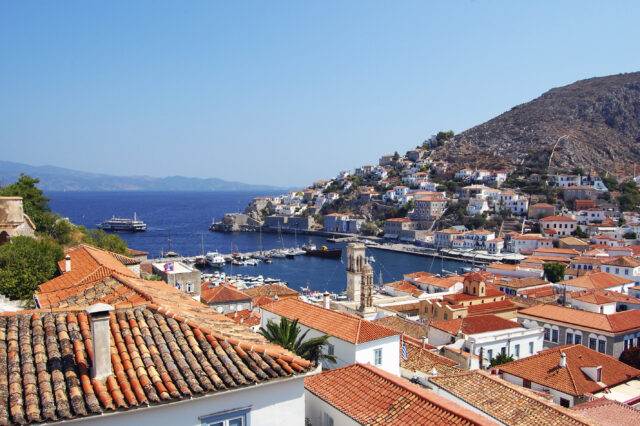
Hydra — just an hour by fast ferry from Athens — has one town, a quaint little harbor, isolated beaches, and some tavernas. There are no real roads, no cars, and not even any bikes. Other than zippy water taxis, donkeys are the only form of transportation. Slow and steady, these surefooted beasts of burden — laden with everything from sandbags and bathtubs to bottled water — climb the island’s stepped lanes. On Hydra, a traffic jam is three donkeys and a fisherman.

In addition to the tired burros, this is a land of tiny cats and roosters with big egos. While it’s generally quiet, dawn has taught me the exact meaning of “cockcrow.” The end of night is marked by much more than a distant cock-a-doodle-doo: It’s a dissonant chorus of cat fights, burro honks, and what sounds like roll call at an asylum for crazed roosters. After the animal population gets that out of its system, the island slumbers a little longer, as if hitting “snooze.”

This afternoon, I’ve decided to head uphill, with no intention of anything more than a lazy stroll. One inviting lane after another draws me up, up, up… At the top of the town, shabby homes enjoy grand views, burros amble along untethered, and island life trudges on, oblivious to tourism.

Over the crest, I follow a paved riverbed (primed for the flash floods that fill village cisterns each winter) down to the remote harbor hamlet of Kaminia — where 20 tough little fishing boats jostle, corralled within a breakwater. Children jump fearlessly from rock to rock to the end of the jetty, ignoring an old man rhythmically casting his line.

A rickety woven-straw chair and a tipsy little table at Kodylenia’s Taverna are positioned just right, overlooking the harbor. The sun, as if promising a worthwhile finale to another fine day, commands, “Sit.” I do, sipping ouzo and observing a sea busy with taxi boats, the “flying dolphin” hydrofoils that connect people here with Athens, freighters — like castles of rust — lumbering slowly along the horizon, and a cruise ship anchored as if threatening to attack.

This cloudy glass of ouzo, my anise-flavored drink of choice, and the plastic baggie of pistachios I purchased back in town are a perfect complement to the setting sun. An old man flips his worry beads, backlit by the golden glitter on the harbor. Blue and white fishing boats jive with the chop. I swear the cats — small, numerous, and oh so slinky — are watching the setting sun with me. My second glass of ouzo comes with a smudge of someone’s big fat Greek lipstick. I decide not to worry about it before taking a sip that seems to connect me with the scene even more.

As twilight falls, my waiter brings a candle for my table. He lingers to tell me he returned here to his family’s homeland after spending 20 years in New Jersey, where he “never took a nap.” The soft Greek lounge music tumbling out of the kitchen mixes everything like an audio swizzle stick. Downing the last of my ouzo, I glance over my shoulder to the coastal lane that leads back to my hotel…thankfully, it’s lamplit.

Walking back under a ridge lined with derelict windmills, I try to envision Hydra before electricity, when it was powered only by wind and burros. At the edge of town, I pass the Sunset Bar, filled with noisy cruise-ship tourists, which makes me thankful I took the uphill lane when I left my hotel. Resting on a ferry cleat the size of a stool, I scan the harbor. Big flat-screen TVs flicker on the bobbing yachts moored for the night.

Back in Hydra town, I observe the pleasant evening routine of strolling and socializing. Dice clatter on dozens of backgammon boards at tavernas, entrepreneurial dogs seek out scraps, ball-kicking children make a playground out of a back lane, and a tethered goat chews on something inedible. From the other end of town comes the happy music of a christening party. Dancing women fill the building, while their children mimic them in the street. Farther down, two elderly, black-clad women sit like tired dogs on the curb.

Succumbing to the lure of a pastry shop, I sit down for what has become my day-ending ritual: honey-soaked baklava. I tell the cook I’m American.

“Oh,” he says, shaking his head with sadness and pity. “You work too hard.”

I answer, “Right. But not today.”

(These daily stories are excerpted from my upcoming book,  For the Love of Europe — collecting  100  of my favorite memories from a lifetime of European travel, coming out in July.  It’s available for pre-order. And you can also watch a video clip related to this story: Just visit Rick Steves Classroom Europe and search for Hydra.)

Daily Dose of Europe: Bruges — Pickled in Gothic 

Chocolates, craft beer, church tower chimes…what’s not to like? Join me on a mellow little visit to Bruges, Belgium.

Europe is effectively off-limits to American travelers for the time being. But travel dreams are immune to any virus. And, while many of us are stuck at home, I believe a daily dose of travel dreaming can actually be good medicine. Here’s another one of my favorite travel memories — a reminder of what’s waiting for you in Europe at the other end of this crisis.

With a smile, the friendly shopkeeper hands me a pharaoh’s head and two hedgehogs. Happily sucking the liquor out of a hedgehog, I walk out of the small chocolate shop with a €3 assortment of Bruges’ best pralines — chocolate treats with sweet fillings.

Belgian chocolate is considered Europe’s finest. And in Bruges, locals boast that their chocolate is the best in Belgium. I’m always tempted by the treats in display windows throughout town. Godiva’s chocolate is thought to be the best big-factory brand, but for quality and service, I drop by one of the many family-run shops. (I pray for cool weather in Belgium because quality chocolate shops close down when it’s hot.)

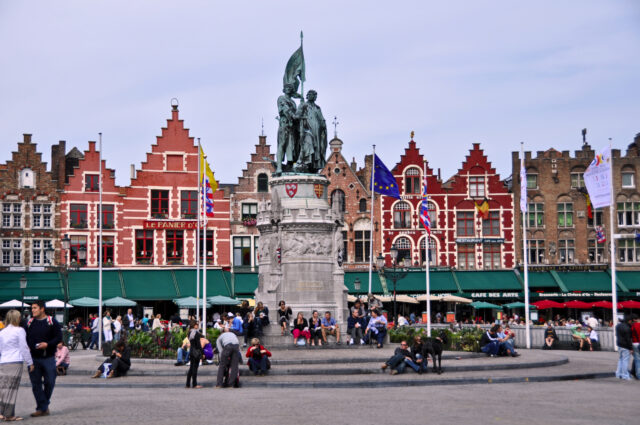
Free time to explore Bruges always puts me in a fun-loving mood. With Renoir canals, pointy gilded architecture, and stay-awhile cafés, the marvelously preserved medieval town is a delight. Where else can you bike along a canal, munch mussels, drink fine monk-made beer, see a Michelangelo statue, and savor heavenly chocolate, all within 300 yards of a bell tower that rings out “Don’t worry, be happy” jingles?

The town is Bruges (broozh) in French and English, and Brugge (BROO-gah) in Flemish. Before it was French or Flemish, the name was a Viking word for “wharf” or “embankment.” Right from the start, Bruges was a trading center. By the 14th century, it had a population of 35,000 (comparable to London’s) and the most important cloth market in northern Europe. By the 16th century, silt had clogged the harbor and killed the economy. Like so many of Europe’s small-town wonders, Bruges is well-pickled because its economy went sour. But rediscovered by modern-day tourists, Bruges thrives.

The colorful heart of the city, Market Square, is ringed by great old gabled buildings. Since 1300, it has been crowned by a leaning bell tower with a famous set of musical bells. Climbing its 366 steps rewards me with a commanding view and a chance to peek into the carillon room. I time my climb to be there on the quarter hour. That’s when the giant revolving barrel with movable tabs jerks into motion and mechanically rings the 47 bells to play the tune du jour.

Marveling at the medieval contraption doing its musical thing, I meet the carillonist who explains how the adjustable tabs are moved one way to ring different bells and the other way to make different rhythms. For concerts, the barrel is disengaged, which then engages the manual keyboard. About to leave, I shake his hand…and realize it’s deformed by a massive callous making his little finger twice the normal width. Noticing my reaction, he says, “That’s from lots of practice…a carillonist plays the keyboard with fists and feet rather than fingers.” Then he reminds me there’s a free concert tonight at eight.

Scampering down the spiral steps, I realize I need to be quick to see the remaining sights and still have time for the brewery tour. Thankfully, everything’s very close.

The Basilica of the Holy Blood is named for its relic of the blood of Christ, which, according to tradition, was brought to Bruges in 1150 after the Second Crusade. The City Hall has the oldest and most sumptuous Gothic hall in the Low Countries. The Gruuthuse Museum is a wealthy brewer’s home, filled with everything from medieval bedpans to a guillotine. The Church of Our Lady has a brick tower that rockets high above anything else in town — standing as a memorial to the power and wealth of Bruges in its heyday. The church holds a delicate Madonna and Child by Michelangelo. Bought with money made from Bruges’ lucrative cloth trade, it’s said to be the only statue by the artist to leave his native Italy during his lifetime.

I step into the De Halve Maan brewery just in time for the last English-language tour of the day. This is a handy way to pay my respects to the favorite local beer: Brugse Zot. The happy gang at this working family brewery posts a sign reminding their drinkers: “The components of our beer are vitally necessary and contribute to a well-balanced life pattern. Nerves, muscles, visual sentience, and a healthy skin are stimulated by these in a positive manner. For longevity and life-long equilibrium, drink Brugse Zot in moderation!” Like any good beer tour, it finishes with a proud tasting.

Belgians, who seem to speak better English after a beer, love to show off their beer expertise. The man at the bar gives me an earful. “Our country has more than 350 types of beer. That’s the most. And each beer must be served in the right glass. If they don’t have the correct glass, I will order a different beer. Look at our variety,” he says, handing me a menu of what’s available. “Dentergems is made with coriander and orange peel. Those who don’t usually like beer might enjoy our fruity brews: cherry-flavored kriek and raspberry-flavored frambozen.”

I tell him I like the complex and creamy, monk-made Chimay.

He says, “Me as well. Brewed by Trappist monks, the Chimay could almost make celibacy livable… almost.”

I walk off my beer buzz with a stroll through the begijnhof — a tranquil courtyard of frugal little homes. For reasons of war and testosterone, there were more women than men in the medieval Low Countries. The religious order of Beguines gave women (often single or widowed) a dignified place to live and work. While there are no longer Beguines, many begijnhofs survive — taken over by town councils for subsidized housing, or — like this one — still church-owned and housing nuns. Walking beneath the wispy trees of the charming begijnhof almost makes me want to don a habit and fold my hands.

It’s been a full day, but I’m not quite ready for my hotel room. Stopping by a waffle stand, I get a Belgian waffle to go. Grabbing a wooden bench in the little courtyard under the bell tower, I’m just in time for the evening carillon concert. As the bells ring, I imagine the musician’s massive calloused hands hard at work. Eating the last sweet strawberry on my waffle, I ponder how, even though this Gothic town is a thousand years old, it makes me feel like a kid.

(These daily stories are excerpted from my upcoming book, For the Love of Europe — collecting 100 of my favorite memories from a lifetime of European travel, coming out in July. It’s available for pre-order. And you can also watch a video clip related to this story: Just visit Rick Steves Classroom Europe and search for Bruges.)

Daily Dose of Europe: Piero’s Venice

Until a few weeks ago, Venice was inundated with tourists. But my local friend Piero has a knack for explaining the real Venice. (Here’s hoping that very soon, Venice will once again be crowded.)

Europe is effectively off-limits to American travelers for the time being. But travel dreams are immune to any virus. And, while many of us are stuck at home, I believe a daily dose of travel dreaming can actually be good medicine. Here’s another one of my favorite travel memories — a reminder of what’s waiting for you in Europe at the other end of this crisis.

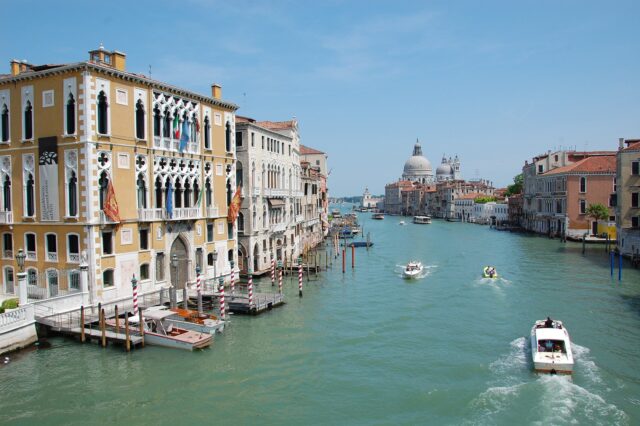
Descending the Rialto Bridge, I shuffle slowly, spinning my wheels in a human traffic jam congesting one of the biggest shopping streets in Venice. Finally breaking free, I turn down a dank and empty lane, reach the big black door of my hotel, and push a bronze lion’s nose. This security buzzer brings Piero to the second-floor window. He welcomes me with a “Ciao, Reek!” and buzzes the door open. I climb the steps, eager to settle in.

Piero, who runs the Venetian hotel I call home, shaved his head five years ago. His girlfriend wanted him to look like Michael Jordan. With his operatic voice, he reminds me more of Yul Brynner. He often says, “My voice is guilty of my love for opera.”

Proud of the improvements in his place since my last visit, Piero shows me around. While remodeling the hotel, he discovered 17th-century frescoes on the walls of several rooms. The place was a convent back then. An antique wooden prayer kneeler, found in the attic and unused for generations, decorates a corner of my room. The whitewash is partially peeled away, revealing peaceful aqua, ochre, and lavender floral patterns. In Venice, behind the old, the really old peeks through.

The breakfast room is decorated with traditional Venetian knickknacks — green and red decorative glass, prints of canal scenes, and sequined masks reminiscent of Carnival indiscretions. The room is strewn with antiques. Everything is old. “It’s kitsch,” Piero admits, “but only the best kitsch.” I sit down. As Piero brings me red orange juice — made from blood oranges — he reports on his work and the latest Venice news. While the sounds of Don Giovanni fill the air, guests prepare for their day.

Piero’s cell phone rings and he apologizes with operatic eyes. “In Italy, this is success.” He answers it and talks as if overwhelmed with work: “Si, si, si, va bene (“that’s fine”), va bene, va bene… certo (“exactly”), certo… bello, bello, bello (“beautiful,” in descending pitch)… OK, ciao, ciao, ciao.” He hangs up and explains, “That was the night manager. Always problems. I call him my nightmare manager.”

In my early travels, hotel night managers were a sorry lot. Generally speaking only the local language, they worked at night when the most complicated guest problems hit. When a tourist in a bind came to them, communication was impossible, so things just got worse. On a good night, they’d spend their time carefully ripping the paper napkins neatly in two so they’d go twice as far at the breakfast table.

Opera continues to fill the air as Piero dashes to help some French guests heading out for the day. He pours coffee for both of us, then sits back down and says, “In hotels all the people are different. The French don’t use the shower. Young Americans are most messy but use the shower very much. I don’t understand this. Americans ask, ‘What is this bidet for?’ I cannot tell them. It is for washing more than the feet. In it we wash the parts…that rub together when you walk.”

“The tourists have taken over your city,” I say sadly.

Walking me to the window and tossing open the decrepit blind, Piero answers, “But Venice survives.”

As my gaze moves from the red-tiled roofs to the marketplace commotion filling the street below, I see his point. Tourists cannot take over Venice.

“Venice is a little city,” he says. “Only a village, really. About 55,000 people live on this island. Not Italian — we are just one century Italian. I am Venetian in my blood. I cannot work in another town. Venice is boring for young people — no disco, no nightlife. It is only beautiful. Venetian people are travelers. Remember Marco Polo? He was Venetian. But when we come home we know this place is the most beautiful. Venice. It is a philosophy to live here…the philosophy of beauty.

“The life here is with no cars…only boats. To live properly in Venice, you must have a boat. With a boat you live in Venice in another dimension — with no tourists. You cruise under bridges and see the tourists walking in their dimension but you are in the Venice of no tourists. The boat is my alternative Venice.”

(These daily stories are excerpted from my upcoming book, For the Love of Europe — collecting 100 of my favorite memories from a lifetime of European travel, coming out in July. It’s available for pre-order. And you can also watch a video clip related to this story: Just visit Rick Steves Classroom Europe and search for Venice.)

Daily Dose of Europe: Wandering Dubrovnik’s City Walls

While I’m stuck at home, I’m missing some of my favorite walks in Europe. And high on that list is the glorious stroll around the top of Dubrovnik’s perfectly preserved City Walls.

Because of the coronavirus, Europe is effectively off-limits to American travelers. Through this crisis, join me for a quick, daily escape from the headlines as we count down the days until we can head back to Europe.

Anxiety is something I like to sweep away when guiding a tour. And anxiety is not welcome at home either — especially when dealing with a crisis characterized by uncertainty. As we work through these challenging days, I believe a daily dose of travel dreaming can actually be good medicine.

I’ve collected my very favorite travel dreams-come-true to share as a daily dose of embrace-the-world during a time when we’re unable to physically do that. Share this with your friends. Let each daily travel dream be a small dose of the wonder of our world that you can inhale, swirl around, and really enjoy.

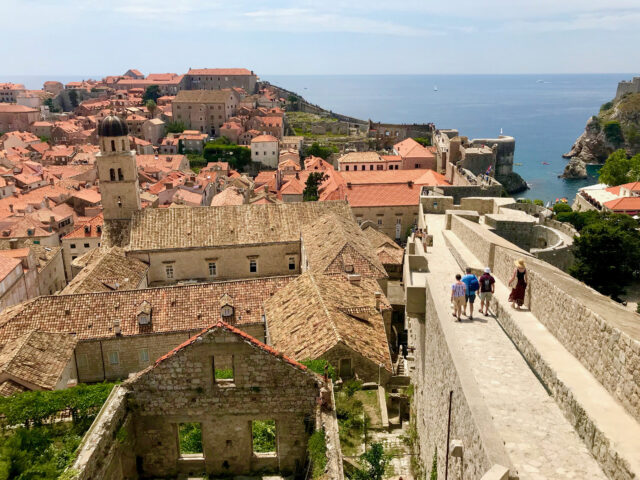
Jostled by the crowds, I walk toward the still-stout medieval wall encircling Dubrovnik, deservedly known as the “Pearl of the Adriatic.” It’s an unforgettable mile-long stroll above the city. While constructed over many centuries, today’s impressive fortifications date from the 1400s, when they were beefed up to defend against the Ottoman Turks.

I jockey my way between cruise-excursion groups that have descended upon the town (these days about 800,000 cruisers stop here each year) and climb the steep steps to the top of the mighty wall. As I begin a slow, circular walk around the fortified perimeter, I’m bombarded with ever-changing views. On one side is a sea of red rooftops; on the other side, the actual sea.

As I approach the wall’s formidable gate — the walled city’s front door — I pause to enjoy a sweeping view of the Stradun, the 300-yard-long promenade that runs through the heart of the Old Town. In the Middle Ages, merchants lined this drag; before that, it was a canal. Today, it’s the city’s pedestrian boulevard: an Old World shopping mall by day and sprawling cocktail party after dark.

Farther along on my rampart ramble, I look down and see a peaceful stone terrace perched above the sea, clinging like a barnacle to the outside of the city wall. Generously shaded by white umbrellas, this is my favorite Dubrovnik escape, a rustic outdoor tavern called Buža. The name means “hole in the wall” — and that’s exactly what customers have to climb through to get there. Filled with mellow bartenders and tourists, Buža comes with castaway views and Frank Sinatra ambience.

Looking inland from my rampart perch, my eyes fall on a random arrangement of bright- and dark-toned red roof tiles. In this complex and once-troubled corner of Europe, even a tranquil stroll comes with a poignant history lesson. After Croatia declared independence from Yugoslavia in 1991, the Yugoslav National Army laid siege to this town and lobbed mortars from the hilltop above. Today, the new, brighter- colored tiles mark houses that were hit and have been rebuilt. At a glance, it’s clear that more than two-thirds of the Old Town’s buildings suffered bomb damage.

Locals are often willing to talk openly about the bombing, offering a rare opportunity to grasp the realities of war from a survivor’s perspective. As I survey the rooftops, my thoughts turn to Pero, my B&B host, who spent years after the war turning the bombed-out remains of his Old Town home into a fine guesthouse.

When I arrived last night, Pero uncorked a bottle of orahovica, the local walnut liqueur. Hoping to write that evening with a clear head, I tried to refuse the drink. But this is a Slavic land. Remembering times when new friends force-fed me vodka in Russia, I knew turning Pero down was hopeless. My host had made this hooch himself, with green walnuts. As he slugged down a shot, he handed me a glass, wheezing, “Walnut grappa — it recovers your energy.”

Pero reached under the counter and held up the mangled tail of a mortar shell, describing how the gorgeous stone and knotty-wood building he grew up in suffered a direct hit in the siege. He put the mortar in my hands. Just as I don’t enjoy holding a gun, I didn’t enjoy touching the twisted remains of that mortar. Pero explained that he gets a monthly retirement check for being wounded in the war, but he got bored and didn’t want to live on the tiny government stipend, so he went to work rebuilding his guesthouse.

I asked Pero to hold up the mortar for a photograph. As he held up the mortar, he smiled. I didn’t want him to smile, but that’s what he did. He seemed determined to smile — as if it signified a personal victory over the destruction the mortar had wrought.

It’s impressive how people can weather tragedy, rebuild, and move on. In spite of the terrors of war just a couple of decades ago, life here is once again very good — and, as far as Pero is concerned, filled with promise.

(This story is excerpted from my upcoming book, For the Love of Europe — collecting 100 of my favorite memories from a lifetime of European travel, coming out in July.It’s available for pre-order. And you can also watch a video clip related to this story: Just visit Rick Steves Classroom Europe and search for Dubrovnik).