Here you can browse through my blog posts prior to February 2022. Currently I'm sharing my travel experiences, candid opinions, and what's on my mind solely on my Facebook page. — Rick
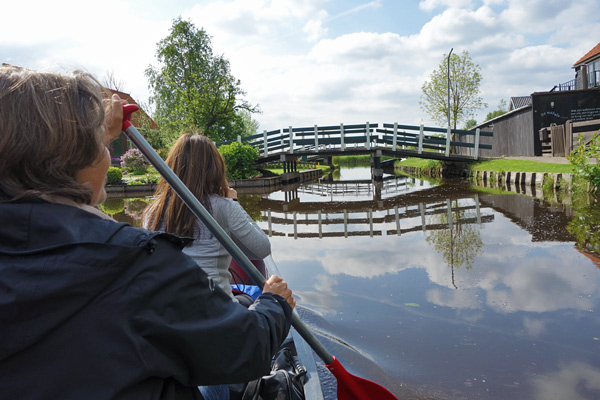
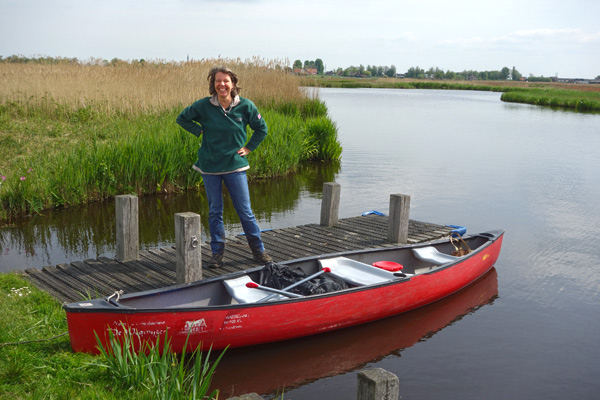
An amazing thing about Amsterdam is that, in 10 minutes (by bike or public bus), you can be in the wide-open polder land — the vast fields reclaimed from the sea where cows graze, tiny canals function as fences, and only church spires interrupt the horizon. A fun way to experience this is by canoe with a local guide. And that’s the mission of Majel Tromp, a friend who runs Wetlands Safari (which I’ve recommended in my guidebook for many years). In a couple of months, I’ll be taking my film crew on a canoe ride with Majel.
Paddling through villages where front doors face the canal rather than the road is a reminder that there was a time when the main form of transportation in the Netherlands was by boat.In July, my film crew and I will be on Majel’s tour. So, this month I took her tour to preview what we might shoot. In this natural preserve, the water is shallow. When you stick your oar into the mud and twist you wring bubbles out of the sod: methane — natural gas. (You can smell it.) And, sticking a pole into the ground, you discover the “land” is thin — about a meter thick before you hit the water table underneath.There’s no dry ground in the polder land, so a Wetlands Safari picnic is always spread out on a plastic sheet.
The TV crew has flown home with two great new shows in the can, and I’m in the Netherlands. How do I know? Where else would you find a “marching band” on bicycles!
If you can’t see the video below, watch it on YouTube.
Two and a half years ago, horrific flash floods buried two of the five Cinque Terre towns in mud. My favorite town, Vernazza, was left uninhabitable for months as the Italian army and emergency workers helped dig it out. I wanted to be sure the Cinque Terre was ready for prime time before we produced our new show on the area — and thankfully, after lots of hard work, it is.
Imagine five wonderfully remote and rustic port towns dotting the most rugged part of the Italian Riviera. Here are two of those towns — each connected by very scenic trails.Throughout Europe, there are towns built along ravines where rivers run into lakes or the sea. As their town grows, someone gets the bright idea to pave over the ravine and build a practical main road, rather than a charming but impractical line of little bridges. Vernazza (whose name means “little Venice” in the local dialect, for its many long-gone bridges) was one such town. Generally it’s not a problem, and the stream runs peacefully in a canal under the main drag. But in October 2011, a year’s worth of rain fell in a couple of hours. The steep surrounding hills functioned as a funnel, a wall of water hit the town, and the underground stream got jammed up. The violent torrent washed cars and mud and rocks — anything in reach — through the city and into the sea, and buried every ground floor in mud. Today, Vernazza has made sure its drainage system is ready for violent weather — destructive weather that all the world likely will find routine in the future.While the flood of 2011 was a disaster that swept several locals out to sea (their bodies actually washed up in France), one benefit of the flood in Vernazza was the creation of this wonderful beach at the edge of town.When I first came to the Cinque Terre as a scruffy backpacker, Monica’s father, Lorenzo, befriended me and made me welcome at his restaurant. That was back in the 1970s. Lorenzo is now enjoying an eternal view from a cemetery high above his town, and his daughter Monica, seen here, runs the family restaurant. Twelve years ago, Monica took me to the cemetery overlooking her town, with our cameras rolling. And with this visit she took time out (on the day her restaurant was opening after being closed for the winter) to take us up to the cemetery again. To follow my dear Vernazza friend Monica through her town’s cemetery and hear her remember her departed friends illustrated the beautiful function cemeteries provide.
Stumbling into Vernazza’s city hall I found a chart showing how the random pastel colors so characteristic of Cinque Terre villages are actually not so random.
If you can’t see the video below, watch it on YouTube.
Having visited Vernazza for over 30 years, I now have many friends in its cemetery. I remember following one of these dear friends, Monica, past the tombs in her town’s cemetery as she recalled her departed friends — illustrating the beautiful function that cemeteries provide.
If you can’t see the video below, watch it on YouTube.