Here you can browse through my blog posts prior to February 2022. Currently I'm sharing my travel experiences, candid opinions, and what's on my mind solely on my Facebook page. — Rick

Daily Dose of Europe: The Cotswolds — Thatched Kingdom of Quaint

There are places in Europe where I go to do what I call “convalesce” — places that, when I’m burned out or feeling spent, I can go to be calm and recharge. England’s Cotswolds is one of those places. As a travel writer, I try not to use the word “quaint.” But in the Cotswolds, I just can’t help myself.

With so many of us stuck at home for the foreseeable future, I believe a daily dose of travel dreaming can actually be good medicine. Here’s another one of my favorite travel memories — a reminder of what’s waiting for you in Europe at the other end of this crisis.

The Cotswolds are crisscrossed with hedgerows, strewn with storybook villages, and sprinkled with sheep. Everything about them — the meadows, thatched roofs, churches, pubs, B&Bs, and even the tourist offices — is quaint.

The Cotswolds are also walkers’ country. The English love to walk the peaceful footpaths shepherds walked back when “polyester” only meant two girls. Hikers vigorously defend their age-old right to free passage. Once a year, the Ramblers, Britain’s largest walking club, organizes a “Mass Trespass,” when each of England’s 50,000 miles of public footpaths is walked. By assuring each path is used at least once a year, they stop landlords from putting up fences. Most of the land is privately owned, but you’re legally entitled to pass through, using the various sheep-stopping steps, gates, and turnstiles provided at each stone wall.

As with many fairy-tale regions of Europe, the present-day beauty of the Cotswolds was the result of an economic disaster. Wool was a huge industry in medieval England and the Cotswold sheep grew it best. Wool money built lovely towns and palatial houses. Local “wool” churches are called “cathedrals” for their scale and wealth. Stained-glass slogans say things like “I thank my God and ever shall, it is the sheep hath paid for all.”

Then came the rise of cotton and the Industrial Revolution. The wool industry collapsed, mothballing the Cotswold towns into a depressed time warp. Today, this most pristine English countryside is decorated with time-passed villages, gracefully dilapidated homes of an impoverished nobility, tell-me-a-story stone fences, and “kissing gates” no one should experience alone. Throngs of 21st-century romantics enjoy a harmonious blend of humanity and nature…and the Cotswolds are enjoying new prosperity.

In these small towns, everyone seems to know everyone. They’re all ever so polite. Chatty residents commonly rescue themselves from a gossipy tangent by saying, “It’s all very…ummm…yaaah.”

I use Chipping Campden as my home base. Just a few miles from the train station at Moreton-in-Marsh, it was once the home of the richest Cotswold wool merchants.

The great British historian G. M. Trevelyan calls Chipping Campden’s High Street the finest in England. Walking its full length, I agree. As in most market towns, the street is wide enough to have hosted plenty of sheep business on market days. On one end are the top-end homes with, it seems, competing thatched roofs. I pass the 17th-century Market Hall, the wavy slate roofline of the first great wool mansion, a fine and free memorial garden, and, finally, the town’s famous 15th-century Perpendicular Gothic “wool” church.

Nearby, Snowshill, Stanway, and Stanton are my nominations for the cutest Cotswold villages. Like marshmallows in hot chocolate, they nestle side by side.

Snowshill, a nearly edible little bundle of cuteness, has a photo­genic triangular town center and a good pub. I enjoy observing the ­hikers, young and old, wandering through, much like the wayfarers from centuries past. And, as if standing by for the older hikers, the traditional red phone booth no longer offers a telephone…but a defibrillator.

Stanway is notable for its manor house. The Earl of Wemyss, whose family tree charts relatives back to 1202, opens his melancholy home — once so elegant and now wistful for times gone by — to visitors two days a week in the summer. His 14th-century Tithe Barn was where the peasants of the manor would give one-tenth of whatever they produced to their landlord. While motley peasants no longer gather here to pay their feudal “rents,” the lord still gets rent from his vast landholdings and hosts community fêtes in his barn.

Stepping into the obviously very lived-in palace feels like stepping into a previous century. I see a demonstration of the spinning rent-collection table and marvel at the one-piece oak shuffleboard table in the great hall. I ask about the 1780 Chippendale exercise chair, and get an answer from the earl himself. He explains, “Half an hour of bouncing on this was considered good for the liver.” He also shows me that the manor dogs have their own cutely painted “family tree,” but then admits that his last dog, C. J., was “all character and no breeding.”

This place has stories to tell. And so do the docents stationed in each room — who, even without fancy titles, can trace their histories back just as far as the lord of the manor. Talking to them, I’m reminded that seeking out one-on-one conversations like this is how I’ve really gotten to know and understand England.

Stanway and neighboring Stanton are separated by a row of oak trees and grazing land, with parallel waves echoing the furrows plowed by generations of medieval farmers. Driving under a canopy of oaks and past stone walls and grazing sheep to get to Stanton is a joy.

In Stanton, flowers trumpet, door knockers shine, and slate shingles clap — cheering me up the town’s main street. The church, which probably dates back to the ninth century, betrays a pagan past. Stanton is at the intersection of two ley lines (considered by many to come with mystical powers) connecting prehistoric sites. Churches such as this one, built on pagan holy ground, are dedicated to St. Michael —
the defender of the Church against pre-Christian spiritual threats. Michael’s well-worn figure is above the door. Inside, I take a seat in the back pew and study the scene. Above the capitals decorating the columns leading to the altar, I see the pagan symbols for the moon and the sun. But it’s Son worship that’s long established here; the list of rectors behind me goes back to 1269. I finger the grooves cutting into the finely carved end piece of the pew, worn away by sheepdog leashes over the generations. Even today, a man’s sheepdog accompanies him everywhere. Some things never change, especially in the Cotswolds.

(This story is excerpted from my upcoming book, For the Love of Europe — collecting 100 of my favorite memories from a lifetime of European travel. It’s coming out in July, and available for pre-order. And you can also watch a video clip related to this story: Just visit  Rick Steves Classroom Europe  and search for Cotswold.)

Daily Dose of Europe: St. Sulpice — The Grand Organ of Paris

These days, on Sunday mornings I’ve been “attending” church by Zoom-ing in from my couch. But I’m dreaming of some of my favorite European churchgoing experiences. And near the top of the list is the organ loft at Paris’ St. Sulpice.

With so many of us stuck at home for the foreseeable future, I believe a daily dose of travel dreaming can actually be good medicine. Here’s another one of my favorite travel memories — a reminder of what’s waiting for you in Europe at the other end of this crisis.

On Sunday morning in Paris, I’m enjoying Mass in a church with perhaps Europe’s finest pipe organ. St. Sulpice has only 40 or 50 worshippers this morning. I grab a pew.

Going to church anywhere south of the Rhine generally means going to Mass. Catholics claim that since Mass is the same everywhere, there’s no language barrier. Maybe it’s just the Lutheran in me, but I miss the alpha, the omega, and, except for Communion, nearly everything in between.

When I do make it to church in Europe, I’m surrounded by towering vaults, statues of weary saints, and small congregations, but it’s the music that sends me. The spiritual sails of St. Sulpice have been filled for two centuries by its 6,600-pipe organ. Organists from around the world come to Paris just to hear this organ.

As the first Mass of the morning finishes, half the crowd remains seated as the organist runs a musical victory lap. I happen to sit next to Lokrum, a young organist from Switzerland. He never comes to Paris without visiting St. Sulpice. When the organ stops, he whispers, “Follow me. You see nothing like this in America.”

I follow Lokrum to the back of the church. A small church-mouse of a man opens a little, unmarked door and we scamper like sixteenth notes up a spiral staircase into the organ loft of our wildest dreams. Here, organists are intimate with an obscure world few have entered. They speak of masters from 200 years ago as if they have just heard them in concert.

Lokrum stops me at a yellowed document. Dragging his finger down the glass frame, he says reverently, “The 12 St. Sulpice organists. Most of them are famous in the evolution of pipe-organ music. They have made wonderful music in this church for over 200 years, with no break.”

Like presidents or kings, the lineage is charted on the wall. Charles-Marie Widor played from 1870 to 1933. Marcel Dupré from 1934 to 1971. “Dupré started a tradition at St. Sulpice,” Lokrum says. “For generations people who love the organ have been welcomed here in the loft every Sunday.” (Note that recently, this practice was discontinued.)

And now, the organist is Daniel Roth. I join a select group of aficionados who gather around this slight, unassuming man, who looks like an organist should. He pushes back his flowing hair with graceful fingers. He knows he sits on a bench that organists the world over dream of warming. Maintaining Dupré’s tradition of loft hospitality, Roth is friendly in four languages.

History is thumbtacked all around: dusty charts of the pipes, master organ builders, busts of previous organists, and a photo of Albert Schweitzer with Dupré. And watching over it all is a bust of the idol of organists, Johann Sebastian Bach.

Lokrum pulls me behind the organ into a dark room filled with what looks like 18th-century Stairmasters. “Before electricity, it took five men to power these bellows. And these bellows powered the organ.”

Suddenly, the music begins, signaling the start of the next Mass. Back at the organ, a commotion of music lovers crowds around a tower of keyboards in a forest of pipes. In the middle of it all, under a dangling heat lamp, sits Monsieur Roth. With boyish enthusiasm, he sinks his fingers into the organ.

Flanked by an assistant on either side of the long bench, his arms and legs stretched out like an angry cat, Roth plays all five keyboards. Supremely confident, he ignores the offbeat camera flashes of his adoring fellow organ lovers, follows the progress of the Mass via a tiny mirror, and makes glorious music.

The keyboards are stacked tall, surrounded by 110 stops — wooden knobs that turn the pipes off and on — in a multitude of tonal packages. His assistants push and pull the stops after each musical phrase. They act quickly but as carefully as though God were listening.

Lokrum motions me to a chair with a commanding perch to oversee the musical action. On a well-worn wooden keyboard of foot pedals spreading below the bench, Roth’s feet march with his fingers. A groupie turns on his recorder to catch the music as Roth cranes his neck to find the priest in his mirror.

I peer down at the busy keyboards and Roth’s marching feet. Then, turning around, I peek through the pipes and down on a small congregation. Just as priests celebrate Mass in a church whether worshippers are present or not, this organ must make music. I marvel at how the high culture of Europe persists. I’m thankful to experience it so intimately.

(This story is excerpted from my upcoming book, For the Love of Europe — collecting 100 of my favorite memories from a lifetime of European travel. It’s coming out in July, and available for pre-order. And you can also watch a video clip related to this story: Just visit  Rick Steves Classroom Europe  and search for “Sulpice.”)

Daily Dose of Europe: Portugal’s Sunny Salema 

Who could use a beach break? In the interest of “flattening the curve,” I’m steering clear of beaches for now. But I can still daydream about my favorite beach in Europe…

With so many of us stuck at home for the foreseeable future, I believe a daily dose of travel dreaming can actually be good medicine. Here’s another one of my favorite travel memories — a reminder of what’s waiting for you in Europe at the other end of this crisis.

The flatbed fish truck rambles into the village tooting the “1812 Overture” on its horn. Today’s my beach day and I was ready to just sleep in. But it’s market day in Salema and the parking lot that separates the jogging shorts from the black shawls fills up, one vehicle at a time, with horn-tooting merchants. First the fish truck rolls in, then the bakery trailer steaming with fresh bread, followed by a fruit-and-vegetable truck, and finally a five-and-dime truck for clothing and odds and ends. Groggy yet happy, I quickly get dressed and join the scene — savoring one of the last true villages on the Algarve.

Any place famous as a “last undiscovered tourist frontier” probably no longer is. But the Algarve of my dreams survives — just barely. It took me three tries to find it. West of Lagos, Luz and Burgau both offered only a corpse of a fishing village, bikini-strangled and Nivea-creamed. Then, just as darkness turned couples into peaceful silhouettes, I found Salema.

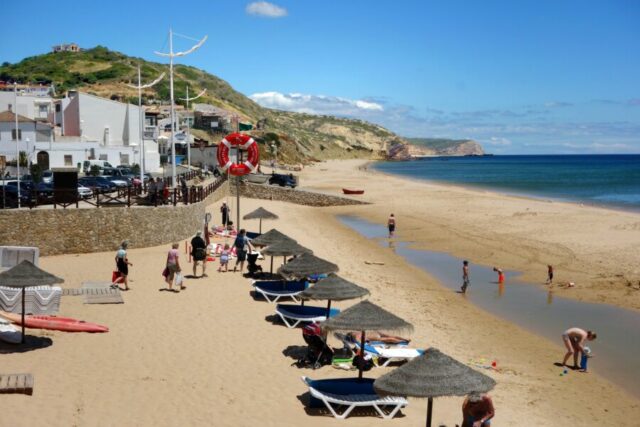
It’s my kind of resort: three beachside streets, a dozen restaurants, a few hotels, time-share condos up the road, a couple of bars, English and German menus, a classic beach with a paved promenade, and endless sun.

Where a small road hits the beach on Portugal’s southwestern tip, Salema is an easy 15-mile bus ride from the closest train station in Lagos. Still a fishing village — but only barely — Salema has a split personality: The whitewashed old town is for residents, and the more utilitarian other half was built for tourists.

Residents and tourists pursue a policy of peaceful coexistence at the beach. Tractors pull in and push out the fishing boats, two-year-olds toddle in the waves, topless women read German fashion mags, and old men really do mend the nets. British and German connoisseurs of lethargy laze in the sun, while locals grab the shade.

While the days of black-clad widows chasing topless Nordic women off the beach are gone, nudity is still risqué. Over the rocks and beyond the view of prying eyes, Germans grin and bare it.

Unwritten tradition allocates different chunks of undersea territory to each Salema family. While the fishermen’s hut on the beach no longer hosts a fish auction, it provides shade for the old-timers arm-wrestling octopi out of their traps. The pottery jars stacked everywhere are traps, which are tied about a yard apart in long lines and dropped offshore. Octopi, looking for a cozy place to set an ambush, climb inside, unaware they’ve made their last mistake.

The wives of fishermen serve up whatever’s caught in huge pots of Portugal’s beloved seafood stew (cataplana) in steamy hole-in-the-wall eateries, where tourists slurp it up.

Salema’s tourist-based economy sits on a foundation of sand. As locals watch their sandy beach wash away each winter, they hope and pray it will return with spring.

Restaurateurs are allowed to build a temporary, summer-only beachside restaurant if they provide a lifeguard and run a green/yellow/red warning-flag system for swimmers. The Atlântico Restaurant, which dominates Salema’s beach, takes its responsibility seriously — providing lifeguards and flags through the summer…and fresh seafood by candle­light all year long.

Tourism chases the sun and quaint folksiness. And the folksiness survives only with the help of tourist dollars. Fishermen boost their income by renting spare bedrooms (quartos) to the ever-growing stream of tan fans from Europe’s drizzly North. Quartos line Salema’s main residential street, offering simple rooms with showers, springy beds, and glorious Atlantic views.

Salema’s sleepy beauty kidnaps my momentum. At the end of the day, after enjoying a nice plate of fish, I take a glass of white wine from Atlântico and sip it with the sunset. Nearby, a withered old woman shells almonds with a railroad spike, dogs roam the beach like they own it, and a man catches short fish with a long pole. Beyond him is Cape Sagres — 500 years ago, it was the edge of the world. As far as the gang sipping port and piling olive pits in the beachside bar is concerned, it still is.

(This story is excerpted from my upcoming book, For the Love of Europe — collecting 100 of my favorite memories from a lifetime of European travel. It’s coming out in July, and available for pre-order. And you can also watch a video clip related to this story: Just visit  Rick Steves Classroom Europe  and search for Portugal.)

Coronavirus Reports from Our Guides in Europe — Week 5

On both sides of the Atlantic, the Rick Steves’ Europe team is doing their part by staying home. And our European guides continue to be in touch with the home office, offering insightful slices of life from quarantine. As great guides, they can hardly miss a teachable moment and grab every opportunity to share insights from their respective cultures.

Here’s our weekly roundup of what we’ve been hearing from our guides during the coronavirus pandemic:

Our man-on-the-street in Oslo, Pål Bjarne Johansen, uploaded this video of a soothing walk through the eerily empty Norwegian capital. He reports some promising news: Norwegian social distancing efforts have been highly successful, drastically reducing the contagion rate. In fact, just a few days from now, Norway plans to slowly open up some daycare centers and other services:

Jeanie Carmichael, one of our UK-based guides, sent us notice that she and other London Blue Badge Guides are offering free virtual “tours” three times each week (Mondays, Wednesdays, and Fridays at 4 p.m. London time — that’s 11 a.m. on the East Coast, and 8 a.m. on the West Coast). You can watch live, or peruse previous lectures.

Jeanie explains: “We are trying to keep our brand alive and provide some light relief for our friends in the United States.” Topics include Jack the Ripper, street art, royal jewelry, and British etiquette. For details, check out their Facebook page or their YouTube channel.

Stefanie Bielekova, who works at our Rick Steves home office, posted this interview (on her blog, Postcards from Stef) with Granada-based guide Margaret Monnier about what life is like these days in South Spain.

We also received a pair of more in-depth reports. From Budapest, Anna Lénárd contemplates how the empty sights of today are reminiscent of the communist days of her youth:

“I have been watching this new, very inspiring promotional video about my beloved home city of Budapest — beautiful shots of the empty city in the time of coronavirus:

“I remember the last few Aprils and Mays, when these iconic sights — now hauntingly empty — were full of locals and visitors. It is a strange feeling to stay at home without a job, without rushing, and without appointments. I am alone (my family got stuck in another country). So now — for the first time in my life — I have so much time to read, write, and learn about the rich history of my favorite city. I have been looking through the photo archives at www.fortepan.hu, three of which are reproduced below.

“The empty streets and squares on the video remind me of my childhood. We did not have tourism in the eighties behind the Iron Curtain except for a few students and comrades from other Eastern European countries. Nobody asked for tickets when I walked up on the Fishermen’s Bastion (the famous view terrace of Budapest). There were no tourists — just those ugly socialist cars and policemen on guard. The most beautiful tourist sight of Budapest was empty…just like today.

“Of course, there were happy times, too, in my country, when we had visitors from all over the world. Just have a look at this international conference of physicians from 1929 — those ladies are so chic:

“And then World War II arrived, and Soviet soldiers looked out over a view of a freshly occupied city:

“To tell the truth, I do not mind having a year off. I was traveling so much, I was overwhelmed with adventures. Now it’s time to have some rest, to cook new recipes, and to talk to old friends. I just hope that the time comes soon when the Fishermen’s Bastion is crowded again with visitors from five continents — especially with Rick Steves tour members, who always want to learn a little bit more than the typical tourist.”

And from her garden on the Sorrento peninsula, in Italy, Ann Long shares this touching point of view:

“Perspective….if this global tragedy has taught me anything, it has taught me to look for some perspective as to what has happened to others, now and in the past.

“This year would have been my eighth season guiding for Rick Steves’ Europe, leading tours all over Italy. Just two months ago, there was such promise for it being a great season for us. Now I am in my home, cleaning everything that can’t get away from me, and trying to get some exercise by walking and climbing around in my garden. The lockdown laws here in Italy are pretty severe: I cannot go outside my house unless it is for necessities like food, medicine, or work.

“Since my area relies totally on tourism as its main industry, not many workers are moving around. All of our hotels (about 150) are still closed, and you can actually feel the tension in the air when the locals speak — fear for their livelihoods for this year. We just passed our Easter season, which was without the noise, activity, food-shopping, cake displays in bakeries, and religious processions that are so typical in my area. It’s clear that the locals are deflated and depressed by not being able to do what they have always done to mark this important holiday.

“During my walks in my garden, I get to thinking about how I ended up where I am and what my ancestor-in-laws must have experienced in their lives on this same land. I am originally from Illinois and came to Italy 40 years ago to spend six months learning the language. I met a tall, dark Italian man…and the rest is history. Now I am a widow with a 29-year-old son and live in the house where my husband and his father were born, on land that has been in his family for 120 years.

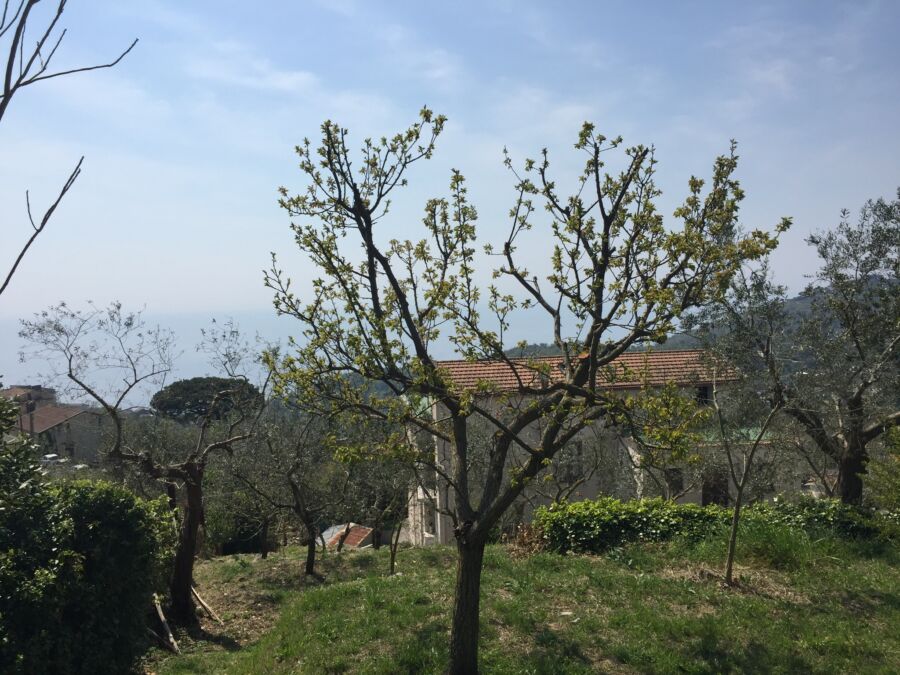
“The trees in these pictures were all planted by my husband’s paternal grandfather. Some of them even came from South America, where he spent six months each year traveling around and selling goods from Italy to make a living and raise his eight children. I moan and groan about having to prune and look after the olive and fruit trees, but then I remember that they kept my husband’s family alive and fed throughout World War II. Perspective…

“My husband’s maternal grandparents emigrated to the States in the early 1900s and settled in New Jersey, where the grandfather sold fruit and vegetables. He started out with a cart in the middle of the street and eventually was able to rent a small shop. More than likely, he worked very long hours to support his six children. His wife caught the Spanish flu. In our time of coronavirus, I try to imagine 100 years ago, when my grandmother-in-law was sick in a country where she probably didn’t speak the language, with no close family around except young children, an illness that was spreading like wildfire, no money for medicine, and no help or information from the government. She survived the illness, but it must have scared her enough that she decided to pick up her children and return to Italy so that she could be closer to her family. If not for that move, her daughter would not have met her husband, and they would not have had my husband! Perspective…

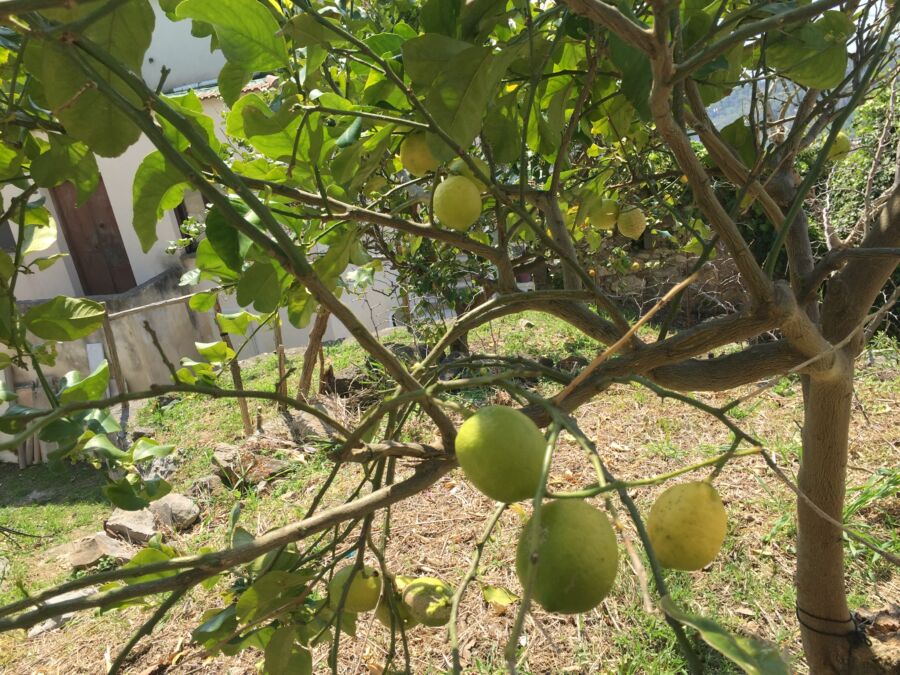
“I am one of the lucky people here in Italy because I do have some land around my house where I can walk and get a breath of air, whereas so many Italians live in apartment buildings with only a small balcony as their ‘yard.’ My land is terraced, and I have a view looking toward the Mediterranean. I have a couple of lemon trees (limoncello…yum!) and several kinds of fruit trees and numerous olive trees.

“Looking out to sea, to the left is the Amalfi Coast and to the right, just a short distance away, is the island of Capri. The emperor Tiberius lived there from A.D. 26 until he died in A.D. 37. I imagine that he, too, lived through some scary, uncertain times like we are now. Otherwise, he wouldn’t have barricaded himself on the island, making it into a fortress where no one came on the island without his permission, very much like what we are going through here in the peninsula by not being allowed to move around freely. Perspective…

“When it is safe again, come and experience our history and get your own perspective!”

Daily Dose of Europe: A Czech Mud Bath in Třeboň

Self-isolating here in my home, I’ve been thinking about how, around the world, people have different ways to relax. The Czechs? They enjoy submerging themselves in a mucky peat brine. I consider this the strangest bath I have ever taken.

With so many of us stuck at home for the foreseeable future, I believe a daily dose of travel dreaming can actually be good medicine. Here’s another one of my favorite travel memories — a reminder of what’s waiting for you in Europe at the other end of this crisis.

I’m in the well-preserved Czech spa town of Třeboň. I’ve decided to supplement my intense time in touristy Prague by venturing south, deeper into the Czech countryside. Třeboň’s biosphere of artificial lakes dates back to the 14th century. Over the years, people have transformed what was a flooding marshland into a clever combination of lakes, oak-lined dikes, wild meadows, Baroque villages, peat bogs, and pine woods. Rather than unprofitable wet fields, they wanted ponds that swarmed with fish — and today Třeboň remains the fish-raising capital of the Czech Republic.

People come from near and far to soak in Třeboň’s black, smelly peat sludge, thought to cure aching joints and spines. Envisioning the elegance of the baths I’ve experienced in Germany’s Baden-Baden, I decided to give it a whirl. I’m filming a show on the Czech Republic and suspect it will make good TV.

My attendant doesn’t understand why I have an entourage (which includes my local guide, Honza, and our two-person TV crew), but she also doesn’t pay them much attention. She points to my room and mimes undressing. With the crew here working, I decide to keep my swimsuit on. She shakes her head, disappointed. The camera equipment takes some time to set up. The masseuse is impatient, anxious to get started because the peat muck only flows at the top of the hour. I climb into the stainless-steel tub, she pulls a plug, and I quickly disappear under a rising sea of gurgling sawdust soup. My toes look cute poking out of the hot brown muck.

Filming takes a long time — and this is one of the quirkiest sequences we’ve ever done for the show. The attendant wants to hurry things along. She acts like I’ll overdose if I stay in the tub too long. When we finish shooting, I stand up in the tub and she showers off the sludge, then ushers me into the massage room, where she has me lie face down. It feels like a nurse’s office with a pile of dirty sheets stacked in the corner. Honza translates what I’m about to experience as a “hand massage.” That sounds redundant at best…kinky at worst. He explains that’s literally what massages are called in Czech (ruční masáž).

We just want to film my shoulders. But she insists on ignoring the camera’s needs and giving me a hand massage from my shoulders to just about where I don’t want the camera to go. When the crew gets what they need, they leave. I try to go, too, but my earnest masseuse won’t let me. She insists on the full body massage that every patient at the Třeboň spa expects.

After finally being set free, I get dressed. Alone and still covered in greasy oil, I head out to meet my crew at dinner. When you come to Třeboň, you have to try the fish. We order all the appetizers on the menu — a good trick when trying to sample another culture’s cuisine. There’s “soused” (which must mean “pickled”) herring, fried loach, “stuffed carp sailor fashion,” cod liver, pike caviar, and something Honza translates as “fried carp sperm.” As we eat, I notice that the writing on my beer glass says, “Bohemia Regent anno 1379.” It occurs to me that I’m consuming exactly what people have been eating here for 600 years: fried carp sperm from the nearby reservoir, washed down with the local brew.

Dinner comes with a lively band. They play everything from Bach and Smetana to Czech folk favorites and 1930s anti-fascism blues. The string bass player grooves like a white Satchmo, his long and forceful bow sliding in and out between diners. The bandleader plays a 100-year-old black wood flute. During a break, I run my finger along its smooth mouthpiece — worn down like an ancient marble relic by countless nights of musicmaking. The flutist sports a big bushy mustache just like Emperor Franz Josef, who looks down at us from a yellowed poster.

Above the quartet is a high window. The heads of teenagers bob into sight — they’re straining on tiptoes and craning to look in. Each time a song ends, glass mugs of golden beer rattle on rough wood tables as the roaring crowd claps and cheers for more. As the night wears on, there are fewer tourists snapping photos and more locals singing along as the quartet sways together like seaweed in a nostalgic musical tide.

I compliment our server on the beer. He says, “These days, many Poles and Hungarians are going west to France and Germany to get jobs. But not the Czechs. We can’t find good enough beer anywhere but here. Our love of Czech beer keeps us from going abroad for better jobs.”

Back in my hotel, I climb to my attic room — careful not to bean myself on a thick medieval timber. I lean out my tiny dormer window, the sound of the boisterous bar small in the distance. The new, sturdy roof tiles around me are slick and gleaming with a light rain. The street, wet and shiny, is as clean as a model railroad town. Cars, while not expensive, are new and parked as tidy as can be. Cheap yellow lampposts light the scene. After 40 bleak years of communism, the lampposts seem to be intentionally cheery, decorating the line of pastel facades arcing into the distance. They seem to proclaim a society on track for a brighter future.

(This story is excerpted from my upcoming book, For the Love of Europe — collecting 100 of my favorite memories from a lifetime of European travel. It’s coming out in July, and available for pre-order. And you can also watch a video clip related to this story: Just visit  Rick Steves Classroom Europe  and search for Czech Republic.)

Want to watch the segment we filmed in Třeboň? You can check it out here.