Here you can browse through my blog posts prior to February 2022. Currently I'm sharing my travel experiences, candid opinions, and what's on my mind solely on my Facebook page. — Rick

Visit the Factory Where Schindler Employed Jewish Workers During the Nazi Occupation

One of Europe’s best museums about the Nazi occupation fills the factory building where Oskar Schindler and his Jewish employees worked, in the Kazimierz district of Kraków, Poland.

While the museum tells the story of Schindler and his workers, it also broadens its perspective to take in the full experience of all of Kraków during the painful era of Nazi rule. It’s loaded with in-depth information (all in English), and touchscreens throughout invite you to learn more and watch eyewitness interviews. Scattered randomly between the exhibits are replicas of everyday places from the age — a photographer’s shop, a tram car, a hairdresser’s salon — designed to give you a taste of 1940s Kraków.

When Steven Spielberg made his film Schindler’s List, Kraków’s Jewish Quarter of Kazimierz was an overlooked slum — having become ramshackle under communism. Spielberg chose to film his movie right here, in the place where the real events actually happened, and helped revive a vibrant Jewish culture that had gone dormant. While several other synagogues, cemeteries, cultural centers, and other sights reward those coming to Kazimierz, the Schindler’s Factory Museum is the best.

The Easiest Way to Get the Best Deal Changing Money in Europe

The days of changing money are a distant memory for many travelers — thanks both to ATMs, and to the common euro country shared by much of the Continent. And, while ATMs are every bit as abundant in Eastern Europe as in the West, most of these countries have still retained their traditional currencies. If you wind up with a few Czech koruna or Hungarian forints when you cross into Poland, you may need to track down an exchange booth to turn them into Polish zlotys.

Anytime you need to use an exchange booth, comparison-shop by looking carefully at the various rates. Look for places that do not charge a commission and that show both the buying and selling rate. And confirm that the buying and selling rate are within a few percentage points of each other.

There are about 3 zlotys to a dollar. These two photos (taken on the same day and on the same street) show two different exchange bureaus. One has a decent mark-up (as indicated by the spread in the buying and selling rate — buying and selling for 3.10 or 3.15), while the other is a terrible rip-off (with a huge spread — buying and selling at 2.33 or 3.20).

Avoid exchange booths like this one, with a huge gap between the buying and selling rates.
The small gap between the buying and selling rates suggests this exchange bureau is a good deal.

Exploring a Polish Farmers’ Market in Kraków

Dropping by the farmers’ market in Kraków with my guide, Marta, was like a cultural scavenger hunt — complete with the lovely image of watching TV snuggled up with a big pod of sunflower seeds. Here’s a two-and-a-half-minute slice of Polish life, and a video reminder not to miss the markets wherever you travel.

The Sanctuary of St. John Paul II

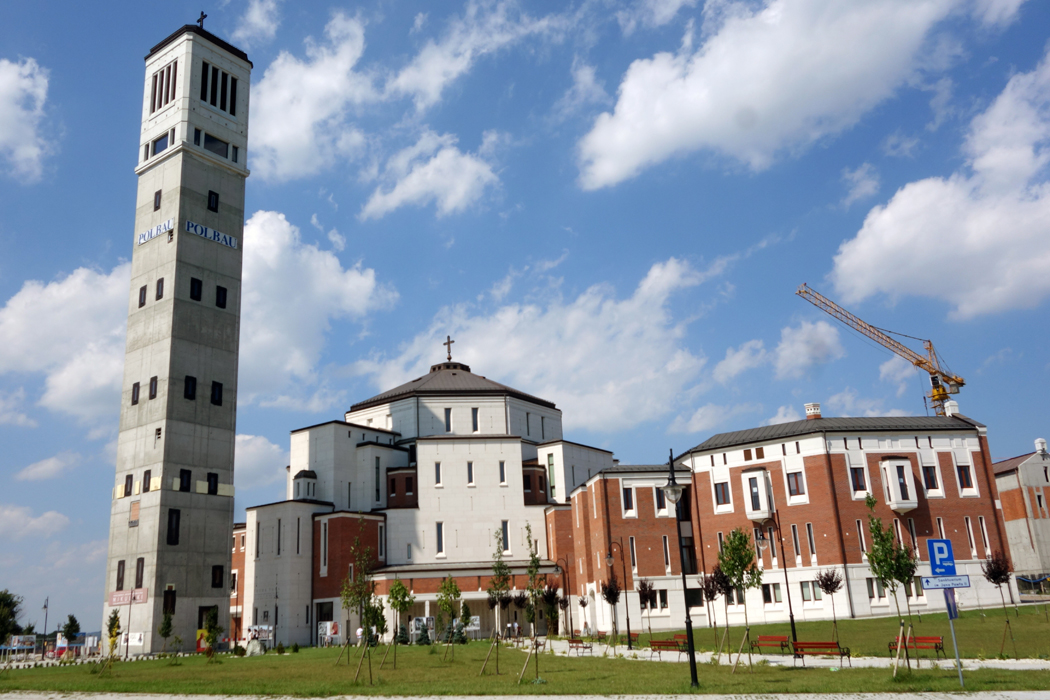
The brand-new Sanctuary of St. John Paul II — built on the outskirts of Kraków, where he served as archbishop — is an impressive place to visit.

When you travel around Europe, you rarely see new churches. And the old churches you see often feel more dead than alive…more for tourists than for worshippers. But in Poland, churches are alive with the faithful.

In small Polish towns, there’s a strong tradition of building huge, architecturally daring churches as a sign of both civic pride and deep respect for their Catholic faith. Particularly during communism (when atheism was the official state religion), building a bold new church was a statement. The architecture of these modern houses of worship sometimes feels more slapdash and on the cheap than the great churches of an earlier age (which were often built over centuries). But the spirit that fills them is powerful.

If you can’t see the video below, watch it on YouTube.

Kraków Celebrates Hometown Boy St. John Paul II

The man who would become St. John Paul II grew up, studied, and served as a priest and archbishop in Kraków, Poland. And today, on the heels of his sainthood, the city is ramping up celebrations of the person many consider to be the greatest Pole in history.

Imagine you’re Polish in the 1970s. Your country was devastated by World War II, and has struggled under an oppressive regime ever since. Food shortages are epidemic. Lines stretch around the block even to buy a measly scrap of bread. Life is bleak, oppressive, and seems hopeless. Then someone who speaks your language — someone you’ve admired your entire life, and one of the only people you’ve seen successfully stand up to the regime — becomes one of the world’s most influential people. A Pole like you is the leader of a billion Catholics. He makes you believe that the impossible can happen. He says to you again and again: “Have no fear.” And you begin to believe it.

Many people (including Mikhail Gorbachev) credit Pope John Paul II for the collapse of Eastern European communism. His compatriots — even the relatively few atheists and agnostics — saw John Paul II both as the greatest hero of their people…and as a member of the family, like a kindly grandfather.

A speedy nine years after his death, Karol Wojtyła was made a saint. And today, when you travel in Poland, you’ll find St. John Paul II wherever you go.

Sanctuary-of-St-John-Paul-II-krakowThe John Paul II Center is at a huge new church at the edge of Kraków, consecrated in 2013 and dedicated to St. John Paul II.


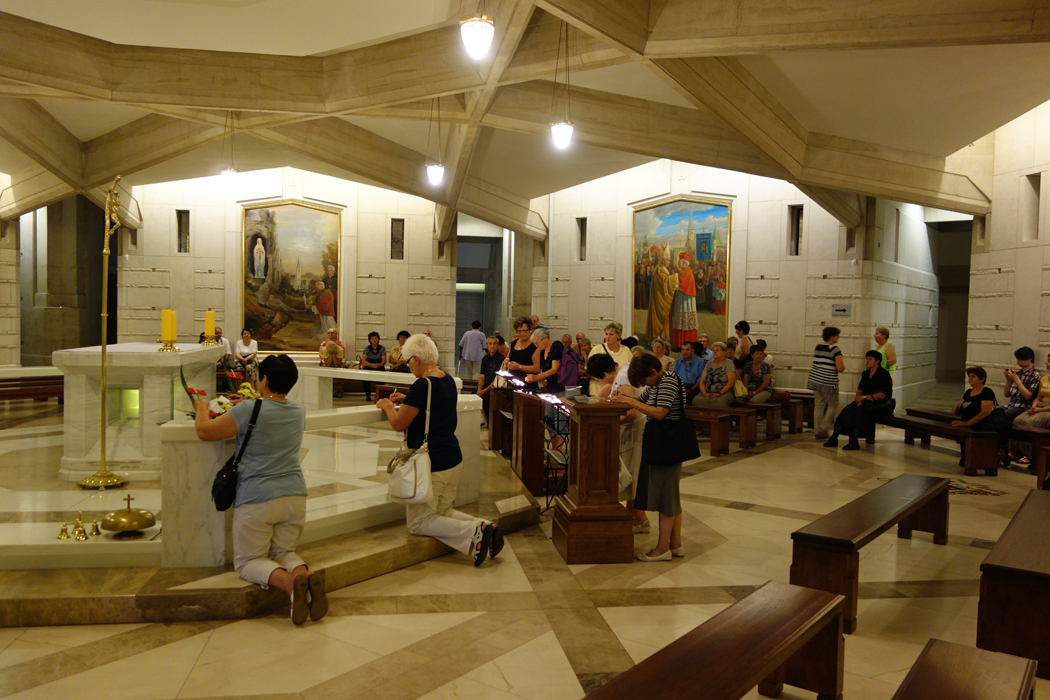
pilgrims-and-the-faithful-in-Sanctuary-of-St-John-Paul-II-krakowThe church is big and dazzling, with art in the lower sanctuary that highlights St. John Paul II’s illustrious ministry.


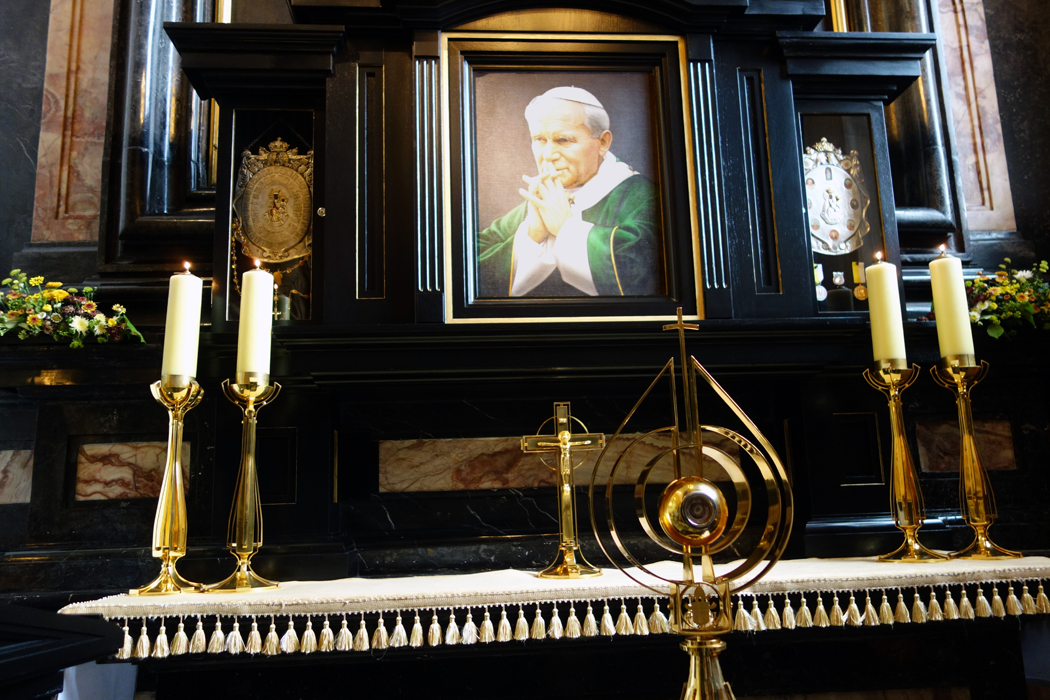
Saint-John-Paul-II-krakowSt. John Paul II seems to have a chapel dedicated to him in every Polish church. Seeing a man we all grew up with actually up on the wall, glorified with the apostles and other saints, you feel we all experienced the charismatic presence of an historic figure who will be honored for ages to come.